Funeral services set for drummer ‘Jockey’ Etienne Herman Fuselier, hfuselier@gannett.com 4:13 p.m. CDT August 17, 2015
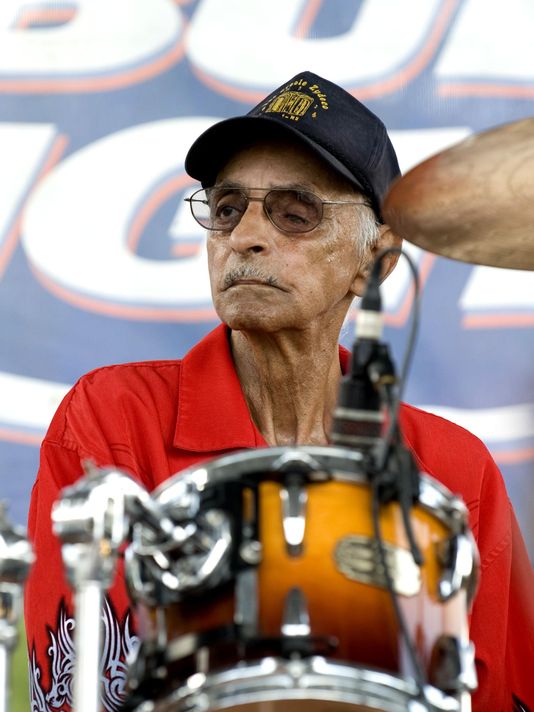
Funeral services…for Clarence “Jockey” Etienne, a legendary zydeco and R&B drummer who died Sunday.
With more than 50 years as a musician, Etienne, 81, played with Fernest and the Thunders, the Creole Zydeco Farmers, Lazy Lester, Carol Fran, Katie Webster and more recently, Lil Band O’ Gold. In the 1960s, Etienne toured with R&B greats Solomon Burke and Joe Simon and played drums on “Nine Pound Steel,” “Choking Kind” and other Simon recordings.
Etienne, known for his rhumba beat, was a studio musician at J. D. Miller’s famed studio in Crowley, which produced national and regional hits for Slim Harpo, Guitar Gable and many others. In the studio’s meager beginnings, Etienne played a cardboard box on Harpo’s “Scratch My Back,” which became a No. 1 Billboard R&B hit in 1966.
The cardboard box drumming became his signature, said longtime friend and blues guitarist Paul “Lil Buck” Sinegal.
It’s fun remembering when and where these interviews happened. This one, for example, was at Ed’s Connecticut home.
It’s also fun bringing back into the light hard-to-find gems from the original published interviews. And sharing gems never-before-published, often simply because there wasn’t room to include it. This 52 page transcript, for example, would have to be cut to around 25 pages to meet Modern Drummer’s feature interview length at that time.
In this exchange, Ed Soph and I are talking about different ways of learning how to play the drumset. Caveat: Ed refers here to the “Peanut Gallery” in the old NYC jazz club Birdland. That was a part of Birdland where no alcohol was served, where kids too young to drink alcohol could still sit and enjoy the jazz.
Ed Soph: I ran into Papa Jo a long time ago in Frank Ippolitio’s old shop on 8th Avenue. And I went up to Papa Jo and figured a way to introduce myself and to ask him if he could give me a drum lesson.
I said, “Gee, Mr. Jones. I sure would like to get a drum lesson from you.” He says, “If you want a drum lesson from me, come to such-and-such a club. I’m playing there every night.”
And I’m thinking, “You dumb [so-and-so], Soph.” Click! Those guys didn’t go to teachers. They went to clubs and watched the cats play. That’s gone now! How many kids can afford to go to that club in New York that charged $17.00 to get in to hear Chick Corea, Roy Haynes, and Miroslav Vitous? And then there was a $10.00 drink minimum. Then if you’ve got to pay parking on top of that? Come on!
Scott K Fish: They pay that kind of money to see rock bands.
ES: But those kids aren’t there to learn how to play drums. How can they be if they’re in a 10,000 seat auditorium? My God Almighty! You’ll learn more listening to the record.
I’m talking about going to a club, getting up into the Peanut Gallery like they used to have at Birdland, and just sit there and check somebody out. Or go to the Vanguard, and get there early, and get in that spot that’s right back there by the drums, and watch Elvin. That’s the learning opportunity right there. But times have changed. It’s not happening anymore like it was.
Can you wonder why people get discouraged? It would be nice if they’d give a concert in the afternoon. In the old days, clubs used to have matinees for kids or for musicians who weren’t working.
Again, you see the strength of clinics, of presenting the music in that sort of environment. [S]omething always comes along to fill in the gap. But that gap will never be filled. I mean, can you imagine going into a club and watching Sid Catlett or Dave Tough or Tiny Kahn? Or just going down and listening to Mel Lewis play?
And the thing is, Scott, that you or I could take a kid…. And I’m not making a value judgement on the kid. I’m just thinking about exposure. We could take a kid who’s into Eric Carr, or into Neil Peart, or who’s into Alan White, and you could say to this kid, “Come here. Have you ever seen Elvin Jones play drums?”
Who???
“Come here, kid. You’re coming with me tonight.” You could sit that kid down in that Peanut Gallery at the Vanguard and that kid’s mouth would be on the floor after the first chorus. Simply because he’s never had any opportunity to be exposed to it.
SKF NOTE: I remember very well how nervous, how uncomfortable I was asking 48-year old Joe Morello if he had lost his chops. The back story to this interview is here. Suffice it to say I was sitting right next to Joe in his living room. My friend, drummer Chris Conrade, was with me. Chris grew defensive on Joe’s behalf — which you’ll see in the following exchange.
I don’t think this part of the interview has been published. To put some perspective on this interview. It was March 7, 1978 — about 20 years before the internet began. My whole life was drums, my circle of friends and acquaintences was full of drummers and other musicians. Joe Morello was certainly not at the most visible point of his career. And I had heard from people I respected and other places that Joe was in a bad way and not playing anymore.
In 1978 I couldn’t just Google that question. Instead, I swallowed my fear and gave Joe an opportunity to answer the question in his own words. That’s the best way to kill rumors.
==========
Joe Morello
Scott K Fish: The impression I’ve gotten of Joe Morello is…. Well, I’ve heard people say things like, “Oh, he’s lost his chops.”
Joe Morello: Who me?
SKF: Yeah. Morello’s lost his chops. That’s why he’s not playing anymore. I feel like saying, “Bullshit,” because it’s such a drag.
JM: Is that what they’re judging me by? Do I have to prove it again?
When the group [Dave Brubeck Quartet] broke up I just did clinics because I only had to work maybe four or five days a month. That’s it. I didn’t need anything else. And I still do that. Not as much as I used to because there’s new cats coming up, and now with this rock thing, naturally the drum companies are out to push their instruments.
So let the other guys have a shot at it. What the hell. I don’t care. Give ’em a break. Let ’em do it. God’s been good to me. Give somebody else a chance.
I can still play if I want to play. But as far as my chops being gone? No. Not gone. I don’t think that I could keep a single stroke roll for ten minutes like I could do when I was playing every night. But again, who cares? Where are you going to use that anyway?
But when I was teaching and practicing and playing every night of the week — your endurance is up.
That’s nice to hear [sarcasm], because it really doesn’t bother me. I think that as far as my playing, I’m playing better than I ever played. Musically, I think.
SKF: I didn’t mention that “no chops” as a slur….
JM: No, no. That’s alright.
Chris Conrade: Part of being a person is never needing to defend yourself.
JM: That’s right. See, I don’t know what they’re talking about. Chops. What do they mean? What do they want me to do?
To close this part of the conversation I’ll tell you: my endurance, if I’d just woodshed about two hours a day I could get it back in about two weeks.
CC to SKF: I don’t even know why you mentioned that.
SKF: Because the impression I get from all of the press I’ve been reading… they paint a picture of Joe Morello as an embittered recluse.
SKF NOTE: This exchange is from my 1984 Modern Drummer interview with Les DeMerle. The back story is here. We had discussed the greatest service a drum teacher can offer students. I circled back to that topic and asked Les, “What about the greatest disservice a teacher can give a student?”
Les DeMerle circa the time of this interview
Les DeMerle: Honesty is the key service. There’s alot of drum teachers out there that I feel aren’t really qualified. You can’t jump into teaching too soon. Even at the beginner’s level. You should really have a certain amount of knowledge and direction and your own style. And be open-minded.
There are alot of guys who are locked into a system and they preach that one particular system. If it’s a technical approach — that’s fine. But on the bandstand it’s a different thing. You have to get the natural quality out of the individual and deal with the way he approaches the instrument.
If I get a student who has only one way of approaching a certain thing because his teacher taught him that for five years — it’s like untying a bunch of knots to get that student to be loose again.
There might be one way to do certain things. But, to me, the most natural players — which is what we strive for — do it several ways.
Les DeMerle
Let’s use Buddy Rich as an example. I’ve seen him play a whole set with matched grip. He doesn’t always do that. But that night he felt like playing matched grip. Maybe it was with the butt-end of the sticks.
Certain teachers would say that you should never do something like that. Usually those students come in stiff to begin with. They are so scared because they’ve been taught one regimented way for so long.
The idea is to loosen it up.
Scott K Fish: Buddy used the term attitudinal playing in a recent interview. Can you hazard a guess as to what he meant by that?
LD: I would think he was saying that you should play with a good attitude. He hears everything. Just that alone is such a courtesy. Even though he’s such a force, he’s still one of the greatest sidemen in the world. I’ve heard him sitting in with trios playing as tasty as Marty Morell did with Bill Evans.
SKF NOTE: Found among my clippings in a box in my basement. Sad day. Keith Moon was a very early influence on me from about age 16. I was fortunate to see Moon with the The Who in concert twice.





 Scott K Fish
You must be logged in to post a comment.