SKF NOTE: From my interview with Alan Dawson published in Modern Drummer‘s 10th Anniversary Issue in 1986. Here Alan is talking about drum innovators.
Alan Dawson: Innovators are very few. Innovators trod a lonely path. I don’t know who’s the next person who’s going to come along and revolutionize the music itself or drumming. There’ll be somebody. When the people latch onto him after, of course, initially putting it down — which is how the history of things goes — the people who will latch onto it will do whatever it is very well.
Scott K Fish: Who do you feel are the last drum innovators we’ve seen?
AD: As I go along I start to find more people who are derivatives. I would say, certainly, that Jack DeJohnette is innovative in his approach. But I’d say he’s probably derivative from Tony Williams and Elvin Jones. By the same token, Tony is derivative from Elvin and Max [Roach].
But the people who are setting trends, just in listening to them and listening to comments of people who listen to them, I’d say probably Jack DeJohnette and Tony Williams may be two of the most influential drummers of the 80’s.
SKF: Do you think there’s a difference in being an innovator and being innovative?
AD: Maybe I’m splitting hairs a little bit. When I think about an innovator I think of the person who really seems to have taken something, and seems almost completely in another direction when he bursts on the scene. And people don’t understand what he’s doing. They have to catch up. A person can be somewhat innovative if he can take somebody’s style and make something else out of it.
SKF: So an innovator is someone whos style can’t really be traced back to anybody?
AD: Yeah. It actually is. Eventually you probably can. When I first heard Max Roach I certainly wouldn’t have been able to say, “Well, yeah, he sounds like Jo Jones.” He didn’t. But, he still was influenced by Jo Jones. So, I would consider Max an innovator, yet in retrospect, I know that his style didn’t come out of nowhere.
When somebody’s reactions to the very same things everybody else has been exposed to turns out to be so completely different — you can think that person couldn’t have been exposed to so-and-so at the outset. Later you find differently.
SKF: Would you consider Elvin Jones an innovator?
AD: Yeah. Yet, I realize — and Elvin will tell you — that he came out of Roy Haynes among other people. Elvin doesn’t sound like Roy Haynes, but it’s obvious to me where he came from.
Just like Roy Haynes doesn’t sound like Jo Jones, but it’s obvious to me where he came from. Jo was one of Roy’s strongest influences in that formative stage.
In my formative stage Jo Jones had a tremendous influence on me. Max Roach had a very strong influence on me. But not as strong as Jo, because I wasn’t quite as young and impressionable. Since then there’ve been plenty of other players who I’ve listened to and admired.
If I stop splitting hairs I’d have to think that the last great drum innovator was Tony Williams.
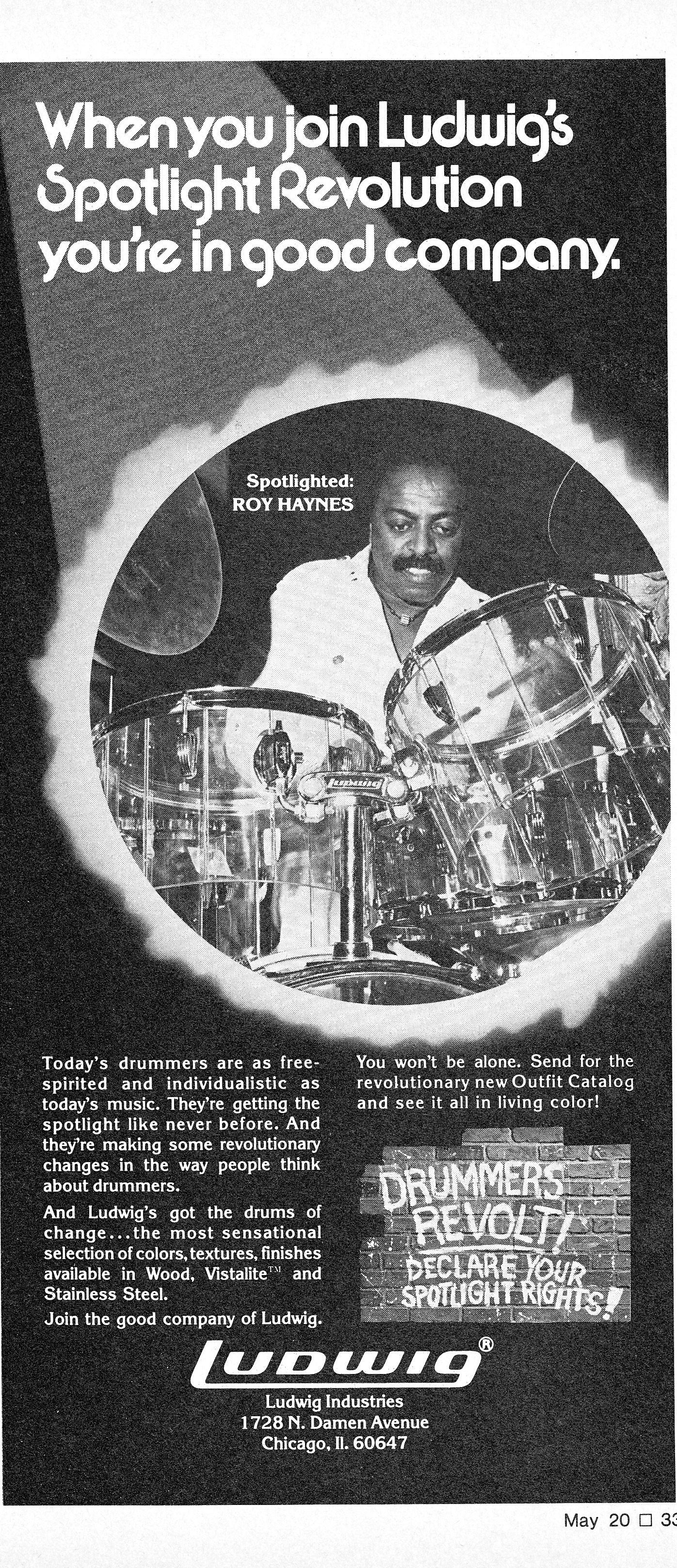
September 20, 2015. I found this Roy Haynes Ludwig Vistalite ad in the May 20, 1976 Down Beat.
SKF NOTE: This segment is from my interview with Roy Haynes at his home on November 15, 1978. According to my notes “It was raining, traffic was heavy, a chilly…evening, and I was nervous about meeting him. We had spoken on the phone a few times. The week before [this interview] I had seen Roy perform with the bassist and guitarist from his Hip Ensemble at a small Long Island, New York jazz club. The trio was hot. The music ran the gamut of emotions and it was always swinging. Roy Haynes is both amazing to watch and to listen to. He sat behind a set of Smokey Vistalite Ludwig drums, eyes closed in relaxed concentration, playing with that precise, crisp sound that earned him the nickname Snap, Crackle, Pop.”
Roy Haynes
Roy Haynes: [Charles] Mingus used to say the damndest thing about me years ago. He’d say, “Well, Roy Haynes. Yeah. You don’t always play the beat. You suggest the beat. I don’t know what the heck I was doing, but I know that the beat is supposed to be there. If I leave out a beat — it’s still there. If I’m playing fours or eights or twelves, and I play four-and-a-half bar and leave out a bar-and-a-half — that don’t mean I don’t want it to sound like that! But, if I’m playing with a horn player — sometimes they get confused. They get hung up ’cause I didn’t play a bar-and-a-half.
You got to use a little imagination in there. That bar-and-a-half still counts. I’ll come out in the right place — where it should be — to make it even. And they’re somewhere else at that point. I didn’t always play the beat which I though was very good. You don’t always have to say ding ding-da ding ding-da ding. You know? It’s there. So if one of those saxophone players has to depend on that, then you know he’s not right or something.
You’ve got to have ding da da ding within yourself. [John] Coltrane had it. [Lester Young] Pres had it. Miles [Davis] had it. So it’s beautiful with them. But there’s so many other people who don’t have that thing — and you got to carry them. Now how you gonna be inventive and create when you’re trying to lift them up?
– end –
SKF NOTE: The morning of September 9, 2015 I found more pages from my Roy Haynes interview with more details about Roy’s Vistalite drums. Several registered users of the Drummerworld web forum commented on Roy’s Vistalite’s, surprised to know Roy played them, and hungry to know more specifics about Roy’s Vistalite drumset.
=========
The first time I saw Roy perform he was playing a five-piece Vistalite outfit. A year later his set had grown! The two mounted toms had multiplied to six, one floor tom, and a single-headed bass drum. The set was augmented by temple blocks, Vistalite bongo drums, ratchets, a tambourine, and probably several percussion things Roy didn’t happen to use that night.
“It’s interesting.” Roy spoke about his set. “With the set I have now, the see-through drums — people love ’em! And somebody will come into a club and they’ll get wrapped up with the drums right away. Even before you play you got it made,” he smiled.
“I read a review about myself in some paper and the reviewer wrote, ‘Roy Haynes’ drums look better than they sound.’ That’s the worst thing I’ve ever seen about myself,” he laughed.
“I like sounds,” Roy said of the added percussion. “It adds, rather than just hitting the drums, seeing how great and fast you are.”
[SKF NOTE: This young man, Kojo Odu Roney, is encouraging. He appears to have a very good head on his shoulders and he plays jazz well. Roney has a few YouTube videos. He’s fun to watch. Above all, he has a great feel to his playing. Kojo closes one video by saying, “I want to make the great ancestors of jazz proud of me and my development. People like Tony Williams, Elvin Jones, Art Blakey, Max Roach, Philly Joe, Papa Joe, and Buddy Rich. I want to make them smile when I play the drums.” ]
SOUTH BRONXArts & Entertainment
See a 10-Year-Old Jazz Prodigy Perform for Free in Crotona Park on Friday
By Eddie Small | July 23, 2015 4:43pm @eddie_small
CLAREMONT — This SummerStage performer may have mastered the drums, but he still isn’t old enough to drive.
Kojo Odu Roney, a 10-year-old jazz drummer…has been playing since he was a toddler….
Roney was able to confidently play with jazz ensembles by age 4 and began his professional music career at age 8, when he went on his first tour of Europe.
He said he instantly fell in love with the drums and aims to practice them every day….
“I try to practice about seven hours. That’s on a good day,” he said. “On a bad day, it’s about three hours.”
He comes from a family of musicians. His father, Antoine Roney, is a jazz saxophonist and his uncle Wallace Roney plays the trumpet.
Roney’s dad said he has fun playing with his son and compared him to “one of the great drummers” like Elvin Jones and Tony Williams. “He’s playing, he’s performing at such a high level, and it’s really rewarding to see that.”
But as soon as he stops playing the drums, he is just a regular kid…. [T]hen when he gets on those drums, he’s like a 40-year-old jazz cat.”
W.S. Holland: the man behind the Man in Black
John Connor Coulston, MTSU Seigenthaler News Service
10:55 a.m. CDT August 7, 2015
….Bicentennial Mall Park in downtown Nashville.
[O]ne name on the lengthy bill you may not recognize…is one of the architects of early rock ’n’ roll, Sun Records session player and former Johnny Cash drummer W.S. “Fluke” Holland.
“I started playing drums in 1954,” Holland recalled…. “One night Carl (Perkins)…said, ‘We’ve got an appointment with Sam Phillips Thursday at Sun Records for a record audition. Borrow some drums and go with me.’”
In October 1955 Holland, with less than a week of drumming to his credit, headed to Memphis with Perkins, who landed a contract that day.
“When ‘Blue Suede Shoes’ came out, I had to make a decision to either keep working on air conditioners or play in a band,” Holland says. “So, I decided to play in a band.”
He spent the next five years touring and recording with Perkins….
Before he could call it quits, a musician called to ask if he’d join him on tour.
“He didn’t have a drummer in the band, and he wanted me to go on a two-week trip,” Holland remembers. “I went for that two-week period, and it lasted almost 40 years.”
The caller was Johnny Cash.
“We’re gon’ be playing a big building in New York, and I’d like for you to go, cause I think we’re gonna need more noise,” Cash told him….
When asked what it was like to tour with Cash, …Holland’s response is…: These were just the latest in a long line of gigs for what became known as the Tennessee Three.
“At the time we were doing it, we didn’t think anything about it,” he says. “It was just another place to play. Even [during] the prison [shows] there was never any kind of a problem. We just went in and played the shows just like we played anywhere else.”
Holland toured with Cash until the singer fell ill in 1998….
[C]urrent bandmate/manager Ron Haney… convinced him to start his own band, aptly named “The W.S. Holland Band.”
The four-piece group tours across the globe…laying Cash’s songs as well as hits from Elvis, Perkins and other stars of the era.
Smokey Dacus: Pioneer of Western Swing Drumming: Pt. 2 by Scott K Fish
[SKF NOTE: The back story to this Smokey Dacus interview is in Part 1.]
SKF: The playing was different then also. You didn’t have ride cymbals. You were swinging bands with press rolls, right?
SD: Press rolls! A press roll with either a straight rimshot on 2 and 4 or…. When I went to work with Bob I played a press roll with a rimshot in that press roll on the second and fourth beat. Then, if I took a chorus…. I got a damn tape over here a guy sent me a week to ten days ago. I take a whole chorus on drums and don’t play anything but press rolls! But I’m playing syncopated rimshot with both hands through that press roll.
And that was they way you played. You played press rolls. You played your drums. You didn’t just get up there and ride a cymbal or make a hell of a lot of noise. The boys I admired were the boys that played rhythm, that played the drums. If they set something up they didn’t set it up for the crowd to look at. They set it up to play it.
SKF: Was Bob Wills coming from a country music background?
SD: No. The one thing true with all of the musicians in Bob’s band was they had the freedom. Bob didn’t tell them what to play. There wasn’t anything written.
SKF: There was nothing written?
SD: Oh no! Later on, San Antonio Rose was written. But we played it a long time before it was ever written.
SKF: So you were like Basie’s band. Everything was head arrangements.
SD: Yes. When Bob asked me to join him I had the best job in Tulsa by far. I played luncheon music, dinner music each night, and I played three nights of dances up in The Topaz Room. I got my room and my board at the Tulsa Hotel. And on top of all that I got $15.00 a week in money. That was a hell of a good job.
Bob offered me $55.00 a week and I wondered where in the hell he was going to get it! I never did work a week for Bob for $55.00.
I worked for Box six weeks. He paid his band every night at the dance. We’d go eat and he and Mr. Mayall — the business manager, O.W. Mayall — took the tickets and done all that. They’d go back to a table, count up what they made, lay so much aside for the expenses, and then lay so much aside for operating capital. Then we’d split the rest of it. Mayall would decide what each man had coming. He’d be there eating ham and eggs or whatever, and he’d call us one at a time. We’d go back and get our money.
So, I went back in this cafe in Edith, Oklahoma. I never will forget it. Bob said, “Dacus, what am I supposed to be paying you?” I said, “Well, you told me you were going to pay me $55.00 a week.” And he said, “Well, what have I been paying you?” I said, “Oh, anywhere from $65.00 to $70.00.” [Bob] turned around to Mayall and he said, “Mayall!” He said, “That ain’t no good.” He said, “Let’s raise his salary to $65 a week.”
But we were doing better all the time. In about six or seven weeks Bob asked me the same question. He said, “What am I supposed to be paying you?” I said, “Well, over in Edith you said you was going to move it up to $65.00 a week.” He said, “What have I been paying you?” I said, “Oh, anywhere from $80.00 to $90.00.” He said, “Mayall, that ain’t no good. Let’s raise him to $90.00.” And there was some nights, Scott, I would get maybe $90.00 in one night.
I remember one night in Oklahoma City we went out to some people’s house — which we did all the time. So, [Wills and Mayall] would go through the same process whether we went to somebody’s ouse or we went to a cafe.
Mayall and Bob would count the money up. They had a set percentage they worked on all the time. I never did know what it was. But it included the expenses of that trip and a given amount for operating capital. That applied to every job.
But I never will forget. That night he give me $110.00. That night. That was the way it worked all the time.
On the music side of it. [Joining Bob Wills] put me in the position of being the first drummer in country music. There never was, at no time, a sheet of music on the bandstand. Myself, the piano player, and Eldon Shamblin on guitar were the only three people that ever set down on the bandstand. Leon McAuliffe stood up. He had a Dobro guitar with strap around his neck.
SKF: And he stood up all night?
SD: He stood up all night. The fiddle players stood up all night. And even, Scott, when we added horns to the group, they all stood up.
SKF: They never sat down?
SD: Never sat down. No.
SKF: Was that mostly for show? What was the reason for that?
SD: That was just the way we worked. We played one tune after another.
Somebody asked Eldon Shamblin one time, “How could you tell what Bob was going to play?” Eldon said, “Well, if you was one of the old hands, if you were around there long enough, when he picked up his fiddle you could tell what he was going to play.”
He would just hit a kind of an up beat with his fiddle bow. And when he come down — he was playing it! And the rhythm was already set. But nobody sat down. Horns, nobody. Eldon sat down playing a standard guitar. Piano player sat down, and I sat down. Everybody else on the bandstand — that included Leon McAuliffe…. Leon McAuliffe still stands and plays. He doesn’t sit down.
SKF: How many hours a night would you play?
SD: We’d play 9:00 [p.m.] to 1:00 a.m.
SKF: Forty minutes on and twenty minutes off?
SD: Oh no. We’d get on at 9:00. We’d get off at 1:00.
SKF: No breaks?
SD: No! We didn’t take intermission.
Bob was like this: I liked to dance. And maybe some girl would be there, or somebody I knew, or whatever. If I wanted to dance, then I would get down and dance. Tommy Duncan, he’d sit down and beat drums while I went down and danced. We all had that kind of freedom.
Leon McAuliffe loved to square dance. So, boy, the minute we called a square, why down he’d go.
But, as far as the band was concerned, it kept operating — 9:00 too 1:00 — riding down the road.
SKF: What was the band’s rehearsal schedule?
SD: Well, we had our noon program everyday at 12:30. On Thursday night and on Saturday night we played in Tulsa at Cain’s Ballroom — where we did our noon program. On Thursday and Saturday, since we weren’t going out of town, if somebody had an idea they wanted to work on, or if somebody had an idea and wanted to learn a new tune, why, then we might spend 30- to 45-minutes. Most of the rehearsal was oral rather than by instruments. Because there wasn’t anything written anyway.
You told somebody, “Well, why don’t you play it this way. Why don’t you play this and I’ll play this. Okay?” We made them up. We didn’t write them.
A while ago I mentioned Earl Hines. Well, Bob loved Blues tunes. Earl Hines’ recording of Rosetta was absolutely one of my tops. Bob decided he wanted to learn Rosetta. This was getting up in 1937 or 8, you know. Bob had a great big two-story house. All his family lived with him. All of his sisters and brothers, and Aunt Lou [sp.?] and Uncle Peak [sp.?] — the whole bunch. So he had to have a great big house. We’d go out to Bob’s and rehearse on a night. Like we were off — which had to be like a Sunday night or something — if we hadn’t played a theater someplace that day.
So, okay. Bob wanted me to bring my old 78 of Earl Hines Rosetta. Bob lived right on the Northwest corner of Second and Peoria in Tulsa. Now, right straight across the corner on the Southeast was one of these little, long, one-story grocery stores. Just a flat roof.
So, okay. I brought my record and Bob played it. He’s learning the words and the melody and all. But he kept breaking meter. When he’d sing, “Rosetta-aaaa,” he’d hold it too long. After about 30-minutes of that I couldn’t stand it anymore. I’d been [with the band] about three years then. I went over to the phonograph machine and I took that 78 of Earl Hines off there and I started to the front door.
I said, “Bob, you’ve got the right to play anything you want to play. But you do not have the right to mutilate!” And I walked out on the front porch and I sailed that 78 catty-corner across the street and it come down on top of that grocery store over there. We laugh about it yet. As far as we know it’s still laying up there. He just wasn’t going to tear old Earl Hines’ band up like that.
SKF: Did he ever get it right?
SD: No!
SKF: He never did?
SD: Never did. And he never got it the same way twice! There’s 32 bars. A standard chorus. Depending on how big a breath he got when he’d sing, “Rosetta-aaaa,” it might wind up with 31 bars. The next night it might wind up 31-and-a-half. And the next time we played it — it might wind up 33 and-a-half. Our piano player, Al Stricklin, tells this story in is book, My Years with Bob Wills.
SKF: Coming from bands where you read music for everything, to be thrown into a band where your depending totally on your ears — was that difficult for you?
SD: That’s the good part of the story, Scott. As soon as I tell you the good part, then I’ll tell you the hard part.
I didn’t know what it was like to have the freedom of playing whatever you felt like playing. Thee was no sheet of music there that said you play this here, you do it this way. You played whatever you felt like! All of us played all together by feeling. And it was great. I never looked at a piece of music in all of the years I was with Bob. I could watch somebody dance out there. I’d watch somebody fight over in yonder corner — whatever.
I didn’t have anything [sheet music] to look at. There was no straight-jacket you had to stay in. You played whatever you felt like.
An example of that: Johnny Gimble went to work with us. Johnny tells this one and just laughs about it. Johnny said the first night, Bob came over to him, he said, “Alright, son. When I point this fiddle bow at you I want you to play everything you know.” And Bob turned around and walked back over in front of the band.
And old Gimble was just standing there thinking, “My Lord!” Bob turned around and walked back over to him and says, “But, if you want to play the lead then you play it.”
You played whatever you wanted to play. Now, if [Bob] liked it, he’d let you know. If he didn’t like what you played — he’d let you know. But you had the freedom to improvise or play anything you wanted to.
To me it was great. I discovered for the first time…. When I was like 11-years old I learned to play Green Corn, Green Corn, Bringin’ in the Jimmy-John on a 5-string banjo. I was brought up on country music in the first place, but I was a country boy gone to town. And when I went to work with Bob, I didn’t know it, but I realized that I was back playing the kind of music I really liked. And on top of that, I didn’t have to read it because it wasn’t even written. That was great.
I played a lot of Dixieland — particularly when we were playing a nightclub or something — before I went to work with Bob. Maybe we had a bad night. Maybe wasn’t nobody there. Okay, we’d shut down [at] 11:00 or 12:00 o’clock. The place was empty. All we were getting were our tips anyway. We’d go over to another nightclub where some of the other boys were playing and we’d set in and play with them.
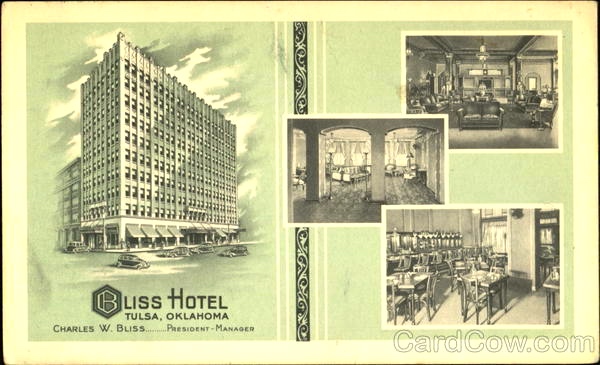
Bliss Hotel Tulsa
When they shut down at 1:00 or 2:00 o’clock, there was a bunch of us that lived in the Bliss Hotel, and we’d go back to the Bliss Hotel and jam until daylight. In those cases, when you were jamming, I played a lot of Dixieland because I loved it.
Okay. When I went to work with Bob — what the hell do you play? There’s nothing there to tell you what to play. There’s nobody in front of you [giving] you any indication of what you were supposed to play. And I fought it, uh, terribly hard.
I played a press roll on some tunes, [that] would work fine, Scott. Then on Maiden’s Prayer or something like that — you didn’t play a press roll. I went to the wire brushes in both hands and played smooth, swishy, hotel-easy brushes.
And so, different styles would work on different tunes. But what do you play that is basic with all tunes? I just sweat blood over that, Scott. The only thing that I knew for sure — the banjo played on the offbeat — just plank, plank. If you’ve every heard a banjo it goes clank, clank, clankety clank. That’s all there is to it! That’s why I ain’t that crazy about banjo players.
And the bass fiddle — he didn’t play four beats. If I played four beats I’d play four beat by myself on my bass drum. But, you see, whether or not you could do anything on a bass fiddle in a string band was how hard you could slap it. That was where the rhythm was.
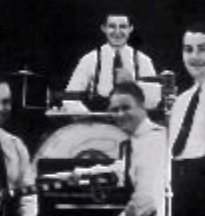
William “Smokey” Dacus
So, when I listened to that slap on the bass fiddle I begin to notice I could be way up front…. Maybe I’d got down to dance or something and I went up there and got a Coke up at the bar. When I couldn’t hear the rest of the music very well I could still hear the slap of that bass fiddle. Frankly, I didn’t understand it then, but it was the tonal frequency of that slap that just cut like a knife. You could hear the slap of that bass fiddle two blocks from the dance hall! That’s all you could hear two blocks from the dance hall, but you could hear that.
So that slap and the banjo — they played together. When Eldon came in the band he played rhythm guitar and choked the second and fourth beat.
Now my problem was: What do you play? Like I said, I had come up playing in this concert band before I ever graduated high school. The main objective there is to take 70-pieces and make it sound like one. You don’t hear single instruments. You hear the whole thing.
So with that in mind I took a brush in my left hand and played on 2 and 4. That brush blended with the choke of the guitar, the whack of the banjo, and the slap of the bass.
Well, that left my right hand free to do whatever I wanted to. To blow my nose or whatever!
So I would play [ride] cymbal. Or I would close my sock cymbal and play on my sock with my right hand, still playing my left hand with a brush underneath it. I learned I could play on all four beats with my brush! It just added a little bit to the first and third beats. In other words, it was a matter of accent. I didn’t accent the first and third, but you could feel it under there. Again, it was a situation of frequency.
SKF: What rhythm were you playing on your closed hi-hat?
SD: The standard rhythm. Like a bounce rhythm. I would play that on my sock cymbal with a stick. The first and third beat on top of the closed sock was just a click. That’s all it was. But when I hit the second and fourth on a closed sock, why, then the sound just melted into the rhythm guitar.
That’s when I finally found out. I had to figure it out — what I could play on drums that matched every other instrument in the band. And I still play it.
We were playing in San Antonio, this big thing, a year ago. There were about five or six bands. Tompall Glaser was there. When it come time for us to play, all these kids — there were six of them standing off there in the wing up there watching me play.
Tompall called me down to his room the next morning. He said, “Why don’t you come on down here. I got something I want to tell you.” I went down there and he had Leon MacAuliffe sitting down there because they’ve been great friends for years.
[Tompall] said, “You notice them bunch of drummers standing off over there in the wings watching you? I said, “Yeah. I don’t know what the hell they expected to see, but they was all over there watching me.” They said, “I wish you’d look at that old man up there. He’s playing a brush in one hand and a stick in the other — and you can’t do that.”
Because a brush is a hell of a lot lighter than the stick, you know? So you got a different weight in each hand. But way back there in the [1930’s], Scott, I had to learn how to compensate for that different weight.
The night before last in Austin, I walked in and Tammy Wynette’s band was there. I had used her drummer’s drums once before. I asked him, I said, “Is it alright if I use your drums if I don’t play in [the key of] A or in any of them damn offbeat keys? And he said, “Yeah.” I said, “You got any brushes?” He said, “I got one.” I said, “Hell, one’s all I ever need anyway!”
SKF: Tammy Wynette’s drummer had one brush and that was it?
SD: That was it. ‘Cause they don’t know how to use two. Most of them ain’t got any. That’s why, when I leave here — like when we went to the Smithsonian — I don’t take anything except a pair of sticks and a pair of brushes. I take a par of each one of them just in case I drop one of them or lose it.
SKF: What was your drum setup? Snare, bass, hi-hat, cymbal?
SD: Period.
SKF: You weren’t ever playing many fills?
SD: No. I don’t play lead. I told Bob when I went to work, I said, “Look, if you want me to play lead, then I want to set up out there on the front row with the rest of them. If you want me to play rhythm, then I’ll set back here in back.” He said, “I want you to play rhythm.” I said, “Great. I’ll set up here behind the band and that’s what I’ll play: rhythm.”
That’s what I tell the kids today. What they do, Scott, just to tell you the truth…. And I don’t mean this critical at all. But, you know, they’ll come to the end of an eight bar phrase and they got a two bar turnaround. So what [a drummer] tries to play in that two bars is about eight bars. And it won’t go in there! On top of that — they rush. They got all these wild licks they’re going to play and they got this one time.
When they come up to that turnaround — boy! — they fly into them damn things and all their tom-toms. They’ve got to hit everything they’ve got. Like they were sorting wildcats. When they come at the en of that two bar turnaround they’re going about 20-miles an hour faster than they was when they started!
A drummer — most of the time nowadays — has some kind of a complex. If he is just playing rhythm for the guys standing up there playing lead, he will think he ain’t doing nothing.
I don’t play for the audience. I play for the guys that are standing on the bandstand in front of me. And all the guys I’ve ever played with kind of like it for a drummer to play for them instead of play[ing] for hisself.




 Scott K Fish
You must be logged in to post a comment.