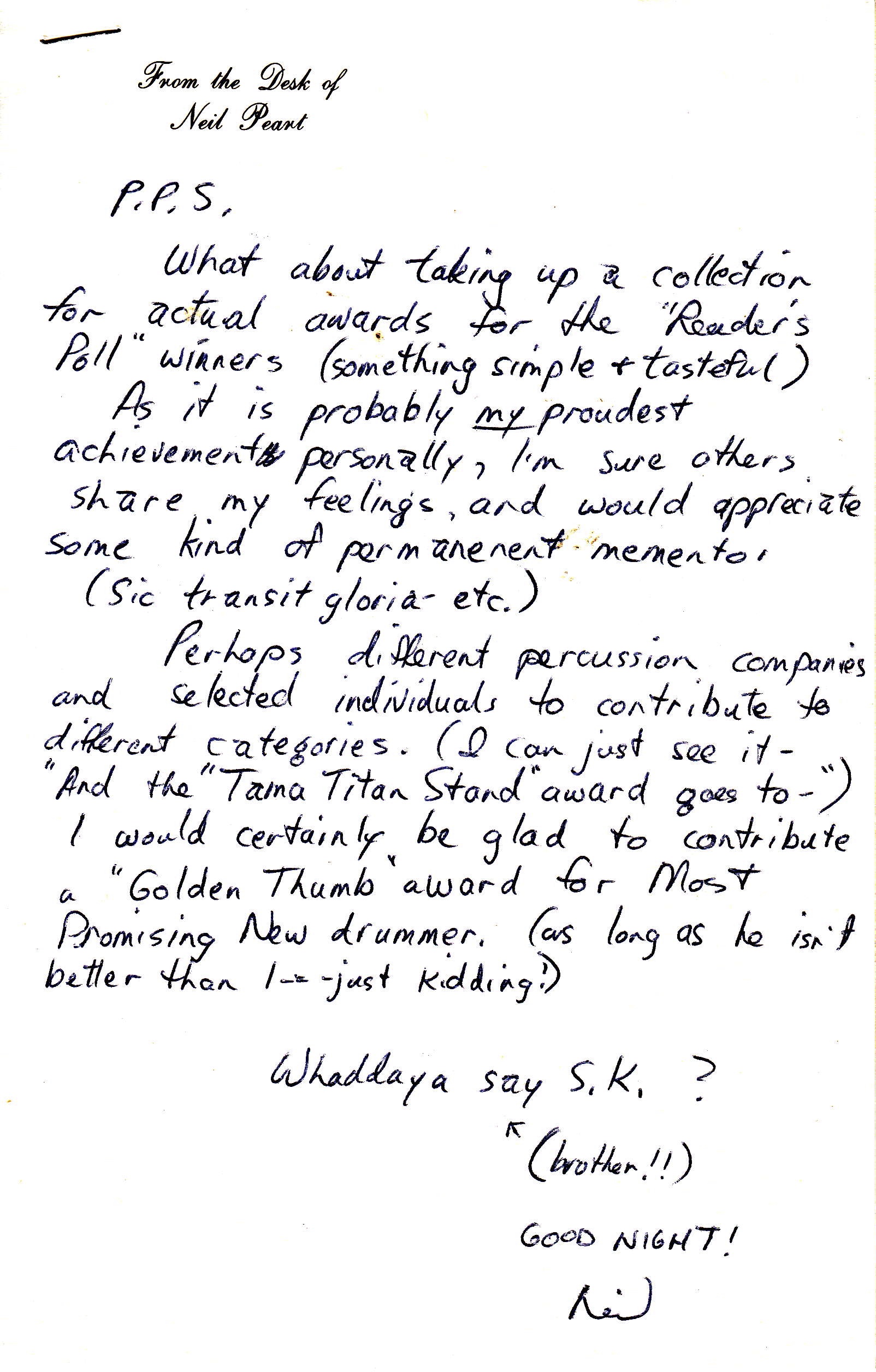
SKF NOTE: Neil Peart sent me this curious note in early 1982.
Why curious? Well, the note is curious to me for these reasons:
Until I reread Neil’s note, I hadn’t given any thought to physical awards to Modern Drummer Readers Poll winners.
I have a memory of seeing two award plaques in Buddy Rich’s apartment. I wouldn’t swear to it in a court of law, especially after reading this note, but I was pretty sure those were Modern Drummer Readers Poll Awards.
My friend and former MD Features Editor Rick Mattingly tells me the magazine did present award plaques. One well-known drummer, who shall remain nameless, “won more than one category one year, so they sent him a single plaque that listed all of the awards. He thought he should have gotten a separate plaque for each award,” said Mattingly.
It was not Neil Peart.
That Neil thought of this MD Readers Poll Award as “probably my proudest achievement personally,” surprises me in a good way.
MD’s 1982 Readers Poll voters awarded Neil Peart first place for Best Rock Drummer, Percussion Instrumentalist, and Recorded Performance for Rush’s “Exit: Stage Left” album.
SKF NOTE: Keith Copeland, jazz drummer and music educator, died in February 14, 2015. During his career Copeland played and/or recorded with Sam Jones, Billy Taylor, Johnny Griffin, Stevie Wonder, Rory Stuart, George Russell, and Hank Jones. He also led his own groups and taught at Berklee College of Music and Eastman School of Music, among others.
While I’m afraid I don’t remember the specific steps leading to my interviewing Copeland for Modern Drummer, I remember the interview clearly. We met at a restaurant on Centre Island, NY on July 23, 1983. The interview was published in the May 1984 MD.
I rediscovered my full Copeland interview transcript in July 2015, five months after Keith passed. Re-reading our conversation after 30 years I was impressed!
Here’s part of what I wrote about Copeland in his May ’84 interview introduction:
“After meeting and interviewing Keith Copeland, there’s one word that seems to represent his overall approach to drums: tradition.
“One of the most impressive aspects of Keith Copeland is that, unlike many of his contemporaries, Keith is carrying on the mainstream tradition not by default, but by choice. At one time in his life he was at the apex of the rock world as the drummer in Stevie Wonder’s first Wonderlove band. And prior to that he’d earned himself a reputation around the Boston area as a funk drummer to be reckoned with.
“When Alan Dawson retired from Berklee after 18 years of teaching, Copeland was hired for the position based on Dawson’s personal recommendation.”
In this interview, Keith shared a wealth of information for drummers. Especially, but not only, for drummers wanting to play jazz drums.
I have already posted on my blog and YouTube page audio segments of this interview. The original is on two sides of a 90-minute audio cassette.
This is the complete Side 1.
Again, this interview took place over dinner in a crowded restaurant. I promised myself never to to do that again. There is quite a bit of background noise. I’ve modified the sound to where listeners should have an easy time following the conversation.
The knowledge Keith Copeland shares during this interview deserves to be in circulation.
I am working on Side 2 of this interview. If I can modify the sound to where it is discernible I will post it. Think pure thoughts.
SKF NOTE: I don’t remember the exact moment learned about drummer/bandleader Sherrie Maricle. But it was probably through the “THE JAZZ NETWORK WORLDWIDE & NOT JUST JAZZ NETWORK” Linkedin group.
Our conversation centers mostly on Maricle’s current activities – which are substantial. She is both leader and drummer for the DIVA Jazz Orchestra, the Five Play Quintet, and the 3D Jazz Trio. She just celebrated the DIVA Jazz Orchestra’s 30th Anniversary with a swinging CD recorded live at Dizzy’s Club in NYC.
Add to that Maricle’s work as a coast-to-coast clinician for Sabian Cymbals, Yamaha Drums, Vic Firth Drumsticks, and Aquarian Drumheads, as guest conductor, soloist, and adjudicator for collegiate and high school jazz festivals. Maricle’s one-on-one lessons with students. Plus, her role as Adjunct Associate Professor, School of Music Drumset Co-Coordinator, at University of the Arts in Philadelphia, PA.
I was surprised I had never before heard of Sherrie Maricle or of the musicians making up her several jazz collaborations. There are no seat warmers. Every musician plays great and has a long, long list of musical credentials.
From strictly a drumming perspective, Maricle plays very well with her big band, quintet, and trio. She is an exciting player and fun to hear.
I hope you enjoy listening to her as much as I enjoyed interviewing her. And be sure to check out Sherrie Maricle’s extensive CD offerings.
You can find everything about Sherrie Maricle on her website: sherriemaricle.com.
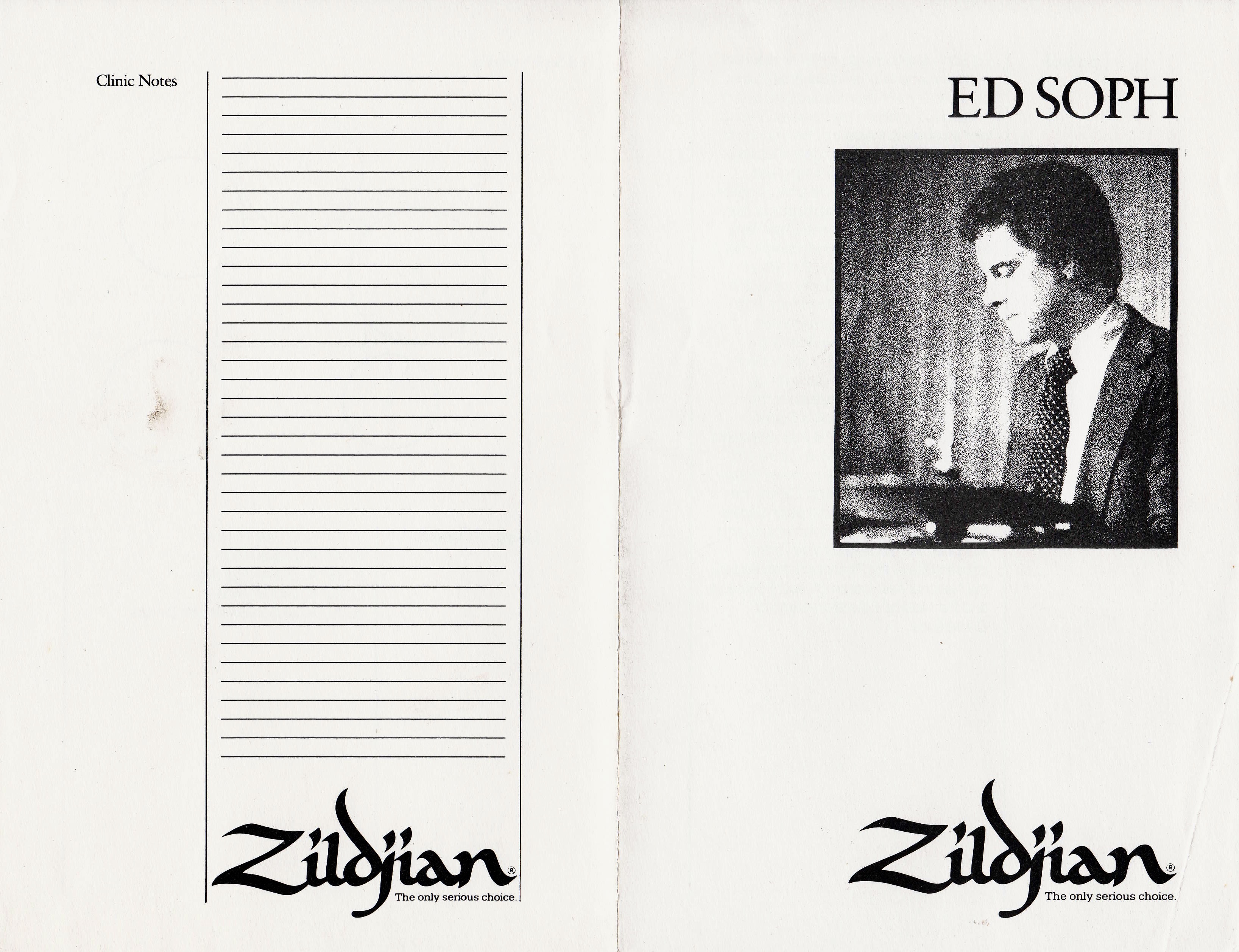
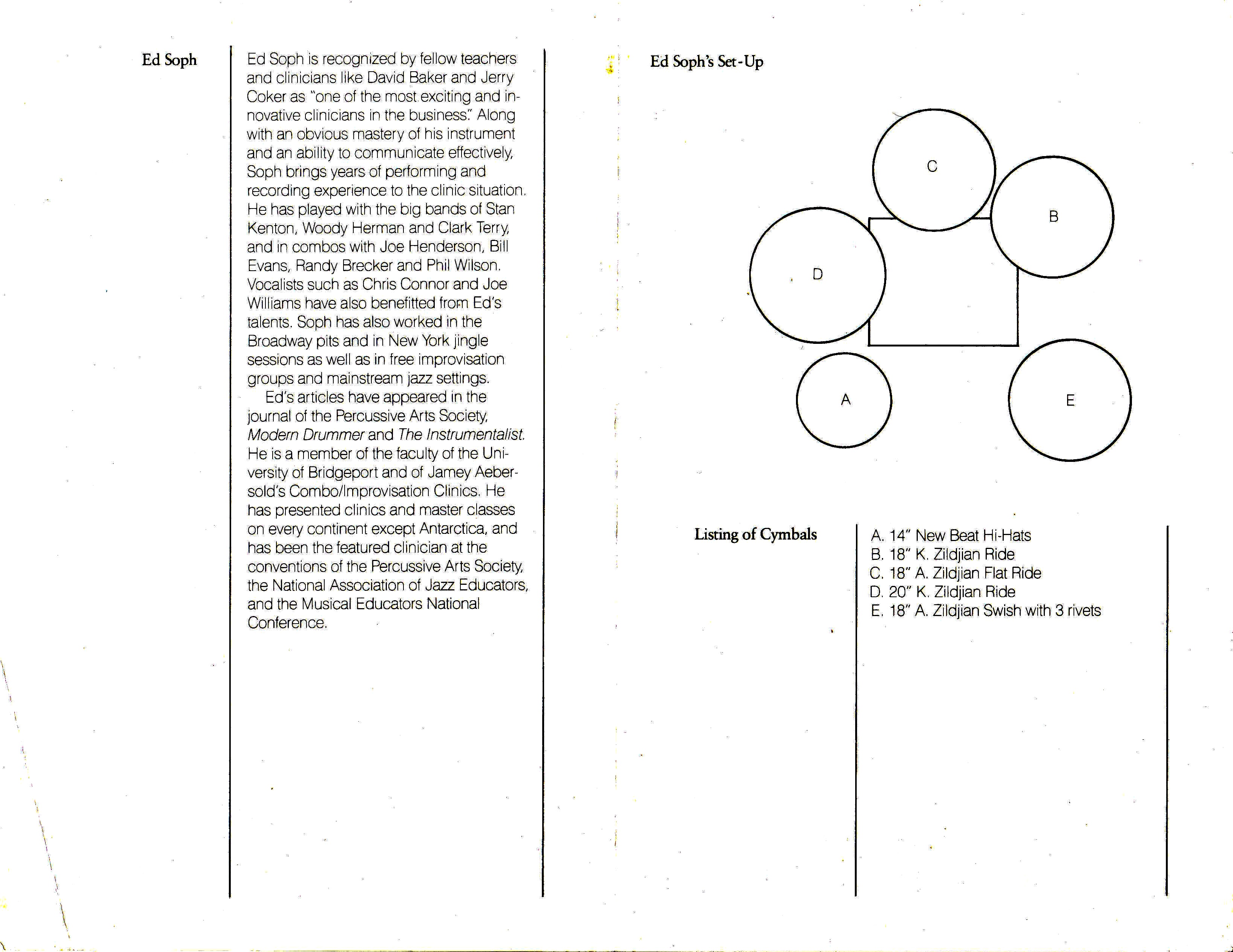
SKF NOTE: A “for the record” post of a 1980s Ed Soph Zildjian Cymbal Set-Up pamphlet.
Is this Soph’s current cymbal set-up? I don’t know. But it’s a snapshot of Soph’s playing career roughly 40 years ago.
Ed Soph was living in a small Garrison, NY house in the middle of the woods when we first met in the 1970s. My first interview was completed and accepted for publication around 1978.
MD was a quarterly publication back then. Before Ed’s interview could be published, a significant part of it was outdated.
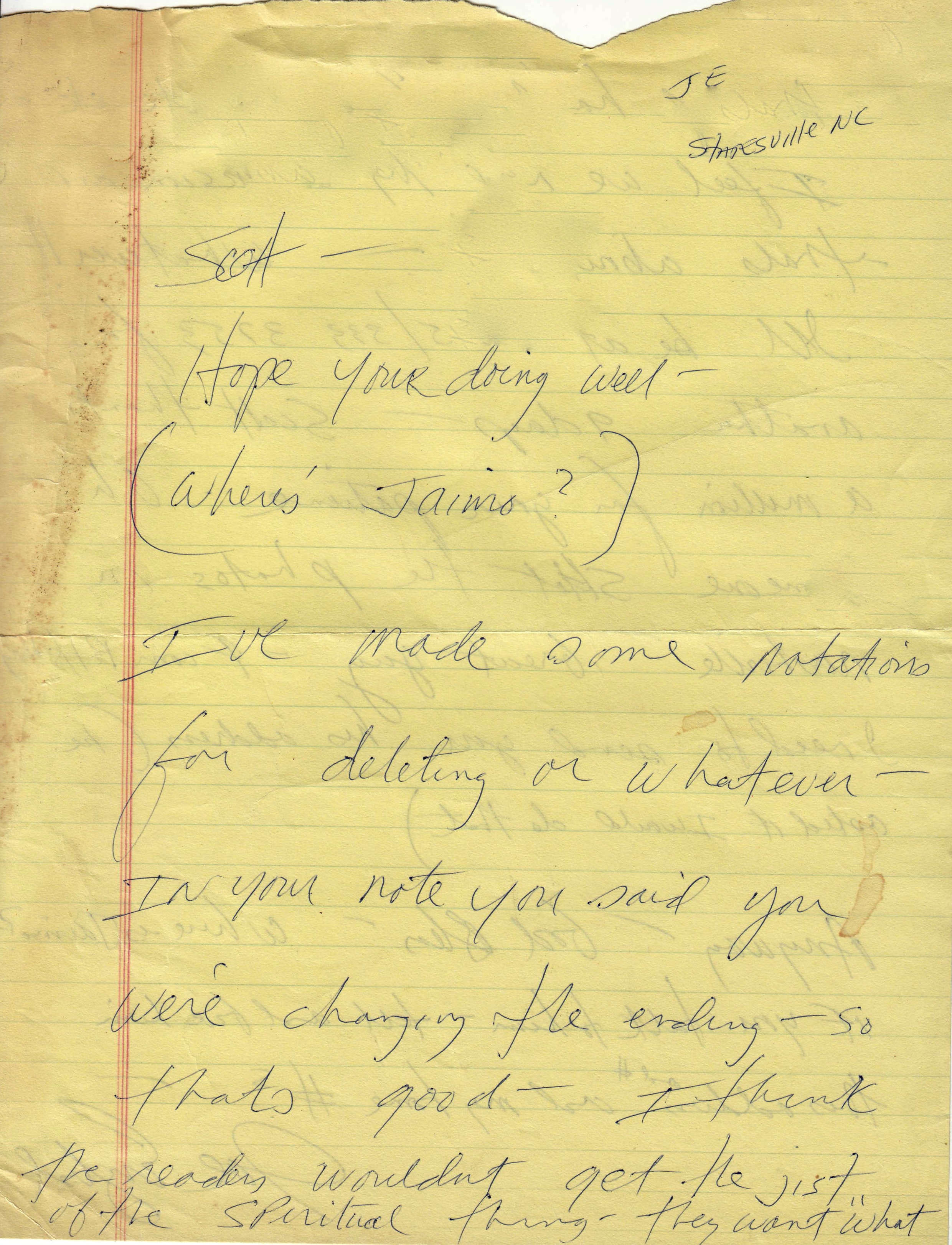
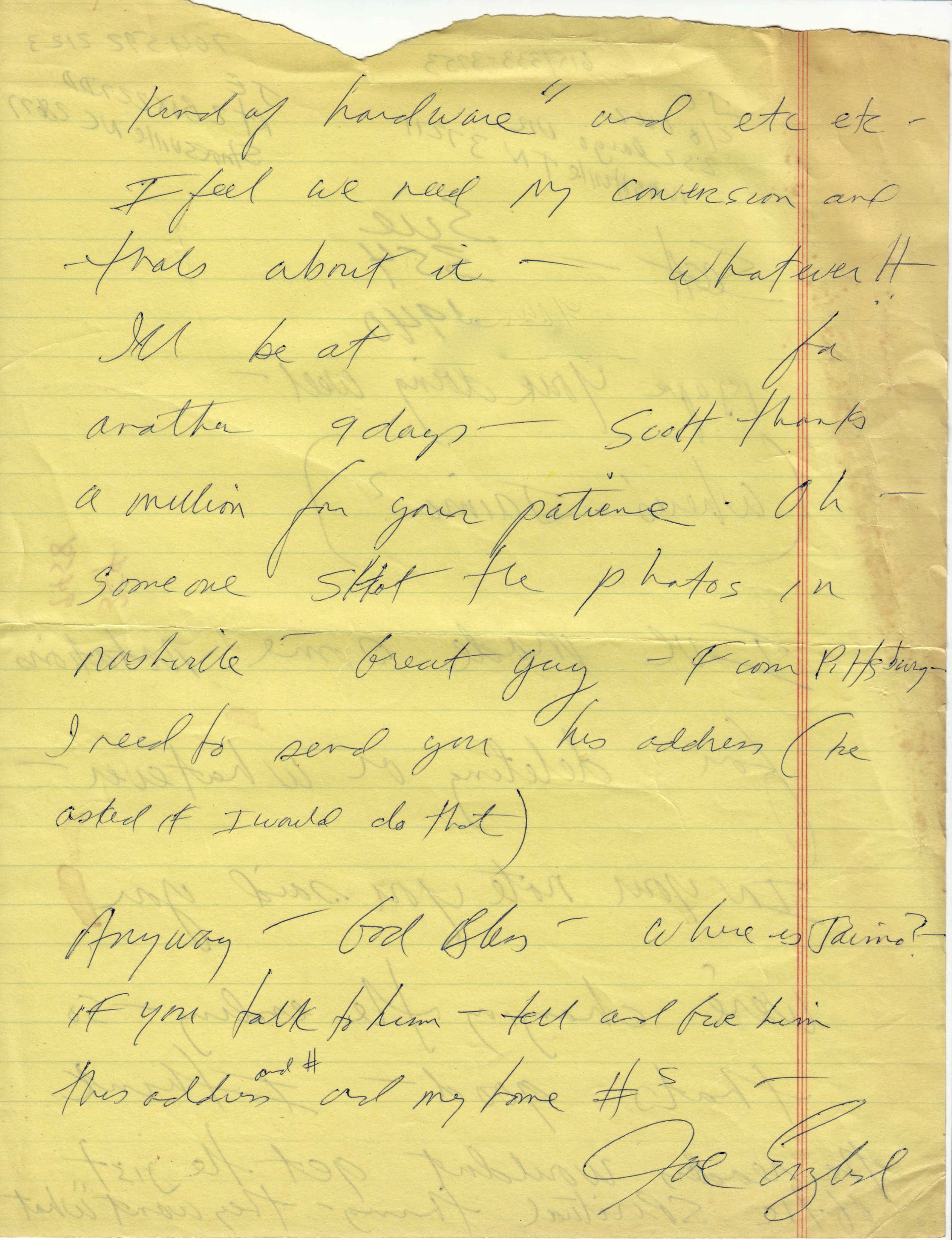
SKF NOTE: This handwritten note from drummer Joe English is not dated. My guess is Joe wrote this circa 1985-86. Other than my scrubbing a couple of phone numbers and addresses, the note is intact. I’ve transcribed it below for anyone having trouble reading Joe’s handwriting.
“Joe English agreed to to this interview in 1980. Then he disappeared. In 1983, I got approximately three-fourths of this interview on tape when Joe disappeared for another three years. I nicknamed him the Howard Hughes of Drumming. I had no positive proof that Joe was a bad guy. He never returned my phone calls or answered my letters, but I have two grandmothers who are guilty of the same thing, and they’re not bad people. The last quarter of this interview was, finally, taped at the tail end of 1985, and I submitted it to MD and it was published in the June 1986 issue.”
When I left MD’s employ in 1983, instead of someone else preparing interviews on which I was working, I assured MD Founder Ron Spagnardi I would finish them. Joe English was one of those interviews.
Joe’s two references to drummer Jaimo are interesting on a couple of levels. While my friend, Bill Grillo, and I were in NYC interviewing Allman Brothers’ drummers Jaimo and Butch Trucks, Jaimo’s wife at the time, Candy, asked me if I would let her read the interview before it went to publication.
Without skipping a beat I said, “Yes.” When I then asked Candy why, she told me of a time an interviewer put words in Jaimo’s mouth, made up quotes Jaimo never said or inferred.
From then on I sent everyone I interviewed the copy headed for publication. That’s what Joe English is talking about in this letter. He’s read the interview, made a few changes – he calls them “notations” – and he likes the changes I’ve made or told him I’d make.
Once the interviewer and the subject agree to a reasonable turnaround time to look over, make any changes, and return an interview – it’s a win-win policy I still use.
The Pittsburgh photographer who took Joe’s MD interview photos in Nashville is Rick Malkin. Rick was always a professional pleasure to work with.
=====
Scott –
Hope your (sic) doing well –
(Where’s Jaimo?)
I’ve made some notations for deleting or whatever –
In your note you said you were changing the ending – so that’s good – I think the readers wouldn’t get the jist (sic) of the Spiritual thing – they want “what kind of hardware” and etc etc.
I feel we need my conversion and that’s about it – Whatever!
I’ll be at (deleted phone number) for another 9 days –
Scott thanks a million for your patience.
Oh – someone shot the photos in Nashville – Great guy – From Pittsburgh. I need to send you his address (he asked if I would do that)




You must be logged in to post a comment.