“I loved [Keith Jarrett’s] attitude toward the piano, just sitting down and playing, just to see what would come out. Whether it worked or didn’t work wasn’t the point. It was simply doing it.”
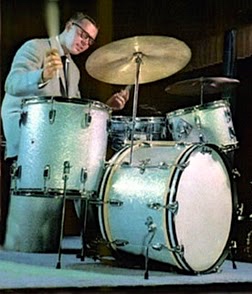
Les DeMerle‘s interview appears in the October 1984 Modern Drummer. Les was an interesting musician who maintained a good balance between the business and artistic sides of drumming. At one point during the interview I ask Les, “It’s intriguing that you can remain so active in concerts, in teaching, in clinics, in seminars, in recordings, and in other areas of the music business – like owning and operating your own night club – and still grow on your instrument. How do you find the time to do all that?”
Les answers, “You have to make time for it. I openly admit that I’m totally dedicated to drumming and to music. Never in my life have I had to do anything other than play drums to make a living,” adding, “In other words, I keep enough things going so that if one falls through, the other one happens.”
I came across the transcript for this interview a few weeks ago. I’m sure it has been 30-years since I last read it. Les and I had good discussion. Here’s one part of it:
Scott K Fish: Fred Gruber told me that he once asked Buddy Rich what questions he would ask in an interview. And one of the questions Buddy asked Fred was, “What’s the greatest four-bar drum break ever recorded?” I’ll ask you the same question.
Les DeMerle: I would pick a four-bar break that Art Blakey does on the original recording of “Blues March.” I’m not even sure what album that’s on. The note placement gives me chills. Right where Art put the time is right where it should be.
There’s a live recording that Buddy did with Sammy Davis, Jr. Buddy plays a four-bar break on “Ding, Dong the Witch is Dead” that kills me too. But, as a favorite, I would say the Blakey one.
SKF NOTE: At 9:01 a.m. on July 4, 2014, I read guitarist Emily Remler’s May 1985 Down Beat article, “Emily Remler, Life After Wes,” with Julie Coryell. I know Emily’s name, but have never heard her music. I underline several Emily quotes, including these:
* “I’m trying to live up to my own expectations, which were that at 21 I should be like John Coltrane – and I’m not. So I’ve got to give myself to 31 now. To have a totally unique voice like Coltrane had. You hear two notes and you know that it’s him.”
* “I think [life maturity] is what you have to go through – that plus a spiritual maturity like Coltrane did. I want to be innovative.”
* “[Wes Montgomery] cracks me up. Because I can hear him quoting things. That’s obvious humor. When someone quotes a little song, you laugh. But other things; just the way he did an ingenious turnaround. Came around the bend like that. Raised up to a climax – just like life.”
* “There’s a lot of humor missing, I think, from some of the younger players today.”
Finishing her 1985 DB interview, I turn to the web to see what Ms. Remler’s up to in 2014. I like her ’85 perspective on the musicial life. I wonder what her music and life are like 29 years up the road.
I am very, very sad to learn Emily Remler never made it that far. She died in 1990 at age 32.
SKF NOTE: Ed Soph was living in a small Garrison, New York house in the middle of the woods when we first met. My friend, Chris Conrade – a terrific drummer and teacher now living in Oregon – studied with Ed. He suggested I interview Ed for Modern Drummer.
I first heard Ed Soph in 1974 – years before meeting Chris – on trombonist Bill Waltrous‘s “Manhattan Wildlife Refuge” album. Ed’s playing on that date is so clean and precise, even in uptempo songs such as “Zip City.“
Soph moved to Connecticut, not far from my home. We visited several times. Once, Ed asked me to listen to two cuts of a guitar/bass/drums trio with which I was unfamiliar. The first tune had a rock beat. The second tune was in swing time. Afterwards, Ed asked me, “What do you think of the drummer?” “Who is it?” I asked. Ed wouldn’t say. Finally, I said, “He sounds more comfortable with swing than rock.” Ed nodded. “Who is it?” I asked again. “It’s me,” Ed said.
Ed was smart, funny, curious, methodical. He was a wonderful person to interview. No matter what question I asked, Ed had a thoughtful answer.
I don’t remember if this exchange on rudiments from my Ed Soph interview transcript is part of Ed’s MD feature story. But let me clarify a photo MD used showing Ed playing a drumset with four sticks. We – MD’s editors – didn’t know it at the time, but after Ed’s interview was published he laughed about the photo. Ed said he was just clowning around with the photographer. Nothing against using four sticks. It was just that Ed Soph didn’t use play drumset using four sticks.
Ed Soph
Scott K Fish: Going back to the rudiments/no rudiments argument. If you found the most unschooled backwoods drummer in the world – would there be anything in his playing that could be rudimental?
Ed Soph: Sure. Single-strokes and double-strokes. I think the rudiments are very valuable because they teach a certain discipline. Plus, they teach a linear concept that can then be translated into a drumset concept.
Man, what would rock drumming be without the paradiddle?
There’s something magical about the rudiments. If you play drums, you’re going to play a rudiment.
Where did the ride cymbal pattern come from? Why does ding-dinga-ding exist? Where did that come from? Why is the hi-hat played on two and four, and not on one and three? Why was the bass drum played on four beats? Why was it played on one and three? And why is it not played either of those ways anymore?
There are reasons for all that. Why did guys start playing drums with single heads? Knowing the reasons for all that is how you find direction in your own playing.
You must be logged in to post a comment.