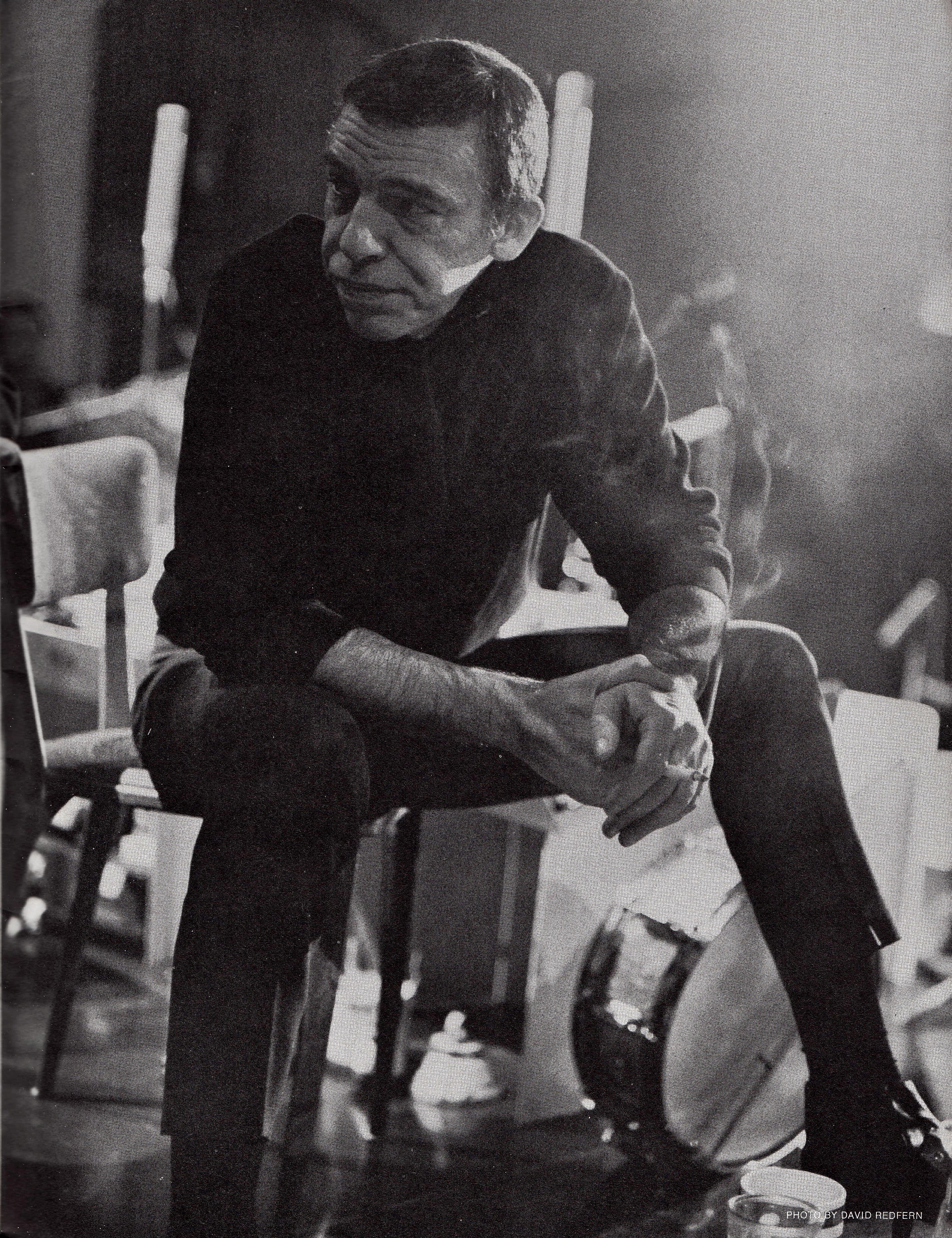
SKF NOTE: There can never be too many good-to-great Buddy Rich photos. Years ago I wrote about the times in my life when drummer photos were drum lessons.
These two photos I scanned from a Rich concert program. They show Buddy playing full-steam ahead and in repose.
I have nothing more to add except to say that I like these Buddy Rich photos.
SKF NOTE: My idea for the “Who Reads Modern Drummer?” in-house magazine ads were based, I think, on a similar idea I saw somewhere else. Possibly it was Gretsch‘s great ad campaign with Charles Stewart drummer photos. When and if it comes to me I will post that info.
Basically, MD would ask respected drummers if they were okay with us using their photo in a full page “Who Reads Modern Drummer?” ad. Drummers who agreed were asked to submit a brief MD endorsement to use with their photo in the ad.
I conceived the MD ads with minimal clutter added to the drummer’s photo: the quotation and, across the lower part of the ad page, a subscription coupon to be clipped and snail mailed to MD. (At the time, MD was only available as a print magazine.)
MD Founder Ron Spagnardi approved the ad idea. Ed Shaughnessy’s letter here indicates the excellent response drummers had to the idea. It really was a win-win. No money was involved.
MD benefitted from the drummers’ endorsements, and the drummers secured a full-page ad in MD.
Over time Ron couldn’t resist adding clutter to the “Who Reads…?” ads. I protested at first, but it was Ron’s magazine. Bottom line: it was a successful ad campaign.
SKF NOTE: Looking again over my 1976-77 Mel Lewis interview transcript. Among Mel’s comments, deleted because there wasn’t room for them in his first Modern Drummer interview, are some interesting insights from the master drummer and storyteller.
Asking drummers their memories of great drummers who preceded them was a key part of my interviews. In hindsight, I wish I had dug deeper into those memories.
This Q&A exchange with Mel is verbatim from the typewritten pages transcribed by me from his taped interview.
When I was a youngster, a little kid, he came through Buffalo. I got to see him once. Of course, I got to hear him more on records later.
But, for me, see, out of Chick Webb the main man was really Gene Krupa. So really, through Krupa, you could hear Webb. If you missed Webb, you could hear it through Krupa.
Now, of course, there’s plenty of reissues of Chick Webb drumming.
Another important guy to me was Jimmy Crawford from Lunceford’s band.
But I heard all those guys.
I also was interested in listening to Lombardo’s drummer, George Gowans. I made sure I heard the society drummers too. I listened to everybody. I had to know all those styles.
And my father, who was a pit drummer, a show drummer, and also a good wedding band bar mitzvah drummer. I knew his style backwards. That was my first influence. And he was sort of a Dixieland style jazz drummer, and he was one of the best pit drummers in the City of Buffalo. And he was an excellent show drummer. He could read anything.
He wasn’t modern by any means, for his time, but he had excellent time. Bill Robinson was crazy about him, about his feel and all that. And I think I was blessed with that from him.
And my father had great taste too. He was a very tasty drummer. I think I got that from him.
My favorites were Krupa and Jo Jones from that era, from the Thirties. I was in love with those two guys.
And then after that I was in love with a whole lot of people, but they were my main loves.
And then, of course, in the Forties, Max [Roach] made a big impression on me. More than Klook [Kenny Clarke]. ‘Cause Max was very impressive then, you know.
Then Roy Haynes. In the Forties I heard Roy Haynes talking about what Elvin [Jones] was talking about later. Roy was really one of the first “out” drummers, man. He was really very good.
SKF NOTE: Sabian Cymbal’s Deal Support Program including Roy Burns as drum clinician. Seems like a win-win for drum retailers.
Based on what I’ve read, Burns said he entered into this deal with Sabian Cymbal Founder Bob Zildjian in or around 1984, to both help the new cymbal company and to help his own new Aquarian drumhead and accessories company.
I attended a Burns drum clinic in Moline, IL in 1974 and thoroughly enjoyed it. The man could play! Many years later I discovered I had taped that clinic and still had the cassette, which I digitized and have posted on my blog.
SKF NOTE: I have a handful of these Zildjian Cymbal Set-Up handouts that were, I believe, meant to be used for note taking at drum clinics. I’ve already posted one for Vinnie Colaiuta and Steve Smith.
As of this writing I am unable to date these handouts other than sometime in the 1980s.
I don’t know if Robinson always used this set-up in the studio or if he still uses this set-up. Until I know for sure I will view this information as a moment in time.
Meanwhile, here’s how Robinson describes himself on his website.
World-renowned, Grammy winning musician, John JR Robinson is the drummer to the soundtrack of our lives. Having played on recordings that have sold well over 500 million copies and currently streamed well into the trillions, JR’s grooves are featured on many legendary hits with artists Michael Jackson, Lady Gaga, Daft Punk, Madonna, Steve Winwood, Rufus & Chaka Khan, Lionel Richie, The Pointer Sisters, Quincy Jones, George Benson, Barbra Streisand and many more. When JR is not in the studio, he performs with his own groups and tours with various artists. JR’s talents also extend into drumming masterclasses, motivational speaking and writing. JR’s autobiography King of the Groove-The John JR Robinson Story is due out in 2024.





 Scott K Fish
You must be logged in to post a comment.