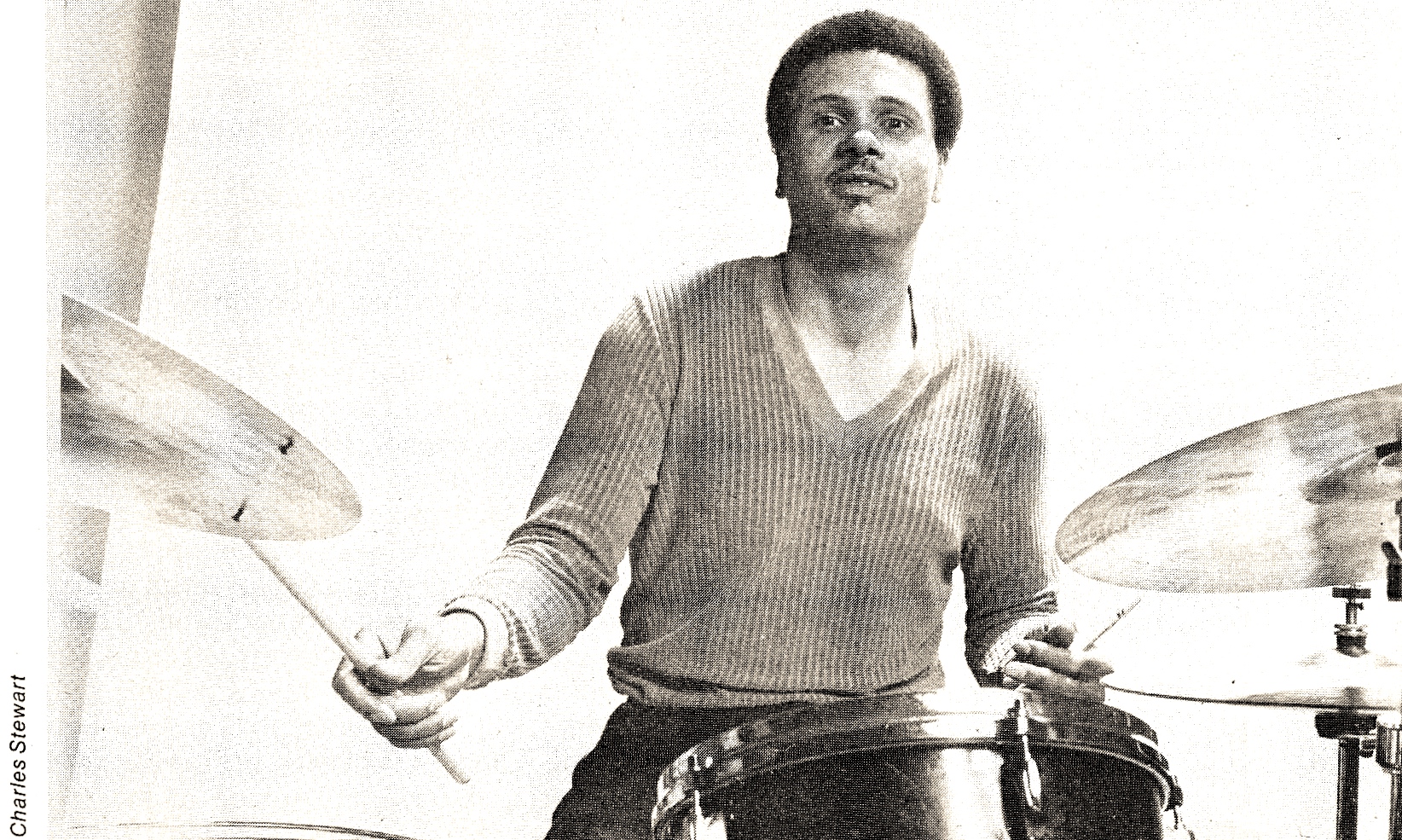
Keith Copeland
SKF NOTE: You don’t see many wordy posts on Life Beyond the Cymbals. Now and then I find an interview excerpt where a musician covers a topic beautifully, with an answer a bit longer than usual. But it would be a sin to chop up the answer into multi-posts.
Keith Copeland‘s words of wisdom on building an essential jazz listening library is a case in point. And here’s Keith Copeland again on how drummers can approach different size groups, as Keith did, from piano trios to symphony orchestras.
====
Scott K Fish: You’ve played drums in trios all the way up in size to symphony orchestras. How does your approach to drumming differ in each situation?
Keith Copeland: In a trio there’s only two other people. I have to really listen to the leader, and figure out what style he’s coming from, and provide the accompaniment/support that’s going to make him feel comfortable.
In some situations you can play busier than others because the piano player might like a busy drummer. Other pianists might like a less busy accompanist.
Then you have to understand the way the bass player is playing. Both of you are supposed to support the piano player. You have to interpret the beat the way the bass player is. Is he right in the middle of the beat? On top of the beat? A little behind the beat? You’re supposed to interpret what makes him feel good. Both of you have to agree on that so you can provide the accompaniment to the next person.
As the groups get larger the responsibilities changes.
In a quartet or a quintet you do all the things you’d do with a trio. Then, you have to understand the styles of the horn players, and what makes them feel good. Do they like a lot of activity from the drummer? Do they play off the drummer? A lot of horn players play off the drummer, just like Elvin [Jones] and [John] Coltrane. Some horn players don’t like that.
You don’t need to play a lot behind a horn solo — if that doesn’t make him feel comfortable — and you can still play fairly busy by playing off the way the piano player is comping and give some support that way. Or you can try to play off the soloist and cause excitement because he likes that exchange — and still be aware of how the piano player is comping, and of the rhythmic emphasis the bassist is providing.
The bass player may be playing more than four beats to the measure if you’re playing a swing feel in 4/4. He may be adding other rhythmic inflections to that.
You really have to have yourself together because you’re listening to three or four things at one time, trying to acknowledge them all, while still concentrating on keeping the time, and meter, and making it sound like everything is together.
When you get into big bands, the emphasis changes. You might want to get very busy and communicate with a lot of soloists. But, your main priority should be to hold the band together. In that situation the most important thing is to lock up with the bass player and provide the dynamic textures that fit.
This is where your choice of cymbals is really important. You have to have cymbals that’ll make the reed section sound good, the brass section sound good, and your soloists sound good.
I’m only using three cymbals. I use the same cymbals in all the situations we’re discussing. I picked them so they’d be able to fit a lot of different situations, depending on the way I played them, and the type of stick I use. I get a different sound out of a plastic time than I do a wood tip. For big band, sometimes I have to use plastic tips so the cymbals will cut through a bit more.
It’s important to lock up with the bass player and the lead trumpet player. If you’re interpreting the figures with the lead trumpet player, and you two agree on the placement of the notes, that section is really going to make or break a big band.
If the brass section is really together, and the drummer and lead trumpeter are really together, giving support to the rest of the rhythm section and reed section, and you’re using your ear, and you know how to keep that intensity, say, behind a sax soli, and how to give them the support they need — then you start to get to the most important aspects of a big band drummer.
It’s not true that the drummer has to play louder because you have more men. Sometimes you have to play softer. Sometimes, in the symphony orchestra, I have to play as soft or softer than when I play in the trio, because of the acoustic problems of the halls. If I play too loud there’ll be too much echo and resonance, and it will cut the clarity. The orchestra brass is way in the back, and I’m up front. I have to be very intense and precise, but not too overpowering, so that all the elements of the orchestra can be heard.
But, to sum up the qualities of a good big band drummer: you have to have really good ears, a good working knowledge of reading figures, and interpreting figures — especially with your left hand — and not let that affect your time feel.
And have a really good sense of dynamics so you can play softly and not lose your intensity. Then, just generally be aware of everything that’s happening. One of the soloists might need that excitement so, you can give it to him. But, not to the point that it throws the rest of the band or the leader trumpeter off when it’s time to come back in and play a concerted passage. That’s one of the hardest places to function.
The prerequisite to all of this is to listen to the drummers who did it the best: Sonny Payne, Jake Hanna, Mel Lewis, Kenny Clarke, Rufus Jones, Louis Bellson, and all the master who played with big bands. These are all very important people who came out of the big band era. Most of them can play well in any situation, but they happen to be experts at big band drumming.
Grady Tate is one of the greatest, most versatile drummers. Beside being able to play small group, and big band jazz, he can even fit in to today’s fusion and pop music.
Earl Palmer is another one of the old masters. He has that New Orleans tradition in his playing that fits big band, small group, rock, and R&B.
There’s not many of those guys around. If I ever try to pursue a living in studios I would want to be that kind of player.




You must be logged in to post a comment.