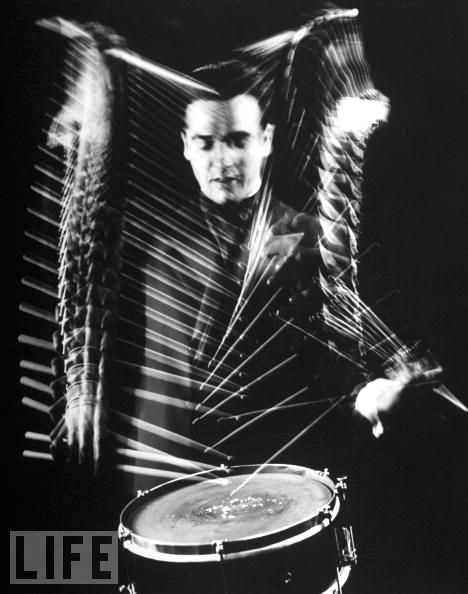
Gene Krupa’s Wisdom for the Ages

Gene Krupa

SKF NOTE: This is worthwhile drumming advice from Gene Krupa. I’ve written before on Krupa’s comments on starting “a roll or sequence of beats with the left or right hand.” Glad now to have identified the quote source.

Krupa’s comment on “how to keep the bass and snare drum in tune” is also unclear. Is Gene talking about keeping the bass/snare drums tuned to each other? Or is he talking about the importance of keeping both drums tuned well?

Either way, this is good stuff. Put it in your “Drummer Wisdom for the Ages” journal.

==========

Any idea that I knew anything about skins had to go out the window once I started hitting those [Chicago] South Side joints. For one thing, I had no idea of the wide range of effect you could get from a set of drums. I picked up from Zutty Singleton and Baby Dodds the difference between starting a roll or sequence of beats with the left or right hand and how the tone and inflection changed entirely when you shifted hands. Those Negro drummers did it nonchalantly as though it were a game.

Taking my cue from what I heard, I next went to work on the tom-toms trying to get them in tune and knowing when to use ‘em. I punched holes in them with an ice pick, as Zutty told me, until they were just pitched right.

Another trick I got from Baby Dodds was how to keep the bass and the snare drum in tune and how to get cymbals that rang in tune and were pitched in certain keys.

Then came the cowbell and the wood block.

You see, most white musicians of that day thought drums were something you used to beat the hell out of. The monotonous pattern made you feel weary after listening to it for a while. Few of them realized that drums have a broad range of tonal variations so they can be played to fit into a harmonic pattern as well as a rhythmic one.

Source: The Book of Jazz: From Then Till Now, by Leonard Feather, Dell Publishing, 1976
Posted in SKF Blog | Tagged , , , , , | Comments Off on Gene Krupa’s Wisdom for the Ages

Elvin Outlines His Soloing Thought Processes

SKF NOTE: It’s not uncommon, in drum forums, for a drummer to ask for help understanding Elvin Jones’s drumming. Count me among drummers who spent a long time listening and trying to “get” what Elvin was doing during his solos, intros, and trading fours and eights. I wrote about my “Elvin Years” in this blog post.

This afternoon, reading Rick Mattingly’s May 1992 Modern Drummer Elvin Jones interview, I spotted a couple of Elvin’s statements in which he explains his inner process while trading fours and playing drum solos.

The subject is Elvin’s playing on Sonnymoon for Two on Sonny Rollins’s 1957 A Night at the Village Vanguard album. Mattingly asks Elvin what he hears on the track.

Elvin said, “I hear myself trying to keep up with Sonny Rollins and Wilbur Ware. Sonny began to overlap his phrases when we started exchanging fours. So I decided to overlap with him. To me, it was like a great release….

“When exchanging fours or eights, I was always thinking in terms of musical phrasing as far as the composition was concerned. I think the phrasing should never be confined to a rigid pattern. Why shouldn’t it overlap? If everyone is paying attention, it shouldn’t make any difference. You can simply pick iup from where the other person left off, and he can come in where he wants in order to complete the continuity of the phrase. You can’t play that way all the time, it depends on the artist. Sometimes they require a rigid pattern, and if it’s required, that’s what you should do,” Elvin said.

Later on in the interview, Rick wonders if Elvin sings the melody of the composition to himself when he solos.

Elvin answers, “Well, I hear the tune. …I can hear it in my mind, and I try to follow it that way, so at least I know where I am at any point in the composition. Of course, this has to be reflected in what the solo is stating, whether it be realistic or abstract, in tempo or out of tempo. It doesn’t matter, as long as the time frame is accurate. Then one can pick up from any portion of the composition and reestablish the continuity.”

Good stuff. Thank you, Rick for asking the questions. Thank you Elvin, wherever you are, for your insightful answers.

Posted in SKF Blog | Tagged , , , , , | Comments Off on Elvin Outlines His Soloing Thought Processes

Simon Kirke – Double Drumming with John Bonham

SKF NOTE: In this second interview excerpt with Simon Kirke, recorded on August 3, 1983, I ask Mr. Kirke if he and John Bonham ever compared notes about drumming and/or drum recording.

Kirke was playing drums in a new band, Wildlife, at the time of this interview. Wildlife, and Kirke’s band, Bad Company, before it, were on Led Zeppelin’s “Swan Song” record label. That John Bonham and Simon Kirke might have been together during a Zeppelin recording session seemed possible.

“John and I were great friends,” said Simon, but never together while recording. Simon does relate a story of the two drummers playing together, using two drumsets, on “Whole Lotta Love” during a Berlin Led Zeppelin concert.

“[It was] about the heaviest thing I’ve ever heard in my life,” said Kirke, who shares other memories of Bonham, plus of Bad Company recording their first album.

Posted in Audio, SKF Blog | Tagged , , , , , , | Leave a comment

Al Duncan – Great Ears, Good Memory (Circa 1981)

SKF NOTE: (April 11, 2022) – Today I added the audio for Al Duncan’s circa 1981 interview with me. Mr. Duncan’s nephew, Michael Haggins, is a musician too. He has three smooth jazz CD’s of his own available, and he was kind enough to let me use three photos of his uncle I never had.

SKFNOTE: Last week I found an old cassette labeled on one side,“Al Duncan,” among my old cassettes. The cassette itself needed repair, which I did. I then digitized the Al Duncan interview and, for the first time, I am posting one of my Modern Drummer interviews in its entirety.

Almost three years ago to the day I posted on my blog the original transcript I made from this tape. Mine is not a verbatim typed transcript. I transcribed information I believed, circa 1981, would be useful in the History of Rock Drumming I was writing for Modern Drummer magazine.

In January 2016, my blog intro says, in part:

“I was interested in speaking with Al Duncan because I knew — from printed sources and from other musicians, like Willie Dixon — that Mr. Duncan had played on several early rock recording sessions for Chess Records and Motown.

A quick Google search today shows Al Duncan on records by The Orioles, The Spaniels, The Dells, Little Junior Parker, Priscilla Bowman, Dee Clark, The Falcons, The El Dorados, among many others.”

Listeners will hear Al Duncan telling me he’d never heard of Modern Drummer. Also, you will hear me explaining why I was writing my History of Rock Drumming.

Posted in Audio | Tagged , , , , , , , , | Leave a comment

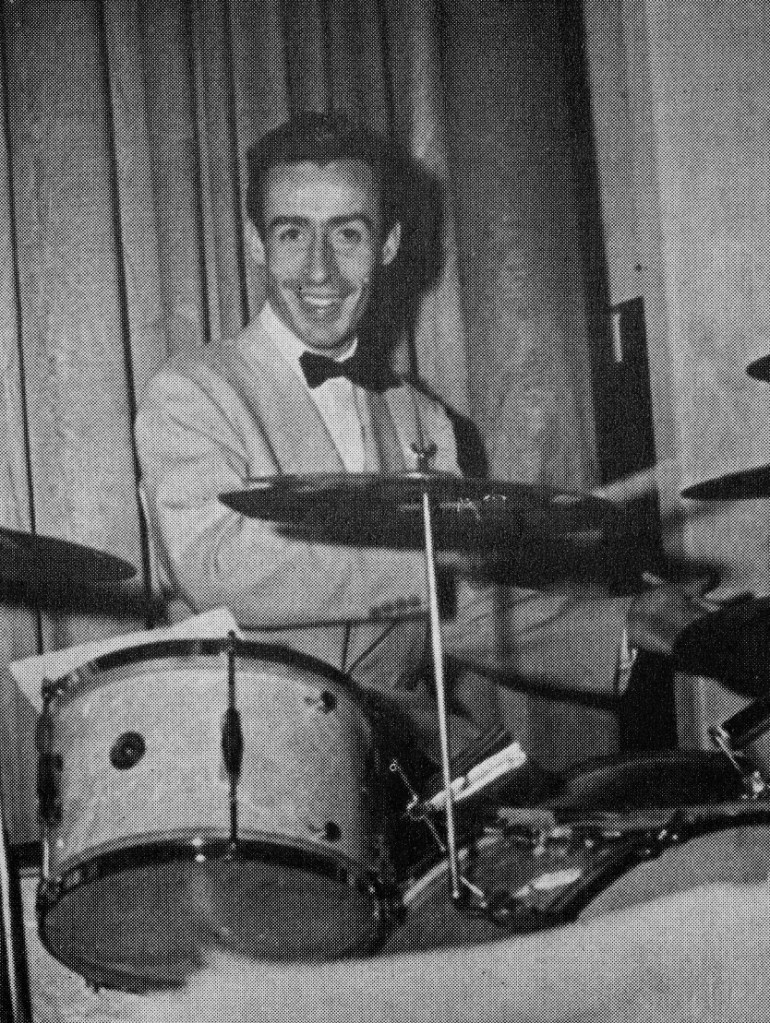
Dave Tough: Absolutely Perfect Bass Drumming

Dave Tough

SKF NOTE: James Lincoln Collier‘s book, Benny Goodman and the Swing Era, has a few interesting Davey Tough insights. This Sid Weiss quote is one example. I don’t recall reading or hearing another musician saying Tough could play faster bass drum than either Buddy Rich or Louie Bellson. Or that Tough’s understanding of playing the bass drum was rare.

In 1945, after eighteen months with the brilliant Herman band, [Dave] Tough won first place in the Down Beat, Esquire and Metronome polls. [In an interview with James Lincoln Collier, jazz bassist] Sid Weiss said:

Buddy Rich is supposed to have that fast foot. But Davey could play faster than Buddy, and also play faster than Louie Bellson with two drums. Davey was unbelievable. Take charge. As small as he was, he knew just how to do it. When I played a note his bass drum would go through the note and amplify it. He had a way of playing the bass drum so it would not cover — the tonality was right or whatever. The way the pedal struck the drum, it was just absolutely perfect. Most drummers didn’t really understand about the bass drum, they weren’t really listening to the bass.

Source: Benny Goodman and the Swing Era, by James Lincoln Collier, Oxford University Press 1989.

Posted in SKF Blog | Comments Off on Dave Tough: Absolutely Perfect Bass Drumming