SKF NOTE: This excerpt is from my interview with Ed Soph on May 19, 1978 at his home, a rental cabin, in the woods of Garrison, NY near West Point. It was my first time meeting Ed. A few years later we were both living in Connecticut and got to know each other better. Soph was a delight to interview. Always thought provoking and thoughtful.
Our conversation opens here with me mentioning how Mel Lewis notes the dropoff in drummers who can swing. A phenomenon Mel attributed to up-and-coming drummers listening mostly, or solely, to straight eighth-note feel music — such as rock music.
Soph agrees and we define the issue, then offer some alternative ways in which young drummers can be taught how to swing. As usual, good thoughts and advice from Ed Soph.
CAVEAT: The language here is graphic in a few spots. Anyone thinking of playing this for minors may want to listen first, then decide.
Chris Conrade was the common denominator here. Chris and I shared an apartment at the time, and Chris had studied drums with Ed Soph. Ed’s voice and my voice are heard most here, but Chris is the third voice you hear.
SKF NOTE: Listening to my copy as I write. Great band all around. Roy Haynes burns.
“Getz At The Gate” is a previously unreleased 1961 live recording from the historic Village Gate in New York City. This release features an all-star, rarely heard quartet with pianist Steve Kuhn, bassist John Neves and drummer Roy Haynes (aka ‘The Boston Band’). Includes extensive liner notes by Boston jazz historian Bob Blumenthal.
SKF NOTE: This excerpt is from my 1985 interview transcript with Neil Peart for Modern Drummer’s Tenth Anniversary issue published in January 1986. My assignment was to ask Neil to look forward and back, ten years in both directions, with a special emphasis on styles, drummers, and drum gear taking center stage within the last ten years. And then, to give readers a best guess as to what might lie ahead in the next ten years.
The Linn Drum and electronic drums were a radical change at the time. I was surprised to hear Neil say that his band members used drum machines to write songs, to produce song demos to share with Neil, on which he could build his actual drum parts.
Here’s Neil, in 1985, explaining how Rush makes it all work.
=====
Neil Peart: Drum machines are for a songwriter. As a songwriting tool they’re invaluable. You can’t begrudge them. They help the drummer out a lot by giving an accurate picture of what the songwriter really wants to hear. During the last album these things have come more clearly into focus.
Being in a three-piece band where the other two guys write the music, basically, and I write the lyrics, a lot of times, when I’m off working on the words, and they’re working on the music, I’m not there to be a rhythmic part of it. But they can program a drum machine to give me some idea of how their thinking goes. It becomes a springboard.
I could never play a song the way a drum machine would — particularly because I’m a hyperactive player — but I certainly use it as a foundation, and often a very interesting one. Sometimes it points me in a way that I wouldn’t otherwise have explored. Sometimes they come up with something on the drum machine that sounds deceptively simple, but ti can be a springboard into interesting areas.
Scott K Fish: So, sometimes Alex and Geddy will cut a song demo with a drum machine?
Neil Peart: Oh, invariably. Especially since, in our case, we have to work apart. Many bands or songwriters have to work on their own. They don’t want to have to call the rest of the band in just to put the song in shape.
So it’s a tool in that respect, of making it easier for a songwriter to work at making his presentation to the rest of the band — especially the drummer — that much more clear.
The drummer certainly should be free to take that foundation and have a lot of fun with it and be free with it. I think it’s accurate communication at its best for the songwriter himself, and also for the songwriter to communicate with the other musicians.
If it’s used in that respect I’ve found it to be very healthy and even helpful sometimes. I think it’s starting to lose a bit of its presence on records; that more and more you’re hearing real drums.
SKF NOTE: Why does Baby Dodds matter? It’s year 2019. What can today’s drummers learn from a drummer born in 1898 who died 60 years ago?
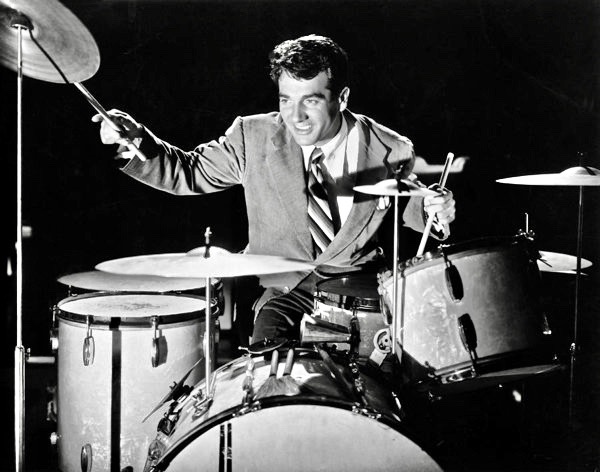
Well, I am always interested in discovering drumming roots. Gene Krupa was the first drummer to grab my attention when I was six years old. Later, through reading about Gene Krupa — including Krupa interviews — I discovered he revered Baby Dodds’s drumming. Krupa used to watch Dodds drum in theaters and nightclubs.
To a degree, Baby Dodds mentored Gene Krupa. Krupa studied Dodds by watching the elder man behind the drumset. And we know they were on speaking terms. In interviews, Krupa mentions drum advice he received from Dodds.”
“Baby taught me more than all the others — not only drum playing but drum philosophy. He did all that the others did, and more. He was the first great drum soloist. His concept went on from keeping time to making the drums a melodic part of jazz. It was partly the way he tuned his drums — the intervals he used. I got that from him. And it was partly his concept of tone. Baby could play a tune on his drums, and if you listened carefully, you could tell the melody,” said Krupa in Eight Lives in Jazz Combo U.S.A. by Rudi Blesh.
Of course, Dodds influenced other great jazz drummers of Krupa’s generation (i.e. Dave Tough and George Wettling) — and for this alone Baby Dodds matters.
I mostly admire Dodds’s press roll. Before drummers relied on the hi-hat, then the ride cymbal, as the dominant timekeeping elements of drumset playing, drummers used their snare drums. Played on a snare drum, the familiar ride cymbal timekeeping ding-dinga-ding was played as accents and press rolls.
Dodds’s recording career happened when live music recording was primitive. That’s especially so to ears accustomed to listening to modern digital music recordings.
There’s also a 1953 Dodds interview by Bill Russell, which was available on Chip Stern’s web site. In this interview, Chip noted, “Dodds shares his insights on the spiritual and human side of the percussionist’s art, in an impassioned soliloquy about how a drummer can learn to play for the benefit of the band.”
I first read this Dodds interview long ago and it remains one of most insightful pieces of drummer philosophy ever written. Dodds’s perspective, his advice, is timeless; as true today as it was in 1953 and before.
These are key reasons why Baby Dodds still matters.
Not bad for a young upstart Scott K. Fish, Special to the Piscataquis Observer • June 1, 2019
Since I am no longer employed at the Maine State House (1989-2012), I haven’t tried this experiment. But every now and then, while at the State House, I would take one workday and ask people:
If I ask you to name a famous drummer, which drummer first comes to mind?
As someone passionate about drumming, very familiar with the history of drumming and drummers — I was curious to know how drummers appeared to the outside world. That’s all. And asking legislators, lobbyists, visitors, staffers, to name a famous drummer, seemed an easy yardstick by which to measure.
A few people had no response, but most State House inhabitants I asked had, to me, a surprising response. The two famous drummers most often named were Gene Krupa and Ringo Starr. What surprised me was, Krupa was mentioned more often than Ringo.




You must be logged in to post a comment.