Neil Peart – If the Simple Dumb Thing Works Best

SKF CORRECTION: Learned users of DrumForum.com pointed out it is Steve Smith, not Neil Peart, playing drums on Jeff Berlin’s Subway Music. Neil plays on other tracks on the album.

It’s good to know the truth, and it’s good that the truth changes nothing about my comment to Neil in this post or about Neil’s answer.

I was sitting with Neil in his living room, about 25 years ago, when he played cuts from the Berlin album. The track I remembered had a shuffle rhythm with busy double bass drums. Subway Music seemed the likely song, but it’s not Neil.

SKF NOTE: During this interview Neil Peart defined “selling out” as playing drums “someone else’s way.” I mentioned Neil’s playing on Jeff Berlin’s album, Champion, specifically the song, Subway Music. To my ears, I said, Neil’s playing there doesn’t sound like the way he plays with Rush.

Neil’s answer is where we begin this excerpt.

Neil Peart: In a situation where there’s a musical empathy I’d bend to the needs of the song. The same as I’d give a Rush song a simpler part. I’d force myself to do it.

There’s a perfect example on Presto. The guys had written one song to a very simple plodding drum machine pattern. I tried everything, but nothing worked as well as that stupid lunkhead beat. If the simple dumb thing works best, it works best.

Philosophically I’ve quarreled my whole life with the less-is-more idea. I think more is more. A beautiful groove played simply is powerfully effective. I admire guys who can do that — plus. That groove is always present, but they have the chops and feel to go on top of it and spark songs.

Transitions are the weakness of many drummers who can lay down a nice feel and move to another feel. The points in-between are where a lot of people fall down. It’s still the thing on which I most focus.

Drummers I admire might play one fill in a song, but the way they set it up, every figure they play is flawless. When they get to that fill it has such impact.

I’ll never be a simple eighth note snare drum-tom-tom fill. Guys that play that well have too much class. A lot of R&B drummers are very exemplary of that quality; devoted to a simplicity of feel, but the rhythm they play needn’t be simple. The way they embellish it — end of measure figures, the big fill, a dynamic sweep into the midsection — that’s where their lights shine. That’s where a truly simple drummer could never rise above the simplicity.

I like hyperactive music that permits a lot of messing around, but still serves the music. Music is designed to be that way.

There are lots of Rush songs, like Tai Shan, that require a very sensitive, simple approach. Maybe a series of simple steps. Remembering them properly constructed, and putting them together, becomes very complex. Reproducing them as a single flow of music becomes the big challenge. As hard to play as any complex part.

Posted in SKF Blog | Tagged , , , , , , | Comments Off on Neil Peart – If the Simple Dumb Thing Works Best

Les DeMerle – Music vs Business

SKF NOTE: Les DeMerle asked me during his interview to ask him about music versus the music business. So I did. Les’s reply is still valid in 2020. The interview was published in Modern Drummer’s October 1984 issue.

Les DeMerle: There are so many guys in the circle of working players who go through a negative trip, in every instrument, not only drums. In fact, most of the time the drummers are the most up guys in the group.

You’re coming to music because you love music. I can remember the first time I ever saw a snare drum in a store window. I didn’t think about how many dollars I was going to make playing it. I just wanted to play the drum and play music.

If you can keep that attitude, no matter how successful or tough the times might be, that’s the core of the inspiration you need to keep the growth process going.

I understand that if you don’t work at all and you’re constantly banging your head against the wall — that’s tough. But the thing is, that even if you’re playing something that you don’t like musically — you’re still playing music and making a living. Today, that alone is an accomplishment.

And I see so many guys come to the gig with bad equipment and an attitude that says, “Aw, man. When is it going to be over?” And it shouldn’t be like that. They are their own fault. They’re making it harder on themselves when they think like that. There’s all this good music being played out there today and if you want to play it, there are ways to do it.

I hear my students say, Well we don’t have any place to play. I tell them to find a place in their neighborhood that has a bar or a backroom, and tell the owner that you’ll play for the door. Get guys that you want to play with and play the music you want to play. And if the music is good, somehow people will hear about it and you’ll attract people.

You’ve got to take those kind of shots. It seems to me that alot of guys want the glory, but they don’t want to do the work.

I’ll use Chick Corea and Chuck Mangione as examples. I remember getting flies in the mail every week from little holes in the wall in New York and Rochester where they were playing. I still have one of those fliers in my scrapbook for a band that included Chick Corea and Steve Gadd playing at a place called “The Other Side of the Tracks” — for the door money. No admission.

But they believed in what they did and now they’re able to sit back and pick and choose.

Posted in SKF Blog | Tagged , , , , | Comments Off on Les DeMerle – Music vs Business

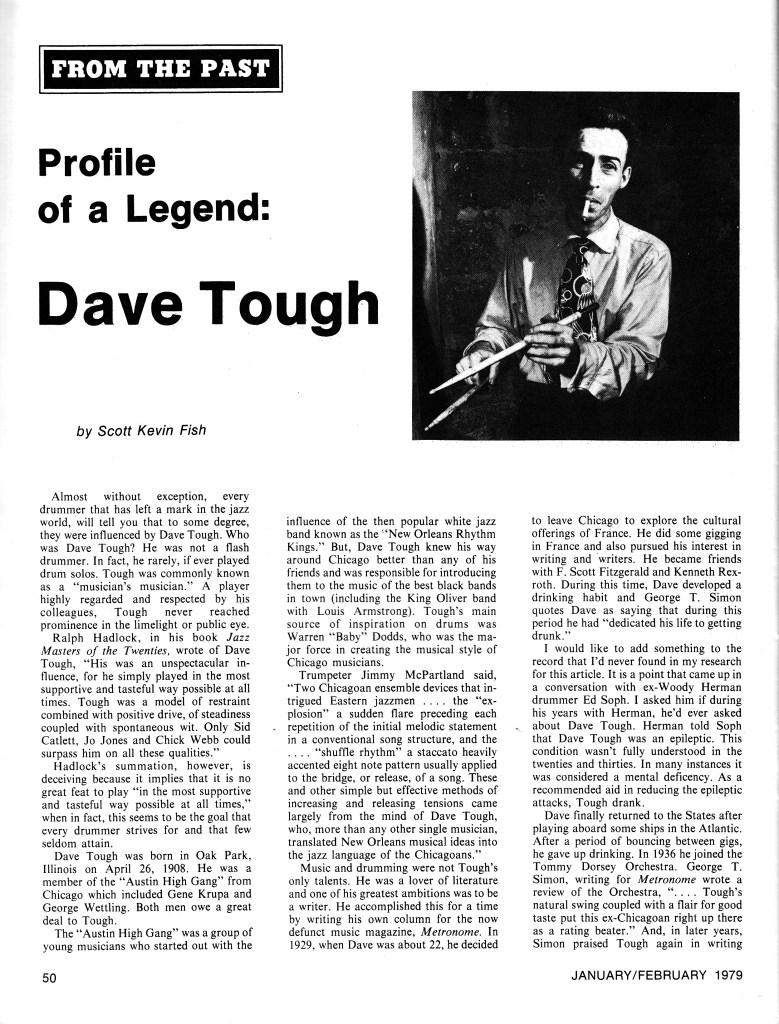
Three ‘Down Beat’ Quotes on Dave Tough

SKF NOTE: I used several written sources — as many as I could find — for my Modern Drummer Dave Tough profile. Last week I came across some of my resource notes, including these three quotes from different Down Beat issues.

  • “Just as the new boys dig and study the present greats, so were Chick (Webb), Baby (Dodds), Davey (Tough), George (Wettling), Sidney (Catlett), and Zutty (Singleton) emulated and idolized in earlier jazz eras.”

Source: Gene Krupa: What’s New?, by Dom Cerulli, Down Beat, March 20, 1958

  • “…Dave Tough…was credited with the most dynamic and sensitive use of cymbals and evolved from a career in small combos to a decade of great distinction with many name bands before his death in 1948.”

Source: Jazz Drummers: A History, by Leonard Feather, Down Beat, March 20, 1958

  • “I remember Davey Tough,, who couldn’t even play a solo, but Davey used to go brr-ipp boom bam, but it was so well placed in juxtaposition with the rest of the music, it was just right.”

Source: Shelly Manne in a round-table interview, Drum Shticks, by Harvey Siders, Down Beat, March 15, 1973.

Posted in SKF Blog | Tagged , , , , | Comments Off on Three ‘Down Beat’ Quotes on Dave Tough

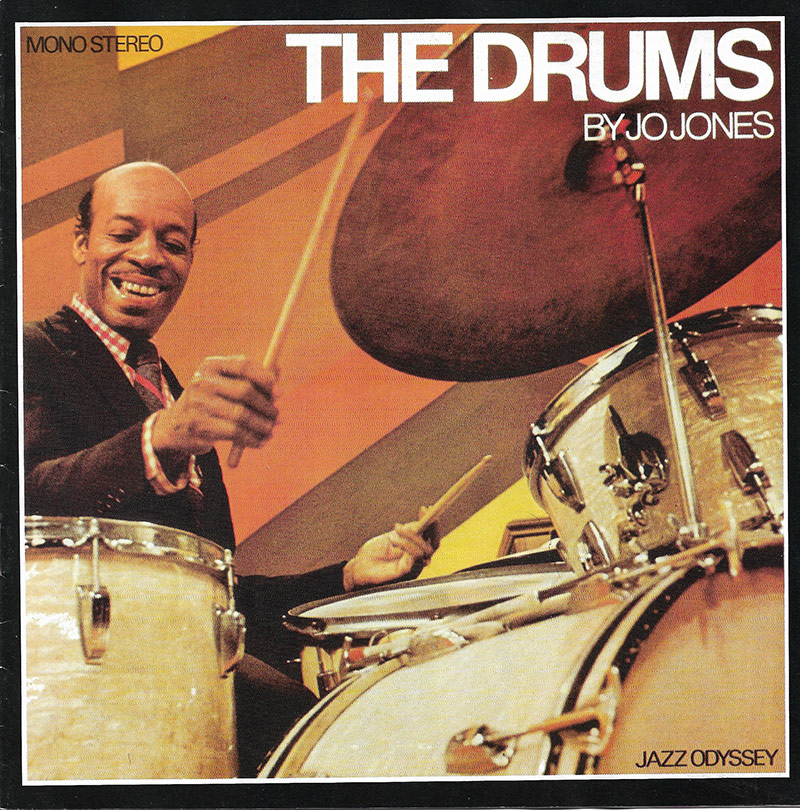
Papa Jo Jones – To Become a Good Jazz Musician

SKF NOTE: Words of Papa Jo Jones wisdom I highlighted in my copy of Rifftide: The Life and Opinions of Papa Jo Jones. Timeless. In my experience it’s easy to lose track of the spiritual piece of drumming/music, while lost among licks and the search for the Holy Grail of snare drums and ride cymbals.

Papa Jo Jones: “To become a good jazz musician, you must try to hear and see things that are beautiful. Be like a sponge; absorb experience and play it. Music is therapy for people, and the most stimulating music there is is jazz. It is also the most spiritual of all the musics-a delicate thing. You can’t play it unless you have found yourself and it takes time to find ourselves.”

Source: Rifftide: The Life and Opinions of Papa Jo Jones, by Papa Jo Jones, Paul Devlin, Phil Schaap, Albert Murray

Posted in SKF Blog | Tagged , , , | Comments Off on Papa Jo Jones – To Become a Good Jazz Musician

Jim Gordon – Full Interview – Tape B Side A – The End

SKF NOTE: This is the third and final segment of my interview with Jim Gordon. I posted the back story, the genesis, of this interview, on my blog.

This interview with musician Jim Gordon took place January 11, 1982. That makes it 38 years old. Yes, I’ve posted on my blog audio and written excerpts from this interview. An edited version of the interview transcription appeared in Modern Drummer magazine.

But this is the first time I’m making available my full, unedited interview with Jim Gordon. I think it’s time. Jim Gordon is an important piece of pop and rock music history. He is a key part of drumming history. And as far as I know, 38 years later, this is the only full-length Jim Gordon interview in existence.

Looking back, I wish I had more time to prepare for this interview. Those of you who read the back story will learn I didn’t have more time. On the bitter cold night of January 11, 1982, in my room in a Nutley, NJ rooming house, my phone rang unexpectedly. Jim Gordon was calling.

So began this interview. I would only add here one more point. The tapes do not run seamless from tape to tape. That’s due to my having to stop and flip the tapes in my cassette machine. At the end of this last segment I’m sure I caught myself mid-sentence because I intentionally pushed the stop button.

Posted in SKF Blog | Tagged , , , | Comments Off on Jim Gordon – Full Interview – Tape B Side A – The End