SKF NOTE: For years now I’ve had on a hard drive a digitized version of one of my Neil Peart interviews. The sound volume of the initial tape transfer was very low. Consequently I’ve never been able to use it.
On a related topic: I sent Gary’s daughter, Kat, an email on June 29 of this year. I remembered my last meeting with her dad, Gary Chester, and I wrote her about it. “The last time I saw Gary we were in Suffern, NY. He asked me to ask Neil Peart if Neil played heels down or toes down,” I said.
Kat replied the next day. “That’s funny. And did you? A student posted on FB he was in his lesson once and neil called and this student said he heard dad and neil talking. I wasn’t aware they knew each other. We’re you?”
“Yes, I did ask Neil,” I wrote back to Kat, same day. “He [Neil] said he plays toes down, to which your dad said, ‘I knew it.’ No, I didn’t know if Gary and Neil knew each other. It’s possible, at Gary’s request, I gave Neil Gary’s phone number. Or Neil may have gotten the number elsewhere. But that’s just my educated guess.”
Back to my low volume digitized Neil interview. I came across it yesterday while transferring photos to an external hard drive from my laptop. On a whim I opened the Side B wav file using WavePad Masters Edition audio app. Low and behold! I was able to amplify the sound and remove some its background noise.
I placed my cursor on a section of the interview and, no kidding, it was Neil answering what sounded like Gary Chester’s bass drum questions. I scrolled back a bit and found me actually asking Gary’s question. Enjoy!
[SKF NOTE:July 12, 2021 – Ed Soph spotted this blog post and was kind enough to fill in its blanks. Ed writes, “The book I mentioned in this interview is by George Kochevitsky and is titledTHE ART OF PIANO PLAYING. It is still in print. He died in 1993 at the age of 90. Check out his obituary in the New York Times.
“I never wrote the book predicated on sound associations. The book that I did write, that you mentioned in your preface, has more practical applications to learning jazz “coordination” based upon dependence as well as independence. I wrote it for the marimba and drum line folks whom I taught and the results were truly revelatory.”]
=====
SKF NOTE: Include the date and location on interview transcriptions. That’s a bit of advice I can pass along to music writers. In my earlier years interviewing musicians, mostly drummers, I was generally good about dating the interview cassettes with the subject’s name and the interview date. Rarely did I write the interview location.
That policy carried over to my typed transcripts. Forty years after the fact I often have to scramble to pinpoint an interview date.
Such is the case with one typed transcript of an Ed Soph interview I’ve pegged as taking place in 1985. From my editing on the transcript, this post’s entire section wasn’t included in the published interview. That surprises me. Reading it today it strikes me as full of drum insight – which was always in abundance during conversations with Ed Soph.
Two caveats to this post. In putting it together, I was unable to find the book, 200 Years of Piano Technique. If I can locate the interview cassette maybe I will now be able to identify the author. I was unable to when I transcribed this tape almost 40 years ago.
Which brings up another tip for music writers. When you don’t understand something the person you’re interviewing says, ask them to clarify. Sometimes I didn’t do that. Either I didn’t want to appear ignorant and/or I assumed I would be able to figure it out during my tape transcribing.
Ed Soph: [T]here was a guy who wrote a famous book called 200 Years of Piano Technique. He documented all the different schools of technique that had been taught since the time of [Ferruccio] Busoni – who’s probably the first great [piano] teacher.
I realized that all of this was very similar to the same sort of categorization that’s been going on for years with drum technique: finger technique, wrist technique – all of these things. And no one looking at the arm as being what it is: one big machine.
That’s the way we all use it when we’re doing something that we’re not thinking about. You don’t think about using finger technique to turn a doorknob. So, that got me to think about drum technique and the approach to motion studies.
Like everything else I thought I’d really discovered something, until I started talking to other people about it, and realized that people have been hashing this over for years. As long as people have been playing the instrument.
There’s a lot of things tied into this, like the Alexander Technique, which is a posture study.
ES: Yeah, similar. George’s book is the same thing, but he comes at it from a different direction. He ties it in with Tai Chi.
The Alexander Technique is about body alignment. Technical considerations, the way of approaching the instrument, has to do with motion studies because that’s how you produce the sound out of it.
I’m using these ideas to write a book that will be comprised of simple exercises that deal with sound association.
What sound do you associate with your right hand on the drumset?
SKF: The ride cymbal and the floor tom.
ES: Thank you. And what role do you associate your right hand with on the ride cymbal?
SKF: Timekeeping.
ES: Okay. In other words, in one way or another [the right hand] plays the quarter note pulse, right? And your left hand does what? Say, in a bebop style.
SKF: Accompaniment.
ES: Right. Syncopated, right?
In a simple exercise, in which those roles are reversed, and the quarter note is played with the left hand and the syncopation is played with the right hand on the cymbal – you won’t be able to play it at first. Simply because of the sound associations.
In a nutshell, my book is about a combination of motion studies and the breaking down of sound associations. Sound associations have evolved through stylistic considerations.
If a person plays rock ’n’ roll he associates, usually, the bass drum on down beats and the left hand with the back beat – depending on what kind of rock ’n’ roll he’s playing.
And a person who was raised on Chapin [Jim Chapin’s Advanced Techniques for the Modern Drummer] – a la bebop – is the right hand pulse timekeeper, left hand syncopater, and all that stuff.
The idea is to break it down so that we can hear the set however we wish.
SKF: How is that different from the four-way independence technique?
ES: They never dealt with sound associations before.
SKF: Wasn’t the four-way independence concept designed so that a drummer could play anything any way?
ES: I don’t think so. And as far as I’m concerned there’s never really been a four-way coordination book. Inner Drummer, [Marvin] Dahlgren and [Eliot] Fine [4-Way Coordination], approach it. But it’s much too dogmatic.
Four-way coordination can be approached mechanically – which has been done. But it needs to be approached musically, which is what Marsh has done, and what I want to do.
By musically, I mean using it as a means for improvisation and not just playing exercises. That’s the whole problem with most drumset books. They only take you so far. They teach you how to play through your eyes because you’re reading everything, and they don’t teach you how to play through your ears – which is the ultimate goal in playing the instrument. Improvising. That is, unless you have the misfortune of being in a Top 40 band and you’ve got to play like the records.
And you learn to improvise musically in the same way that we’re improvising verbally. If we associated only certain words with certain subjects we’d be very limited in the way we would speak. We wouldn’t be able to draw metaphors or anything like that.
SKF NOTE: In 1981, when I interviewed Paul English for Modern Drummer, I was early into my self-study of country music. This was a music that, at its inception, and for many years after, didn’t use drummers. In many instances, country musicians wanted nothing to do with drummers.
That situation had changed, of course, by the time Paul English started playing with Willie Nelson. My intro to Willie’s music happened much earlier, but it was his Stardust album, released in 1978, that really caught my attention. The album is a combination of great American songs played beautifully, uniquely, by Willie’s country band – including drummer Paul English.
When I heard Willie Nelson was performing in New York City, I was successful in securing a phone interview with English. Then I met Paul and Willie in NYC and saw their show. Willie used two drummers then: Rex Ludwig and Paul, which was disappointing. Ludwig played much louder, too often drowning out the more subtle drumming of Paul English.
In my introduction to Paul’s MD interview I wrote, in part, No drummer can play Willie Nelson’s music better than Paul English because Paul’s drumming is a great part of Willie’s music. You can hear the empathy, the craziness, and the love. Paul’s and Willie’s musical relationship somehow always reminded me of the same type of relationship between drummer Sonny Greer and Duke Ellington.
Finally, I know wooden brushes are readily available in 2021. But the first time I heard of them was from their inventor: Paul English.
=====
Paul English: See, I play with mallets, brushes, sticks, and I play with wooden brushes.that nobody has ever heard of because I made ’em!
Scott K Fish: What are wooden brushes?
PE: You take some little bitty dowels. Wooden dowels. Take about 15 or 20 and cut them off the length of the stick and glue them all together in a circle. Wrap some tape around them and file the ends off. They’re only about a quarter-inch in diameter. Then you have your set of wooden brushes!
I used them on On the Road Again ’cause I’m playing 16th-notes with a syncopated accent.
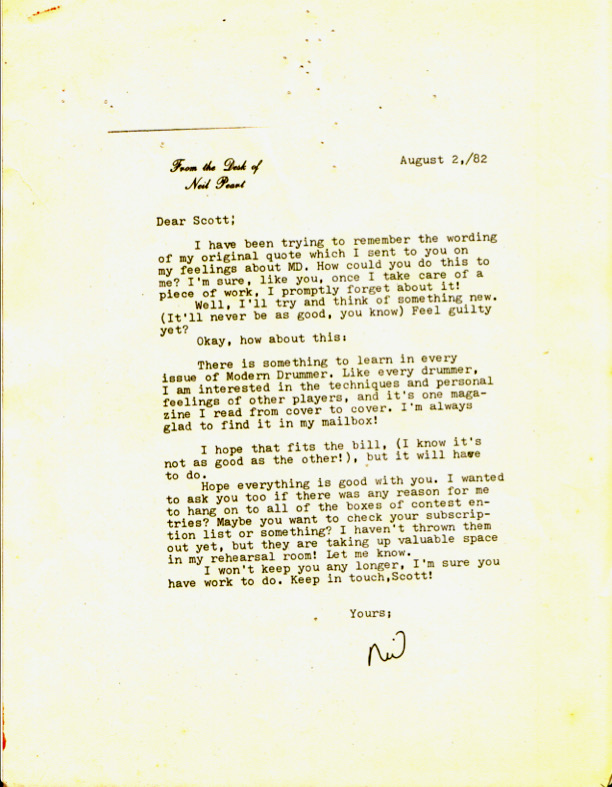
SKF NOTE: It’s clear from Neil Peart’s letter that I lost his first “quote” meant for use in his Who Reads Modern Drummer? ad. Yikes! But Neil’s response was gracious.
I don’t remember if we — Modern Drummer — requested back the 1982 Neil Peart Drum Giveaway contest entries. But it’s interesting Neil thought enough of the contestants to ask about preserving their entries.
SKF NOTE: One night at a club in Illinois, back when I was earning a living as a drummer, musician friends and I were checking out the band. This was not a name band. It was a lounge band traveling a circuit, probably, of short stints at different Midwestern venues.
The only bit of music I remember from that about 47 years ago? During a ballad, the drummer gently dragged the loop on the wire end of his brushes straight down, from just below the cymbal bell to the cymbal edge.
I had never seen that before. What a great sound effect. I’ve used it countless times since.
And it taught me that, in almost every musical situation, even the mostly lame musical situations, if I keep my eyes, ears, and mind open — there’s always at least one good takeaway.




You must be logged in to post a comment.