http://www.rockcellarmagazine.com Neil Peart of Rush: The World’s Audience (The Interview) Written by: Marshall Ward – December 2014
RCM: What motivates you to write?
NP: The desire to share. And I love the tools of writing. I’ll draw a drumming comparison there, drumming is about communication also and trying to move people, and the tools of it are the drums. And I have the same fascination for words as tools as I did since I was a child, from crossword puzzles to reading.
Scott K Fish Audio Letter to Friend, Bob Baranello, about the drum lesson with Max Collie’s Rhythm Aces.
I lived in Davenport, Iowa from 1971-73, earning a living drumming and singing with the Millard Cowan Trio, first at the Holiday Inn in Bettendorf, Iowa, and later, at Millard’s own Davenport club, The Steamboat Lounge.
Davenport hosts the annual Bix Beiderbecke Memorial Jazz Festival on the banks of the Mississippi River. Davenport is hometown and burial place for legendary jazz cornetist, pianist, composer Bix Beiderbecke. The Festival is a gathering of traditional jazz bands – what some might call Dixieland jazz bands.
One year I spent as much time as I could at the Bix Festival, wanting to learn more about playing traditional jazz. To me, age 21, it was mostly guys in straw hats, white pants, and red-and-white striped shirts playing old-timey tunes.
But, I was awestruck by a band of Australians and Brits – Max Collie & the Rhythm Aces – playing one morning on the back of a flatbed truck parked on a street in downtown Davenport. These guys looked like a rock band. But they played traditional jazz with authenticity and heart, in my opinion, far better than any other band at that year’s Beiderbecke Festival.
The Rhythm Aces drummer, Ron McKay, played the traditional snare press roll dominant style as if it was brand new. He swung like mad. Here’s the same group in Germany. On this tune, McKay is relying on his ride cymbal. My memory of him at the Bix Beiderbecke Fest is more his brilliant snare drumming.
The bassist shown in the video above soloed with a slap bass style much like Milt Hinton with Cab Calloway’s big band. This old music was new to me, and I loved it!
One night, Davenport’s famed Hotel Blackhawk held a jam session in huge room – which was really a giant dance floor, packed with Festival goers. Max Collie, a trombone player, was leading the session. Drummers were using a white pearl Rogers four-piece drumset.
One song ended. Musicians were talking about what to play next. No one was stepping up to play drums. I turned to a friend, a tuba player, and asked, “Is it okay if I play drums?” “Yeah. Go for it,” he said.
Sitting on the drum throne, looking on the side of the snare drum for the snare strainer, I found a gold plaque engraved: Custom Built for Louie Bellson by Bob Grauso. Bellson grew up and started his career in Moline, Illinois, right across the Mississippi River from Davenport. So, I’m thinking, “I’m playing Louie Bellson’s drumset?” Yikes!
I decided, whatever song they chose, I was going to play straight-ahead, supportive of the front line musicians. I was going to play nothing meant purely to attract attention to myself.
Max Collie counted off the tempo and away we went. I don’t remember the song, but I remember keeping my eyes and ears on the front line horn players. At one point, Max Collie turned, looked at me, and motioned me with his hand. “Oh no,” I thought. “He wants me to take a solo when the next chorus comes around.”
Sure enough, at the start of the next chorus all musicians stopped playing. I broke into a floor tom solo, my best traditional jazz impression of Gene Krupa. A few measures in, I looked up. Max Collie and several horn players were looking at me, shaking their heads in disgust and/or disbelief.
Collie, it turned out, was motioning for me to stop playing when the chorus came around so he could solo on his trombone. I stepped all over him!
I felt miserable. Now, I look back on that night and smile. I was there to learn how to play traditional jazz — and that’s exactly what happened.
SKF NOTE: Revisiting the transcript of my early 1980’s interview with Joe Morello today. Five or six times Joe Morello said some things about Buddy Rich which were new to me. I also found Joe’s remarks instructive and/or funny. I posted the remarks separately. This is the last one. Links to the first three are at the end of this post.
Joe sat through our entire interview with a pair of drumsticks, sitting near a coffee table on which he had a practice pad. In upcoming posts, Morello demonstrates points he was making about Buddy Rich’s playing. Joe did so playing on his practice pad.
Joe Morello: Buddy always seems to come up in the conversation…. But, when he was with Dorsey…, Buddy…would go to 52nd Street [in New York City] and Sid Catlett was playing there. He’d ask Buddy to sit in, and Buddy would get up and go [JM plays some fast licks].
Old Sidney would get up there and – he was so heavy – he’d just do a little drum thing, leave a lot of holes and things, and it use to frustrate the s**t out of Rich. He use to wig out. He’d be playing across the street doing all his gyrations, y’know.
….Buddy was just a young guy, maybe 27, and making a little name. He was always trying to get Krupa’s reputation.
IN PROFILE
Japanese drumming workshop encourages rhythm, expression
Taiko drumming a route to free expression
By Caitlin Andrews – Posted Dec. 11, 2014 @ 1:23 pm
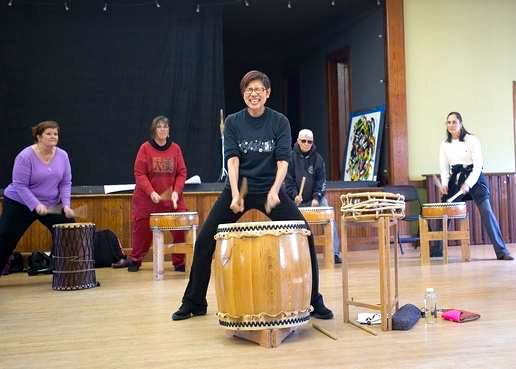
Elaine Fong, of Brookline, Mass., stands calmly at her byou-daiko – one of the many types of taiko drums – beating out a basic rhythm. Around her, 13 members of her Taiko Drum Workshop…are keeping time….
There’s a steady wall of noise….
For Fong, the…discovery of taiko, a style of Japanese drumming, during a festival was the start of a lifelong fascination.
“[I]n the 1980s, I was…near a stage, where there was some music and dance. …I heard a boom from the stage.”
…Fong…saw…10 or 12 drums, beat mostly by Asian women, played together to create a massive sound. It was something she had never seen in her life.
“It unblocked something in me, inspired me,” she adds. “It was like they were giving voice to who they were. It just spoke to me.”
…Fong went to an open audition for Soh Taiko, the group she had witnessed at the festival.
Since then, taiko has been a way of life for Fong. She created her own group, Odaiko New England, or ONE, as she likes to refer to it, in 1994….
Fong says one of the attractive aspects of drumming for her is the chance for expression – especially for women.
“It’s interesting – there are around 150 to 200 taiko groups, and most members are women.”
Fong feels women often have a difficult time expressing themselves…. Taiko…can be used as an outlet.
“I have a philosophy: I look at people who say they have no rhythm, and reply, ‘You spent the first nine months of life in the womb, hearing your mom’s heartbeat, so you actually have a lot of rhythm. There’s a key that unlocks the door; humbly, I would like to give you as many keys as possible.”
SKF NOTE: I thank Mr. Richard Brody for bringing to my attention two CD’s and one bit of news unknown to me: We may yet hear more of Elvin Jones with the classic John Coltrane Quartet, there is unreleased Tony Williams with Miles Davis’s Second Great Quintet, and unreleased Philly Joe Jones with the Red Garland Trio. Merry Christmas, indeed!
The New Yorker – DECEMBER 9, 2014
The Best Jazz Reissues of 2014
BY RICHARD BRODY
The archives are still full of inaccessible treasures. Ben Ratliff, in his book on John Coltrane, reports that eighty-six CDs’ worth of live recordings of Coltrane from the early nineteen-sixties are locked up in Verve’s vaults.
=======
Another Davis issue, of a May 21, 1966, concert from the Oriental Theatre in Portland, Oregon… features the mid-sixties quintet (with bassist Richard Davis, in place of Carter). The music is acoustic and very free. Williams had played with the saxophonists Eric Dolphy and Sam Rivers, and he pushed the band toward an oceanic, pulse-free swirl that came to the fore when the young bandmates Shorter and Hancock soloed. Though Williams snapped into rhythm for Davis, it was one of wide-ranging, impressionistic broadness, with shimmering cymbal-smacks and tom-tom rumble pushing the beat into uncharted territory.
=======
Miles Davis’s first stable working band, a [1955] quintet..,, featured John Coltrane.., …Philly Joe Jones, and…Red Garland, whose distinctive style, with bouncy chords chimed out by his interlocked hands, lent the earnest and even brooding band a sideline of warmhearted relief. A new release, coming January 20th, “Swingin’ on the Korner” (Elemental Music), features Garland and his trio from December, 1977, at San Francisco’s legendary Keystone Korner…. Garland is in astonishing mettle here…. What’s more, he’s accompanied by Jones and the bassist Leroy Vinnegar, and their chemistry is passionate. Jones…matches Garland in inspiration and enthusiasm….




 release, coming January 20th,
 Scott K Fish
You must be logged in to post a comment.