
SKF NOTE: This ad is on the inside back cover of the November 2, 1967 Down Beat. I’ve always loved this photo.

SKF NOTE: This ad is on the inside back cover of the November 2, 1967 Down Beat. I’ve always loved this photo.
Ludwig‘s Facebook post today commemorating the company’s 400 Supra-Phonic Snare Drum reminds me of story involving drummers Jimmy Madison and Joe Morello. Madison told me the story during our interview which was published in the October 1982 Modern Drummer.
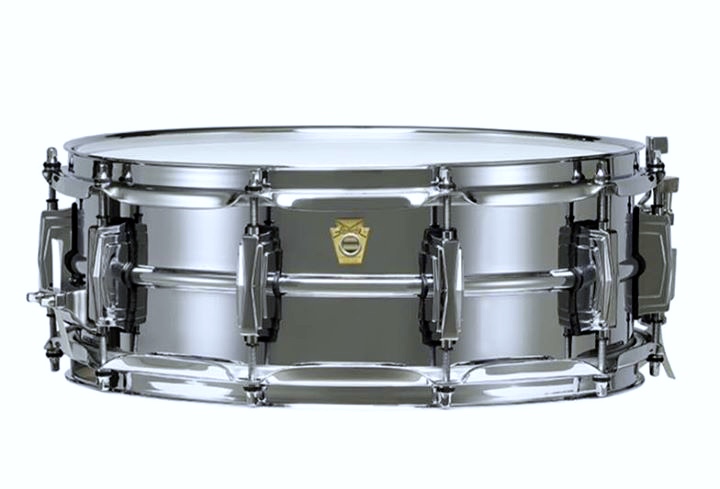
Madison was a kid living in Ohio. The Dave Brubeck Quartet was set to appear at a local fair. Jimmy was very excited at the chance to hear and see Joe Morello.
Madison arrived at the fair stage in time to see Morello setting up a drumset. As I recall the story, it was a rental set. I think Joe’s drums were lost in transit. Jimmy said the rental snare was dead-sounding and awful. He watched Morello trying without success to adjust the drum so it was playable — and then Madison approached Joe Morello.
Madison told Joe Morello he had just acquired a Ludwig snare exactly like the snare Morello normally used. It was a present, I think, from Jimmy Madison’s parents. Madison offered to loan it to Morello for the show. He lived close by and, said Madison, it was no trouble to go get his drum.
Morello accepted the offer, played the gig on Madison’s snare. It was a win-win. Plus, Jimmy told me, he had the bonus of owning a new Ludwig snare drum used in concert by Joe Morello.
Which reminds me: Whatever happened to Jimmy Madison? He was a super nice guy and a top-shelf player.
– end –
SKF NOTE: It was Hal Blaine, I think, who recommended I speak with drummer Jesse Sailes when I was writing Modern Drummer’s History of Rock Drumming. I knew Jesse Sailes only from one B.B. King album. Hal, among others, said Jesse was one of the early pioneers of rock drumming.
This is a phone interview transcript. I hesitate to post it because, from my perspective as the interviewer trying to get background material from Mr. Sailes –this interview did not go well. That’s clear from Sailes’s first two answers. I was hoping to hear details of Jesse Sailes’s career as a studio drummer.
When I knew that wasn’t going to happen, I improvised. I had almost zero background info on Sailes, making it a click above impossible to see if I could get him to be more talkative by asking questions specific to his work in the studios. But finding out specifics about his work in the studios was precisely the reason for the interview. Catch 22!
So here is a very uncomfortable Scott K Fish interview circa 1981. I did notice while retyping this transcript that Jesse Sailes mentions a West Coast studio drummer, Dave Mills. That’s a new name to me. I’m sorry I apparently didn’t follow up on Dave Mills with either Jesse Sailes or anyone else.
———

Jesse Sailes with Daniel Glass. Photo Credit: Daniel Glass. http://danielglass.com
Scott K Fish: I wondered if you could run down for me some of the things that you were involved in in the late ’40s and ’50s.
Jesse Sailes: Oh Lord! That’s really hard to do.
SKF: Maybe some of the key records you were on?
JS: Wow! Offhand I really couldn’t tell you. One of my big things was The In Crowd with Dobie Gray. I did lots of stuff with B.B. King. It’s just hard to think of everything right now.
SKF: I can understand that. Were you involved mostly in playing with bands or groups?
JS: I was doing mostly recording around that time. And in ’54 I joined Teddy Buckner‘s band.
SKF: You’re still with Teddy Buckner, right?
JS: Oh yeah. We’re working out at Disneyland now.
SKF: So, you’ve been with him since 1954. You’d better be careful. That’ll turn out to be a steady gig!
JS: It’s just liable to! Yeah. We’ve been out to Disneyland going on 14 years now.
SKF: What years were you active in the recording studios?
JS: From about…. I started really around ’54 to ’61 or ’62, doing quite a bit.
SKF: Were you on the West Coast or in Chicago?
JS: The West Coast strictly. As long as I’ve been playing I ain’t never done no traveling. The furthest I’ve been was to San Francisco with Teddy’s band. Went there for three months, and then again for two weeks. That’s all the traveling I’ve done since I’ve been playing music.
SKF: Can I ask you what kind of music influenced you when you first started playing?
JS: All of it. I wasn’t into no one thing. I was studying all of it. In fact, when I started playing it was mostly swing. Then when the trend changed, I went on with the change.
SKF: So you were involved with a lot of blues and rock and roll?
JS: Yeah.
SKF: Did you like playing that music?
JS: Oh yeah! It was very interesting.
SKF: Was it a tough transition for you?
JS: No! Once you’ve studied it’s not hard to get into what’s happening.
SKF: How did you first run into Hal Blaine?
JS: Oh, we met in the studio.
SKF: Are you about the same age as Hal?
JS: No, I don’t think so. I think I’m a little bit older than Hal.
SKF: What do you feel was the drummers’ contribution to rock music of the ’40s and ’50s?
JS: That was the whole thing. Getting that beat going. Because that was what made the thing go. The rhythm. The drummer. That was really what made the rock deal go.
SKF: How many drummers on the West Coast, at that time, could make the change to rock?
JS: When I was coming up there was quite a few of us. Sharkey Hall, Dave Mills, Hal Blaine, Earl Palmer. Those are the maine ones. We were doing nearly all of the stuff.
SKF: You can’t remember what groups you recorded with?
JS: Well, here’s what I was doing. They’d call me into the studio to do a session. I really didn’t know who the group was. I’d just do the session and that was it.
SKF: Just a lot of ghost drumming for different guys?
JS: Yeah.
SKF: Did the recording scene change….
JS: Yeah, it started changing because a lot of groups started coming in with their own rhythm section.
SKF: So, from ’54 to ’61 how did the recording scene change?
JS: Well, some rhythms changed, and beats changed. You were always looking for new ideas to make things go. Rhythm things changed as time went by.
SKF: Did you work with charts or mostly by ear?
JS: Oh yeah, charts. Sometimes they’d just bring a sheet in and say, “Take it from there and see what you can come up with.”
SKF: B.B. King worked with charts?
JS: B.B. had nearly all charts. You rehearse in the studio. You run down the chart two or three times and then made a take.
– end –
Beatle’s Ringo Starr drums up a new job
WITH a personal fortune of £180 million he doesn’t need the money but the 75-year-old Beatle’s new TV ad is hardly his first commercial starring role.
By DOMINIC UTTON
PUBLISHED: 08:09, Thu, Aug 27, 2015 | UPDATED: 08:23, Thu, Aug 27, 2015

Ringo and family.
“I love to be relaxed,” Ringo says. “I don’t know why people think because you’re a well-known pop star that we relax differently. We don’t.
“We hang out at home, have dinner and go to the movies.
“I like to sit on a beach in the sun and listen to waves. But you can’t do that every day, can you?”
In the 1980s Ringo’s struggles with alcoholism led second wife Barbara Bach to write about their hard-living lifestyle in the book Getting Sober… And Loving It .
Ringo later described that time in similarly bleak terms: “It gets really lonely, you know? It’s just really cold and lonely. It’s a miserable disease in the end.
“There’s a crowd of you and it’s lonely. Because that’s all you’re doing is getting p****, you know?”
In 1988, however, he straightened out, sobered up and concentrated on music.
[S]ince recovering from alcoholism [Ringo] has recorded another nine [albums] – six since the turn of the millennium alone.
With the release of his 18th album Postcards From Paradise this year he has overtaken Paul McCartney for solo records and in April his fortune was estimated at £180 million.
SKF NOTE: An interesting piece in this morning’s news. Some drummers listed are new to me — always a pleasure! The full story includes all the songs. You can listen to the beats and read backstories to all the songs. Some of the drummers aren’t listed. Thank you in advance to anyone who can correctly fill in the blanks.
These are the breaks: 10 of the most sampled drum beats in music history
By Corbin Reiff@corbinreiff
Aug 26, 2015 12:00 AM
Drum breaks: Those small patches of space within a song where the singer shuts up, the guitarist backs off, the bass rumbles down, and the percussionist is given a moment or two to shine. Before the rise of sampling, those moments were merely considered artistic flourishes, necessary bridges, or just breathers from the mayhem swirling around the kit. Afterward, they became essential building blocks for some of the greatest music ever recorded. Below is a collection of some of the most widely sampled drum breaks, with just a few of the songs that feature them.
1. Led Zeppelin, “When The Levee Breaks” (1971) John Bonham
2. James Brown, “Funky Drummer” (1970) Clyde Stubblefield
3. The Winstons, “Amen, Brother” (1969) G.C. Coleman
4. Melvin Bliss, “Synthetic Substitution” (1973) [No drummer listed]
5. The Honey Drippers, “Impeach The President” (1973) [No drummer listed]
6. James Brown, “Funky President (People It’s Bad)” (1974) Allan Schwartzberg
7. Mountain, “Long Red” (1972) N.D. Smart
8. Billy Squier, “The Big Beat” (1980) Allan Schwartzberg
9. Kool And The Gang, “N.T.” (1971) George “Funky” Brown
10. Lyn Collins, “Think (About It)” (1972) [No drummer listed]

Life Beyond the Cymbals
A Blog about Music and Popular Culture
Online Drum Tracks | Drum Recording | Remote Session Drumming | Pro Session Drummer
Life Beyond the Cymbals
Writing About and Reviewing Classical Music and Jazz
Life Beyond the Cymbals
A Drummer's Look at Drums and Drumming
 Scott K Fish
You must be logged in to post a comment.