SKF NOTE – My recorded drumming/singing output is quite small. I have a few tapes of me playing in The Steamboat Lounge in Davenport, IA on my YouTube page.
I have a 45-rpm of a tune called “Slave Girl,” written by my high school friend, Neil Ralph. That song is loosely based on George Harrison’s “Tax Man.” We recorded “Slave Girl” for our high school arts album at CBS Studios in NYC.
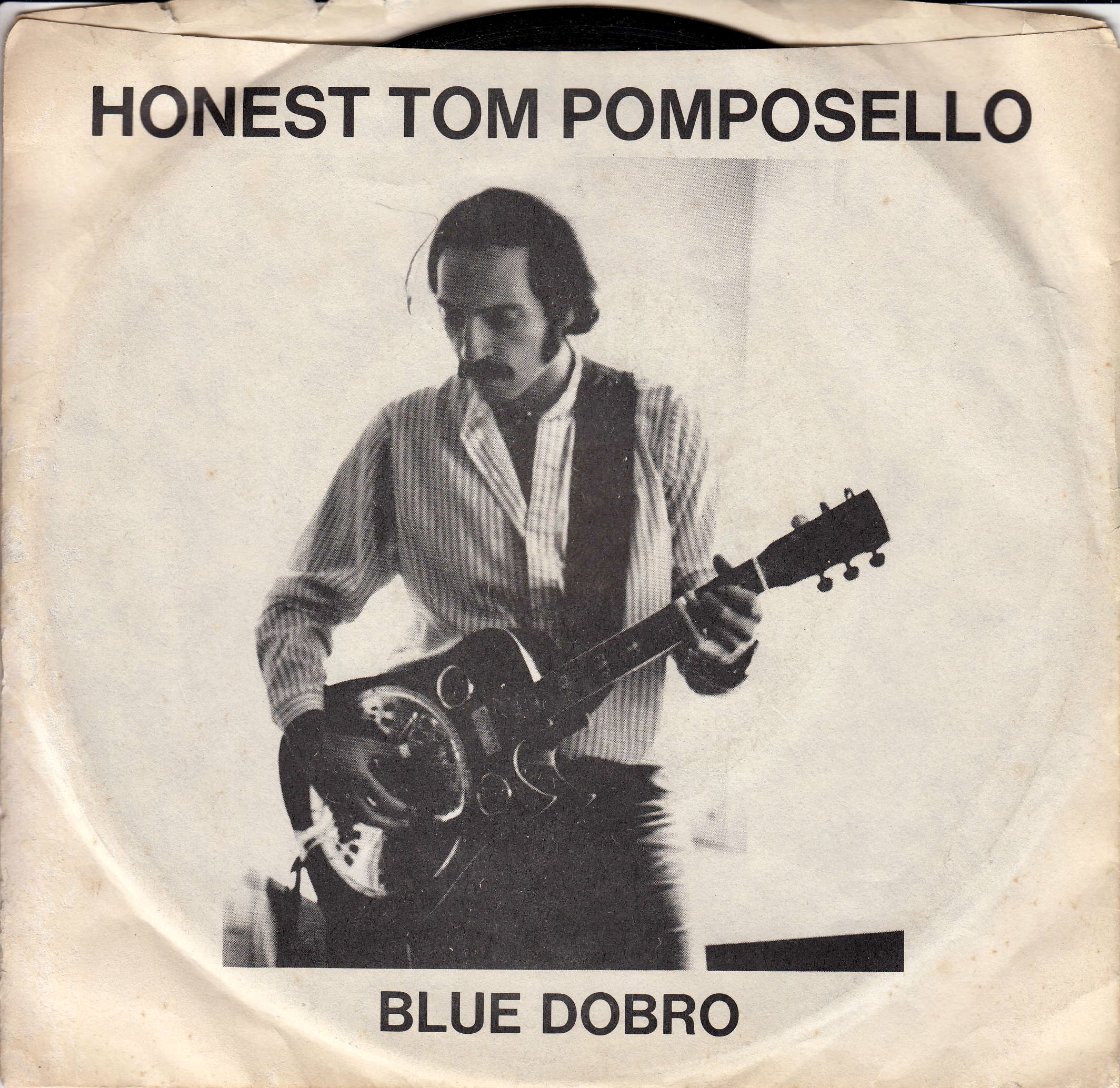
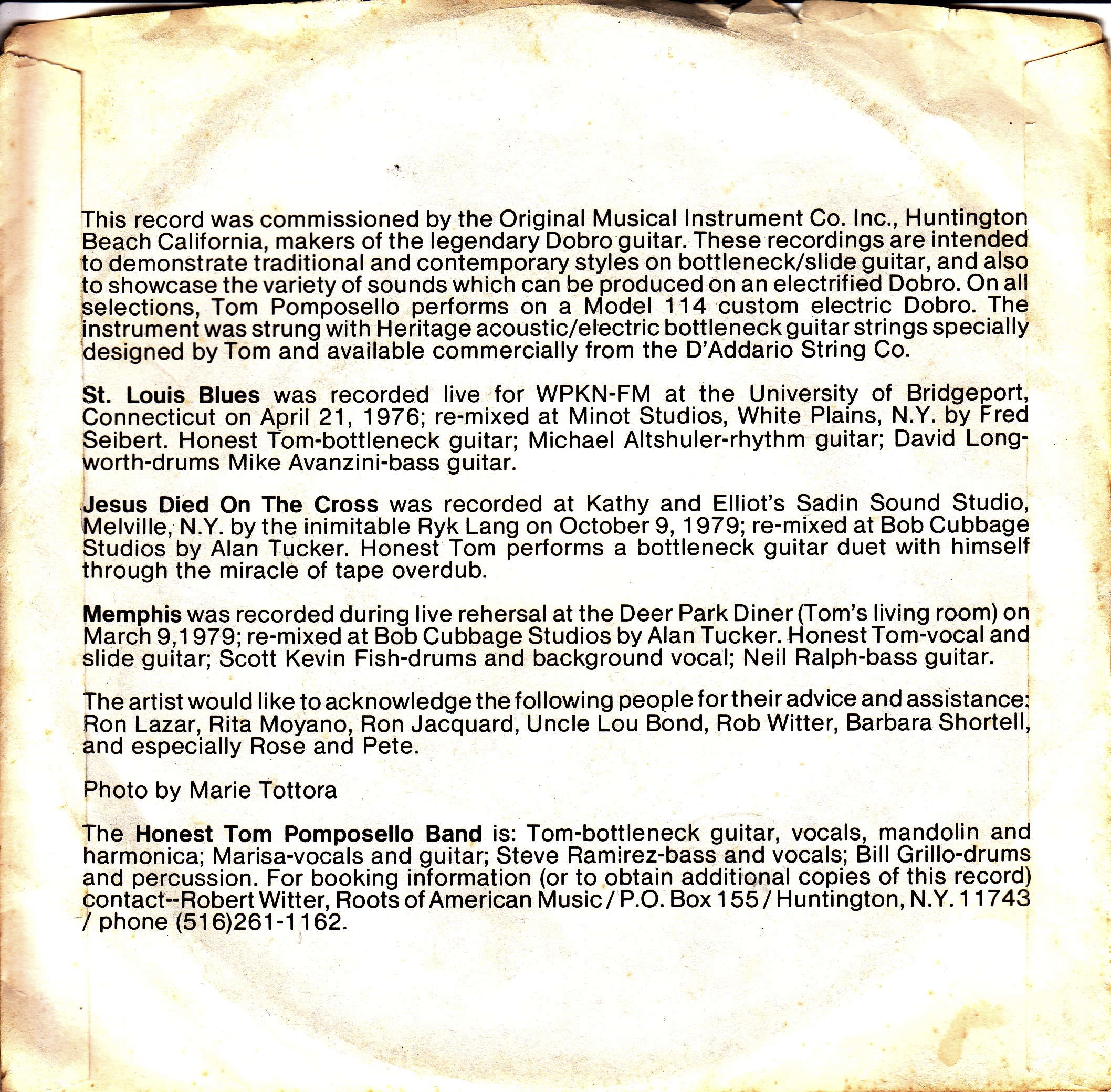
And then there’s my one track, “Memphis,” on this EP with Honest Tom Pomposello. Neil Ralph is on this track too, playing bass. I joined Pomposello’s band soon after arriving back on Long Island, NY from my gigs with Millard Cowan in Iowa.
Tom was a good friend. I learned a ton from him about Blues and Country music. He would introduce me on the bandstand, tongue in cheek, as “Scott K Fish, the great Blues drummer from Davenport, Iowa.”
When I can get it together I will digitize my track from the “Blue Dobro” EP and upload it for listening.
SKF NOTE: As interesting as it was swapping stories in person and through letters with Neil Peart about drummers, drums, and drumming; sharing stories about writing and writers was equally enjoyable and informative.
Neil read all the time. He may have said so in one of his letters – I would have to check – but my impression from our conversations is that Neil read for these reasons:
To learn to write
For enjoyment
For self-education
To reach a goal of reading the world’s great literature
Those reasons aren’t unique to Neil. All serious writers can identify with them. And you could substitute any other art form – music, dance, sculpture – for writing and those reasons remain universal.
Neil’s letters on writers and writing usually made me feel like a slug. How could he read so many books, by so many different authors, so thoroughly, in such a seemingly short amount of time?
What was my problem?
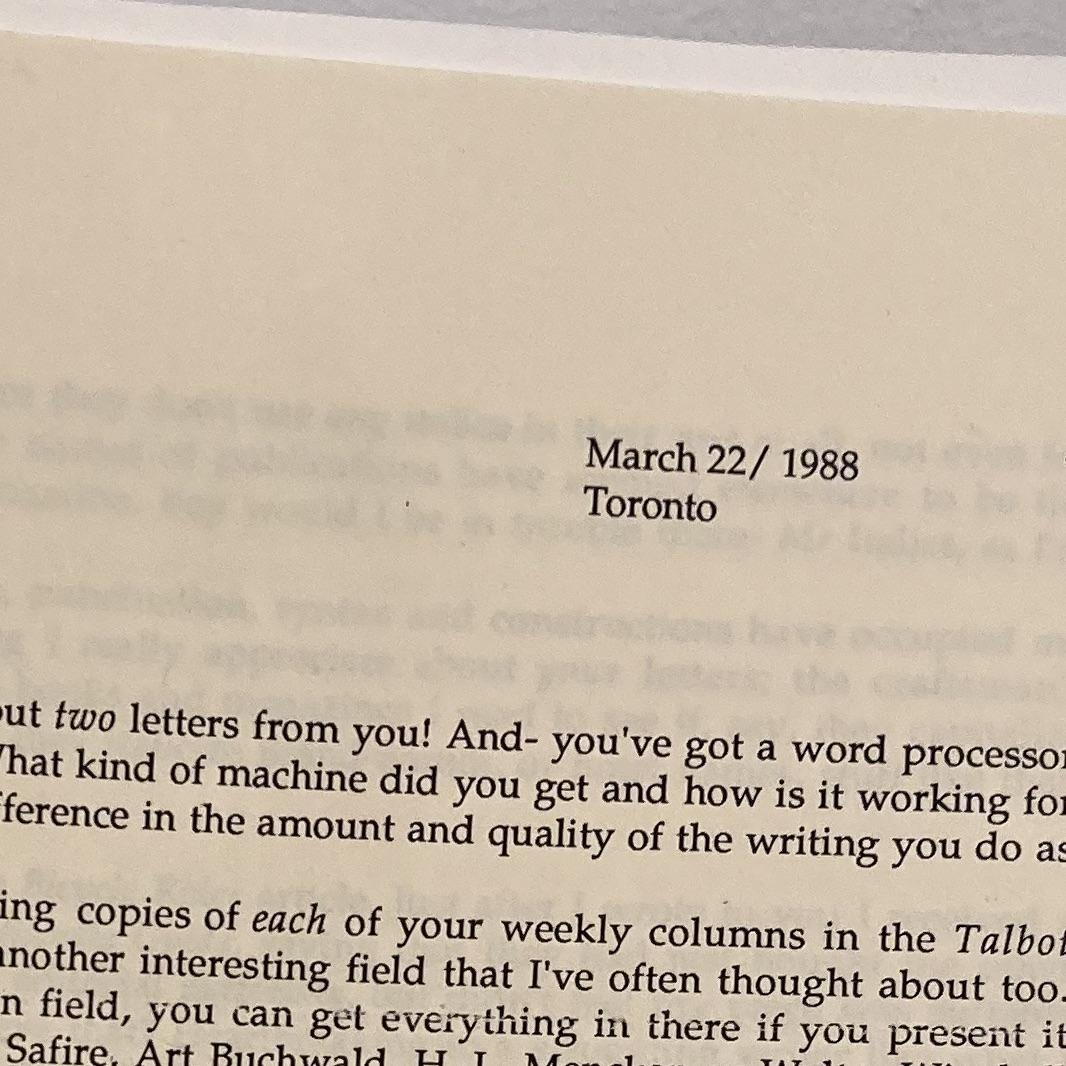
Here’s Neil talking about writing in a segment of a letter he wrote in Toronto, March 22, 1988. Originally, Neil’s letter excerpt was written as one paragraph. I’ve divided Neil’s paragraph into seven paragraphs for easier reading.
=====
March 22, 1988 Toronto
Reading wise, I’ve been into almost all non-fiction lately: history, biography, a book on the human body, and travel books. All in keeping with my new taste in non-fiction writing I suppose.
In line with that, I was so impressed by a work by Truman Capote, a collection of shorter pieces called Music For Chameleons.
I had read and loved Breakfast At Tiffany’sand the short pieces that are included in that volume, but in this one he talks in the preface about what he calls the “non-fiction novel”, referring to the experiment of In Cold Blood.
That idea, of presenting a true story, journalism, in the form of a narrative, refined carefully and beautifully as if it were a novel. I too could get very into that idea.
He remarked that Norman Mailer had criticized this concept when Capote first expounded it, calling it a “failure of imagination,” but of course later went on to work in the same genre, stuff like The Executioner’s Song.
Capote writes cattily that he’s “always glad to do Mr. Mailer a favor”! Bitch.
But I highly recommend that collection, it’s really beautifully done, and the Breakfast At Tiffany’s collection too if you haven’t read it yet.
SKF NOTE: An early 1980s letter from Bill Bruford with what appears to be a good news/bad news message.
Bruford starts out accepting Modern Drummer‘s offer to serve on its Advisory Board. He asks (tongue in cheek?) that, in exchange, we “send the magazine over the minute it is off the presses and stop asking me to pay for it!”
I have no idea how MD Founder Ron Spagnardi handled magazine subscriptions for Advisory Board members. Either way, Bruford was a strong addition to the Board.
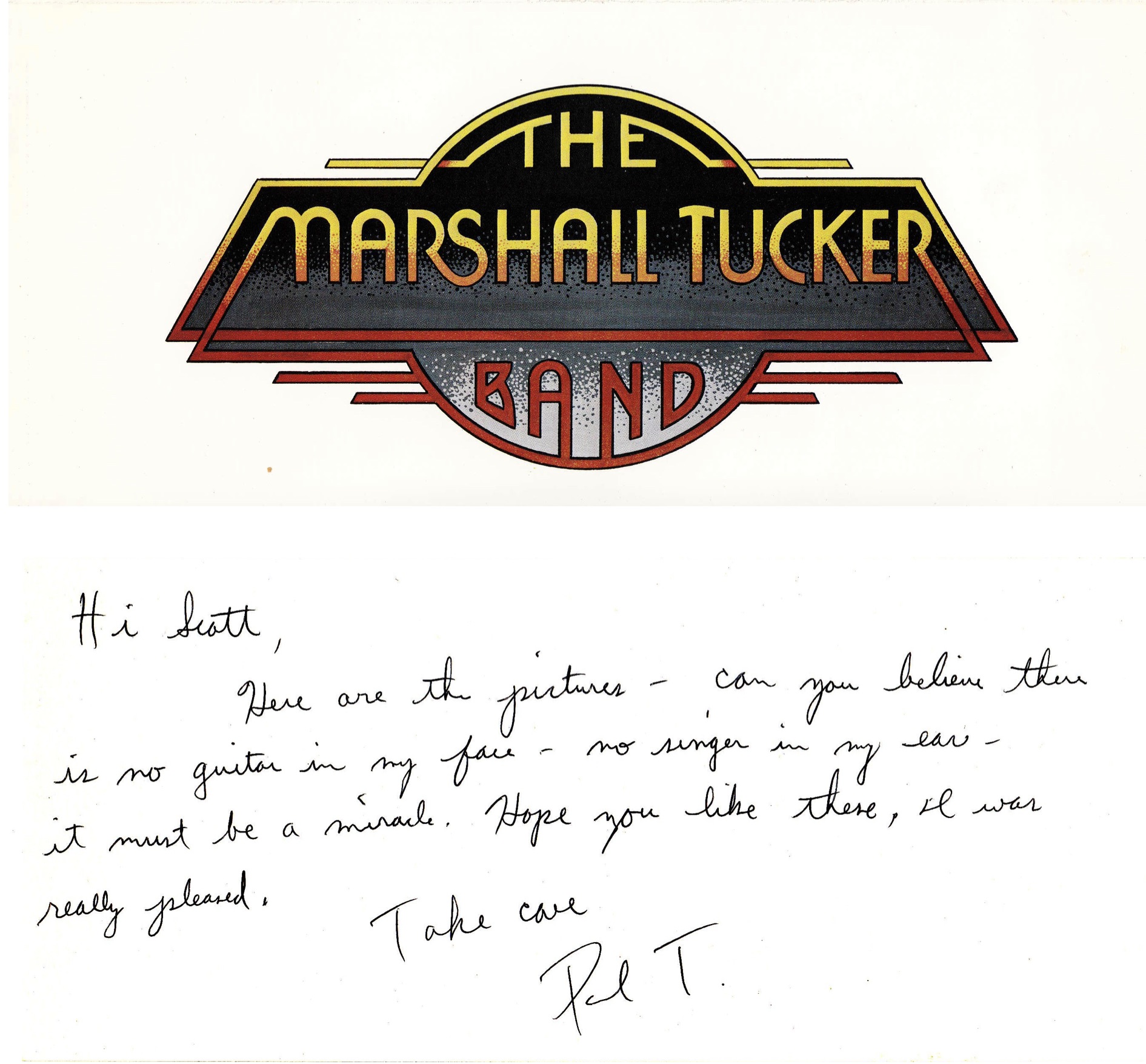
SKF NOTE: A note card from one of my oldest friends, Paul T. Riddle. I don’t know what pictures Paul is referring to. Probably the photos accompanying his feature interview in the May 1981Modern Drummer magazine.
When Paul writes about photos of him at the drums with “no guitar in my face…no singer in my ear,” he has a legitimate point.
Until Modern Drummer came along, there wasn’t much of a market for photos of drummers. Onstage, drummers were often in back of the rest of the band, while music photographers were standing in front, with the stage floor at chin level, shooting up at the musicians.
Even drummers on risers were usually hidden behind their drums and cymbals. Or they were caught in the shadows of poor stage lighting. The more drums/cymbals drummers used, the tougher it was for photographers to get photos of them.
As the market for drummer photos opened, everyone involved became more creative in getting quality drummer photos.
Riddle’s May 1981 photos were taken, I believe, in a studio by one of the drummer’s friends. Photographers began showing up at concert venues at soundcheck time, where they had optimal lighting, and great access to drummers and drumsets.
By 1983 I had a list of about 80 photographers to work with. But that’s a topic for another day.
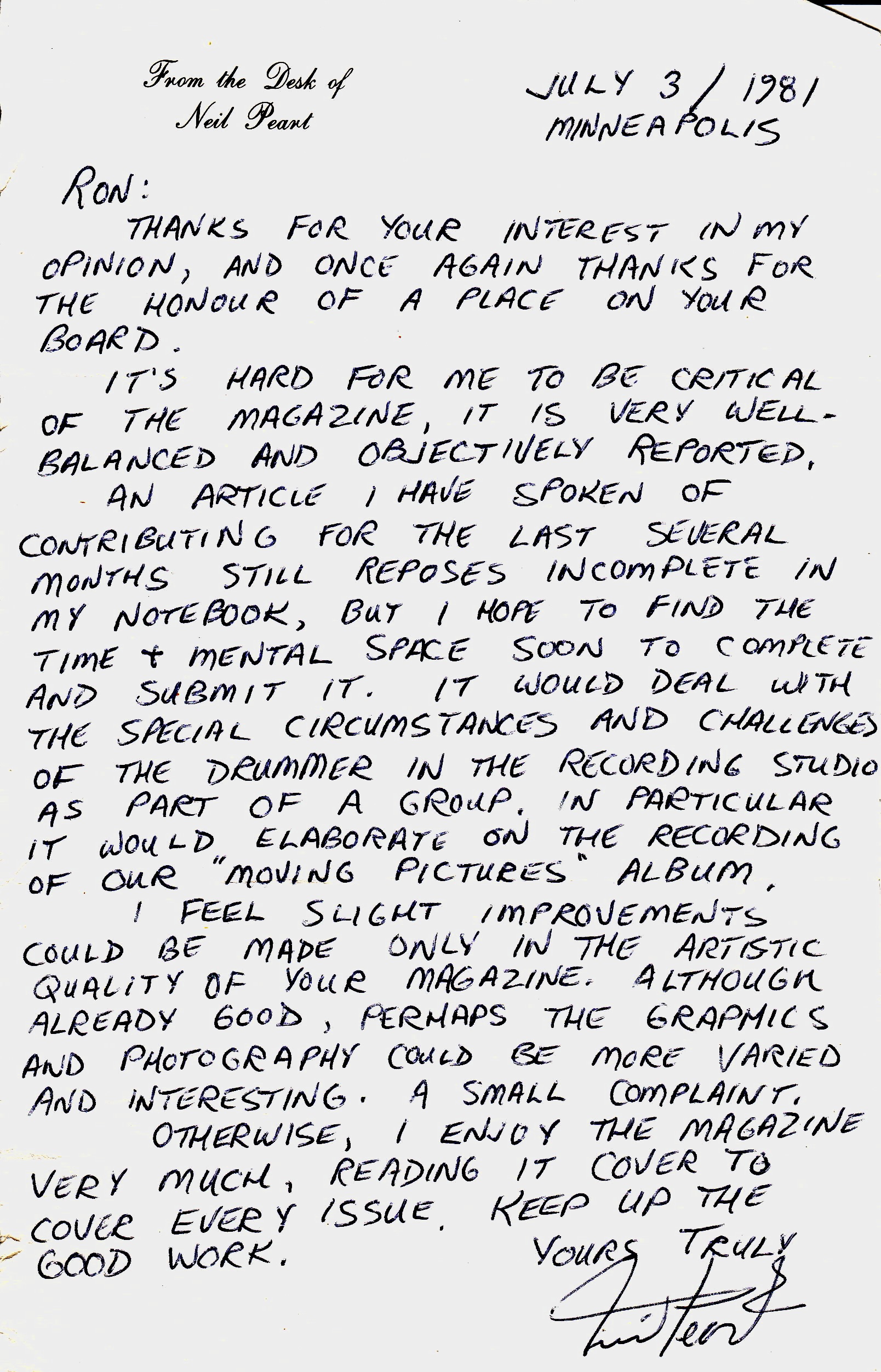
SKF NOTE: This handwritten note is Neil Peart accepting Modern Drummer Founder Ron Spagnardi’s invitation to join the MD Advisory Board.
Most interesting to me, and perhaps to his fans who know Neil only as a prolific book author, is Neil’s third paragraph. In his 1981 note we have an indication of Neil’s cold feet at writing and submitting his “Moving Pictures” piece for publication.
An article I have spoken of contributing for the last several months still reposes incomplete in my notebook, but I hope to find the time & mental space soon to complete and submit it.
It would deal with the special circumstances and challenges of the drummer in the recording studio as part of a group, in particular it would, elaborate on the recording of our ‘Moving Pictures‘ album.
All writers and musicians experience cold feet. Typically, Neil persisted, and almost one-and-a-half years after writing his note to Spagnardi, MD published the first of three installments of Neil’s “The Making of Moving Pictures.” The full piece was published in three issues of MD: December 1982, January 1983, and February 1983.



 Scott K Fish
You must be logged in to post a comment.