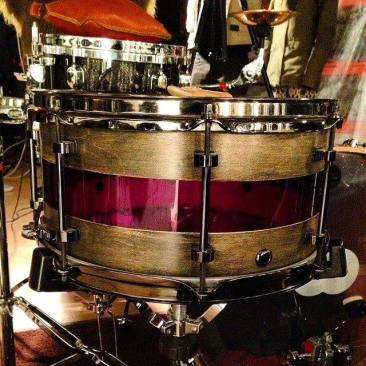
SKF NOTE: I have neither heard nor played Hogchain drums. Still, I enjoy stories of niche drum makers succeeding.
Local Creates Custom Drums
Published November 27, 2015
By Kaitlin Mullins
The story of Brookhaven native Brodie Davis and his custom drums illustrates that success in business is sometimes only a buy-product of the pursuit of happiness. …Davis and his niche business, Hogchain Custom Drums, have proven they can compete with the best of them.
“Over the years as I got better at drums I became more picky about the gear I used.
Davis, who just turned 30, started building when he was about 24. Hogchain Custom Drums has 27,001 followers on Facebook.
He…developed a relationship with powerhouse instrument company Orange Amplifiers out of Atlanta, and built some themed snare drums for them. Working with Orange just about tripled his business, Davis said.
Most of his orders are for snare drums, though he does entire drum kits as well. His drums are 100 percent handmade..of usually walnut, maple, or both, and are hand-stained. [M]usicians may order drums to their exact specifications, any size and any color.
“And it’s all American-made. I will not touch hardwood that isn’t grown in America, nor will a piece of metal go on it that isn’t made in America,” [Davis said.]
SKF NOTE: This brief interview from the early 1980’s with legendary record producer and engineer, Jack Clement, is the verbatim transcript of a backgrounder interview for my Modern Drummer History of Rock Drumming series. It is published here for the first time. It, as with my other backgrounder interviews for the Rock Drumming series was not meant to be published as an interview. This is the transcript of a phone conversation, a phone interview.
I’ve included at the very end of this interview a scan of my original typed transcript (manual typewriter!) with my red pen editing intact.
My goal was to find out as much as possible about the drummers on those records, i.e. D.J. Fontana, J.M. Van Eaton, W.S. Holland. As I’ve said in my intros to other backgrounder interviews – there wasn’t a great deal written about these drummers at the time. Re-reading this and other transcripts I wish I had known much more than I did, and I wish I had asked better questions.
I was disappointed Mr. Clement hadn’t more stores about Sun drummers and recording sessions. No doubt if I had better questions, Clement would have provided the answers.
Still, I was, and am, grateful for Mr. Clement’s several interesting insights on recording drums, recording music in general, and recording studios.
Final Note: There is some language here readers may find offensive.
Jack Clement
Scott K Fish: Do you recall exactly which [Sun Records] sessions you engineered?
Jack Clement: Well, I engineered most of Jerry Lee’s [Lewis] stuff. Did a lot of stuff with Johnny Cash. Did a lot of stuff with Sonny Burgess, Roy Orbison, Charlie Rich.
SKF: Just about everybody?
JC: Well, I didn’t do a lot with Carl Perkins. I did a session or two with him, then he left. And I never did anything with Elvis [Presley]. He had already gone when I got there. I was there from June of ’55 ’til about February of ’59.
SKF: Do you remember how you set up to record drums back then?
JC: Oh yeah. I remember it. How could I forget it? (laughs). You know, you got the drums sitting over there to the far left, and you stick a mic somewhere up above them. If you’ve got two mics, then you stick one down close to the snare. Then if you happen to have three [mics], you can put one on the bass drum.
Most of the time I had to do it with two. Sometimes one. Well, we could only use five mics at a time, see. And you pretty well gotta have one for the lead vocal.
J. M. Van Eaton
Now, sometimes you can put a couple of guitar amps on one mic. If you’ve got some guys that know how to set their levels properly. Which we didn’t! (laughs) Usually we didn’t have but one guitar — which was electric. Now, if the singer played rhythm, we’d try to get that through the same mic. Sometimes we’d get to put a mic on it, but when you only got five mics….
Now, we did do a certain amount of overdubbing with vocal groups and that sort of thing. And sometimes we’d overdub something like a cannon. But not usually. [SKF NOTE: I wrote in my transcript a question mark next to the world “cannon.” That means I wouldn’t swear in a court of law that Jack Clement said “cannon.” But that’s my best guess after our phone interview and transcribing the audiotape.] Mostly the overdubbing was just for the vocal groups. ‘Cause it was all mono. So when we overdubbed it was mono to mono. Sometimes mono to mono to mono! (laughs). Having a little more tape slap back at you as you go and so on. So that the end result sounds like shit. But it’s very musical — you know? — and people like it, and I like it, and everybody likes it. And away we go!
SKF: To record drums now is like Project X. Back then did you pretty much just stick a mic on whatever drumset the musician happened to have?
JC: Well, first of all, they didn’t have all them fucking tom-toms, you know. It was just a bass drum and snare; a cymbal or two; top-hat. Maybe one tom-tom. They’d bring out a tom-tom every once in a while.
But, see, it was a pretty live room. And we didn’t use any baffles or anything. There was always leakage. And it was always a fight to keep the drums out of the vocal mic on some of that stuff. But, then, that’s really what gave it its charm. With all that leakage. Really.
SKF: I know. All the stuff that they try to eliminate now, right?
JC: See, the recording studio is the worst place in the world to make a record. Right now. All recording studios are just wrong. Right now.
SKF: Why is that?
JC: Well, hell. They’re not musical. First of all, recording studios sound different than any other room you make music in. Right?
SKF: Right.
W.S. Holland
JC: Well? There’s your answer right there! I mean, you gotta remember that the room you’re in is really part of the musical instrument. So you got to bounce it off, bank it off the walls a few times there, you know? Then into the mic.
Well, if everything hits a dead wall — nothing comes back. Don’t sound right to the ear. The guy that’s playing. If it don’t sound right to him, ain’t no way he’s gonna play it really right. That is, up to his particular speed.
I don’t like earphones. When I record I still do it the old way. I let them stick a bunch of mics on the drums, but I’m gonna gradually cut that back.
SKF: No earphones at all? Just everybody listening to each other?
JC: Yeah.
SKF: No baffles?
JC: Sometimes. I got some sliding baffles. You can get them totally out of the way, or totally in the middle. I can make a wall there in three seconds. And then I got a couple of little ones we use that sit in front of the drums sometimes.
But I keep eye contact. Everybody hears it. I mean, I have had a lot of trouble getting these people to do that. But, I got Johnny Cash doing it. And he’s the main one I’m producing in my attic now. Him and Vic Damone.
SKF: But, getting back to the Sun sessions. It was no big deal? Just one, two or three mics?
Jerry Carrigan
JC: Well, see, everybody wasn’t drum happy. The drums played with the band. If the tempos moed, the drums moved, of course. I mean, this all bullshit to me with letting the drummer have the tempo. You let everybody have the tempo. If they want to change it — change it. Pick it up. Hell, yes.
Now, J.M. Van Eaton, see, he inspired a lot of drummers, session guys around here today. Well… one I know of one: Jerry Carrigan. He’s one of the top session drummers here. But he told me years ago he learned to play the drums them them ol’ Sun records. And when J.M. Van Eaton would speed up — he’d speed up. That’s the way you’re supposed to do it. Well…it is.
SKF: I know.
JC: (laughs) You see, when everybody’s got on the earphones you can’t change the thing while you’re cutting it. That’s what I can’t stand about it. And everybody plays at different volume levels as soon as they put them things on. And nothing’s ever in tune.
Fuck all that shit.
‘Cause I’ve had a fight on my hands trying to get these boy engineers around here to leave them earphones off. They keep wanting to stick ’em on ’em, you know. Get that Nashville Sound. Fuck the Nashville Sound. It ain’t happened yet. It’s going to, though. I think. It might happen pretty soon.
SKF: So, in your studios you try to set it up like the old recordings?
JC: Yeah.
SKF: That’s great.
JC: I don’t try. I do it. Excepting I let them use a bunch of mics on the drums. I’m going to stop that. I don’t set the mics up. I’m too lazy to do that anymore. But, I’m going to get back to it.
SKF: Given a choice, right now, how many mics would you stick on a drumset?
JC: I’d have two on top and one on the bottom.
SKF: That’s it?
JC: That’s it. I mean, the drummer has got to aim that snare drum. He knows where the fuckin’ mics are. Put that sound, balance that sound. I don’t believe in close miking. That’s what screws everything up. But then you got to have a band in the first place. I don’t mean a bunch of studio guys. You got to have a band.
SKF: There’s not too many bands now.
JC: I’m still trying to get one up. Been working on it since I was about 13. Still looking for that magical bass player.
SKF: Nobody wants to spend the time that it takes to put a good band together.
JC: Well, I’ve been working on it really actively now for about three years. I guess I’e spent about $300,000 and I still ain’t got a band. I got a couple. Me and a ukulele player. That’s about it.
But my favorite bass player is a girl named Rachel.
SKF: In Nashville?
JC: Yeah.
SKF: Is she a studio player?
JC: Well, she plays here. She plays on my records. I mean, there is no righteous bass player that I know of. But, Rachel [Peer-Prine] is the closest. And I’ve had bass players in here from England and everywhere else.
We brought this guy over here from England. Herbie Flowers. He’s the world’s greatest bass player, excepting Herbie’s played too many sessions. And Herbie knows the tempo is supposed to move, but he won’t go with it. I can’t shake him out of his tree. I’m going to take my big Gibson guitar to England one of these times, shake Herbie out of his tree.
But, he’s a great guy. He is a great player. It’s just that he can’t fucking let go of the tempo!.
SKF: It loses some of the humanness.
JC: These guys play too many sessions and they’ve got to be recycled a little bit or something.
SKF: Well, I sure appreciate your time.
JC: Well, see, we had five mics and sometimes I didn’t need but three or four of them. But then I probably always used all five. If I had vocal and a piano, I’d probably put about three on the piano. So, I had five mics. And when I overdubbed I had them same five mics again.
SKF: What kind of mics were they?
JC: Well, we had three RCA 77-DX’s. And we had some nice Shure mics. I don’t remember the numbers on them. And we had an Electro Voice. And we had a power mic. It was an early condenser mic. An Altec. But nobody knew enough to put a pad on it, so sometimes it sounded good if you didn’t get very close to it.
It would distort. We use to use it on Johnny Cash sometimes. That’s how it would sound distorted. Using that condenser mic it was hitting the board too hot. Had this little box on the floor. I got to tinkering with it one day and shocked the shit out of myself. Leave that thing alone.
SKF: Did you get it on tape?
JC: No. We had a couple of other mics around there. But if t was a big day we got them three RCA 77’s. Really sounded good.
Original page one of Scott K Fish transcript of Jack Clement interview
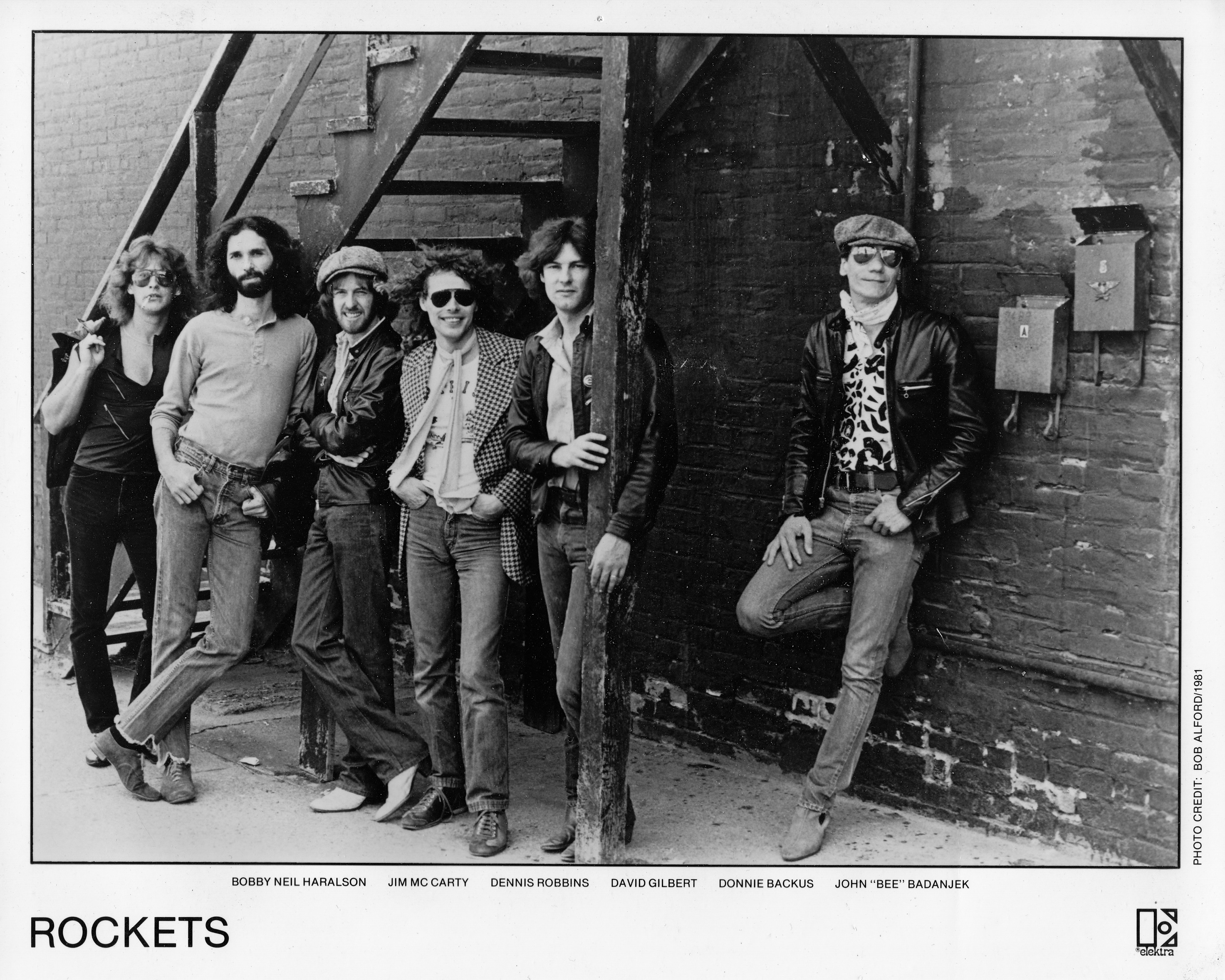
SKF NOTE: Here is an early 1980’s publicity shot of the Rockets with John “Bee” Badanjek on drums. Johnny Bee was — and still is — one of my favorite drummers. Ever since age 15, when I heard him play Devil With the Blue Dress On with Mitch Ryder and the Detroit Wheels — I was hooked.
A quick web search tells me Johnny Bee is still active with the Howling Diablos. Good news!
SKF NOTE: In 1989 I sat with Neil Peart, played him a few of my favorite drummer records without telling him anything about the song or the drummer. Our exchanges were meant for a music publication Chip Stern was creating. You can read the back story here.
Neil refers throughout this exchange to being in the studio working on an album. I’m not sure what album it was. This exchange took place in August 1989. Maybe someone can use that date to best guess the Rush album Neil is talking about.
I need to correct something. I tell Neil in our exchange Shortnin’ Bread was recorded in “the Sixties.” It was, in fact, recorded 1959. My Special Edition LP was released in the early 1970’s.
Also, in 1997, eight years after this exchange, Joe Morello accepted Neil Peart’s invitation to be a part of Neil’s Burning for BuddyVol. 2 project.
Also, you can hear Neil’s and my Blindfold Test conversations on my YouTube channel. Start here.
=====
Neil Peart August 21, 1989 “Trading Fours”
Song Title: Shortnin’ Bread. Drummer: Joe Morello. Album Name: Gone With the Wind. The Dave Brubeck Quartet. Columbia (Limited Edition) LE 10013. Released: 197?
Neil Peart: The first thing I noticed is the beautiful sounding drums. The tuning of them. It’s really sweet. I wonder if it was a more modern recording because more of the tonality seems to come through.
Scott K Fish: The Sixties.
NP: Yeah. Nice playing. But ironically, the first couple of times that the drums and piano play together, they’re out of time with each other. I tend to blame the piano because he’s just not sitting well with the groove the drummer’s putting down. From a modern, metronomic point of view, where all records are made to mathematical perfection….
SKF: So, if they had been working with a click track….
NP: It’s just selective listening, I guess. I would think the piano player would pick up his groove from the drummer.
SKF: Do you have any idea who the drummer is?
NP: No.
SKF: Joe Morello.
NP: Oh, really! Well, lovely sounding drums. And very delicate touch which, of course, he’s famous for.
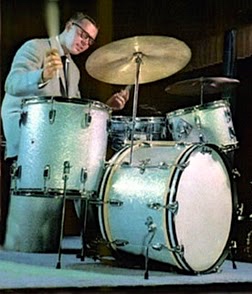
SKF: His bass drum always sounded great. I believe he used a wooden beater on a 22″ Ludwig bass drum.
NP: I’d wondered about the tom sizes too. So, that’s just a four-piece set.
SKF: Yeah. 9″ x 13″ and 16″ x 16″ toms.
NP: Is that a recording with Brubeck?
SKF: Yeah.
NP: [Neil laughs. He seems a bit embarrassed to know we’ve just been criticizing Dave Brubeck’s timekeeping ability.] It’s just because I’m in the middle of making a record. I’m so conscious, with overdubs, that we all respond to the groove when the drums are done.
I can mess with a click track pretty well. At this point I really know how to push it or pull it; and lay back with and give the feeling of ritard over top of the click — and still stay in with it.
So I get my groove laid down. When the others overdub it, it’s important that they have to sit [SKF NOTE: fit?] into my conception of the groove.
So when you hear previous records in any field of rock or jazz, where rhythm sections and other instruments are working together, you hear how different it was then; how much less demanding timekeeping was. It was what I’ve heard jazz musicians call “average time” — where you keep good time overall, but everyone sort of played with it a little bit. If a bit sped up or slowed down — it was entirley acceptable. Which it is. I’m not arguing or finding fault. It’s just ironic to look back now, to hear top musicians of the day on a simple groove like the one we just listened to, and they’re not quite congruent. They’re not hearing it the same way.
SKF: It could’ve been a first take.
NP: No doubt it was. And they’re both playing their part right. But they’re not sympathetically clinging.
SKF: A quarter note subdivided into four sixteenth notes is counted “one, e, and, uh.” The one, the down beat, can be subdivided into two sixteenth notes counted “one, e.” A musician playing right on the beat will hit on one. A laid back musician will hit on “e.” Both musicians will think they’re hitting right on the down beat, the one. That sixteenth note difference in hearing can really effect the feel of a song.
NP: That’s very true in rock too. The big down beat gets pulled back so far. Or you can sit right on top of the beat, and seemingly push it forward. There have been times when I’ve put down a drum track and people will swear that it’s speeding up in a part. They just listen to it against a click….
SKF: And you’re right on the money.
NP: Sometimes I’m just learning forward — sometimes purposely — to give it that effect. Or pulling back to see how far back I can pull and still stay in time. Phil Gould from Level 42 is a master at that. Sometimes you can be tapping along with his beats, just about breaking your hand trying to come down as late on the beat as he does. And the timekeeping is perfect. Feels great.
There’s two different sets of terminology too. Perfect timekeeping and great feeling timekeeping aren’t necessarily the same thing. Modern music demands both. Apart from drum machines and all that, real drummers who are trying to work with modern music, are trying to make metronomic time feel human and impure. That’s certainly the mark of what a modern drummer must do.
SKF: Have you listened to Joe Morello before?
NP: My drum teacher use to play them all for me. Rightly or wrongly, my perception of Joe Morello was always: a Master Craftsman. A Master Technician of drums. And he was the Rudimentary King of the Universe! (laughs)
SKF: Do you recall listening to Joe on any specific records? Take Five, for example?
NP: Take Five I certainly remember to this day. That’s a phenomenal tune.





 Scott K Fish
You must be logged in to post a comment.