SKF NOTE: My friend and music writer par excellence, Chip Stern, had a very good, albeit short-lived, idea for a drummer’s magazine. I did some writing for Chip’s magazine, but I don’t know that any of my writing was published. I’ll have to talk soon with Chip. He can refresh my memory.
Leonard Feather had an ages long Down Beat magazine feature called Blindfold Test. The concept was: play a handful of unannounced tunes for a musician and get their objective reaction.
Chip took that idea and used it for a part of his drummer magazine he called Trading Fours.
This week I found a manuscript of a Trading Fours I did with Neil Peart in August 1989. Again, as dim-witted as it may sound, I don’t remember where this exchange took place. It could have been a weekend I spent at Neil’s home.
Anyway, here’s a look back 26-years at Neil’s reaction to Louie Bellson’s Skin Deep. I’ll post the other Trading Four exchanges with Neil Peart up the road.
Neil Peart August 21, 1989 “Trading Fours”
Song Title: “Skin Deep.” Drummer: Louie Bellson. Album Name: “Hi-Fi Ellington Uptown. Duke Ellinton and his Orchestra. Columbia CL-830. Released: 1953
Neil Peart: Well, my first response: Great to listen to. Really exciting. Dynamic. Some of the same daring and rhythmic abandon as Gene Krupa’s drumming, although I’m pretty sure it’s not him. Smokin’! That’s my overall analysis. Is it Louie?
Scott K Fish: Yeah. What tipped you off?
NP: Oh, the bass drums.
SKF: The double bass drums.
NP: Yeah.
SKF: That was Skin Deep with Duke Ellington and his Orchestra. A song that really put Louie on the map.
NP: Great title for a drum solo.
SKF: What did you think of his drum sound?
NP: Ah! The classic tonality of the period, I guess. That classic sound of big band drums. Very nice. The solo was obviously built with a format and story construction. The fills in the early part of the song put me most in mind of Gene because they’re really daringly awkward. That’s the kind of stuff that Gene pulled off a lot. Something that shouldn’t feel good, but they manage to make it work.
SKF: Louie wrote Skin Deep. He may have arranged it too.
NP: I always think that those kind of arrangements must be so much fun for a drummer to play when you really know them well and you’re not having to read it. Feeling the accents and driving. A brass section in front of you like that is kind of pulling the trigger; when you get the big bass drum accent — or something — and the gun — which is the brass section — goes off. That must be a great feeling of power and control when it’s perfectly timed.
SKF: Have you heard much of Louie Bellson?
NP: Just in my beginning years when my drum teacher use to play me Buddy and Gene. Other than that? No.
NP: Only indirectly. I think it was an influence just because Louie Bellson did use them. By the time I was playing, other people were using double bass drums also. So his influence had become diffused.
SKF NOTE: In my Life Beyond the Cymbals post interview with Motown songwriter Brian Holland, I tell the back story of how tough it was, in the early 1980’s, for me to find information — especially reliable information — for my History of Rock Drumming series for Modern Drummer. That was especially true for Motown which, again, I spell out in my intro to Brian Holland’s interview.
My goal was straightforward: Who were the drummers on Motown’s records? Period. Today that info is well chronicled, although there may be missing pieces to the Motown puzzle. With that in mind, I decided to post verbatim, transcripts of my research intervews about Motown with key people. Maybe some Motown historian willl discover a new fact or the answer to a longstanding riddle.
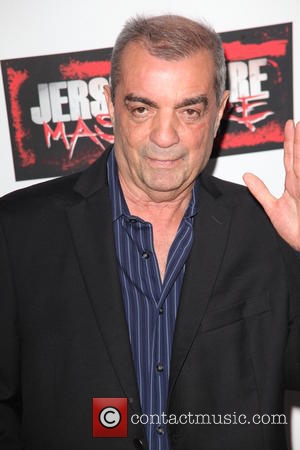
This is my interview with recording engineer Tony Bongiovi. According to Mr. Bongiovi’s web site bio, “At the age of seventeen, while conducting experiments with equipment in his Raritan, New Jersey home, Tony Bongiovi discovered the secret to duplicating the well-guarded audio formula for the Motown Sound. After contacting Motown, his abilities so impressed Motown President Barry Gordy that Tony was flown between New Jersey and Detroit on a regular basis to engineer records for Motown greats such as Stevie Wonder, Gladys Knight and the Pips, Diana Ross and the Supremes, The Temptations, and other leading artists.”
In this interview, Bongiovi tells me, “I was at Motown from ’67 to ’70.” And he shares some great insight into Motown drummers, especially Benny Benjamin.
I admit I’ve forgotten how Tony Bongiovi and I connected for this interview. He designed and founded Power Station recording studio in New York City. I was spending a decent amount of time with drummer Max Weinberg when Bruce Springsteen was recording Born in the USA at the Power Station. In fact, I attended a couple of recording sessions with Max. I don’t remember meeting Tony Bongiovi, but it’s very possible Max — who loved the Motown drummers — deserves credit for my interview with Mr. Bongiovi.
Final note: This is a verbatim transcript. I may have left out some of my questions. That is, I might have asked to clarify something said. In the interest of time — because I always transcribed my own interviews — if I could leave out one of my questions without interrupting the flow of Mr. Bongiovi’s answers — I might have done so. That wasn’t always my practice. But it was sometimes. Also, this transcript has a Bongiovi reference to a Motown song, Agent Double-O Cool. As of this writing I cannot find that song. Maybe Mr. Bongiovi had the wrong song title or maybe I misunderstood him.
I thank Tony Bongiovi was sharing his knowledge with me.
Tony Bongiovi: The drummer who did the main stuff, most of the Supremes hits, and the records that they were famous for like Reach Out, and Smokey Robinson records, Ooh, Baby, Baby, and Can’t Hurry Love — the guy’s name was Benny Benjamin. He’s dead.
My stay at Motown was rather brief because I was working mostly on the production of records. I worked with the producers so I didn’t attend that many sessions. But I know there was Benny Benjamin, and then there was Uriel Jones, who played the stuff from the later 60’s. We did Love Child with Uriel. And a fellow named Pistol [Allen]. He played on Uptight. They’re all around there except for Benny.
When they played they used the traditional grip. One thing that was interesting about Benjamin, if you listen to the records, the drums have a pretty amazing sound — and it wasn’t because of the engineering at Motown. It was because of the way the drummers’ played.
If you walked about ten feet away from Benny, you couldn’t hear him anymore. He played accents, and he knew all of his rudiments. He applied all that knowledge — and he could read music. All of them could read music. All of them played with the Detroit Symphony at some point. They all had an amazing feel, and Benjamin had an amazing foot. He was the best around.
He played sort of backwards. He was a right-handed drummer and instead of leading with his right hand, he’d lead with his left hand. That’s why all the fills and stuff sound like they come in at weird times. That’s the style that he did.
He didn’t play very loud. None of them played real loud, but they played with a certain snap. When they use to hit the back beat, they would crack it in there. And they weren’t loud. None of them played overhead like today’s guys do. They bounced more. Today’s guys, from what I’ve seen in the studio, they lay into the beat more. They just whack it real hard. But those [Motown] guys sort of snapped it in. You could tell the difference.
Even when I was working out there [Detroit] and I use to come to New York. You know, who played like that too was Buddy Saltzman, who played all The Four Seasons records. He played the same same way as they [Motown’s drummers] did.
They didn’t have the muffling like they do today. And the drummers controlled the way it sounded themselves. We just stuck the microphone right in front of the bass drum and, depending on how he hit it, that’s what gave it that sound.
Scott K Fish: I’ve heard about West Coast players doing Motown sessions.
TB: They weren’t doing the original…. I’ll tell you right now. All the records that were done, the majority of hits that we know, were James Jamerson on bass, Uriel Jones, Earl Van Dyke, Robert White, James Giddens, and whoever played percussion just showed up. There was a vibes player from the Detroit Symphony who use to play.
What the California guys did were like special album projects for…. Like, The Temptations‘ In a Mellow Mood. That was out in California.
I use to go into the tape library and pull the tapes and I know where the stuff was cut because it was written all over the tape. I know in New York they use to cut the discs here in the beginning, and then they got…. RCA in Chicago ultimately ended up cutting all the discs that came out. The mastering of the discs. One of the engineers from RCA helped them [Motown] build their studio in Detroit.
The musicians in Detroit were on some kind of a retainer. I know that. Most of the hits — like Mr. Postman and all those early records that were smashes — they were all cut in Detroit. Even Cool Jerk and Agent Double-O Cool [?] and The Platters’ record With This Ring — they were all cut in Detroit.
Bob Babbitt played bass on some of those records. There were a lot of hits where a lot of session players at Motown were moonlighting at a placed called the Golden World. It was the same rhythm section on those records too and it was all done out of Detroit. Some were done at Golden World.
But, I don’t believe this California bullshit. I just don’t, because I was there and I actually lived it. I wasn’t there that much, but I saw and I had access to all the tapes in the library. I use to go and pull some of the Mary Wells stuff. And it would say, Universal Recordings, Detroit, right on the box. Three track. Some of the stuff was four track.
I would pull the tapes and listen to them and see what they’d do on the earlier stuff. I’d be very skeptical of what they tell you in California. Even in New York, for that matter.
But New York, I would tend to think, would be a little more honest about it because they…. There wasn’t too much done here other than I remember The Supremes overdubbing in New York. And we did a Gladys Knight and the Pips record in New York live. But most of the serious records were done right there in Detroit.
When Benny died the rhythm section fell apart. I know Uriel Jones is selling aluminum siding or something like that. I was at Motown from ’67 to ’70. I use to pull the tapes and I could recognize different drummers right away. They all sounded different.
The Junior Walker records weren’t made with his band. That’s all Benny Benjamin. He was about 40 years old when he started doing this stuff. I guess he was in his 50’s when he died. He was a heroin addict. He died poor as shit.
SKF NOTE: I liked everything about The Band from the moment I first heard The Weight on some student’s record player in my high school cafeteria. The gist of The Band’s bio was, these were accomplished musicians in upstate New York, renting, living, and writing songs in a house they called Big Pink .
At the time, 1968, theirs was my dream scenario. I was usually in one band or another with high school friends, but our groups never stuck together. I learned early that a band is as good as its weakest member. Just one uncommitted player will, sooner or later, cause our bands to disband.
The Band, it seemed to me, were strong musicians individually. They all played several instruments very well, and they all sang great. Each musician was unique. When you heard them play or sing you knew who they were.
When The Band released their second album — called The Band — I loved it. The songs were great, and the photos inside the album jacket reinforced my dream scenario for the musical life. One photo taken inside Big Pink showed guitarist Robbie Robertson sitting on a chair, holding a Fender Telecaster guitar with drummer Levon Helm behind a Gretsch bass drum, a snare drum, and a hi-hat. They’re rehearsing!
There were photos of The Band’s in-house studio — cool! — and Levon Helm with what looked to be an antique Ludwig drumset with wooden drum rims! Like young drummers everywhere, I suppose, I wondered if those old Ludwig‘s were the secret to Levon’s great drum sound on record.
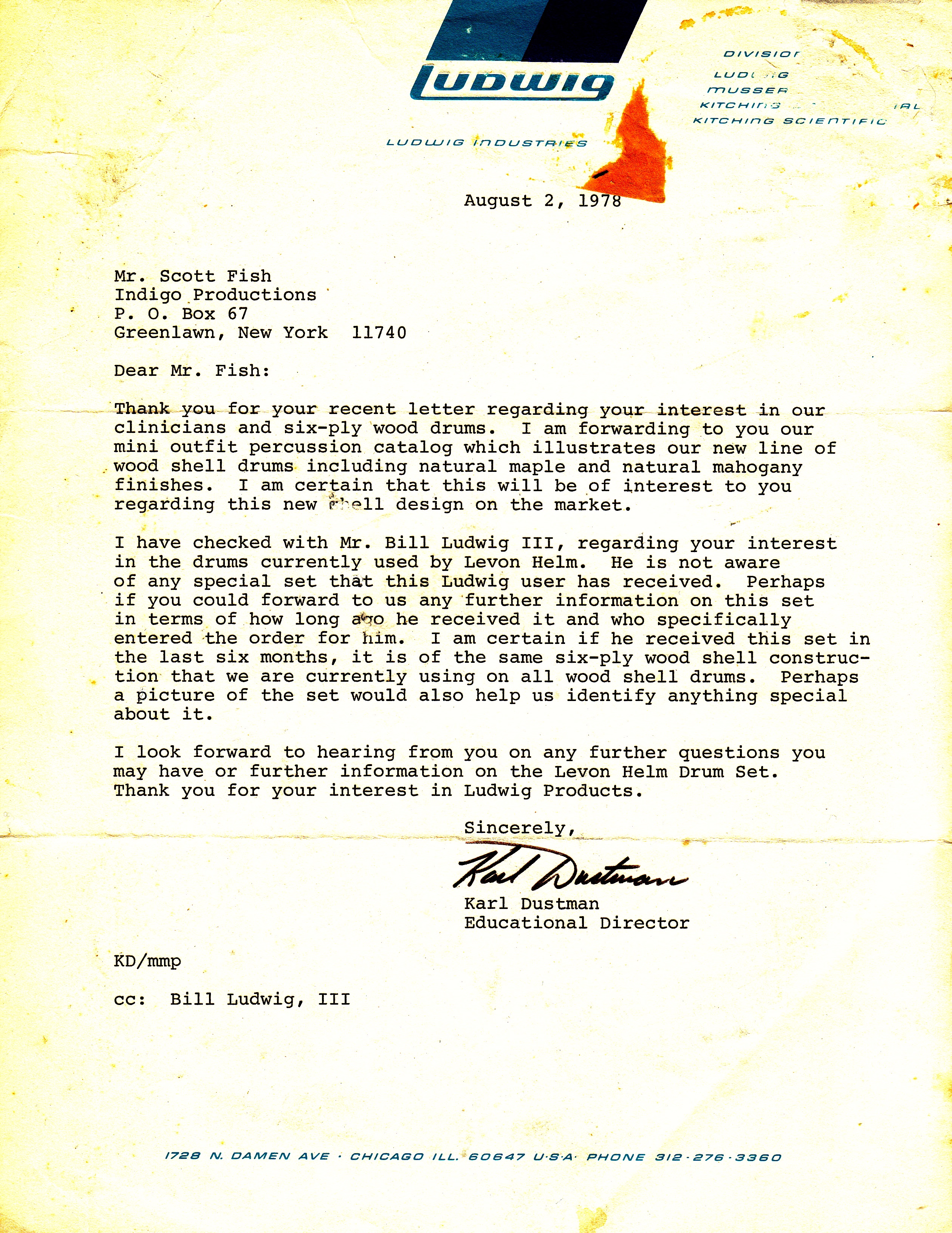
So in 1978 I wrote the letter posted here to Ludwig Educational Director Karl Dustman. I’m guessing my letter was preparation for a Levon Helm interview for Modern Drummer.
Karl’s answer is disappointing. I remember expecting someone at Ludwig would have a pretty good idea, if not exact knowledge, of Levon’s drumset: “We don’t know for sure, Scott, but it looks like the drums Ludwig was making circa 1935.”
In his defense, Karl makes a good point: “Perhaps a picture of the set would also help us identify anything special about it.” Of course, I remember wondering why no one at Ludwig was either aware of Levon’s set or apparently unable to get a hold of The Band to look at it.
Just over two years later, when I started at Modern Drummer, Karl and I developed an excellent working relationship. He was one of the industry good guys. And when I left MD to work for Gretsch, Karl was at Gretsch before me. We worked together there for about one year.
Finally, I remember a conversation up the road with Karl about our written exchange about Levon’s drums. My thinking in 1978 was: Maybe Ludwig can again start making drumsets like Levon’s. If not, why not use Levon’s wooden hoop Ludwig‘s in advertising? Karl’s response? Ludwig is not going to advertise drums it doesn’t sell.
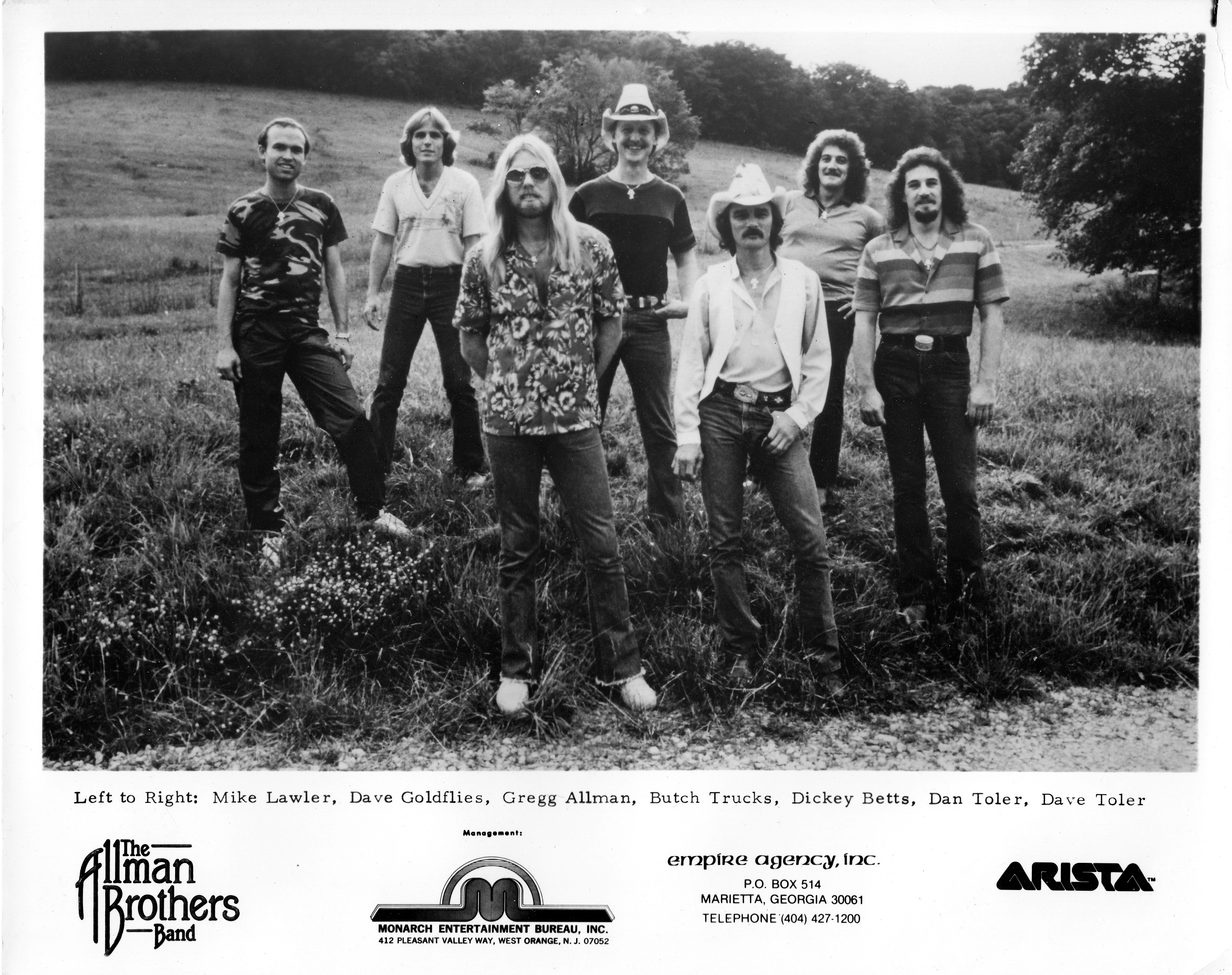
SKF NOTE: The late drummer Dave “Frankie” Toler replaced Jaimo (1981-82) in the Allman Brothers Band. This is a publicity shot of that makeup of the band.
SKF NOTE: Excellent portrait of Jack Costanzo. Here’s my edited version. Be sure to read Pop music critic George Varga’s full portrait with video at the San Diego Union Tribune web site.
Bongo pioneer Jack Costanzo drums on at 96 The legendary Latin-jazz percussionist, fondly known as “Mr. Bongo,” will perform Friday at Dizzy’s with the Bi-National Mambo Band, under the direction of Bill Caballero
By George Varga | 12:35 p.m. Nov. 14, 2015
What is most notable about this longtime San Diego resident isn’t how vivid his memory is now. Nor [that] he has collaborated with everyone from Nat “King” Cole, Dizzy Gillespie and Elvis Presley to Sam Cooke, Barbra Streisand and Marlon Brando…
Rather, it’s…that – at 96 – he is preparing for his next concert.
“I never smoked, I never did drugs, and that helped me be a healthy person,” said Costanzo.
“Jack is really an inspiration and a hero to all us musicians,” [trumpeter Gilbert] Castellanos said. “He put the bongos on the map and is the bridge between Latin-jazz and jazz. The fact that he’s 96, and still doing it, is unbelievable. He gives 200 percent every time he gets on the bandstand.”
Bongo pioneer
He is likely the only living musician whose credits range from Charlie Parker, Yma Sumac and…Patti Page to Mexican “Space-Age Bachelor Pad” music pioneer Esquivel, jazz-funk band The Greyboy Allstars and film giant Orson Welles….
…Costanzo was also hired to teach movie stars how to play bongos and congas.., …includ[ing] Gary Cooper, Betty Grable, Jack Lemmon, Rita Moreno, Van Johnson and James Dean.
[T]he bongos were virtually unknown in the United States when Costanzo was born in Chicago on Sept. 24, 1919. His first passion was dancing….
When he was about 14, Coztanzo heard a visiting band from Puerto Rico…. For one song, the group’s drummer switched to bongos…. Costanzo was instantly mesmerized.
Since there was nowhere in…the nation to buy bongos.., the enthusiastic teenager made his own. …Costanzo is entirely self-taught on the bongos.
“I listened to a lot of music,” he noted.
Why? What drew him to drumming?
“I don’t know,” he said. “It just came to me, and I did it.”
His big break came in 1947, when…Stan Kenton [hired] Costanzo….
His public profile grew almost instantly, thanks to such key recordings with Kenton as “Bongo Riff,” “The Peanut Vendor” and “Abstraction.”
Costanzo’s career soared even higher in the 1950s and ’60s, when he was being paid double and triple the going Musician’s Union standard rate for recording sessions. He was especially favored by singers, including Ella Fitzgerald, Peggy Lee and Frank Sinatra….
Has Mr. Bongo ever contemplated writing his autobiography?
“I can’t tell you how many people have asked me to, and my answer is always no,” Costanzo said.
“I played with Charlie Parker and Dizzy Gillespie, but my favorite was Bud Powell. How come? Because he complimented me when we were done playing, that’s how come! He shook my hand, and said: ‘Finally, a bongo and conga player who can play jazz’!”

 This is my interview with recording engineer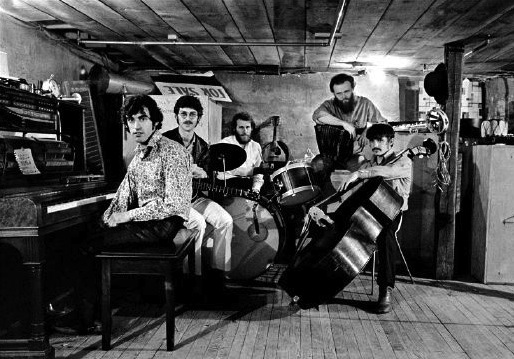
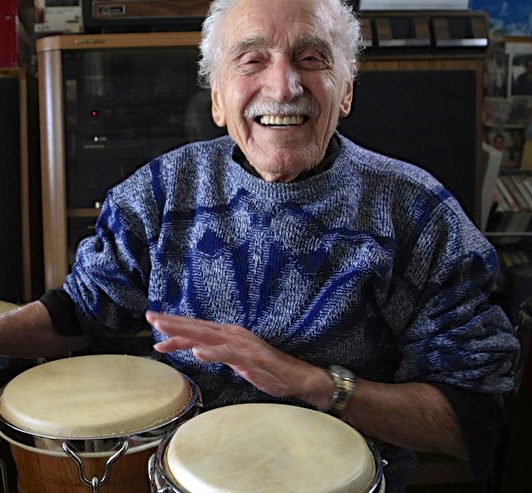 Bongo pioneer Jack Costanzo drums on at 96
 Scott K Fish
You must be logged in to post a comment.