
SKF NOTE: A classic Chuck Stewart Gretsch ad with Max Roach from the October 29, 1959 Down Beat.
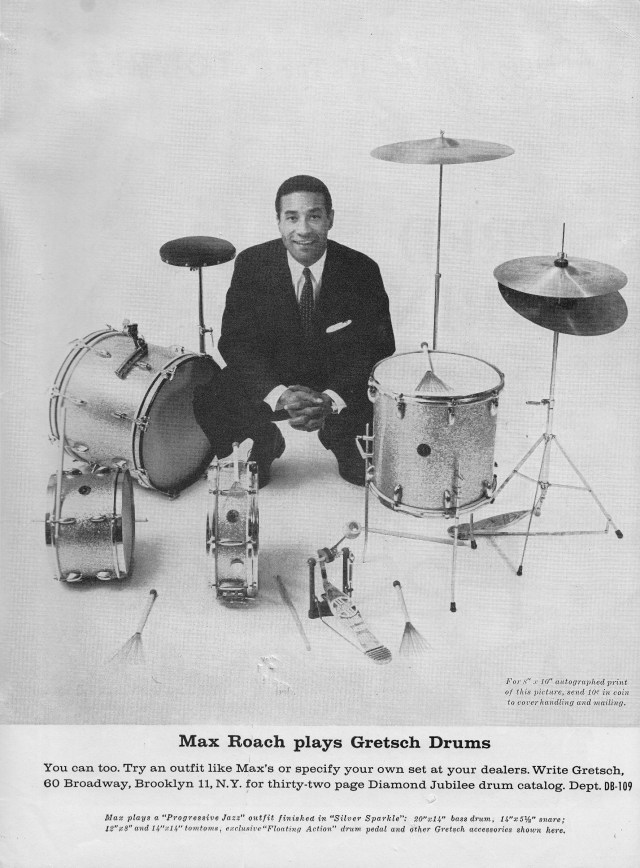
SKF NOTE: A classic Chuck Stewart Gretsch ad with Max Roach from the October 29, 1959 Down Beat.
SKF NOTE: Hal Blaine was a great friend to Modern Drummer magazine while I was on staff. It would not surprise me to know Hal is still a great friend to MD. In the early 1980’s, when I was writing The History of Rock Drumming for MD, Hal was always ready, willing and able to help me.
I don’t remember the specifics of this transcribed conversation with Hal. An educated guess? Hal and I were talking on the phone, the conversation got around to topics I could use in my rock drumming history, and so, with Hal’s permission, I fired up my trusty Radio Shack suction mic and portable cassette recorder and let the tape roll. I transcribed this interview with a manual typewriter on looseleaf paper – which you can see in the photo at the end of this transcription.
When transcribing my Sharkey Hall and Jesse Sailes interviews for this blog, I thought it was Hal Blaine who put me in touch with both men. This interview proves my memory on that remains intact.
Caveat: Hal sounds pessimistic here at times. That was very, very unusual. Most of the time Hal Blaine was the consummate optimist.

Hal Blaine
Hal Blaine: I met Earl Palmer right around 1960. Earl was the drummer out here for the late ’50s. I probably had more influence from Earl than anyone else. Earl and I became friends and, later on, we’d work together whenever they used a double drum situation.
Sharkey Hall was one of the biggest influences in my life. Sharkey Hall is one of the nicest gentlemen in the world. I met him when I was about 15.
Jesse Sailes kind of taught me a lot of stuff too. Between Sharkey, Jesse Sailes, and Earl Palmer — that was one of the big, let’s say, Black influences in rock ‘n roll.
As a kid I played with all black people. All black. Until I got into the service. At about 16 or 17 was when I first started working with white guys in the Army. So, when I was 14 or 15, and I knew Sharkey Hall, I use to hang out with Sharkey a little bit. He was just beautiful. I use to go to jam sessions and things. Sharkey was doing a lot of records then.
Another guy that was doing a lot of records in the ’50s — and he turned out to be a total asshole, unfortunately — was Roy Harte. He’s the guy that owns Drum City.

Jesse Sailes with Daniel Glass. Photo Credit: Daniel Glass. http://danielglass.com
Scott K Fish: So, Sharkey Hall and Jesse Sailes were studio drummers?
HB: Absolutely. And the only thing that kept them from staying in the studios was the fact that they weren’t tremendous readers. I think what happened was that all that early stuff, when rock started happening — Sharkey, Jesse were the guys that were doing garage demos and stuff like that. And they were the guys that were happening. And Earl.
That whole thing just started evolving there.
When I came along in the early ’60s — that’s when the thing became maybe more sophisticated. It started happening, technically, better. Recordings started getting better. There were more changes. Guys sounded like they were playing more in tune.
I don’t mean that as a gag. The early rock ‘n roll out of the studios was not out of the studios. It was out of garages! And the equipment wasn’t that good, with wire recorders and stuff like that. And they had strange sounds. Microphones picking up across the room. Well, with the Doppler effect it sounded like the guy was out of tune. From where the horn passed, to where it got picked up on the tape or something, a lot of it got out of tune.

Earl Palmer
They were so infantile, those tunes. They were so baby-like at the beginning, with two or three [chord] changes, that the average jazz musician, or even learned musician, scoffed and laughed and said, “What kind of bullshit is that?”
It’s like a lot of guys today are saying, “What are they doing to us with this New Wave crap?” They forget, man. It’s evolution. And you’ve got to go with it. And that’s all there is to it. The world is changing.
Buddy Harman is another innovator. We both got out of the Roy C. Knapp School in Chicago. The same school at the same time. He went to Nashville and I went to Hollywood. I was at the school ’48, ,’49, ’50.
Most of the guys I know from my era were all guys that played shows, dances, bar mitzvahs — whatever! It just evolved. The rock ‘n roll thing was happening. You had to learn to play OOM dah dah OOM dah. Even then that beat was ancient history. You heard it from India. Every time you saw a camel movie they were playing that [beat]!
It’s a whole different world today. Today it’s so different. There is no more respect for parents. There’s no respect for school or authority. Nobody really seems to give a shit about anything. It’s a pity.

Buddy Harman
A lot of kids who want to be drummers today, they are only learning one thing. And that is whatever they see the drummer with Van Halen doing. That’s all they want to do. And that’s all they know how to do. And they don’t know that anything else exists.
There is only one favorite radio station that they listen to. And their favorite [music] tape. And that’s it.
It’s a shame because, one of the things about Roy Knapp was that you studied Music Appreciation and all the aspects of it. Like any other business.
SKF: Roy Knapp would hip you to all different kinds of music?
HB: Well, it’s just that everybody did. You were in the heart of Chicago — which was Polka country. South Chicago was black stuff. The West Side was Polish stuff and different ethnic groups. There was some Puerto Rican stuff. Mexican stuff. There was a lot of stuff around. And everybody was interested in it all.
Most of the guys that went to that school? They were interested in all of it. They weren’t just interested in Stan Kenton, for example, who was real popular then. Everybody didn’t just think “Stan Kenton.”
SKF: What did you have to learn to graduate from the Knapp School?
HB: Well, it was an eight hour a day school. I went for almost three years, five days a week. You had classes in sight reading, sight singing, music appreciation. And I was taking piano on the side. I was studying vibes with Margie Hyams.

Marjorie Hyams
There was band. There was a get together — they had a long table, man, down the middle of one of the classrooms that was an entire felt table. The guys would sit with their sticks, side-by-side. There would be 20 or 30 guys, and everybody would be playing fours.
There was just a certain camraderie, a certain thing that happened. Like a medical school. And that doesn’t seem to happen today.
The point is: It’s not so much who your teacher is. It’s how hard you’re going to work with what you learn from your teacher. And from listening, and seeing, and watching. That’s the way I feel.
If you’re motivated enough…. I don’t give a shit if Buddy Rich is your teacher. That’s not going to make you the best drummer in the world. There are an awful lot of kids out there who think if they can study with a name, well, that might give them some great motivation.
It’s still not going to make them good.
But if they’re motivated enough, I don’t care who you’re studying with, it’s a matter of practice and learning and listening to everything and everybody.
I really think the guys who succeed in playing — I don’t mean an ocassional Friday night — but, the guys who really work at their craft, are the guys who were motivated. And I don’t think it was any one teacher. You gotta watch. You gotta learn. You gotta listen.

— end —

Michael Carvin
SKF NOTE: I hate sounding like a broken record (no pun intended), but for the sake of readers visiting Life Beyond the Cymbals for the first time: I conducted a series of backgrounder interviews in the early 1980s for a five-part feature series I wrote for Modern Drummer magazine called The History of Rock Drumming. None of these interviews were published — until now.
With the publishing of this interview I’ve added a new Backgrounder Interview category. With one click, readers can access all my backgrounder interviews for MD’s The History of Rock Drumming.
These verbatim interviews have some rough edges. They were originally transcribed from audio cassette using a manual typewriter. In the interest of time, I sometimes did not transcribe my questions, only the interviewee’s answers.
Still, there are many interesting stories in these interviews. I was in uncharted territory much of the time. No one before had written a rock drumming history covering the late 1940s, the country music influence, the blues influence, right on up to the early 1980’s. The cut-off point was around the time Stewart Copeland was a rising drum star with The Police.
Michael Carvin is no doubt best known as a jazz drummer. I don’t recall how I found out Mr. Carvin spent two years drumming at Motown. But the purpose of our phone interview was to find out.
Caveat: The language is coarse in spots. In one place, Mr. Carvin says he was at Motown with a name I transcribed as “Eddie Khan.” Eddie Khan was a jazz bassist, but I find no evidence he was a Motown musician. It’s not out of the realm of possibility, but, outside of Carvin’s statement I have no information. It’s also possible I misunderstood Carvin, or misspelled the name “Eddie Khan” while transcribing. Maybe someone reading this can clear up the confusion?
Finally, I think towards the end of this transcription I stopped transcribing my questions. It’s also possible I didn’t transcribe some of Michael Carvin’s remarks if they were not germane to the topic. There’s one bumpy transition in the conversation — and I think that’s why.
Scott K Fish: I heard some stories that some West Coast drummers, like Earl Palmer, played on some of the Motown….
Michael Carvin: Bullshit. Pistol [Allen] started the sound. Benny Benjamin started the sound on the bass [drum]. Pistol was the drummer that invented the Motown thing. When you first heard Motown — all of that shit was Pistol. Benny was in on the early stuff too.
Earl Palmer was on the West Coast in the early ’60s when he had just started to become very, very big in the studio thing. Now, there’s a possibility that he did a lot of the things from the West Coast because — let’s say Diana Ross was out there and they did something live.
But the [Motown] sound was coming from Woodworth Street and a place called Hitsville.
[The California story] might be true. See, Motown was a funny place. It was a factory… like working in a factory. We had ID cards and they had heavy security and all of that shit. I don’t know what records I played on because we cut rhythm tracks like my job was to put the fender on the car. I don’t know what color the cat is painting the car because that’s painted further down the line.
So we would just make fenders. Then when they got the fenders the way they wanted them to be, then they would decide what car this fender would go on. It might be Marvin Gaye. It might be Diana Ross. It might be Stevie Wonder. Then they would put that fender on that particular car.
Now they would paint it. They might use…. It might be a 32-piece orchestra when it’s finished.
 That’s why they always had a feeling. Because we would play a groove — and I was there with Harvey Fuqua and Smokey Robinson — and Harvey was doing all the arranging then.
We would go in at nine in the morning. We’d come out about 5:30 or 6 o’clock. Harvey would say, “Okay, lay this groove down.” We would finally get it. Then he’d say, “Okay. Now lay this down.” It would be layers. “This is going to be the bridge.”
Now — the name of the tune? We don’t know. Who is singing? We don’t know.
We’d just do that all day, man.
SKF: You did that for two years?
MC: Yeah. Then they would say…. That’s all we would do. During that time it was me, Wah Wah Watson, Eddie Khan [sp?] — and Michael Henderson was coming in and out then. He was 19.
SKF: Was there a reason why they would record like that?
MC: It wasn’t that they were keeping any secrets. It’s just that they don’t know.
Heat Wave wasn’t written for Martha [and the Vandellas]. It was written for Marvin Gaye, but it was too high for his range the way they was hearing it. See, it was the company, man. That’s why they was successful. There wasn’t no egos.
They would say…. Like, Harvey would listen to it and say, “Man, this sounds like some shit that The Four Tops would eat up. This sounds like their kind of beat.” So that’s who they would give it to. And they would try the first order. They would say, “Man, this sounds like something for Diana. This sounds like a song that she would carry well.” They they would give it to her.
I remember when The Spinners used to rehearse every day, man, for two years. They wasn’t ready to be an act yet. As far as I was concerned they was raising hell. But Motown worked like this with an artist: Until you get a rhythm section, you know you’re not going anywhere. It’s kind of like that. You go to apply for a job and until you get the application, you can’t apply for it.
SKF: They had The Spinners rehearsing two years?
MC: On salary.

Richard “Pistol” Allen
I remember Thelma Houston couldn’t get a rhythm section. Until they give you a rhythm section you can’t say, “Well, I’m going.” Once you get a rhythm section you go upstairs to the third or fourth floor. I don’t remember now. Then you could say, “Well, we’ll be going out soon.” Then, once you get a rhythm section and a choreographer you know you’re on your way.
Oh, no, man. It was business. It was with no bullshit. That’s why every time you saw an act — it was polished.
You get a rhythm section first…. No, you get them both at the same time. Well, you might get the choreographer first. You would be just singing your song acapella and he would be showing you steps and all of this shit. Then you get your rhythm section.
That will be your rhythm section. They would hire some cats and that would be your rhythm section.
Now, if the drummer would quit — okay, I might have to go out there and hit the gigs until they get another drummer. Then I’ll shoot back. Whoever quits, one of us would shoot out to teach the next cat who was going to take the gig. So, during the day you would practice with him in the hotel room, and show him all of the fill-ins.
See, you could be a hell of a reader and you couldn’t play the Motown music. Because it was a school within itself. It was a school about putting the beat in the pocket. And it was a good experience for me because it was nothing like you would encounter in Western music.
A lot of the cats can read all of the notes and all that. And that’s great. But, that has nothing to do with playing Motown music. Motown music fucked up most drummers because it was written with four-way coordination. What he wanted you to play on bass drum was written. What he wanted you to play with your left hand was written. What he wanted you to play with your right hand — it was written. You had to coordinate that shit, and that’s what fucked up most cats.
SKF: Weren’t Pistol and Benny Benjamin inventing their own stuff?
MC: Well, they invented the sound. Then Harvey Fuqua translated the sound. The standard was set when I showed.
My idol in high school was Martha Reeves. I finished high school in 1963. So they were burning then. I use to dance to Martha in 1957, ’58, ’59. I remember when Heat Wave came out. I’m from Houston, Texas. So I know what heat wave is. So I always wanted to play with them. I was madly in love with Mary Wells. And I always dug that shit. The Four Tops, Smokey and all of those cats.
See, I never wanted to play with Miles Davis because he didn’t have no sound to me. I wanted to play with Louis Armstrong.

Louis Armstrong
See, Texas has that dark sound. Motown was perfect for what my ears wanted to hear. Art Blakey was perfect. The Jazz Messengers. Kenny Dorham was perfect. Max Roach? I couldn’t hear him because he was too fast. I couldn’t hear him until I really mastered my studying and shit. But the drummer I could hear then was Blakey because it was dark. He and Bobby Timmons. Bobby Timmons had a dark sound. Lee Morgan.
[SKF NOTE: I’m guessing this is the bumpy transition I mention in my post opening.]

Art Blakey
If you don’t have that kind of organization you can’t swing, man. You don’t know nothing about centering the rhythm section. Centering your beat within the center of the rhythm section and building off of whatever they’re playing. That’s what it’s about.
See, all these cats I hear now, they are good drummers, man, but all they have is top. They don’t have any bottom. That’s why disco was such a hit. Because it was such mechanical music. All you had to be able to play was eighth notes. The down beat on the bass drum and the “and” of each beat on the hi-hat. That’s why you had drummers that you never heard of playing in disco. Because a dog could do it. You went no further than eighth notes — and there was no syncopation. It was like marching music. It was like you put everybody in the same rhythm at 120 [beats] per [minute].
SKF: Was there stuff that you had to woodshed, that just blew your mind when you got to Motown?
MC: That’s right. The coordination. I could read it… but… the coordination, and then to set on it, to be able to pay four-way independence, but set on it and don’t let that time move — to then make it feel like something.
SKF: Were they working with click tracks?
MC: No, man. You know why there’s any click tracks? Because it’s boring to set up and play boom-boom-boom-boom. That’s what you played in disco, so you easily drop it or rush it — because it’s boring. A click track is one of the silliest things I’ve ever heard of.
I never met Pistol or Benny, but I knew their names because I was constantly reminded of them. Motown is the Bebop of rock. Now you have Fusion and all of that shit. It came from Motown and Bebop. That’s what Fusion is. If you really listen to the bass drum of the Motown drummers — it’s playing the melody. That’s why I call it the Bebop of rock. Because the Bebop drummers played the melody.
— end —
SKF NOTE: The Frank Sinatra/Duke Ellington album, Francis A. & Edward K., is one of my all-time favorites. And, of course, it’s fun and instructive listening to Mel Lewis‘s thoughts on the song, Follow Me.
 Mel Lewis: That, of course, was Sinatra, and I’m positive it was with Duke Ellington, although I don’t think the writing was by Duke, but the sound of the fellows comes through, that’s for sure. Anybody can write for Duke’s band, and you’ll still know it’s Duke’s band.
It seemed to me, from the vocal standpoint, that the tempo should have been a little faster. But for the chart itself, the arrangement, it was beautiful. It was just that as a singer, Sinatra would have come off better at a brighter tempo — but the arrangement wouldn’t have. So being the kind of singer he is, he probably thought, “I’ll sing it wherever it’s going to lay best for the band.” So he gets five stars for those thoughts. And Duke’s band, as everyone else who’s ever taken a Blindfold Test has always said, it’s five stars no matter what.
Source: Thad Jones/Mel Lewis Blindfold Test, by Leonard Feather. Down Beat, September 5, 1968
 Steve Khan: This is Emergency!, right? An important record. It captured a feeling about that particular time, when our music was about to take a great change. It’s a five-star record; the only thing unfortunate about it, considering how recording techniques have advanced, is that the beauty of Larry Young‘s sound is not captured properly. But it still sounds great!
One of the things I like most about jazz related music is that excitement when musicians go into the studio, look at each other, and say, “Let’s play!” This album has that, rather than glossy production values, or anyone saying, “Oh, we’ve got to do something four minutes long.” There’s so much spontaneity and intensity — which is not to say you can’t record a beautiful ballad. But on cuts like this, where no one’s holding anything back, this group set a tone some of us got away from, of sheer purity of intent.
Source: Steve Khan Blindfold Test, by Howard Mandel. Down Beat, February, 1985

Life Beyond the Cymbals
A Blog about Music and Popular Culture
Online Drum Tracks | Drum Recording | Remote Session Drumming | Pro Session Drummer
Life Beyond the Cymbals
Writing About and Reviewing Classical Music and Jazz
Life Beyond the Cymbals
A Drummer's Look at Drums and Drumming


You must be logged in to post a comment.