SKF NOTE: Leonard Feather give Kenny Dorham’s classic Una Mas album four of five stars in the March 12, 1964 Down Beat. “Young [Tony] Williams,” Mr. Feather writes, “has a dynamic strength and flowing beat that are, coming from one his age, little short of numbing.” Indeed.
Una Mas is a great album all-around. Dorham, Herbie Hancock, Joe Henderson, Butch Warren, and Anthony Williams? Who could ask for anything more?
SKF NOTE: Yesterday I was using YouTube to find how-to videos for playing press rolls. I came across this Ed Shaughnessy lesson — which is great on a couple of levels. Thank you to the person who uploaded this video to YouTube.
Here we have a fantastic drummer and teacher, Ed Shaughnessy, passing along to anyone who cares to listen, master drummer Buddy Rich‘s explanation of how he plays his, Buddy’s, press roll. And this is the first time I have ever heard of an old whip cream roll. Great stuff.
SKF NOTE: I had this phone conversation with Earl Palmer on February 28, 1981. This is another of my Modern Drummer History of Rock Drumming five-part series backgrounder interviews.
I am so grateful to be posting these interviews for the first time having the internet for fact checking. Several misspelled names in my original transcript are corrected here. And, as always, where I could find a link to more and credible information about people and places mentioned here, I did so.
I think I transcribed Earl Palmer’s and my opening phone greeting at a time when I was transcribing interviews verbatim — every um, y’know, er — to help me better understand how people actually spoke.
Also, Earl has an interesting way of speaking in this interview. Several times he starts a sentence, drops in a clarifying sentence or phrase, then finishes his original sentence. It is likely I would have rewritten some of these sentences, using Earl’s own words, had this interview appeared in Modern Drummer. But this transcript is verbatim. Where I thought Earl’s use of pronouns — usually the word he — was confusing to read, I inserted the proper noun in brackets.
As with all my backgrounder interviews, I don’t know if there is new information here. But I think it’s good to have these interviews as part of the public record of these great musicians.
Earl Palmer
Earl Palmer: Hello?
Scott K Fish: Hi. Mr. Palmer?
EP: Scott?
SKF: Yes.
EP: Oh. Let me get to the other phone.
SKF: Okay. Fine. (Pause until EP picks up other phone). Are you comfortable?
EP: Yes. I started to do some cooking, waiting for you to call.
SKF: I love cooking, myself.
EP: Oh really? That’s my hobby. I love cooking.
SKF: What’s your favorite cuisine?
EP: Well, Creole food from New Orleans: gumbo, red beans and rice, crawfish bisque, and bouillabaisse, and stuff like that.
SKF: Man, you’re going to have to send me some recipes.
EP: (laughs) Send you some frozen gumbo!
SKF: That’s it. There you go. I’ll take you up on that. For sure. There’s not too much of that in New Jersey.
EP: Or better yet, when you come out this way, come on over and have some.
SKF: Okay. You’ve got yourself a deal. So, how have you been?
EP: Oh, pretty fair. I’ve been contracting the Wilshire Theater out here where we have, you know, legitimate theater.
SKF: On the dates you did with Little Richard, Fats Domino and Sam Cooke: From your perspective, what was happening back then in terms of drumming? What your involvement was with the band. Your input into the band.
EP: I had been a dancer in Vaudeville since I was four years old and always dabbled around with the drums somewhat. So when I got out of the [military] service in 1945, the Second World War, I wasn’t quite sure what I wanted to do with my life.
Then I started play drums again around town in New Orleans, and my first job was a very good job out on Bourbon Street playing strip shows. And I was making a lot of money, but I didn’t know what I was doing.
So, finally a friend of mine persuaded me that I should go to music school on the GI Bill, because I had GI rights coming to me. And I went to music school.
Earl Palmer
And Dave Bartholomew — who had this orchestra in town — there was a drummer named Dave Oxley who was playing with the band who was also a friend of my mother’s. He used to be on Vaudeville shows with my mother. And he left the band and Dave asked me if I wanted to play with the band. So I did. After starting playing with the band, then I later went to music school to find out what I was doing, actually.
Lew Chudd came down to New Orleans. He had heard about Dave Bartholomew and that band there, and [Lew] hired Dave to, like, search out New Orleans talent for him. And I’m playing in the band and I use to help Dave out with ideas and the arrangements and so forth. Kind of like an Assistant Producer to him.
So when Dave finds Fats Domino for him [Lew], we started doing Fats’ records.
Prior to that we use to play in a club in New Orleans called Al’s Starlight Inn and Fats use to come around. He played only boogie-woogie piano at that time — which he doesn’t play too much anymore now. But when I’d run the band sometimes, and Dave would go off the stage, I’d let him [Fats] get up and play during intermissions to keep people in there. Because the guy that owned the place was a friend of mine.
Dave didn’t think too much about wanting to let him [Fats] play at that time. So I let Fats play and that’s how I got to know Fats. As a matter of fact, his very first job he had in New Orleans — professional job — was at a club that I belonged to. Used to be a club where a lot of football players…. I played a little football around New Orleans. And we’d hang out in there after the games. And they needed some entertainment to keep people in there.
So, I told them about this guy, plays good piano, a lot of people seem to like him. So they hired him, man. And later he hired his cousin, Harrison Verrett on guitar and Cornelius Robinson, who later died, a drummer. Tonoo, we called him. And Billy Diamond, a bass player who lives out there now. He [Fats] hired them and that was his first group.
And then we did his first record, Detroit City and Fat Man Blues. [SKF NOTE: The “B” Side to Detroit City Blues was the song, The Fat Man.] And on the strength of those records we went on a tour with Dave Bartholomew’s band, and it was supposed to be Jewel King — who David had also produced a hit record on her, I think for De Luxe Records, and she didn’t want to go because her old man’s band was not going.
He [Fats] was a bigger hit everywhere we went because…. Although, nobody was a big hit. The whole trip was a flop. I don’t know why. Not enough publicity or what. We didn’t do any good at all.
SKF: You mean financially?
EP: Yeah. Financially we didn’t do any good at all. That was the beginning of my playing on the Fats Domino records. Consequently we did all of Fats’ records in New Orleans until he left there. And in the interim, Dave began finding other artists like Smiley Lewis, Carbo Brothers, and another artist in New Orleans that became pretty popular: We did Lloyd Price. His original, Lawdy, Miss Clawdy, and those things. And Tommy Ridgley, Jewel King.
At any rate, that was the beginning of the Fats Domino episode and you know the rest.
Now, the Little Richard situation came about by Bumps Blackwell, who was an A&R man for Specialty Records, I think, out here [California]. He discovered Little Richard and brought him down there [New Orleans] to record with us. So, consequently we did all of his records there. And I did a few after we moved out here. We did…. This was during one of the times where he had become a preacher, then stopped and came back, and stopped and came back.
But I never travelled with him [Little Richard] or Fats Domino. Except that one tour with Dave Bartholomew’s band. But it wasn’t Fats’s band. He was just one of the recording artists on the trip.
Sam Cooke was brought also down there [New Orleans], by Bumps Blackwell, to record. So we did all of his records. And then I did all of Sam’s stuff out here — ’cause I moved out here — ’til he died. And I thin I did everything that he did. I don’t remember anything Sam did that I wasn’t on. But, I never traveled with Sam.
I recommended another guy, a friend of mine from New Orleans, June Gardner, who was with Sam ’til Sam died. Traveling with him. But I did all their records, ’cause when he’d come home out here [California] to record, he wasn’t on tour, June was back in New Orleans.
So that took care of Sam Cooke. Let’s see. Who else was there?
That’s all of the story of the New Orleans artists. So many different artists Dave Bartolomew recorded. Most of them I don’t remember their names. Archibald did the old Stagger Lee record. Tommy Ridgly was another Imperial artist. He was primarily New Orleans based, but he sold quite a few records. He later became a vocalist in Dave’s band.
EP: Right. First he had a little one room studio behind a record shop, behind J&M Record Shop. And it was just a little one room studio where we did all those things. I think he used maybe three mics in a room about 12 foot square. That’s about as big as the room was. Very tiny, little place. This was before he got the big studio and went into producing with himself. Jimmy Clanton was a big artist for him, and that kind of put him in the producing thing. But he still kept that studio there. And, I later understood, he and Allen Toussaint did some things together. To what extent I don’t really know.
But, anyhow, that’s where all the recording was done there. Just about all of it. Whether it was Dave or anybody else — it was in that J&M Recording Studio. As soon as Fats got a hit out of there then everybody wanted to go there.
SKF: So during the recording — how many musicians would you use?
EP: You’d have myself, Frank Fields on bass — these are the early things — Ernest McLean on guitar, Fred Lands was on piano. This is practically all of Dave’s band. And Lee Allen, who was not in Dave’s band at the time, but he was on the record. Because the guys in his [Dave’s] band, the saxophone players were kind of older guys and they didn’t play blues too well. Soloists.
So he used Lee Allen, who would come to New Orleans from Colorado. From Denver. Came on a football scholarship [which] many people don’t know. He came to Xavier University in New Orleans on a football scholarship. Got kicked out of school ’cause of his late hours and hangovers. But, anyhow, that’s how Lee got there. And Lee used to do all the tenor solo work on those records. He, and then later, Herbert Hardesty and Alvin Tyler. He did quite a bit, ’cause Tyler was in Dave’s band. But the funkier things, let’s say, was Lee Allen primarily. He was quite a honker.
SKF: You told me before that you were coming out of the Bebop school.
EP: Well, yeah. When I was playing out on Bourbon Street, you know, we use to play for the strippers and so forth. But, at my age, man, we were all interested in Bebop. We use to do jazz concerts during the time that we was playing with Dave. Myself and Tyler. A guy like Edwin Frank — we’d put on jazz concerts. And, all being in music school together — Edwin, Tyler and myself — McLean. We’d write the arrangements and we’d, more or less, play Bebop. We’d play jazz. Not with Dave, because he had a very commercial band. We had some good charts, some jazz things too, but he was mostly a commercial player.
SKF: At that time how did you feel about the music that Little Richard, Sam and Fats were doing?
EP: Well, it was very exciting. Coming from New Orleans, not only myself, I find that most of the guys in those days — they didn’t put down any kind of music.
SKF: That seems to be a real trait of New Orleans musicians.
EP: We played all kinds of music and enjoyed it all just as well. Maybe it’s because those of us who were playing it in those days, the kind of music that was being played — whatever kind of music it was — still had a little bit of New Orleans in it, perhaps. Maybe that had a lot to do with it being from New Orlenas. I’m pretty sure it did, because guys from New Orleans never really put down any kind of music. In those days, anyway.
There, like everywhere else nowadays, the younger guys — they don’t want to play one kind of music. Young guys coming up in New Orleans, they had very young guys just learning to play — 14 or 15 years old — was playing Dixieland, Ragtime, and those kind of things. There was never a putdown.
Ed Blackwell
SKF: I was talking to Ed Blackwell not long ago, and he said the same thing.
EP: Yeah, well, Blackwell, for example, we considered one of the best jazz Bebop drummers. He was one of the best I’ve heard. Be he could also play blues an rock. He didn’t like to, but he could also play it.
SKF: Yeah. He still is a good player.
EP: Oh, he’s fantastic. So, you saw him recently?
SKF: Yeah. (Pause). What kind of equipment were you using on those recordings?
EP: The first set I had I bought from a friend of my mother’s. He’s now the head of the Olympia Brass Band. Harold Dejan. He was married to my Aunt Rose. He had a set of drums that somebody pawned him or something
The first set I had was an old Leedy set with the lights on the inside and the waterfall and the nude lady [on the front bass drum head] and all. I had to change that because we played a lot of churches with Dave’s band. But it was great on Bourbon Street. And I was working with Harold on Bourbon Street at the time.
I’ll never forget the first record date I went on. I needed some new cymbals. So I went to a place called Morris Music Shop on Rampart Street and it had a pawn shop section to it. And I bought some of the worst cymbals you ever heard. ‘Cause they looked great. They were brand new shiny brass looking cymbals. They were terrible! But I didn’t know the difference. What the hell. They were brand new. I didn’t even know how to test a cymbal.
I brought them to the studio and Dave said, “Man, if you don’t get those things out of here I’m gonna fire you.” So I think I borrowed some cymbals from Vernell Fournier. Because the ones I had were even better, but I had given them away already.
That was for Fats Domino’s first record, Detroit City Blues.
SKF: You had that Leedy set and Vernell’s cymbals?
EP: Yeah.
SKF: And did you use that set with Sam Cooke and Little Richard?
EP: No. A couple of months after that I realized what a lousy set that was and how much I overpaid my dear Uncle Harold. How much he overcharged me for that lousy set of drums!
I bought a set of Gretschat Werlein’s Music Store on Canal Street, and I used that for quite awhile.
I later got some Ludwig‘s and then another set of Gretsch. Now, fortunately I haven’t had to buy a set for the last 15 or 20 years.
EP: That’s about all he [Cosimo Matassa] used in there. He had one on Fats, and he had one on the horns, and he had one on the bass and guitar. And he didn’t use any on the drums.
SKF: So you must have not had any muffling on the drums.
EP: No. We didn’t know much about muffling. If it sounded bad we muffled it. If it didn’t, we just played it. And the engineer didn’t know a hell of a lot about any isolation either. Cosimo was doing all the engineering. And he was very good, man.
Last time I saw him we were talking about all of the new [recording] techniques. He said, “Man, can you imagine what I would have said to somebody if they’d have asked me about certain oscillators? Some crap like that?”
I said, “Yeah. You would have went right back there and got into your book. Like you did half the time when they asked you something.”
SKF NOTE: Okay. It’s none of my business. Still, I cringed when I read what Carmine Appice’s book publisher wrote about Carmine and John Bonham. Fair enough to say Bonham was influenced by Carmine, but…
CARMINE APPICE’s Memoir, ‘Stick It!: My Life Of Sex, Drums, And Rock ‘N’ Roll’, Due In May
January 20, 2016 68 Comments
Official book description: “Carmine Appice has enjoyed a jaw-dropping rock-and-roll life — and now he is telling his scarcely believable story. Appice…taught John Bonham to play drums….
WSJ.com – ARTS MUSIC Trixie Whitley Learns Some Musical Lessons Trixie Whitley, daughter of the late blues guitarist Chris Whitley, talks about keeping her musical independence
[O]n the eve of a North American tour, Ms. Whitley, 28, is releasing her second solo album, “Porta Bohemica,” on Feb. 5.
Her music is an eclectic mix of blues, pop, and R&B. She has a powerful voice, but also prides herself on playing drums and piano as well as guitar.
Music executives “would literally say, ‘We want to turn you into the next Amy Winehouse, or we want to turn you into the next Adele’,” Ms. Whitley says. Many wanted her to drop her instruments, saying they interfered with doing R&B ballads. “I’ve had to continuously stand my ground,” she says. “It’s definitely made the process a little slower.”


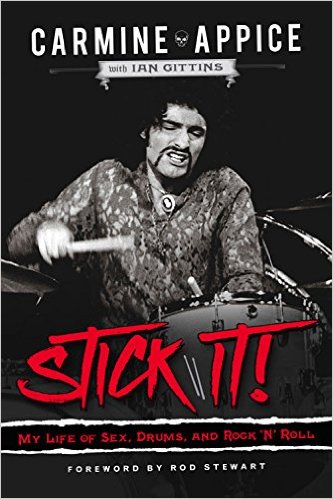 SKF NOTE: Okay. It’s none of my business. Still, I cringed when I read what Carmine Appice’s book publisher wrote about Carmine and John Bonham. Fair enough to say Bonham was influenced by Carmine, but…


You must be logged in to post a comment.