The Police Co-Founder and Drummer, Stewart Copeland, Explains His Journey from Rock to Opera
by Steve Schonberg
Posted: 01/15/2016
“It’s kind of a circle,” Copeland said about the journey that led him to compose for orchestras. “The first musical impressions you get from your parents is what they’re listening to, and then when you get to be a teenager you find your own sound and your own stance and your own hairdo, and you go for it,” he said.
“In my case, the music that my parents were listening to was Stravinsky, Debussy, and also my father raised me to be a big band white jazz drummer. He raised me to be Buddy Rich; he had me in lessons from the start, which cured me of jazz, but in fact, the Stravinsky and the Debussy stuck.”
“That music of the big orchestra doing dramatic things, very powerful, very rhythmic [things], really stuck,” he said.
WSJ.com
ARTS ANATOMY OF A SONG The Story Behind ‘Runaround Sue’ Dion DiMucci recalls how a basement party in the Bronx in 1960 inspired ‘Runaround Sue’
Dion DiMucci: We used to have these parties in the Bronx in the late 1950s and early ’60s. They were held in the basement of an apartment building at 2308 Crotona Ave., where a friend was the superintendent.
We had a portable phonograph, but we soon turned it off and began making up our own songs. I was 21 and had recorded a few hits with the Belmonts, like “I Wonder Why” and “A Teenager in Love.”
That night, I got everyone to lay down a beat on boxes and bottles and to clap hands rhythmically in time.
I then came up with background vocal harmony parts and had everyone sing them over and over. It went like this [Dion sings]: “Hape-hape, bum-da hey-di hey-di hape-hape.” With this going on, I made up a melody and lyrics….
When I left the party that night, I couldn’t let go of that riff and melody.
The next morning I called my friend Ernie Maresca, who was writing songs…and asked him to meet me at…Laurie Records…in Manhattan
The bones of the song were already in place when Ernie got there.
Ernie heard where I was going with the song, we went to work on the melody and lyrics. I had my guitar and Ernie was banging on the desk with his palms.
When we finished, I needed a solid vocal group behind me….
One night, around this time, I was up in the Yorkville section of Manhattan and ran into these five guys singing on the street. They sounded great. I introduced myself and said I wanted to use them on a record. They called themselves the Del-Satins.
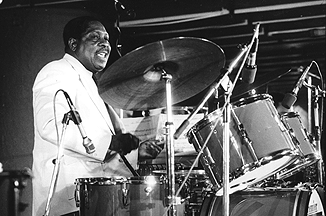
Panama Francis
I called in [Laurie’s co-owner] Gene Schwartz, and we ran it down for him.
After the guys looked over the music, they made suggestions.
There were timpani drums in the corner of the studio covered in canvas. Panama played on top of those, giving the drum a thud factor and primitive vibe. He also put his wallet on the tom-tom so it had a deeper sound.
…I wanted “Runaround Sue” to start slow and sort of pained.
Then Panama took a few sharp shots on the snare and the arrangement became pure street rock ‘n’ roll, …with handclapping by the Del-Satins.
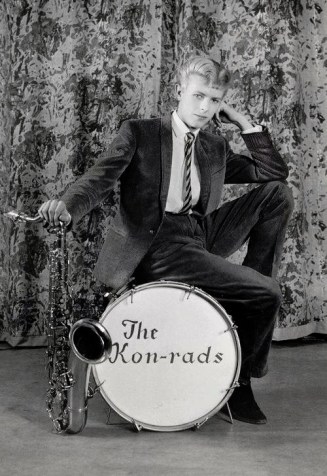
The drummers of David Bowie
By Chris Burke (Rhythm) The great sticksmen who’ve kept the beat behind Bowie
David Bowie certainly knows how to pick a great band, and his drummers are no exception. From Woody Woodmansey, currently back with the Spiders From Mars band, via Dennis Davis and beyond, we round up some of Bowie’s best drummers.
Honorable mentions must go also to John Eager (David Bowie, 1967), Terry Cox (David Bowie, 1969) Andy Newmark (Young Americans, 1975) and Hunt Sales (Tin Machine, 1989; Tin Machine, 1991).
SKF NOTE: Def Leppard drummer, Rick Allen, talks about re-learning how to play the drumset after losing his left-arm in a car accident.
DEF LEPPARD’S ONE-ARMED DRUMMER, RICK ALLEN, IS ALSO A PROLIFIC PAINTER
BY DAVID MINSKY
TUESDAY, JANUARY 12, 2016
Rick Allen
What was/is the hardest part of learning how to play drums again following the accident?
In many ways, it was quite inexplicable, the experience that I went through. I realized that I could do things with my right hand that I could never do before. At a certain point — because I kept going, I kept doing it, I kept playing — the learning curve takes over. I guess now I’m in the learning curve stage of my experience, my recovery, my forward momentum, as it were.
You’re still in the learning-curve stage 30 years after the accident?
Absolutely. I can’t help but move forward. I don’t want to stand still. I find new ways of doing old things. I’ll discover something a year or two ago that I couldn’t do, and all of a sudden, I can do it. I still have the capacity to improve.
Rick Allen Art Work
Are you able to mimic your old drumming style?
Yeah, I can mimic it really well. Where I can’t do things cleanly, let’s say, is consecutive beats on one particular drum. So then I’ll play a game of substitution. So I’ll play right hand, left foot, and then I’ll add kick drum. So what I do is I substitute one of the beats that I was going to play, or that I want to play on one drum, and I’ll substitute those beats with other drums so that I can play something that sounds very similar. It’s not exact, but it sounds very similar to what I would have played before.
What’s your drum setup like?
When I’m performing live, it’s more of a hybrid drum kit that is a combination of electronics and acoustics. All of the foot pedals that I use, everything that I used to play with my left arm, I now play with my left foot. I have a series of foot pedals on the floor that help me to do that. Then, when I’m in the studio, a lot of the times I like to play acoustic drums.






You must be logged in to post a comment.