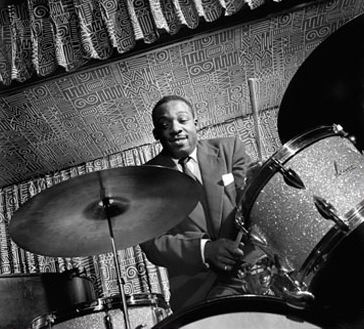
Pianist Dick Katz said in an interview with Ira Gitler, “People don’t know that [Kenny Clarke] had one cymbal. It wasn’t very big, and we used to call it the magic cymbal, because when somebody would sit in on drums, and use [Clarke’s] set, it would sound like the top of a garbage can. But when he played it, it was like fine crystal.
‘He kept the cymbal level, like a plate, and he played with a short, side-to-side wrist motion, and here are these guys — some people today — who look like they’re winding up to hit a home run to simulate the same effect.
“To play softly — strong, but at a low-volume level — is exceedingly difficult; particularly on drums. Most drummers can’t play soft because they don’t have the muscular control. Kenny Clarke used to say this: ‘You don’t beat the drums — you play them.'”
SKF NOTE: Among my boxes of drumming memorabilia come a couple of legal size folders full of writing by Charlie Perry. Charlie was a noted drum teacher and author. His best known method book, perhaps, isThe Art of Modern Jazz Drumming, which Charlie co-authored with Jack DeJohnette. Charlie Perry also had an early rock drum method book with Gary Chester.
I studied briefly with Charlie, and he was an earlyModern Drummerfan and Advisory Board member. How did I end up with Charlie’s file folders? Who knows? Charlie seemed always to have writing ideas looping through his imagination. It’s probable Charlie handed me these file folders, asking me to look them over, and do something with the contents. Do what? If I ever knew, I have forgotten.
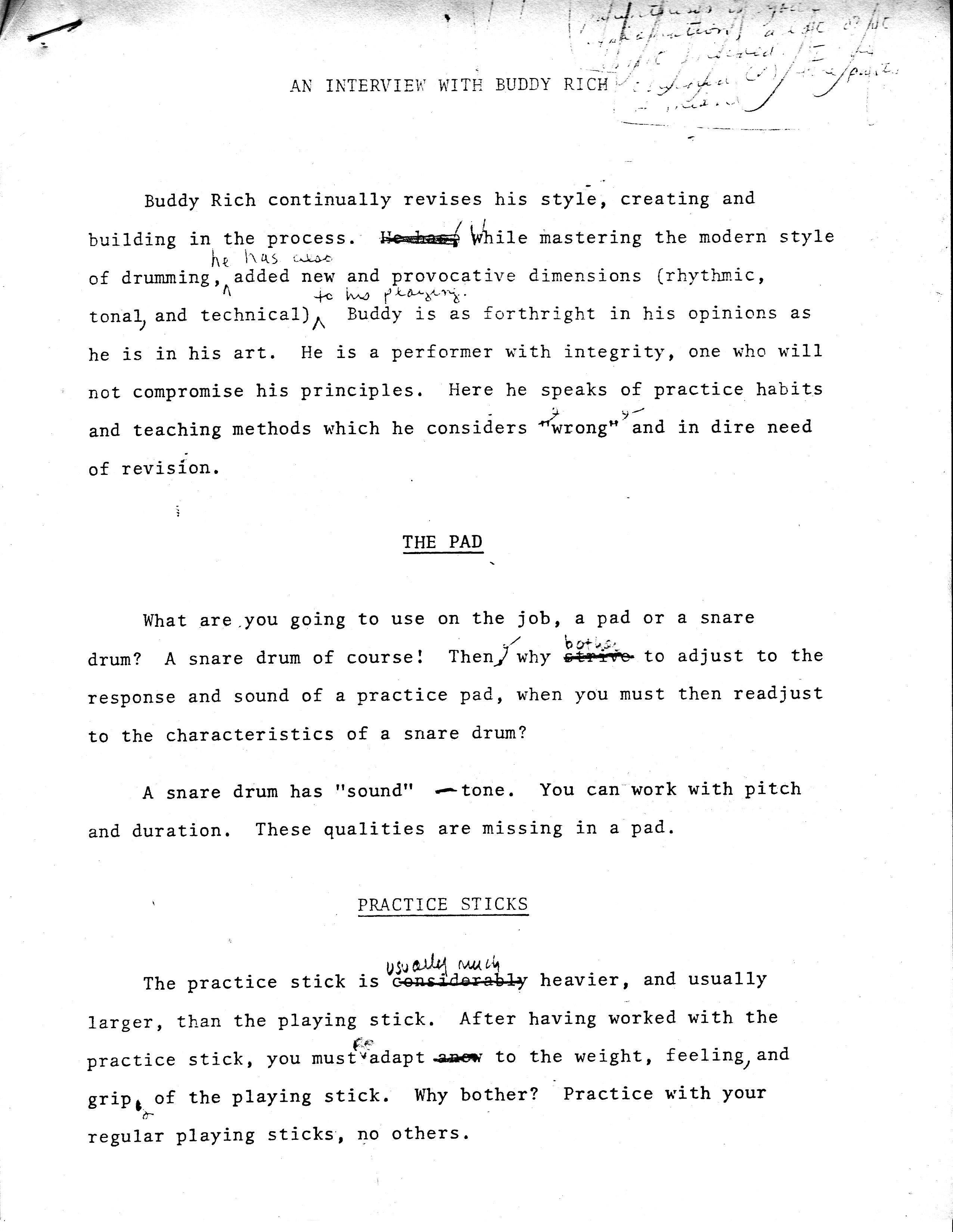
This Buddy Rich interview is in a manila file folder labeled “Q&A Drumset Question Matter.” Charlie Perry, the interviewer, has Buddy Rich‘s answers to “practice habits and teaching methods [Buddy Rich] considers wrong and in dire need of revision.” Buddy’s answers are fascinating and, in my opinion, too valuable to leave buried in a file folder.
The original interview is on photocopied 8.5 x 11 sheets of white paper. Following Charlie Perry’s introduction, this interview is formatted with subjects in underlined block letters, followed by Buddy’s answers typewritten. Charlie has then edited Buddy’s typewritten answers with a lead pencil, removing some of Buddy’s words, replacing Buddy’s words with his, Charlie’s, own words, and sometimes just changing punctuation.
I’m presenting this interview then with Buddy’s unedited words, and – in bold type – Charlie Perry’s edits of Buddy’s words. Where the interview subject title has only Buddy’s words, Charlie left them unedited.
Finally, I have no details on when or how Charlie’s interview with Buddy took place. Neither do I know if Buddy’s typewritten responses are verbatim, or if this interview was published anywhere.
=====
AN INTERVIEW WITH BUDDY RICH by Charlie Perry
Buddy Rich continually revises his style, creating and building in the process. While mastering the modern style of drumming, he has also added new and provocative dimensions (rhythmic, tonal, and technical) to his playing. Buddy is as forthright in his opinions as he is in his art. He is a performer with integrity, one who will not compromise his principle. Here he speaks of practice habits and teaching methods which he considers wrong and in dire need of revision.
THE PAD
Buddy Rich: What are you going to use on the job, a pad or a snare drum? A snare drum of course! Then why strive to adjust to the response and sound of a practice pad, when you must then readjust to the characteristics of a snare drum? [SKF NOTE: Charlie Perry deleted Buddy’s word “strive,” and replaced it with the word “bother.”]
A snare drum has “sound” – tone. You can work with pitch and duration. These qualities are missing in a pad.
PRACTICE STICKS
Buddy Rich: The practice stick is considerably heavier, and usually larger, than the playing stick. After having worked with the practice stick, you must adapt anew to the weight, feeling, and grip of the playing stick. Why bother? Practice with your regular playing sticks, no others.
Charlie Perry: The practice stick is usually much heavier, and usually larger, than the playing stick. After having worked with the practice stick, you must re-adapt to the weight, feeling, and grip of the playing stick. Why bother? Practice with your regular playing sticks, no others.
SITTING POSITION
Buddy Rich: The individual must sit in proportion to his size. If you have long legs, don’t sit too close to the bass drum and hi-hat in a cramped position. If your legs are short, move in close so you will not have to stretch and strain to reach the pedals.
Charlie Perry: The drummer should sit in proportion to his size. If you have long legs, don’t sit too close to the bass drum and hi-hat in a cramped position. If your legs are short, move in close so you will not have to stretch and strain to reach the pedals.
CLOSED ROLLS
Buddy Rich: A closed roll should sound like sandpaper being torn. It should not be a cross between an open and closed roll, each which is composed of different characteristics.
Charlie Perry: A closed roll should sound like sandpaper being torn. It should not be partly open and partly closed. The characteristics of the closed roll are different than those of the open roll.
WRIST AND FOREARM
I make most of the strokes with my wrists at a natural level (wrist level: from quarter to full level strokes).
The power and control are in the forearms and wrists. Raising your arms too high, unnecessarily, results in lost motion, loss of speed, and can interfere with your control and timing.
FINGERS
I use my fingers to supplement the motions of my wrists (fingers and wrists together, as one unit), to tighten or loosen my grip. However, there are times when I do motivate the sticks with the fingers alone.
TECHNIQUE
Buddy Rich: The concept of technique, prevalent among drummers, is ill-founded. Many of them spend countless hours practicing technique for the sake of technique itself, without regard to its ultimate purpose: a means of expressing musical thought and sound.
Charlie Perry: The concept of technique that is prevalent among drummers, is wrong-headed. Many of them spend countless hours practicing technique for the sake of technique itself, without regard to its ultimate purpose: a means of expressing musical thought and sound.
PRACTICE
Buddy Rich: I don’t believe in too much practice: your playing can grow stale. Over-practice often results in unnatural (mechanical) drumming.
Don’t dissipate your energy in practice, save it for the job.
What you should do is to play every chance you get. If you are not on a steady job (six nights a week), then rehearse with units as often as possible. But, by all means, play!
Charlie Perry: I don’t believe in too much practice: your playing can grow stale. Over-practice often results in mechanical drumming.
Don’t dissipate your energy in practice, save it for the job.
What you should do is to play every chance you get. If you are not on a steady job, then rehearse with groups as often as possible. But, by all means, play!
DRUM-SET PRACTICE
Buddy Rich: When on the job, you don’t first play with the left hand, then with the right hand, then with the bass drum, and so forth. Since you don’t play this way, why practice this way? It is nonsensical to do so.
When you do practice, use your drum-set, so your coordination between the hands and feet, and your touch (the response of your drums and cymbals to your strokes) will remain sharp, and further improve. And play as you normally do, with feeling and musical intelligence, not in a cold (strictly methodical) manner.
[SKF NOTE: Charlie Perry removed the second paragraph words, strictly methodical.]
READING AND INTERPRETATION
Most of the notation is unmarked series of notes that are unaccompanied by marks of expression). To merely “read” the part results in a dull literal playing of the notes. To convey the musical feelings of the composer, or arranger, you must inject them (the notes) with dynamic variety, phrasing, tonal effects, and such. This “coloring” can be accomplished through the rise and fall of volume, and by dividing the notes among the snare drum, toms, bass drum, and cymbals.
At the moment of performance you throw away the books and the methods: the artistic instinct of the player takes command.
THE DRUM TEACHER
Buddy Rich: Before you can be a drum teacher, you have to be a well-rounded drummer. To me, that’s someone who, in addition to formal training, has learned through doing; who has had years of top professional experience (big bands and small groups, playing dance music, shows, and jazz).
Those who teach only technique (pad technique) or reading, teach the parts of drumming in an isolated form, separated from the whole. They don’t teach drumming as it really is, drumming as it’s professionally practiced (on the job playing), with a performer’s concept, sensitivity, interpretation, and musical purpose.
Charlie Perry: Those who teach only technique or reading (reading exercises), teach the parts of drumming in an isolated form, separated from the whole. They don’t teach drumming as it really is, drumming as it’s professionally performed, with a performer’s concept, sensitivity, interpretation, and musical purpose.
Scott K Fish: You had mentioned something in International Musician about the importance of being aware of the quarter note. I wonder if you could elaborate on that.
Max Roach: See, the quarter note is the basic thing, regardless of the meter. It’s like the common denominator. If you’re in 3/8, or 6/8, or 7/8, there’s a relationship to understanding where the quarter note is [in ] that pulse, regardless of where you are.
The basic rudiment, for me, for percussion players, is that which is a drone: All four limbs playing just a quarter note. They can do it for five minutes. It’s like a drone.
Where it’s transparent…. Say you play the quarter note with the bass drum, and the foot cymbal, and the snare, and maybe a ride cymbal. Just the quarter notes itself. And have the kind of transparency in it, that you could hear all four limbs in concert [together]. One [limb] would not override the other.
It helps give you some kind of perspective on what the drumset sounds like collectively. Of course, you’re listening to yourself when you do that, and make sure that your bass drum doesn’t override your hi-hat.
It helps you also to understand the relationship between the timbres of the instrument: all these drums, these different thing you have around you.
And it also helps you physically, to know that maybe you have to come down heavier on the hi-hat. Or maybe you have to lighten up on the ride. Maybe you have to lighten up on the snare, or come down heavy on the bass drum.
I was talking [in International Musician] about the quarter note from that aspect. In understanding the timbre of the instrument, and also, of getting a feeling of all four things [limbs] working like a machine. So when you start beginning to separate things out — there’s a certain amount of transparency, no matter how much you’re traveling all over the instrument, if you are playing the hi-hat, or doing something else — everything is being heard. Everything should be heard.
I hate to hear someone pounding away, and [I] see the hi-hat moving, and [I] don’t hear what they hear, in relationship to what they’re doing. I know that the drummer onstage hears that hi-hat within the context of what he’s doing. He hears that. But all I do is see it.
That means, if he could, maybe, develop a system where he could make sure, maybe, that he comes down with his hands on some areas [so] that the hi-hat [sound] woud [stand] out, and it would enhance what he’s doing — because that’s [the sound] he means to do. Otherwise, [I] wouldn’t see the hi-hat moving.
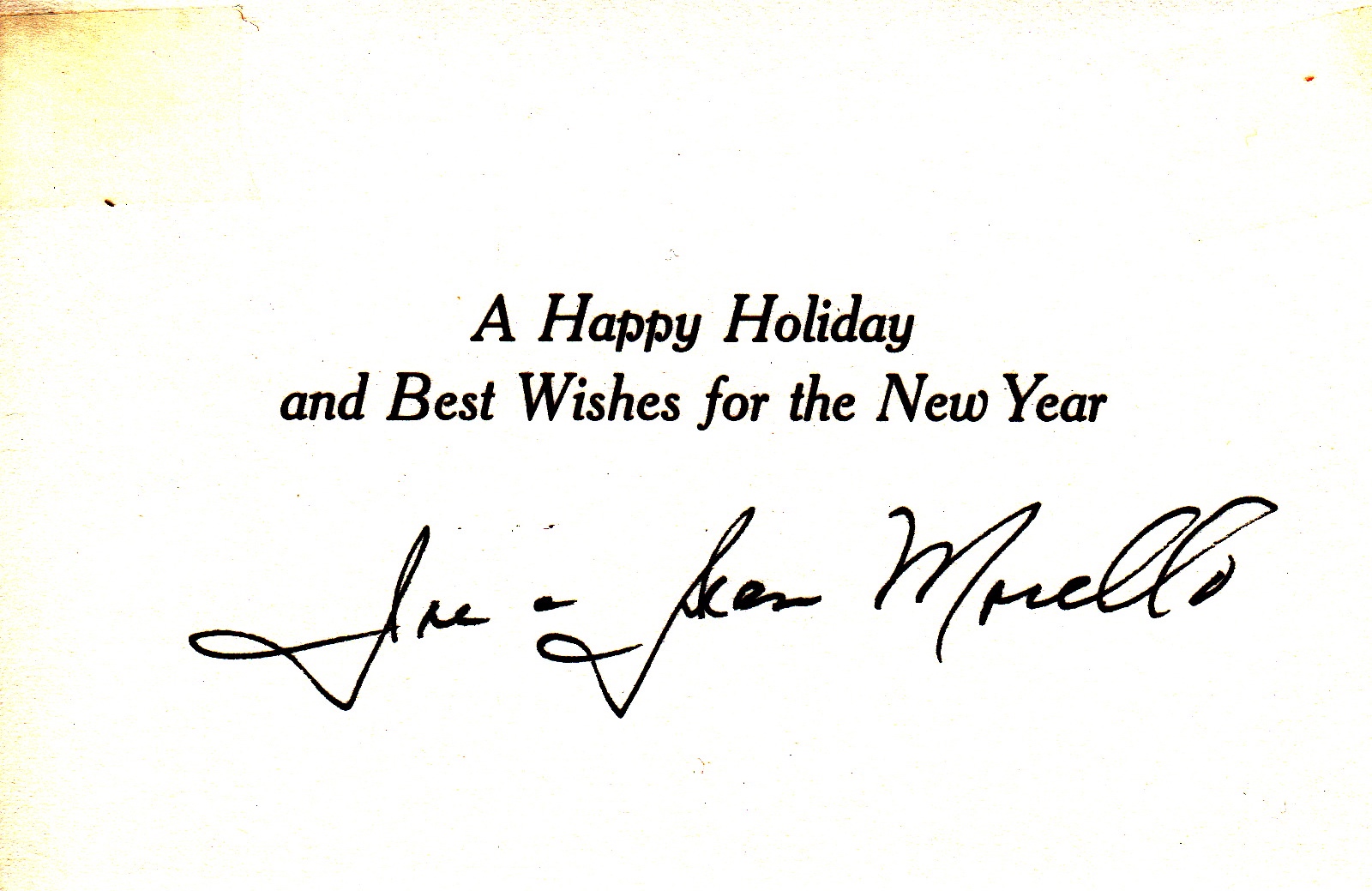
SKF NOTE: Jean Morello, Joe’s wife, was a gracious person. I imagine Joe Morello‘s life would have been much different without her. I don’t know for sure, but I am willing to bet the handwritten Christmas signature is Jean’s. The yellowing on the card inside is where I had taped the card to the wall.
Some family and friends can’t understand why I save personal items like Christmas cards. That’s okay. I save personal items like Christmas cards anyway. They always carry good memories.






 Scott K Fish
You must be logged in to post a comment.