SKF NOTE: Chip Stern‘s 1984Modern Drummerfeature interview with Papa Jo Jones is still, in my opinion, the definitive piece on the great drummer. “It could only happen once,” Papa Jo says, telling drummers born after Papa Jo’s heyday, it’s impossible to play like Jones and his contemporaries. If we weren’t there, we missed it.
Over the years, every time I hear someone singing like Frank Sinatra or like Billie Holiday, for example, I think of what Papa Jo Jones says here. Our musical pioneers are teachers compelling us to learn from them to be ourselves.
=====
Papa Jo Jones: It takes a whole lot of living to do what we did. That’s why I tell these little kids that came after us not to try to play like us, because that’s impossible. We were having a conversation about our lives. You weren’t there; you can’t know what we were talking about.
What I played had to do with who I rubbed elbows with…. We played who we were at the time. You can’t recreate that. You can’t copy that. It could only happen once. I didn’t have to play a thing. All I was doing was sitting there listening. I always was an audience, and I will be an audience as long as I live.”
Source: Chip Stern, Papa Jo Jones, Modern Drummer, January 1984
That 1938 Down Beat was among a couple boxes of old Down Beat magazines I bought in the early 1970’s from McKay’s Music Store, Davenport, Iowa. Pre-internet, those magazines were a great find for an aspiring drummer and writer. Any magazine articles, such as John Noonan’s piece on Chick Webb, out-of-print, and not included as part of a book, were tough to find.
On top of that, to have such an insightful piece on Chick Webb’s drumming technique written by a respected drummer while Webb was still living, still performing, is rare. At least, in my experience. I’ve used Noonan’s article as a source in a couple of my published writings. Almost 80-years after its publication, and 40-years after I first acquired it, here I am again sourcing Mr. Noonan’s piece on Chick Webb.
Drum heads mentioned in Noonan’s piece are made of animal skin, most likely calfskin. The first plastic drumheads were about 20-years into the future.
=====
“[Webb] spends a lot of time balancing the tone of his snare and bass drum, until they sound right to him,” John Noonan writes. “He uses the conventional separate-tension bass drum, equipped with tympani heads and the regular type of separate-tension snare drum.”
Webb’s bass drum is played “free… no mufflers or pads dampening the tone. This is a fine effect when the drum in tuned low, but calls for good pedal foot control to balance the volume of the drum.
“[Webb] watches all his drum heads closely and at the first sign of their drying out or losing their life, he changes them. The snare drum is also tuned low pitch (not too tight) using the regular type heads.
“His cymbals are the finest Turkish, both for stick work and on his High Hat. Webb like a light drum stick (7-A) for general use.
“The outstanding part of Webb’s drumming, I think, is dynamic control,” Noonan continues. “He is a past-master of the art of shading on drums. His playing drops to ‘nothing’ and up to a frenzied roar, as the arrangement demands. He does this effect with either sticks or brushes….
“[H]is drumming always remains solid (the test of the swing drummer). He makes good use of the high High Sock Pedal [sic] in the usual ways, holding four in a bar on the snare drum with the left hand — the right on the High Sock for solid ensembles, here again controlling the volume to suit. The band seems to depend entirely on Webb for these changes from piano [soft] to forte [loud].
“His use of brushes is a study in itself. Fast rhythmical figures or swishes of exactly the right length are used. This latter trick is a Webb art.
“Webb is a firm believer in the ‘play what you feel’ school. He advocates this system to all drummers. He advises young drummers to work on the rudiments for stick control and then apply their beats as they feel them, never losing sight of the type and style of the arrangement,” Noonan said.
“Every drummer is familiar with the famous Webb breaks. [T]he breaks are ad-lib…according to the arrangement of the tune. Webb looks over the arrangement containing breaks or solos for drums, and gets clear in his mind, the type and kind of break he believes will fit. Then he experiments a few times until he finds a solid idea for his solos and then phrases them in this category.
“The man is also a fine showman, combining the rare combination of virtuosity and showmanship.”
SKF NOTE: In July 1974 I bought the current issue of Different Drummer magazine in which Doug Ramsey interviewed Dave Brubeck. A few years up the road I copied a this Dave Brubeck quote on Max Roach and odd-time signatures, for a magazine story I was writing on the history of jazz drumming.
Doug Ramsey is still writing and has an excellent blog, Rifftides, which I follow and recommend.
=====
Dave Brubeck: “Max is one of the greatest drummers who ever lived. When we were young, Max and I played on the same programs and got to talk a lot. He was interested in what we were doing, and I was interested in what he was doing, because at the same time we were both getting away from 4/4 times. Our things just happened to become hits. I’ve always thought [Max Roach] should have a lot more recognition.”
Source: Dave Brubeck on Max Roach, Interview by Doug Ramsey, Different Drummer, July 1974
SKF NOTE: Art Hodes wrote wonderful columns for Down Beat magazine from his vantage point as a jazz musician (pianist) who mixed company with some of the early great jazz pioneers. Plus, I love Art Hodes’s writing. Here’s a quote I kept in one of my notebooks.
“Go back as far as you like — to the very beginnings of jazz. You’ll find that the jazz people were making this music on any instrument they could lay their hands on. Before store-bought instruments were available, they made their own; bass on a jug, fiddle on a cigar box with broom-stick handle plus gut string, washboard drums, kazoo-like toys to express the lead melody.
“People were saying something on anything they could find; the lack of a lacquered horn didn’t keep you from telling your story. That was the big thing — the story.”
SKF NOTE: Discovering music pioneers of horns, keyboards, strings, reeds; songwriters, lyricists, arrangers — this remains one of my favorite parts of studying drum pioneers. A common theme among pioneer musicians is the importance of originality, of learning to express ourselves through our instruments, of learning to communicate through our instruments.
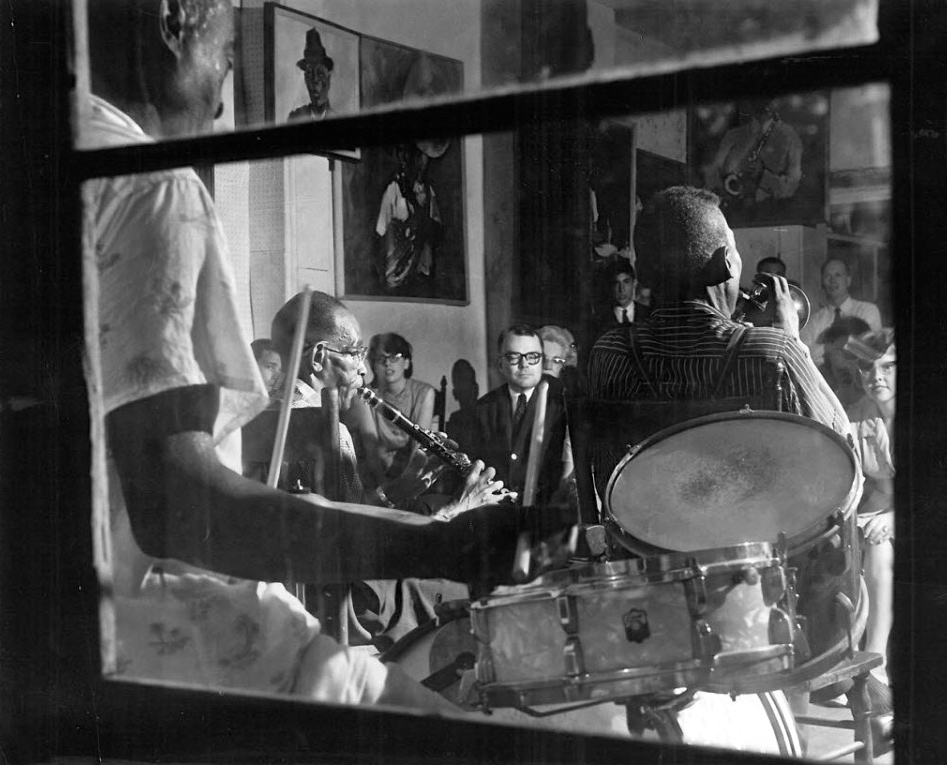
Studying Dixieland jazz led me to two Blue Note albums by clarinetist George Lewis and his New Orleans Stompers — and drummer/singer Joe Watkins. The song, Ice Cream, is from one of the Blue Note albums. After listening to George Lewis’s music, and reading the album liner notes, I bought a George Lewis biography,Call Him George, by Ann Fairbairn. Ms. Fairbarn’s real name is Dorothy Tait. And this exchange between George Lewis and a young clarinet student comes from that biography.
=====
George Lewis explained the improvisation further in response to a question from a young clarinet student.
“How do you get your tone, Mr. Lewis? And what’s the secret to your technique?”
“You got to know your horn, son,” said George Lewis. “Don’t be in too big a hurry. You can’t learn it quick. You got to know it like a baby knows its mamma’s face. It takes time.
“And you can’t do it just taking lessons. You got to play that horn just for yourself, for hours and hours and years. You got to learn to make it say what you want it to.You got to learn to make it talk, just like you learned to talk. I never been much of a talker, not me. But my horn talks for me. There’s no one can teach you that. You got to learn it for yourself.
“And there’s something else you got to remember. Don’t try to play like George Lewis. Try to play like you.”




 Scott K Fish
You must be logged in to post a comment.