SKF NOTE: Shelly Manne in 1974 names his “best” drum solo. An bit of history I saved from Harvey Siders’s column in the short-lived Different Drummer magazine.
=====
Harvey Siders: Of all the recordings you’ve made, which stands out in your mind as being your best, or most unusual, or your worst?
Shelly Manne: That’s easy. Un Poco Loco from the Swinging Sounds album on Contemporary. That’s definitely my best solo.
My first important solo was on the Kenton recording of Artistry in Percussion, but Un Poco Loco is my longest drum solo, my best, and in a sense really an invention. I’m particularly happy with the way it was constructed. It made sense in relation to what the rest of the guys were playing.”
Source: In-siders Groove, by Harvery Siders, Different Drummer, March 1974
Every so often I look online to see if I can remove any albums on my When-Are-They-Going-To-Release-This-On-MP3? list. This week, I am happy to report I removed two Tony Williams Blue Note albums: Tokyo Live, and The Story of Neptune.
Paul T. Riddle gave me his Tokyo Live CD when it was first released in 1993. But Tokyo Live was unavailable very soon and for a long time. I mailed back Paul T.’s CD to cure his Tokyo Live withdrawal symptoms.
The Story of Neptune, released before Tokyo Live, is all new to me.
I long stopped writing album reviews (i.e. I like this, I don’t like that.) Listeners will make up their own minds. (See music samples below). I will say I find it interesting that with this band, Tony’s arrangements and drumming remind me very much of Art Blakey with the Jazz Messengers.
SKF NOTE: Finding new ways to create music, to work with and learn from other musicians, and to earn a living through music — these are timeless traits of successful musicians and music industry pros. They love to experiment.
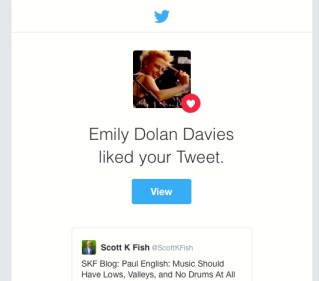
Take Emily Dolan Davies for example. When a Twitter update showed me Emily Dolan Davies “liked” my recent post about Willie Nelson’s drummer, Paul English — I wanted to write Emily a thank you. Jumping to her Twitter page for a way to contact Ms. Davies, I was intrigued by her “online drum recordings” business, and said so in my reply.
This morning, Emily’s answer arrived. Here, in part, is what she tells me about online drum recordings:
Yea the remote recording is a really great thing that I’m having so much fun with! The way it works is, anyone in the world that needs drums recorded on their track can email me over their song, I go away, record the drums in my studio and send back the stems or a stereo mix down for them to use. It’s been so fascinating and wonderful having conversations (verbal and musical) with people from all over the globe (Australia, South Africa, Sweden, America). I’ve been having a blast!
Gotta love it! Check out Emily’s web site for complete info on what she’s doing. I’m looking forward to seeing — and hearing — what happens next.
SKF NOTE: Andrae Crouch, The Winans, Freddie Hubbard, Koinonia — Bill Maxwell’s work as drummer and producer is among the best. Bill first came to my attention through my ears in 1981. No pre-judging on my part.
Introducing The Winansarrived as a new release on myModern Drummerdesk in 1981. I listened to Introducing…. on a marginal stereo system in my rooming house residence — and the music grabbed me immediately. Everything about that album was first class: the Winans, the songs, the arranging, the musicianship, and the production. The drummer and producer was a name new to me: Bill Maxwell.
Long story short, after listening and loving a few more albums with Bill Maxwell producing and/or drumming, Bill stopped by Modern Drummer on August 17, 1982 for a feature interview, published in the August 1983 isse.
My typed transcription of Bill’s interview is 61 pages — much more material than space allowed in his MD feature — it will be fun reading through again, looking for diamonds in the rough.
Here’s Bill Maxwell saying why he branched out into record producing. His first co-produced album, Andrea Crouch’sTake Me Back, won a Grammy Award.
=====
Bill Maxwell: I liked [producing] because I always felt very limited, as a drummer, being able to express the whole scope musically. When I play drums I don’t think drums as much as I do the whole band. I’m thinking the top end with my cymbals, or I’m thinking where the pulse is and what the bass is doing, with my foot. I’m very aware of all the vocal things, and the moods, and the key.
Doing drums you can’t get as fulfilled. But when you’re producing, or when you’re in charge, you really have a say in everything that goes on in every aspect of music — including the way it’s put on tape.
That was very, very interesting. It was just like a broadening of what I was doing playing drums.
SKF NOTE: Most of my published drummer interviews are edited versions of longer conversations. Relistening to the interviews while digitizing the original cassette tapes, I noticed my pattern for getting taped interviews ready for publication. To save time, I would often not bother transcribing sections of taped conversation I knew I would not use in the published interview. And then I would edit my transcriptions.
I’m now rediscovering going through my tapes and transcripts, is plenty of material — both on tape and paper — never used. But, statements or facts made during interview sessions, cut from the published interviews, sometimes have more value decades later.
This excerpt from my Modern Drummer May 1981 feature interview with Willie Nelson‘s drummer, Paul English, is a case in point. The interview back story and full MD feature interview is posted here. While standard wire brushes have plenty of alternatives today, but, for the record, Paul English’s invention “wooden brushes” is the first I ever heard of a wire brush alternative. I thought Mr. English’s “wooden brushes” were a great idea.
Finally, Rogers Drum company turned this interview into a supplemental handout for Rogers Drum dealers.
=====
Scott K Fish: I wanted to ask you about a stigma that seems to be attached to country & western drummers, and also, blues drummers. That, because they are not busy drummers, I often hear there’s nothing to playing country & western drums.
Paul English: That depends on what they’re playing. Music is music. (Of) course, workin’ with Willie (Nelson) is a lot different than working with somebody else.
But, now, working with Willie we play — without people knowing it, maybe — they may not know it, but musicians know it. We play jazz, and we’ll play pop, and we play some hardcore country. And a lot of times I like to go from a funk four beat rhythm pattern into a good country 2/4 in the same song. Y’know, it gives it a real good release, a good feel.
And also, I like to interpret the song: what does the song say?
The only thing I dislike about rock. Acid rock, I should say, not rock. But it only has one level, and that’s high. And I think [music] should have lows, and valleys, and no drums at all!
Matter of fact, Louis Bellson is the only drummer I’ve ever talked to — of any prominence, y’know — when I was younger. And he said, “It’s not what you play, it’s what you don’t play.” I’ve found that to be my inspiration, really. ‘Cause I like to build up to something real loud — and just leave out that one beat — and then maybe come back to a real soft shuffle.
Also, see, I play with mallets, and I play with the brushstick. I play with wooden brushes — which nobody has ever heard of ’cause I made ’em (laughs).
SKF: What are wooden brushes?
PE: Wooden brushes. Alright, you take some little bitty dowels. You know, wooden dowels. Take about 15 or 20 of them and cut ’em off the length of the stick. And you glue them all together in a circle, and then wrap some tape around, and sort of file the ends of them off. They’re only about one-quarter inch in diameter. And then you have your set of wooden brushes. And they’re real good when you’re doing something like, On The Road Again.
SKF: You’re using [wooden brushes] on that song?
PE: I’m using them on On The Road Again, [and] on I’m A Memory. ‘Cause I’m playing, like, 16th notes with a syncopated accent.

 SKF NOTE: Finding new ways to create music, to work with and learn from other musicians, and to earn a living through music — these are timeless traits of successful musicians and music industry pros. They love to experiment.
 SKF NOTE:

 Scott K Fish
You must be logged in to post a comment.