SKF NOTE: A music history lesson from guitarist/singer George Benson. He’s absolutely correct about Motown’s now famous studio jazz musicians.
I was surprised at first to learn how many rock musicians of the 40s and 50s were either jazz musicians, or were strongly influenced by jazz. But the more I thought about it, there was no reason for my surprise. Jazz was a demanding, creative American music. Why wouldn’t serious young musicians aspire to be jazz musicians?
=====
George Benson: I’m using my artistry to show kids who have been told not to listen to jazz. You had musicians who came out of the jazz era recording for Motown records and selling a hundred million copies and creating the number-one sound int the country. But the kids don’t know that, they don’t know that it’s not the Jackson Five playing the music behind them. Those were jazz people and we never got the credit. Now we’re stepping forward and getting the credit.”
George Benson, Bensonality, Riding on a Blue Note: Jazz and American Pop, by Gary Giddins, Da Capo Press 1981
SKF NOTE: I just came across this 1972 Timex All-Star Swing Festival with great drummers throughout.
Harold Jones with Count Basie, Rufus “Speedy” Jones with Duke Ellington, Gene Krupa with Benny Goodman Quartet, Alan Dawson with Dave Brubeck, Bobby Durham (?) with Ella Fitzgerald, and Barrett Deems with a Louis Armstrong Tribute band.
Good stuff. Harold Jones is a study in motion. He wastes none of it. Alan Dawson is on his four-piece set of clear Fibes. And Krupa is Krupa. Good music all around.
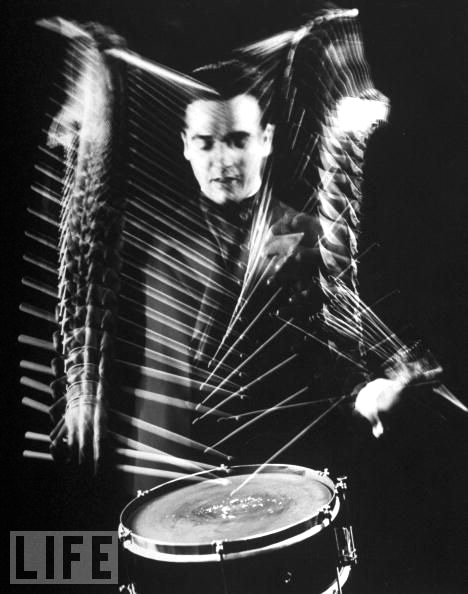
SKF NOTE: This is worthwhile drumming advice from Gene Krupa. I’ve written before on Krupa’s comments on starting “a roll or sequence of beats with the left or right hand.” Glad now to have identified the quote source.
Krupa’s comment on “how to keep the bass and snare drum in tune” is also unclear. Is Gene talking about keeping the bass/snare drums tuned to each other? Or is he talking about the importance of keeping both drums tuned well?
Either way, this is good stuff. Put it in your “Drummer Wisdom for the Ages” journal.
==========
Any idea that I knew anything about skins had to go out the window once I started hitting those [Chicago] South Side joints. For one thing, I had no idea of the wide range of effect you could get from a set of drums. I picked up from Zutty Singleton and Baby Dodds the difference between starting a roll or sequence of beats with the left or right hand and how the tone and inflection changed entirely when you shifted hands. Those Negro drummers did it nonchalantly as though it were a game.
Taking my cue from what I heard, I next went to work on the tom-toms trying to get them in tune and knowing when to use ‘em. I punched holes in them with an ice pick, as Zutty told me, until they were just pitched right.
Another trick I got from Baby Dodds was how to keep the bass and the snare drum in tune and how to get cymbals that rang in tune and were pitched in certain keys.
Then came the cowbell and the wood block.
You see, most white musicians of that day thought drums were something you used to beat the hell out of. The monotonous pattern made you feel weary after listening to it for a while. Few of them realized that drums have a broad range of tonal variations so they can be played to fit into a harmonic pattern as well as a rhythmic one.
Source: The Book of Jazz: From Then Till Now, by Leonard Feather, Dell Publishing, 1976
SKF NOTE: It’s not uncommon, in drum forums, for a drummer to ask for help understanding Elvin Jones’s drumming. Count me among drummers who spent a long time listening and trying to “get” what Elvin was doing during his solos, intros, and trading fours and eights. I wrote about my “Elvin Years” in this blog post.
This afternoon, reading Rick Mattingly’s May 1992 Modern Drummer Elvin Jones interview, I spotted a couple of Elvin’s statements in which he explains his inner process while trading fours and playing drum solos.
The subject is Elvin’s playing on Sonnymoon for Two on Sonny Rollins’s 1957 A Night at the Village Vanguard album. Mattingly asks Elvin what he hears on the track.
Elvin said, “I hear myself trying to keep up with Sonny Rollins and Wilbur Ware. Sonny began to overlap his phrases when we started exchanging fours. So I decided to overlap with him. To me, it was like a great release….
“When exchanging fours or eights, I was always thinking in terms of musical phrasing as far as the composition was concerned. I think the phrasing should never be confined to a rigid pattern. Why shouldn’t it overlap? If everyone is paying attention, it shouldn’t make any difference. You can simply pick iup from where the other person left off, and he can come in where he wants in order to complete the continuity of the phrase. You can’t play that way all the time, it depends on the artist. Sometimes they require a rigid pattern, and if it’s required, that’s what you should do,” Elvin said.
Later on in the interview, Rick wonders if Elvin sings the melody of the composition to himself when he solos.
Elvin answers, “Well, I hear the tune. …I can hear it in my mind, and I try to follow it that way, so at least I know where I am at any point in the composition. Of course, this has to be reflected in what the solo is stating, whether it be realistic or abstract, in tempo or out of tempo. It doesn’t matter, as long as the time frame is accurate. Then one can pick up from any portion of the composition and reestablish the continuity.”
Good stuff. Thank you, Rick for asking the questions. Thank you Elvin, wherever you are, for your insightful answers.
SKF NOTE: In this second interview excerpt with Simon Kirke, recorded on August 3, 1983, I ask Mr. Kirke if he and John Bonham ever compared notes about drumming and/or drum recording.
Kirke was playing drums in a new band, Wildlife, at the time of this interview. Wildlife, and Kirke’s band, Bad Company, before it, were on Led Zeppelin’s “Swan Song” record label. That John Bonham and Simon Kirke might have been together during a Zeppelin recording session seemed possible.
“John and I were great friends,” said Simon, but never together while recording. Simon does relate a story of the two drummers playing together, using two drumsets, on “Whole Lotta Love” during a Berlin Led Zeppelin concert.
“[It was] about the heaviest thing I’ve ever heard in my life,” said Kirke, who shares other memories of Bonham, plus of Bad Company recording their first album.





You must be logged in to post a comment.