SKF NOTE: This exchange is from the full transcript of my 10/12/1984 phone interview with John Von Ohlen. He was at home. I was in my Modern Drummer office in New Jersey.
John Von Ohlen: Well, we’ve got fine players in Cincinnati, and all the guys were doing was playing shows. That’s a drag if that’s all you’re doing.
We all need to make money. So I thought we ought to start a band, play what we like to play and just interest a club owner. You can usually interest a club owner real easy by saying that you’ll play for the door.
We came into the Blue Wisp Jazz Club and played on Wednesday night and got the best players in town for this kind of thing. It’s a real natural band and fun to play with. We’ve been together for about five years with the same guys.
When you start a hometown band, that day of your first rehearsal you might as well figure that those guys are going to be in that band for the rest of your life because they’re your friends. Even if you find out down the road that you don’t like the way they play — you can’t fire your friends. You know, you have to go to dinner with them. So they’re in the band. That’s it.
SKF NOTE: An excerpt from the edited transcript of my 1984 interview with Frankie Dunlop.
Just before this part of the interview we had been discussing Frankie’s formative years as a drummer. The reference here to Charli Persip and Ed Shaughnessy is from earlier in our discussion, Frankie talked about watching those two drummers in New York City jazz clubs, studying their hand-feet coordination and their use of double-bass drums.
=====
Frankie Dunlop: [T]he one who really showed me the key to coordination was my teacher in Buffalo, Johnny Rowland. When I left Buffalo to move to New York, he’d been percussionist with the Buffalo Symphony for thirty to forty years. I’ve been in New York [City] for twenty-five years and Johnny’s still with the Symphony. So he’s got to be seventy-five, eighty years old.
He’s a very good instructor. He had that love in his heart and a will to share his knowledge for a small amount of money. And he didn’t have to do that. And even though he was involved with symphonic pieces and the classics, he knew just what to teach a new drummer so he could play jazz or whatever he wanted to play.
If you asked a thousand young drummers if they wanted to study with the percussionist from the Buffalo Symphony they’d say, “No. I can’t get what I want out of a cat who’s playing in a symphony. I’m a jazz drummer.”
But my experience was the complete opposite. I learned more about coordination from Johnny Rowland at a time when even the average drummer in Buffalo thought it was a drag that I was studying with him.
He showed me all the intricacies and gave me the kingpin lessons in all the things that would lead me to coordination and independence. How to be able to play modern. And I realized from one simple little exercise that you could practice on your knees that this was the same kind of stuff that I heard [Charli] Persip and [Ed] Shaghnessy playing.
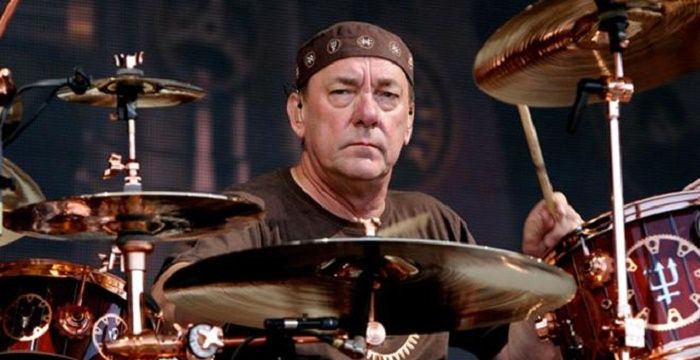
SKF NOTE: As of this writing I don’t remember where or when this interview with Neil Peart took place. The latest reference I’m finding is to the Rush song Prime Mover which was released in 1987. When I figure out the back story I will update this post. Having left in October 1983, I was no longer on staff at Modern Drummer for this interview, but that’s all I know.
What’s most interesting here, I think, are Neil’s answers to my asking him to separate his acoustic drumming from his electronic drumming so that I — and interview readers — can better understand how Neil puts those two parts of his drumming together onstage and in the studio.
Integrating electronics with acoustic drums was, in the 1980s, still a very new practice. I lacked the means to familiarize myself with electronic drum gear. I relied instead on asking drummers using the gear live and in the studio to explain using the electronics.
Scott K Fish: You’re admittedly no longer just playing drums onstage. Can you clarify what happens onstage?
Neil Peart: You have a split second decision when the synthesizer is triggered. I have them straight through my monitors so I can fall into them naturally. Either you go with it or you don’t.
If the timing is wrong, or the machine is screwing the sequence up, you ignore it.
It’s one thing to follow it through the whole song. The hard part is having them come in for bits and pieces.
You start with the timing and stay with it. The hardest is to play the song with your tempo close enough to exact that when the sequencer triggers you don’t have to slow down or speed [up]. That’s why you’re on the edge when it starts, ready to disregard it.
If it’s wrong you just block it out of your mind and play the song. It’s the same as if a click track was blasting in your mind and you’re not allowed to follow it.
SKF: What’s a tough song you play with sequencers?
NP: Prime Mover. The sequencer comes in part way through the song, goes away, then comes in later. I start the tempo as close to that sequence as I can because it’s not running at first. I’m playing in free space without even a click track.
We play through a couple of changes and then — BANG! — the sequence comes in at a dynamic point. I have to be at the right time, the same tempo as I was before, to go forward with the sequence.
We have a few songs like that. I have to be so conscious of the feel, and I have to rehearse it so much before the tour, to get those transitions and feels together. I only use headphones now on Red Sector A where it arpeggiates.
There’s no strong point of demarcation in the sequences and it’s really indistinct in an arena because it’s a bottom end 16th note pulse. If I can’t hear it really well it’s impossible to stay with it. And I have to stay with it through the whole song.
It’s the same as a click track. Once you’re used to it you don’t hear it anymore. Your beats obscure it. I’m conscious of them setting up but I don’t notice the sequences if they come in and stay in. If one sequence doesn’t happen, you play as if it were there.
Mistakes happen.
This last tour I made up a new drum solo based on horn samples, orchestral shots, and all that; carefully constructed like a song. I worked on it for days. Naturally, one night none of that worked. I hit the pads and all I got was a click.
I had to improvise the solo without it. Everybody said it came off fine. I was livid. Again, my antipathy toward machines. I feel enormously betrayed when they let me down.
SKF NOTE: This interview circa 1986-87 is from my sit down with Alan Dawson in his Massachusetts home for Modern Drummer‘s 10th Anniversary issue. I’ve posted several excerpts from the interview — audio and print — on this blog.
In this excerpt, I had mentioned to Alan Dawson that jazz journalist Burt Korall recently asked me to identify the top jazz drummers to emerge in the 1980s. Not jazz drummers still playing in the 80s, but drummers who first caught the drumming public’s eye in the 1980s. I didn’t have an answer for Mr. Korall, and I asked Alan Dawson if he had an answer for Korall.
=====
Alan Dawson: I’m not sure who we consider jazz drummers in the 80s.
AD: They can play jazz, but I think they themselves would disagree in being categorized as jazz players. I have heard a number of purists say, “No, they don’t play jazz. I’ve heard them go ding-dinga-ding, but they don’t do it right.” I guess you’d have to ask, Who’s a mainstream [jazz] drummer of the 80s? Who’s a fusion drummer of the 80s.
SKF: Years ago, were people referring to drummers as swing drummers and bebop drummers?
AD: Yes, I must admit they were. I first came up in the Swing Era, so I bridged swing and bebop. They had terms that I remember, at least locally in Boston. When they first started talking about bebop drumming they used to say, “Yeah, he’s on the kick.” I don’t know exactly what they meant by that.
When I was playing swing I’d say, “Well, that guy’s not modern. He’s not into the swing thing. He’s playing the Dixieland thing.”
As people mature they have a tendency to have more of an open mind toward the things that came before. When I was coming up I didn’t want to hear any Dixieland. I didn’t want to think about Dixieland. Jo Jones was it. If you didn’t play like Jo Jones — forget it.
Later on it was, “That guy’s still playing the swing thing. He’s not bopping. He’s not playing on the kick,” when Max Roach, Kenny Clarke, and those guys came along.
I guess there’s that kind of tendency when you’re young. I think as you mature, not only do you gain tolerance for what came before, you gain respect for the roots and history of the music.
As that happens you start playing more along with your own style of things you’ve heard in other [previous] styles.
For instance, when I started out I really didn’t want to hear the bass drum going boom-boom-boom-boom. I still don’t really hear it, but I didn’t even play it. The bass drum was the last of the three essential pieces of equipment that I got. I had the snare drum first, then a hi-hat, and I played that for a couple of years before I got a bass drum.
When I got a bass drum, it wasn’t the bottom of things to hold things together. To me, it was another voice. It was another piece of equipment. It was bigger than all the rest of them, so I had to do something with it other than boom-boom-boom-boom.
I had to learn later, when I was with Lionel Hampton, that, yes, you’ve got to learn how to go boom-boom-boom. Then you do whatever else you want to do, but if you can’t just play time with the bass drum — forget it.
SKF NOTE: Happy birthday, Elvin Jones. Earlier this week I came across a Blue Note album I didn’t know existed: The Magnificent Thad Jones Vol. 3. What a lineup of musicians.
Alto Saxophone – Gigi Gryce
Bass – George Duvivier
Drums – Elvin Jones
Piano – Tommy Flanagan
Trombone – Benny Powell
Trumpet – Thad Jones
I’ve written before of how I came to know Elvin Jones’s drumming. Understanding Elvin’s drumming took much longer, but was well worth the studying.
Slipped Again is the first track on this Thad Jones album. Elvin’s playing is classic. At first listen, Elvin had me smiling, marveling, and sometimes mentally trying to keep time during Elvin’s drum breaks.




You must be logged in to post a comment.