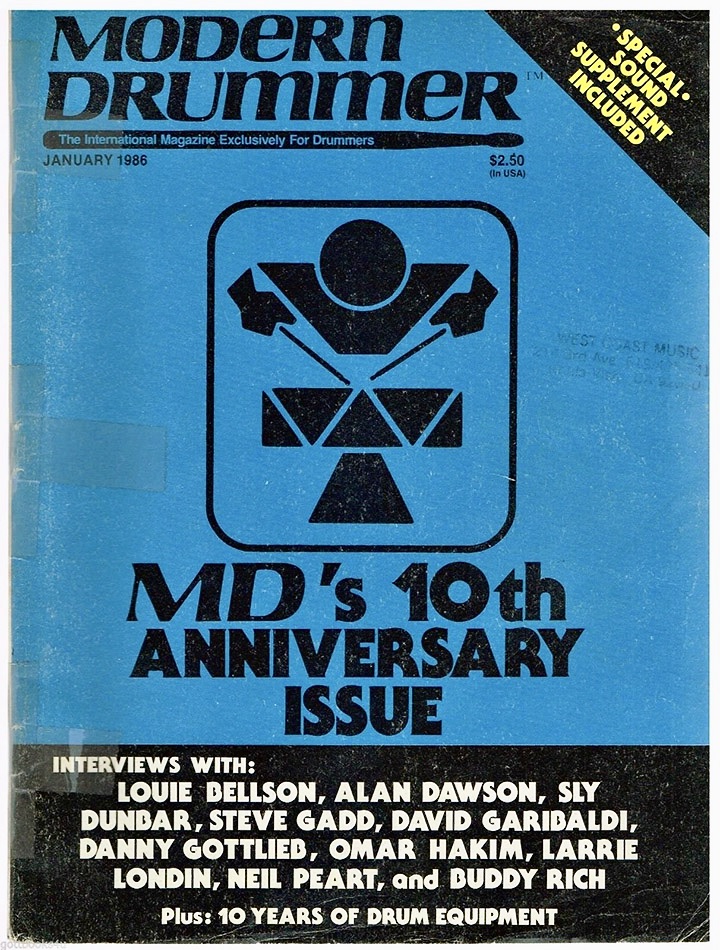
SKF NOTE: This exchange is from my interview with Alan Dawson for Modern Drummer’s January 1986 10th Anniversary Issue. The interview took place in 1985 in Alan Dawson’s Massachusetts’ home living room over Dawson-made tuna fish sandwiches.
This is part of Mr. Dawson’s reply to my question: When you were starting out were drummers separated by titles such as swing” drummer and bebop drummer?
Alan Dawson: I revered Jo Jones. I tried to play like him. Then I revered Max Roach and tried to play like him. Something happened that is inevitable if you’re going to do any kind of growing. There’s some point where you get up on a bandstand and suddenly discover that you’re playing the drums by yourself.
In your mind you can’t say, “Yeah, well this is how Jo Jones would do it,” or “This is how Max Roach would do it.” You’re by yourself and you’ve got to figure out how you do it. You have to start listening to the music and reacting on your own, rather than what you think somebody else would do.
SKF NOTE: Here are three more publicity photos from a stack of photos I accumulated in the early 1980s. I’m posting these primarily to add a few more drummer photos to the worldwide web. From my own research I know how tough or impossible it is to find photos of drummers who appear on recorded music, or who were never recorded but are the stuff of legend.
Looking today, Feb. 20, 2020, for background information on some of these bands and drummers takes time. I confess I am unfamiliar with all of these bands and drummers, but that’s not a reflection on the bands, the drummers, or their music.
Drummer Mike Braun is standing, arms crossed, front right in this Tycoon publicity photo. I found some more information on Mike Braun on Wikipedia, Linkedin, and at Yamaha Drums.
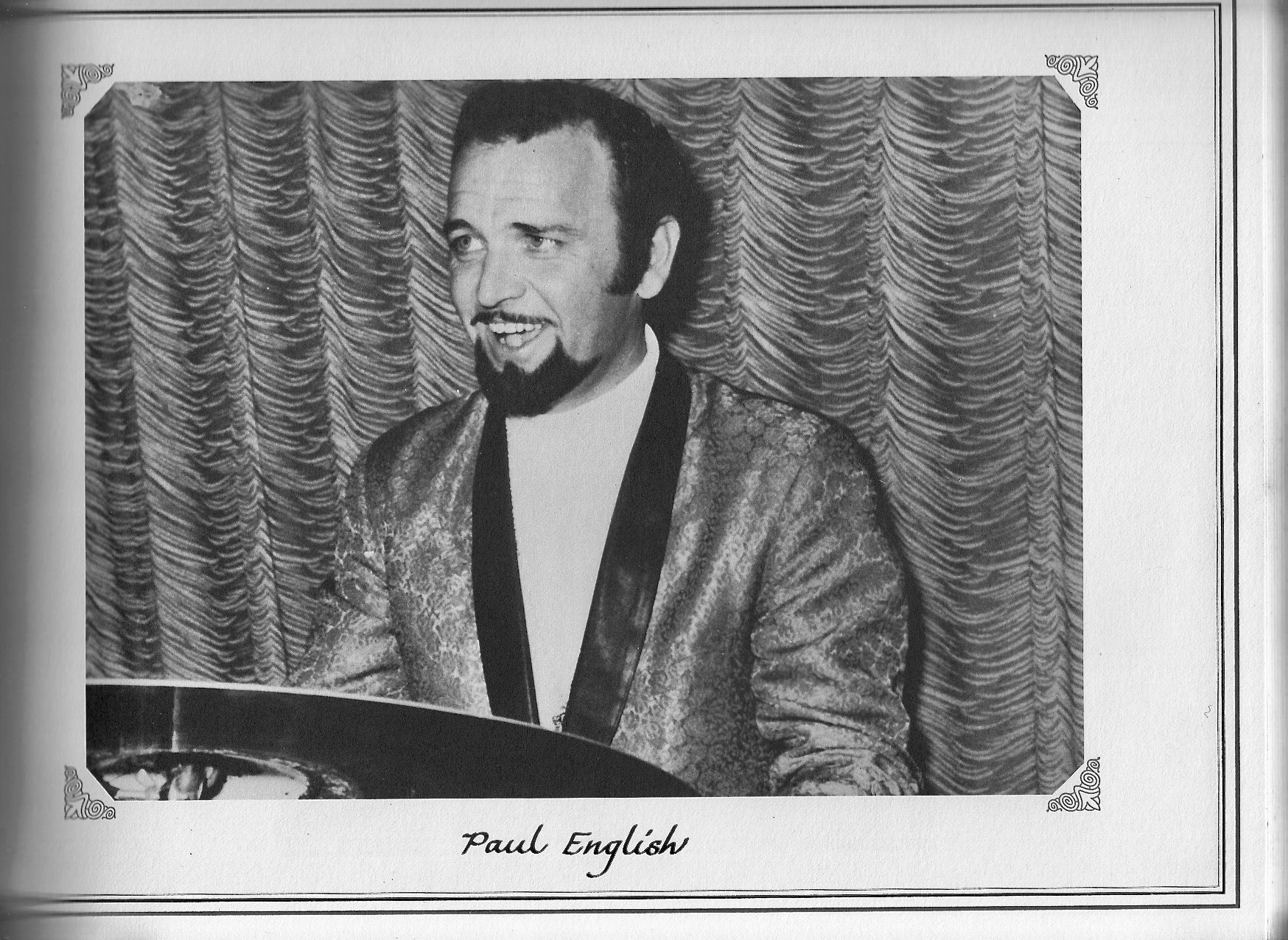
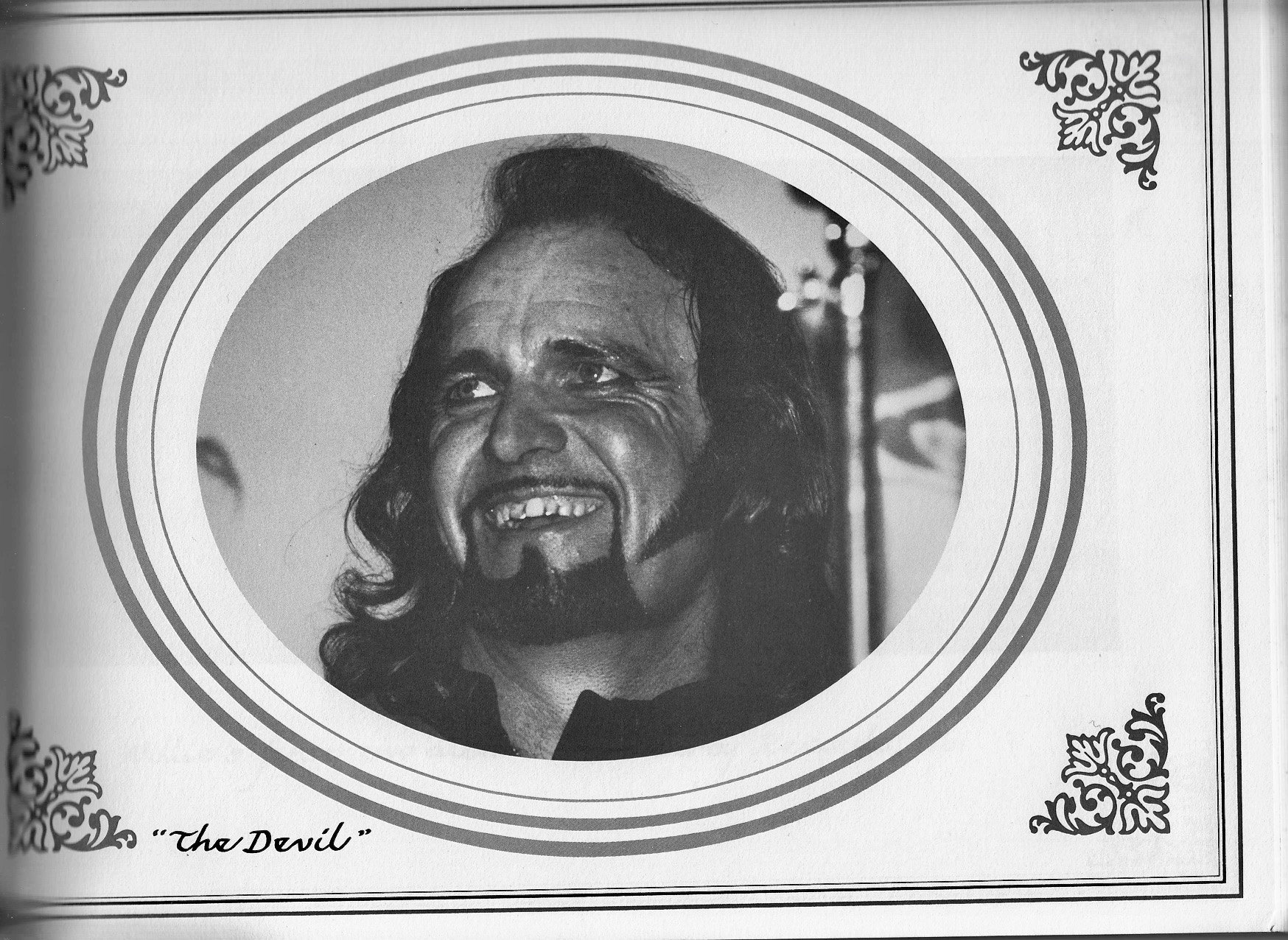
SKF NOTE: Rest in peace, Paul English, who was to Willie Nelson what Sonny Greer was to Duke Ellington. I thoroughly enjoyed meeting and interviewing Mr. English for his Modern Drummer feature interview.
These two Paul English photos are from the Willie Nelson Family Album book I’ve had since 1980.
Also, Jack Propps has an excellent Facebook page dedicated to Paul English with postings and photos from friends and families of Paul English.
SKF NOTE: This morning, revisiting email exchanges with Neil Peart, looking for one exchange in particular, I came across Neil’s March 15, 2015 email and photo describing his “new Romanian Oak drumset,” destined for Rush’s 40th Anniversary show. I’ve spent enough time working with wood, and drums, that I was absolutely impressed with the craftsmanship and beauty of this drumset.
I responded to Neil that day, March 15, and I wrote in part:
Boy, that is a beautiful drumset. A true work of art. Thumbs up to everyone involved with the design and building. Very, very nice. Of course, the bottom line is: How does it sound? But, I know if it didn’t sound first-class, you wouldn’t be playing it. It would be, “Back to the drawing board!”
Again on March 15, Neil wrote back saying:
Regarding the sound of the Romanian Bog Oak drums — I thought I would have sent you the link where I talk about that. When I play them, even playing along with the tracks, with in-ear monitors, I notice the difference.
And he included a link to the video on the making of his Romanian Oak drumset. It’s classic Neil Peart.
=====
Email to SKF from Neil Peart – March 14, 2015
Here’s a shot from my rehearsals at Drum Channel of the new Romanian Oak drumset, with the laser inlays of different woods on all logos and even the red frames (tribute to Keith Moon’s “Pictures of Lily” kit).
Don’t know if I told you that our 40th anniversary show is going to be “reverse chronological,” and in the second half I’ll be playing a replica of the late ’70s black-chrome Slingerlands — open concert toms, double bass drums — though built by DW, and with black nickel hardware.
That setup is not complete yet, but I look forward to seeing what it’s like to play!
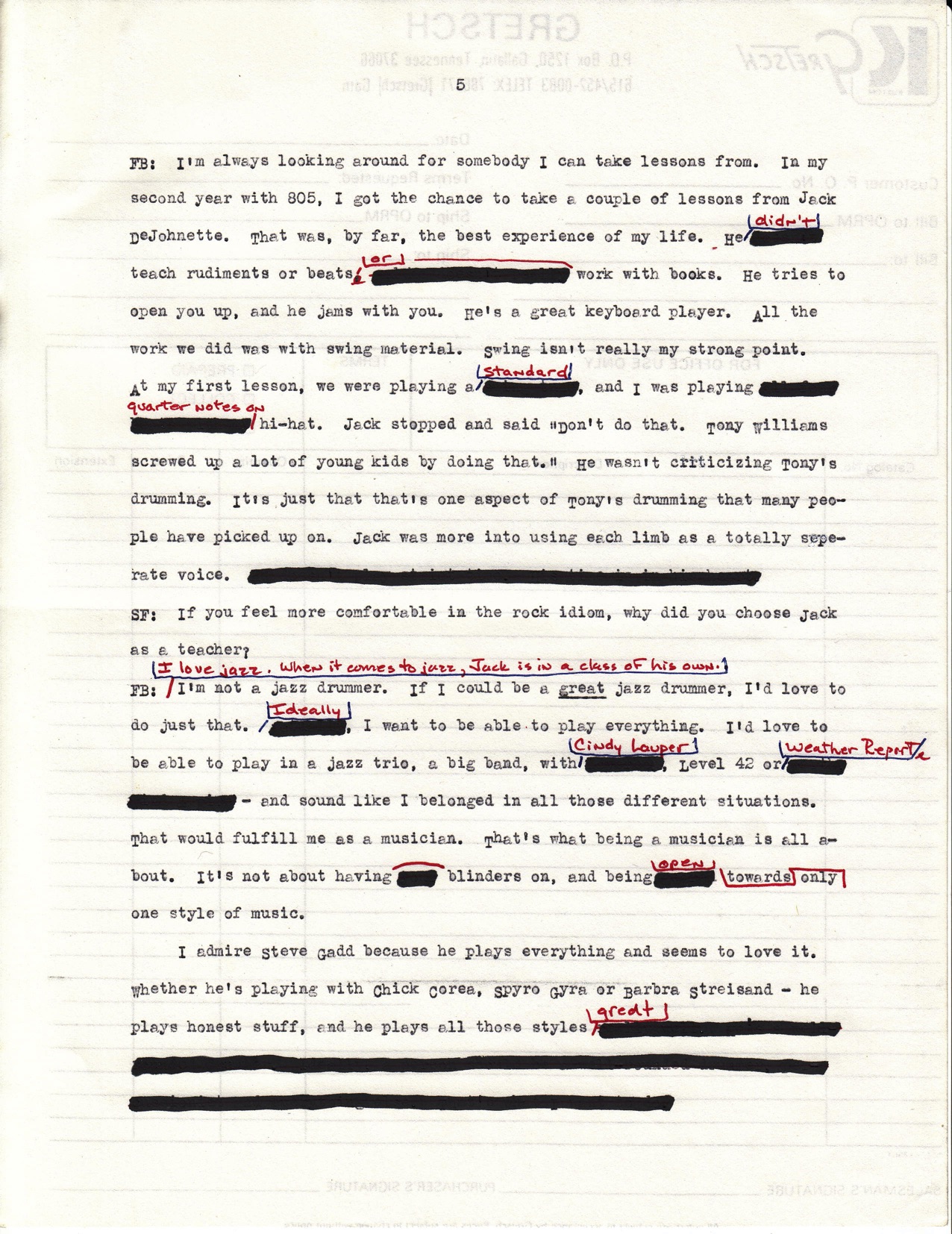
SKF NOTE: I recently uncovered this circa 1983 interview with drummer Frank Briggs. Edited slightly, I’ve retyped my original introduction below, followed by scans of my original transcript, complete with proofreaders marks.
I don’t remember to what magazine I submitted this interview. Probably Modern Drummer. I have a vague recollection of submitting it on speculation — none of MD’s editors were familiar with Frank Briggs — only to have the interview rejected.
Still, on re-reading this piece almost forty years later, it holds up. My original intro gives insight into how new electronic drums were at this time, and this, hopefully, will be of interest to Frank Briggs fans.
Caveat: In case you’re wondering — I typed some of these pages on the reverse side of Gretsch order forms. You can see the bleed-through on those pages.
=====
Original Introduction
When I was a Gretsch sales representative, most of the best music retailers from Albany, NY, all the way up into the Northwest portion of NY State, asked me if I knew of drummer Frank Briggs.
I didn’t.
“Oh, man,” they’d say, “you have got to check this guy out. He’s amazing.”
I’d ask the retailers what kind of music/drums Frank played. They’d answer, “It’s hard to say. He doesn’t sound like anybody else. He plays his own stuff.”
Then one day in a little drum shop in DeWitt, NY, I noticed a Frank Briggs poster tacked onto a bulletin board, announcing that Frank was accepting drum students.
“Does Frank Briggs live around here?” I asked the storeowner.
“Yeah,” he said.
“I hear he’s pretty good.”
“Oh, man,” said the store owner. “He’s incredible. He’s easily the best drummer in this area.”
So I telephoned Frank Briggs. Over the next few months we kept a good correspondence. He sent me a copy of his band’s (805) album, along with some tapes of solo drum music he recorded. Eventually I saw 805 perform at a club in the New London-Groton, CT area.
This interview is important for a few reasons.
First, there has been quite a bit of controversy about Simmons drums. For better or worse, most of the Simmons advocates and practitioners use them to achieve drum sounds aurally resembling mushroom clouds. BOOM!
Frank Briggs is one of the few people I’ve encountered who doesn’t approach Simmons drums as acoustic drum replacements. He’s taken the Simmons at face value. The results are always unique and often beautiful.
Second, this interview happened with Frank Briggs at a career crossroads. One decision he had to make and continued wrestling with, is strictly an electronic drum phenomenon. One that electronic drum enthusiasts would do well to think about.
The dilemma is this: You buy an electronic Simmons SDS-V drumset and create a brand new drumming concept using them. Simmons then releases an “improved” model. You sell your SDS-V, buy the new model, and then find out the electronic brains for the improved model cannot reproduce the sounds you liked on your SDS-V. On top of that, the SDS-V is no longer in production.
Another of Frank Briggs’s crossroads involved a career move. Frank Briggs is beginning his seventh year with 805. Once a copy band, 805 evolved into a band writing and performing original material. The band was discovered and released its first album, Stand in Line, on the RCA label. The album sold reasonably well, but their second demo tape was rejected by RCA for, said the label, having little or no commercial potential.
That action put Frank Briggs and the other 805 members into some soul-searching; trying to find the elusive balance between writing/performing music with integrity, and writing/performing, as Briggs calls it, “accessible” music.
As of this writing it seems 805 will be signing with a different record label for their second album.
No doubt you’ll hear more about Frank Briggs. I am fortunate he was kind and candid enough to discuss with me his drumming and music, not at his career peak, but at one of those tough times every drummer, will have to march through.








 Scott K Fish
You must be logged in to post a comment.