
SKF NOTE: This interview with blues legend Willie Dixon is a backgrounder interview for a five-part feature series, The History of Rock Drumming, I wrote for Modern Drummer in the early 1980s. None of my backgrounder interviews were meant to see the light of day. They were meant to help me piece together the general history of rock drumming and the specific history of key drummers.
Willie Dixon and I spoke by phone. My vague recollection is, I got Mr. Dixon on the phone by making the right phone call at the right time. I was in my Modern Drummer office and called some location, I don’t remember where. The location wasn’t important. I remember speaking first with a woman — the receptionist? — who suggested I speak with Willie Dixon.
Thirty years later, this interview has wonderful Willie Dixon stories about Clifton James, Fred Below, Odie Payne, Al Duncan, and the great Chess blues recordings. Willie Dixon also offers his perspective on blues drumming in general.
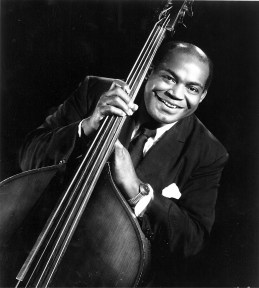
Willie Dixon
Scott K Fish: Could you tell me which drummers you worked with during the Chess sessions of the 40s and 50s?
Willie Dixon: Well, I worked with just about all the drummers at that particular time. I worked with Fred Below and Odie Payne. Al Duncan. Any number of drummers. A lot of them, I didn’t know their name. S.P. Leary. [He was] another fellow that use to work with [Howlin’] Wolf. I worked with Clifton James.
I consider Odie Payne and Below as the best two drummer we had in that time. You couldn’t skip Al Duncan because Al Duncan was raising hell too in those days. He came in my way after Below and Payne because he came out of Kansas City.
But, Clifton James was way up in there early because when Bo Diddley first came to the studio he was with Clifton James. And they had been working in the street together. That was in the early 50s.
SKF: Clifton James was the drummer on those early Bo Diddley records?
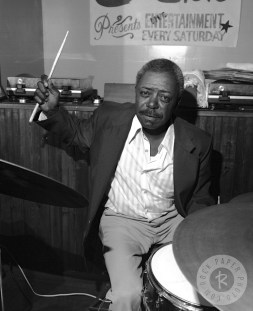
S.P. Leary
WD: That was Clifton James. I was on all those sessions for Bo Diddley on Chess Records [and] Chuck Berry also.
Below was one of the main drummers at that time, especially on the Muddy Waters and Little Walter sessions. Muddy had another fellow that died. I don’t remember his name. He was a little short guy. He didn’t work on Muddy’s sessions. Below worked on the sessions. This other guy worked with Muddy on the bandstand all the time.
SKF: That wasn’t Elgin Evans was it?
WD: No. I can’t recall the name right now. We had several pretty good drummers around here. We always kind of considered Below and Odie Payne as the best at that particular time.
SKF: Below said that he had trouble playing blues initially because he came from a jazz background.
WD: Well, what is jazz but the improvising of the blues? You improvise the blues and you got the jazz. It’s all the same thing. But, you know, guys can try to put more into a thing than is actually designed to be there. And you have to put it in there in a smooth way in order for it to be jazz.
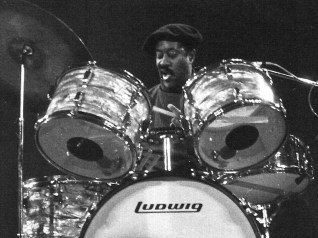
Fred Below
SKF: Below said he ran into trouble because a lot of blues musicians didn’t count in four bar phrases or eight bars. It would be more like three bar phrases.
WD: The thing about it, you know, the early blues guys at that particular time, most of them was accustomed to just plain old backbeat drums. When a guy go to putting in extra phrases in there — and they didn’t feel it.
And at that time, when Fred was trying to get it together himself, he wasn’t always putting it in as smooth. But when you can put them in there smooth, why, then you don’t have any complications.
But then a lot of those guys back in those days wasn’t even keeping the time themselves. They didn’t go by the drummer no way. Because if the drummer didn’t follow them, why, it wouldn’t be no record. Because they wouldn’t follow the drummer no way.
Some guys are like that now. But with drummers emphasizing and improvising in so many different directions, you’ve got to have your thing where you can go on by yourself and they can go by themselves. That’s what they call modern jazz. In modern jazz everybody’s going in a different direction anyway — but at the same time, all in the same line of time and harmony.
SKF: I’m curious about Clifton James because the Bo Diddley beat has become so famous and….
WD: Oh yeah. That actually was Clifton James’ idea of a beat more than it was Bo Diddley’s at that time. But after Bo Diddley got strung out with it, and got named with it, why, he just had to keep it up. Out of all the different drummer that Bo Diddley ever had, he have never had one that pleased him anymore than Clifton James.
We was up in Vancouver, Canada two or three years ago and Bo Diddley was playing, was playing with his group onstage. So, he didn’t know we came in the place. Clifton James just eased his way up there and took the sticks away from the other drummer — and Bo was out there performing.
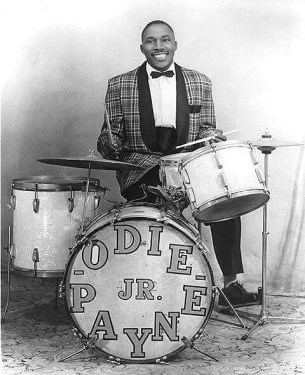
Odie Payne
All of a sudden, when Clifton James started to play, Bo got happy and said, “What the heck’s happening with the drummer?” He come to life and he looked around and it was Clifton James. He started to laugh and he said, “Hey, I thought something had happened.” He knew good and well this wasn’t his regular drummer. All of a sudden this thing stared sound like old times.
SKF: Why do you say it was more Clifton James’ idea than Bo’s?
WD: Well, you see, when they first came to the studio to record, Bo was more interested in selling himself with his particular style of playing an instrument.
But when we went to recording it, by mixing the two of them together, they had such a beautiful thing that one was actually no good without the other. And by putting them together….
And Cliff had this beautiful style. You know, they had been working all up and down the street, passing the hat over in Jewtown and everywhere together. And they just had it down together.
And Clifton James would insist on putting a lot of things in there that I don’t think Bo was accustomed to it at that particular time, But it set in there so beautiful until we started kind of featuring that drumming. And that drumming with that lick that Bo Diddley had made it a beautiful beat.
Of course, it was a working thing together. But, Cliff, I think, was the instigator of that particular beat.
Clifton was born in Chicago on State and 44th Street between State and Wabash on 44th Street.
SKF: When they did those recording sessions was Clifton playing on a full drum kit?
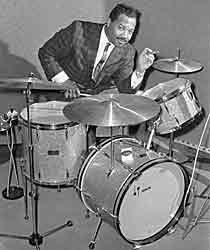
Clifton James
WD: He was playing on what he had — which wasn’t a full drum kit. There was never a full drum kit until after they got on the road. In the studio he didn’t have no sock. [Hi-hat stand and cymbals.]
I think he had a cymbal, drums, and maybe some tom-toms. That’s the reason he had so much of a tom-tom in there.
One thing about it, he had a way of getting the proper sound. Most people get on a bunch of drums and they don’t tune their drums. When this guy [Clifton James] first came up, he was tuning the drums.
I remember on a couple of occasions we wondered what he was doing. But after he got it together he could make his round of the drums with the sticks and he could play certain tunes. That’s when we really realized that he had something cooking for him. One drum would go high, the other low, and the other was medium. And he had a way that he could beat them around. They had beautiful tones to them.
SKF: Was he using a snare too?
WD: Oh yeah. He had a snare.
SKF: I wonder why Jerome Green gets so much more credit than Clifton does.
WD: Well, Jerome stayed with Bo Diddley even through the… most of it. And Jerome was only playing maracas. Then he’d try to write songs. In fact, all of them wrote together. But by Clifton James getting involved in marriage, he could’t be out there as often with them. Of course, he stayed with them a long time, you know. Until he fouled up his whole thing and then it was too late, I guess.
He’s still playing with my son’s band. The Chicago All-Stars.
SKF: I’ve noticed that when historians speak about the evolution of music they rarely speak about the drummers.
WD: Well, believe it or not the drummer have a lot to do with everything. Because if the drummer don’t set the proper patterns — why, then the music will never become right anyway.
You’ve got to have drummers that, once they’ve got the tempo, they’ve got to be able to hold that tempo and keep it together.
Another thing: A drummer has to know how to bring the guys in and out. With pushing power where it’s necessary. Roll in and out and syncopate in between. All of these things have a lot to do with it.
SKF: Do you remember the drummers who played on Chuck Berry’s sessions?
WD: Well, on the first session I’m practically sure it was Below. And I think Al Duncan go in on a couple of Chuck Berry sessions too. The Chess.
SKF: Did the Chess sessions usually go pretty smooth?
WD: A lot of times they did. And a lot of times they didn’t because, frankly, the fellows that was doing the music knew much more about it than the people that owned the company.
Naturally, doing blues — and blues is a black man’s heritage — he knows more about what he’s doing. So they would always give him a chance to do what he wanted to do. Then they’d figure it out later! It was beautiful.
Sometimes they’d get in and play rough session where nobody would get along. See, a guy would have a few drinks like he’d get more inspiration — he felt like he had, anyway — and the other fellows wouldn’t. So sometimes it would be pretty rough and sometimes it’d be pretty smooth.
They all seemed to work out pretty good.
SKF: The music that came out of those sessions was amazing.
WD: With me producing a lot of those things — and I had been singing those spiritual things and harmony things practically all my life — it give me a better understanding of harmony with the instruments. And voices too.
Then, I’d been working with Les DeMille (sp?) long before then. With Tampa Red and Memphis Slim and a whole bunch of guys. Memphis Minnie. Sonny Boy Williamson. The first one and the second one.
SKF: Did the bandleaders — like Muddy Waters, Little Walter, Howlin’ Wolf, or Sonny Boy — tell the rhythm section what to play?
WD: Well, most of the time the rhythm section had it better than they did. Because Below was a good drummer and so was Odie Payne. They both had had a lot of experience. At that time most of the guys would be kind of focusing the attention on his own thing. He was trying to get his thing to be better.
It was just how well balanced the engineer could get it together. Because each man doing his thing, and trying to do it to the best of his ability, naturally one didn’t have too much time to talk to the other one for getting…. [typing ends on page].
SKF: As a bassist, did you ever talk to any of the drummers about ideas to play in any of the songs?
WD: Oh yeah. Well, we had plenty of discussions all the time.
Sometimes some guy want an upbeat, and a downbeat, an a lick like this and a lick like that — in certain places, you know. And they’d be carrying along the rhythm in one pattern, then all of a sudden, why, you’d get ready to turn around or emphasize certain things.
You would try to get something of emphasis in the various patterns. These are the things that kept things going smooth. Because in certain things that they would be saying or doing they would always be trying to get the pattern to where the music would blend with it enough to make the words stick out.
SKF: Do you feel that those drummers’ influence on the rock music that came after them was a great influence?
WD: Oh definitely. As far as that’s concerned. Just like the old blues drummers way back there with Tampa Red. They didn’t hardly do very much. No more than keep the time, and mostly with a backbeat. Instead of rolling in and out they would probably hit a double up, or something like that, for the entrance.
Then after Below, Odie Payne and those guys started to pushing these things around, and began to triple and roll these different artists in and out — well, naturally that gave the inspiration of the rock and roll things a big push.
As you know, nowadays the average rock and roll drummer is a continuous roll thing. Everything is rolling in and rolling out — emphasizing this and emphasizing that — when it use to be just a lot of emphasis on one or two beats of the thing.
But now a drummer have a complete show of his own.
SKF: A lot of the guys don’t play with the dynamics of a Fred Below.
WD: That’s right. What one person feels as a drummer, and what one person feels as another thing, but sometimes you have to get it together so the whole crew can feel it. In doing this, sometime it creates a dissension between singers and players. But you have to make some type of arrangement to do it one way where everybody can understand it.
SKF: I think many people mistakenly feel that blues is a simple music and that, therefore the musicians aren’t really technically proficient.
WD: They think it’s so simple that they don’t have to go into no dynamics on it.
It all depends on what you’re trying to get and what kind of feeling you’re trying to inspire.
The drummers have a lot to do with any parts of the changes of music. Various changes in music themselves. Because it’s the various times, the various syncopations, the various moods, and the various ways they they play these different patterns. The various patterns changes the patterns of the music altogether.
SKF: I don’t think a lot of people realize that.
WD: A lot of things people don’t realize. It takes time sometimes. When they get to experiencing it, and they get involved, you find a lot of things that people that’s not involved — naturally, they don’t be thinking about that. They’re thinking about the enjoyment and how good it feels and what they enjoy about t.
And they don’t think about the various things the average individual have to go through to create and accomplish these things.
— end —




 Scott K Fish
You must be logged in to post a comment.