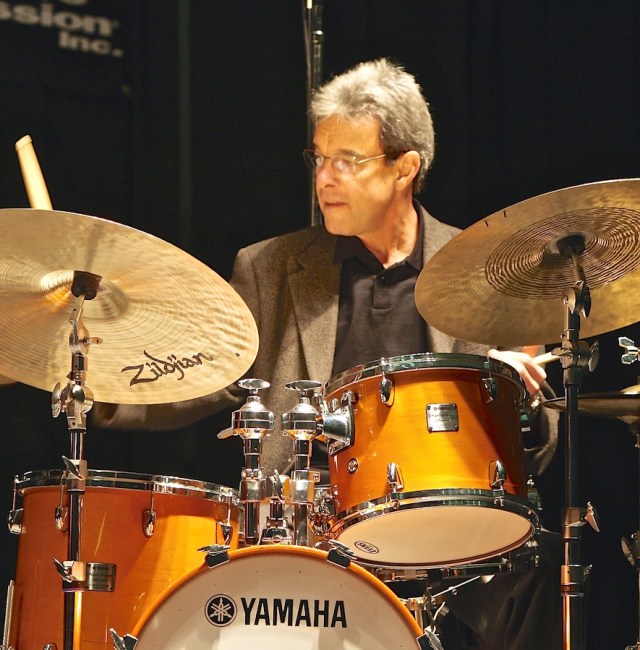
Ed Soph: You’ve Got to Rely on the Time in Yourself

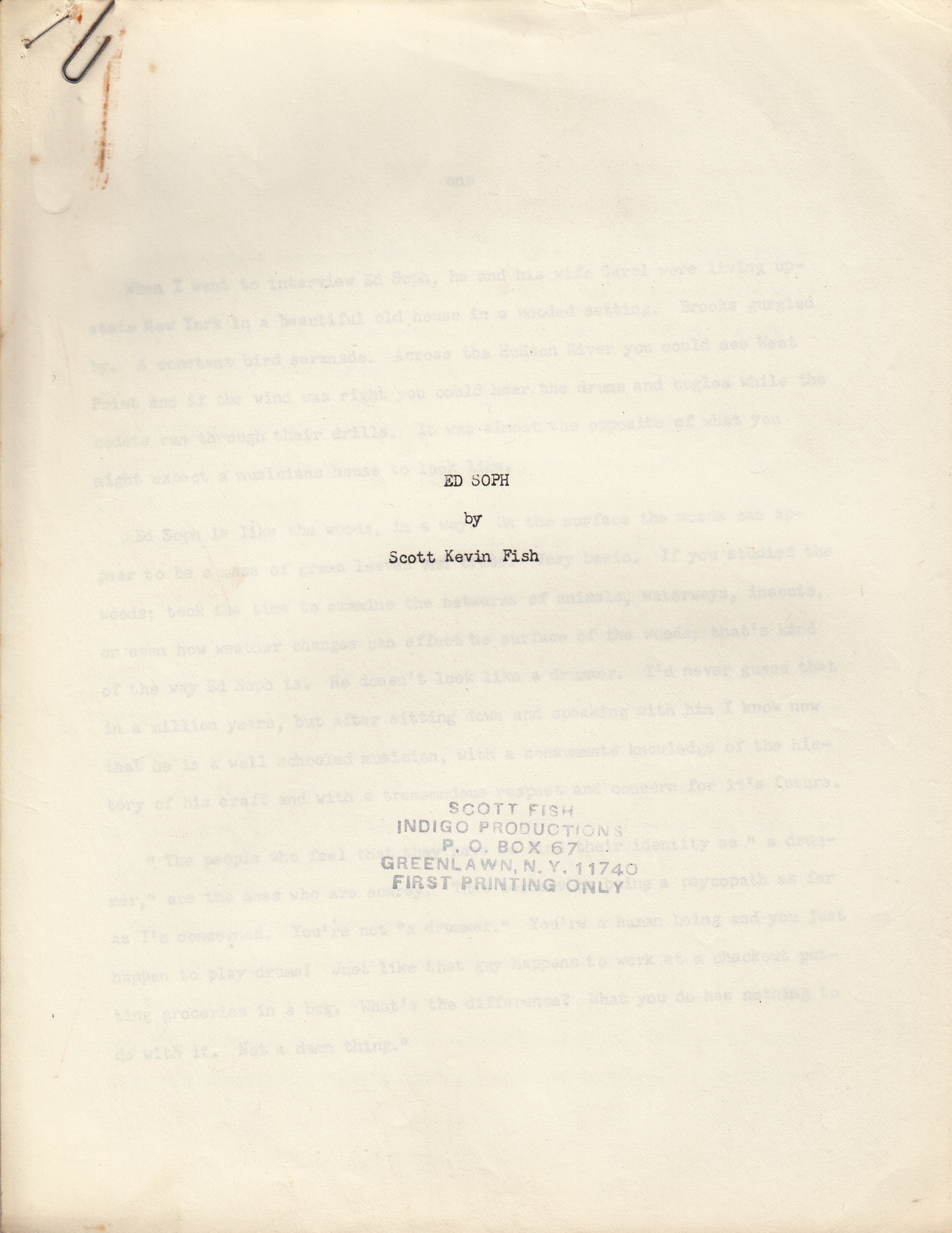
SKF NOTE: Ed Soph‘s thoughts here on big band vs small band drumming are from my undated interview transcript published as a feature Modern Drummer interview in the 1979 January/February interview. The circumstances of this interview are posted here. I was a freelance writer at the time. Ed was working primarily with Clark Terry, living in upstate New York.

My opening paragraph for this 1979 interview:

“When I went to interview Ed Soph, he and his wife, Carol, were living upstate New York in a beautiful old house in a wooded setting. Brooks gurgled by. A constant bird seranade. Across the Hudson River you could see West Point. And if the wind was right you could hear the drums and bugles while the cadets ran through their drill. It was almost the opposite of what you might expect a musician’s house to look like.”

Today I would no doubt describe the Soph’s rented “beautiful old house” as a quaint cedar shingled cottage. It was a great place in a truly beautiful remote area near Bear Mountain, New York.

I had seen Ed Soph in concert with Woody Herman‘s big band, and listened on record to Ed with Bill Watrous‘s and Clark Terry’s big bands. Now that I’m thinking about it, I had started taking drum lessons around this time to improve my ability to read drum charts.

When I asked Ed Soph about his approach to big bands vs small bands, Ed said:

Ed Soph: There’s really no that much difference. In a big band, when a soloist comes up front with just the rhythm section, it’s a small group. And when the ensemble comes in, then it’s a big band.

In  a small group situation there’s greater freedom of expression in that you can be more complicated if you want to be. No that that’s a good criterion for playing in a small group. I just feel like I have greater freedom to stretch the time or to turn the beat around — if it fits what the soloist is doing.

But that can lead to problems. With Woody’s band, when some of the soloists would come out front — like Steve Marcus, who is an adventuresome player — the rhythm section would get loose behind him and away from a very heavy metrical accent on [beats] 2 and 4. When it came time for the band to come in the trumpet players were lost. They didn’t know where their entrance [was]. They would come in all staggered because the guys couldn’t feel where the time was.

I particularly enjoyed Woody’s band when Andy LaVerne was on piano and Wayne Darling was on bass. We really got a small group rhythm section feel within the big band context.

But it took us a while to do that. We had to gradually break in the brass [players]. At first we tried taking the time out by their standards — getting away from a repetitive pulse. And it was just a train wreck.

We’d sit down with [the brass players] and say, ‘Look, you’ve got to rely on the time in yourself. You can’t be up there counting on your fingers and listening to the rhythm section. You’ve got to feel it.’

There [were] some bad feelings at first, but it worked out.

It was our fault too. We were taking a lot on ourselves, assuming a lot, going in behind a soloist and really stretching the time and expecting [the brass players] to be used to it.

Face it. Section players — Third, Fourth, Fifth chairs — in big bands are not really jazz players. They’re section players. And there’s a lot of good ones, but they get lost sometimes.
79_skf_soph_md_feature_cover_pg
Posted in SKF Blog | Tagged , , , , , , , , , | 1 Comment

Mark Herndon: Drummer? What Drummer?

herndon_mark

Mark Herndon

SKF NOTE: Former Alabama drummer Mark Herndon says, “Nobody held a gun at my head…,” but this tale of Herndon’s “non-person” status with the group is troubling. And lead singer Randy Owen’s comments about Herndon to a newspaper reporter make him sound like an insensitive jackass.

This is not the first time I’ve heard stories on in-fighting within popular bands, but such stories almost always cause me to cringe. And the story plots usually hinge on one band member being convinced by management and hangers-on that he/she is the real star of the group while the other bandmembers are easily replaceable.

It’s a great lesson for everyone thinking seriously of going into the music business.

Former Alabama Drummer Describes Conflict Inside the Band
The former drummer of country band Alabama is speaking out about his rocky relationship with the group’s other members over the years.

Mark Herndon’s new book, The High Road: Memories from a Long Trip, looks back on the many years spent on the road with the legendary band and what led to his eventual departure.

high_road_herndon[Herndon] was not considered an “official” member of the band. Lead singer Randy Owen told the Tennessean in 2013 that the decision to include Herndon on album covers and in public appearances was decided by their record label.
“They wanted the four (members) so they could compare it to the Beatles,” Owen said. “I never thought anything about it, because everybody knew Mark had nothing to do with the structure with Alabama. He didn’t play on the albums. He was just on the stage with us, as were several other people. Had we been smart enough, there never would have been four people in the pictures.”

However, no one from Sony Music has publicly corroborated these claims. In The High Road, Herndon…says he was banished from the band’s tour bus, …paid a much lower salary than his bandmates due to his contractual agreement.

“Nobody held a gun at my head and told me to stay there,” he says.

Full Story

Posted in Drum/Music News | Tagged , , , , , | Leave a comment

Can a Piece of Music Stop a Bullet?

SKF NOTE: I remember him by first name only: Bruce. An airline steward by trade, Bruce was a drummer/percussionist at heart. Somehow Bruce and I connected when I was at Modern Drummer magazine, once in person, and a few times by phone. What I remember most about Bruce was that his work took him to countries around the globe. And he loved bringing percussion instruments from one country and giving them to percussionists in another country.

Of course, the percussionists receiving Bruce’s gifts had no familiarity with — let alone formal training — the percussion instruments from foreign lands.

That was precisely Bruce’s point. He wanted to see how, say, drummers in Cuba would use unfamiliar Chinese percussion instruments. And vice versa.

Carrying his quest one step further, when Bruce’s work cycle took him back to, say, Cuba, Bruce would tape record the Cuban drummers using the Chinese percussion instruments. When Bruce returned to China, he would play for his Chinese percussion friends the tapes of how Cuban drummers were using Chinese percussion instruments.

Late last night I was reminded of Bruce’s international percussion swap meet when I came across the trailer for a new documentary on Yo Yo Ma‘s Silk Road Ensemble: The Music of Strangers. Yo Yo Ma has been creating musical alchemy for a long time. I enjoy listening to most of the music from Ma’s collaborations with Edgar Meyer, Bela Fleck, Mark O’Connor, various Brazilian and Argentinian musicians.

And I enjoy the whole spirit of Yo Yo Ma’s musical pioneering.

  • Can a piece of music stop a bullet?
  • During the Cultural Revolution my parents asked me to learn music to escape.
  • By trying to kill the human spirit, the answer of the human spirit is to revenge with beauty.

These statements heard in this documentary from Silk Road Ensemble musicians are reminders of how precious is our American birthright of freedom. Based on the many Americans who are so willing to give up their birthright, I’d say for that reason alone, The Music of Strangers documentary comes at a perfect time.

end

Posted in Drum/Music News, SKF Blog | Tagged , , , , , | Leave a comment

James Black: They Don’t Want You to Shine; You Shine Anyway

SKF NOTE – I posted the transcript of this excerpt on my blog on March 24, 2016. James Black’s words, heard in his own voice, are so much better.

I asked Mr. Black if he had a drum philosophy, based on his life experience as a drummer, he passes on to other drummers. James said drummers would have to come study with him to find out. That’s where this clip starts.

But James Black continues anyway to leave drummers with some universal wisdom.

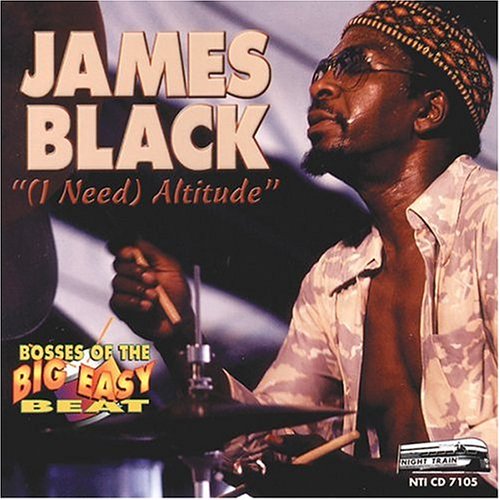
black_james_altitude_cdSKF NOTE: Here is my interview with James Black as it appears in the December 19, 1982 Modern Drummer. The interview back story is there as well.

Revisiting the full interview transcript last night, a couple of passages jumped out at me, including this one on James Black’s philosophies on drumming.

One final point: James Black told me during this interview he had plans to record an album under his own name.  It appears that never happened. If I’m wrong I hope someone will correct me. Meanwhile, in 2004 Night Train Records released a compilation CD of songs James Black recorded over the years called I Need Altitude.

Also, this morning I discovered online a James Black documentary I didn’t know about. I’ve posted the first of seven parts of the documentary now available on YouTube.

Scott K Fish: Do you teach or have you ever taught?

James Black: Yeah, I’ve got a couple of students. I take a couple of students from intermediate to a couple of advanced students. They come to me from time to time and I give them my ideas and basic philosophy on rhythms and what not.

SKF: What do you teach as your philosophy of drums? Can you elaborate on that?

JB: I can’t divulge that information now. You’d have to come to me as a student. But it’s basically a philosophy, as a drummer, about the people you meet, bass players you play with, guitar players, and how to play in a rhythm section.

Not just how to play the drums, but how to play with other people, and how not to get sidetracked. How not to get thrown off. How to keep a certain amount of concentration on what you’re doing — and do that, no matter what the other person does.

I use to depend on the bass player to play. When the bass player would fall down, I’d fall down too.

The bass player and the drummer are the foundation of the band. I got to the point where I’d say, “Hey, man. If you fall down you just fall down by yourself. I’m going to keep playing.”

I try to get my students to realize that, if you’re playing, don’t depend on nobody but yourself. If the bass player falls down, plays a wrong note, has a heart attack, passes over, or goes up in a puff of smoke — you keep playing.

That’s true. If the man goes — POOF! — up in a cloud of smoke, just keep playing. He’ll come back sooner or later.

It’s sort of selfish in a way, but it’s the only way you can play. When you hear it back on a tape you say, “Wow, man. That sounds really good.”

But if you try to play and just go along, you’re limiting yourself to the amount of expertise the other person has. You may have more expertise — rhythmically — than they do. But if you limit yourself up to the point where they are, you never grow.

You’ve got to grow in spite of them. I told my students that there’s a lot of people who are going to hear you and think you’e really great. And they’re going to become jealous of you. They’re going to try to stop you from playing. They want to shine. They don’t want you to shine.

But you shine anyway!

end

Posted in SKF Blog | Tagged , , , , | 1 Comment

Charlie Watts: No Difference in Jazz and Rock Rhythm Sections

charlie-watts

SKF NOTE: This excerpt is from my interview with Charlie Watts. It took place in Charlie’s New York City hotel room in 1982 or 1983. The Rolling Stones were on tour in America. Tina Turner was their opening act. [SKF NOTE March 5, 2017. The correct date for this interview is November 12, 1981. I found my audiocassettes that confirm the 1981 date.]

Two years before, as a freelance writer for Modern Drummer, I called Rolling Stones Records to set up an interview with Charlie Watts. The woman answering the phone told me, very matter of fact, “Charlie Watts does not do interviews.”

Fast forward. I am Managing Editor of Modern Drummer and I have established trust and friendship with drummers — including Jim Keltner. It was Keltner’s stamp of approval that prompted Charlie to agree to the interview.

I invited Max Weinberg to go with me, which he did, and Max and I were both listed as interviewers when MD published Charlie’s interview.

It was a tense interview at the start. My expectation — and I think it was Max Weinberg’s expectation — that we would interview Charlie as I had interviewed Max and every other drummer.

Max and I sat at a table in Charlie’s hotel room while Charlie wandered around the room. We were waiting for him to take a seat at the table. But, standing away from the table and not looking at us, Charlie announced, “Listen, I don’t do interviews. That’s what I told that girl whose name I’ve forgotten.”

Robyn [Flans]?” I asked. Reading the transcript just now I have no recollection of Robyn Flans trying to interview Charlie.

“Right,” said Charlie. I don’t do interviews. I mean, you can talk to me.” And then Charlie said something that remains unsettled. He was standing far enough from the tape recorder that it was hard to hear what Charlie was saying — even when listening back to the tape. I thought Charlie said, “I mean, you’ve got ten minutes and then I have to be out.” And I think Max thought the same.

I started this interview thinking, what are the top two questions I can ask Charlie in the ten minutes we have? But since the actual interview lasted hours, Charlie either said, “I mean, you haven’t got ten minutes and then I have to be out,” or he changed his mind once our interview got underway.

weinberg_max

My intention for this interview, from when I first called Rolling Stones Records years before, was to interview Charlie as a drummer, a musician. I had zero interest in any Rolling Stones sensationalism. 

Scott K Fish: [Your] transition from wanting to play jazz to playing rock — was that a tough thing?

Charlie Watts: No. It’s really the same thing, isn’t it? Really. You need better techniuqe that I have to play jazz. But what you have to do is the same thing, isn’t it?

SKF: Pretty much. What do you think is the difference between a rock rhythm section and a jazz rhythm section?

CW: None! It’s either very precise, or it swings alot. There is no difference. What is jazz? Primarily dance music — originally — isn’t it? I mean, even good jazz, even though it’s an exercise for an instrumentalist — you can still dance to it in a way.

SKF: Even a band like the Coltrane Quartet?

CW: Yeah. Well, when it’s really going it swings. It’s as loud as a rock and roll band.

Well, you see, I don’t see any difference between John Coltrane and Chuck Berry, except one writes lyrics. But they do the same thing to me. I know the difference. I know that you need to be an innovator to play like Coltrane. But Chuck Berry was an innovator as well.

So there’s not alot of difference. Except they sound different. Rock and roll is dance music. And that’s really what jazz music is like.

Photo Credit: Charlie Watts

end

Posted in SKF Blog | Tagged , , , , , , , , | 3 Comments