SKF NOTE: One of my favorite moments of my interviews with the great drummer Frankie Dunlop. Listeners can hear Frankie’s impersonation of Charles Mingus as Frankie describes a scene from a rehearsal for Mingus’s Tijuana Moods album.
The scene opens with pianist Bill Triglia using Mingus’s phone without asking Mingus. Younger viewers should remember this scene took place in 1957, long before cell phones, and long before cordless phones.
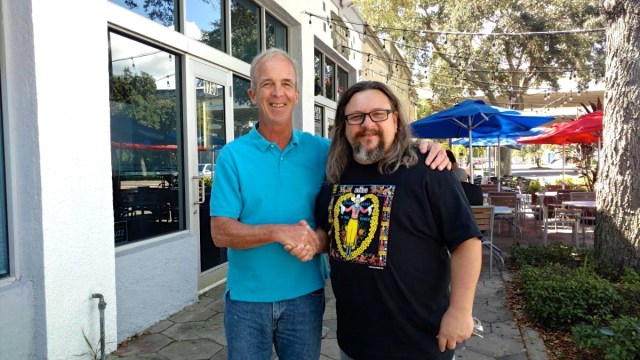
SKF NOTE: My overdue thanks to Dan Eggleston for his kindess when I was visiting St. Petersburg, FL last October. I have Dan’s permission to tell you he is “red66charger” on DrumForum.org — a terrific online gathering of drummers. I’ve been a DrumForum.org member since August 18, 2014.
Last October, under the subject line – “Scott K Fish Visiting St. Pete, FL” – I posted on the forum this simple message, “Hi – Visiting. Any recommendations for local music? Thank you” to any DrumForum.org member willing and able to help.
Dan replied with lots of insightful information that could be reprinted as, “A Drummer’s Guide to St. Petersburg.”
I had the chance to meet and thank Dan in person outside the Hideaway Cafe & Recording Studio in downtown St. Petersburg. Ours was a brief hello. Dan’s band, Cottondale Swamp, was at the Hideaway that afternoon to record a music video of an original song, Leave Me On The Suwannee.
Here’s Dan and I outside the Hideaway. And here’s the music video the band cut that day. Cottondale Swamp, Dan tells me, is performing at the Hideaway Cafe on February 11, 2017.
SKF NOTE: This is another small piece of a longer interview that took place on April 3, 1982 after an Elvin Jones drum clinic at Professional Percussion Center in New York City. Taking part in the interview were Max Weinberg, Jaimoe Johnson, me, and Candy Johnson. Candy was Jaimoe’s wife and the late Allman Brother’s Band bassist Berry Oakley’s sister.
Jaimoe has gone through a few ways of spelling his name. Today he is legally Jaimoe. At the time of this interview he was Jaimo Johnson.
This interview was meant to be included in a book Max and I were writing. Max wanted to take the book in a different direction. I didn’t. So we amicably went our own ways, with Max publishing his book, The Big Beat. Jaimo’s interview stayed with me.
Earlier in this interview, Jaimoe told us of the tremendous influence Charles “Honeyboy” Otis had on his, Jaimoe’s, drumming. Honeyboy’s musicianship had such an impact on him, that Jaimoe at first wanted to quit playing drums. I found this Charles “Honeyboy” Otis video today. The clip seems unedited, with some good camera work and Q&A with Honeyboy. At a minimum it should give readers a better sense of what Jaimoe is talking about here.
Scott K Fish: When you felt like quitting after first seeing “Honeyboy” — why didn’t you?
Jaimoe: Because I enjoyed playing the drums too much. And I just knew that, finally, after I got over the initial shock, that I had to practice. And, I mean, I was in shock for about a month.
And when I did finally come out of it…. Like, “Honeyboy” would be doing this thing between his bass drum and his snare drum, and the way he played the stuff…. I mean, like I was talking about: making what you play count.
Well, he’d play something like that little thing that Elvin was demonstrating this afternoon – the way he played A Love Supreme, and it’d be swinging. It would be swinging, man. And “Honeyboy” would be doing that stuff between his bass and his snare drum, and it would sound just like somebody’d be…
Candy Johnson: …Struttin’.
JJ: I mean, just creating that much sound out of those two instruments: the snare drum and the bass drum. I mean, he’d use his ride, and he’d use his sock cymbal. But what was going on between the snare and the bass drum was incredible.
Max Weinberg: How did you develop the ability to do that?
JJ: I asked him. I said, “‘Honeyboy,’ how do you do that?” And he showed me something. He said, “This is independent coordination.”
[SKF NOTE: Jaimoe played these two bars of music.]
JJ: [“Honeyboy”] said, “If you play that, then you can play anything.”
I tried to play that and I could not… [Using his hands, Jaimoe showed us how, at first, he could not play and sustain “Honeyboy”‘s independent coordination exercise. Jaimoe’s right hand eventually followed his left hand.]
MW: You couldn’t keep it going.
JJ: Right. You know how I learned how to play it? Kind of like [how] I learned how to play in the studios: I messed around and got myself so technically developed that I couldn’t play simple things. So, I went to my left hand, which was less controllable, which made me play more simple.
How I learned how to play [“Honeyboy”‘s] rhythm, was, I had to take my left hand and play the cymbal [part], and take my right hand and play [the other] rhythm.
MW: You reversed it.
JJ: I reversed it.
MW: You had to slow yourself down.
JJ: I had to slow myself down to hear what the hell was going on. And, just to hear it, I didn’t even play the ting-ta-ting. I just played te-te-te-te [quarter notes]. It was like, if you hear something, you can do it. Don’t think about it.
MW: Right. Just play it. That’s true.
JJ: Just do it. And it’ll always come out right.
MW: Ear training, I guess. You have to be able to hear it.
JJ: Yeah. And that simple little thing, man…
CJ: It’s a gift.
JJ: …I learned how to do that and, no kidding, just like [“Honeyboy”] said, everything else, independently – things that I wanted to play – they just come out. Because my rudiments, they were fine. I was hanging out with the 507 Band Squadron in the Drum and Bugle Corps at Keesler Air Force Base. Shit! They were number eight in the nation. So, my rudiments, man was bad. Bad!
I’ll tell you, they got so bad that when I stopped practicing…. One day I was practicing, man, and I just saw my hands blur in front of my face. I’m not kidding you. The sticks was moving so fast that my mind couldn’t control, I mean, my mind couldn’t comprehend the way my hands was moving. Damn right.
MW: When was that?
JJ: That was right before I started playing with the Allman Brothers. About ’68 or ’69.
MW: Did you practice a lot then?
JJ: Oh shit, man. All day. And then played from 9:00 [p.m.] to 12:00 [a.m.] at this place called The Vapor Club. A motel was next door to it. And next door to the motel was The Beach House, [which was] the other club.
One night we played from 9:00 [p.m.] to 1:00 [a.m.], and then we went next door. I used to take the drums and just tote them. [The other band members] had to put the amps in the van and drive it around. But, I’d take the drums with a couple of guys, and we’d just walk out the motel over to the other place.
Well, we was playing from 9:00 [p.m.] to 1:00 [a.m.], and then from 1:00 to 6:00. And then when I’d get home I’d sleep until maybe 8:00, maybe 11 o’clock. I never slept ’til 1:00 or anything like that unless of just too much wine.
But, Lamar [Williams] and I would practice. I’d get him over there and put Coltrane and Elvin on. I’d put Miles on At the Blackhawk. Just stuff like that. Stan Kenton and that kind of stuff. And we’d sit there and we’d practice. We’d play right along with the record, and developed a lot of ideas from it, and I learned how to play the bass drum to Lamar.
While teaching myself how to play jazz I’d play what jazz drummers basically play, say, what I was listening to then. Because it didn’t have…. It had thing up here going and everything, but, like, with the thing I was talking about with Honeyboy; the thing that would be going on between the snare and bass drum…. Because, of the more extensive blues music — jazz, they call it – the bottom part was not as effective.
SKF: You’re talking about the bass drum?
JJ: Right. Because the bass drum didn’t really keep any time pattern in jazz. Whereas, in rhythm & blues, or blues – the more pure form of jazz – there is this rhythm thing that goes on.
MW: So, the bass drum is keeping time?
JJ: Right. See, it’s swinging. It’s keeping the groove and it’s swinging.
That was the lack of…. That was the most weird thing in those days. Cats would say, “Can you play more snare drum and bass drum?” And I didn’t know what they were talking about.
So I got to listening to Lamar. And Lamar was really into [James] Jamerson then, the cat who played with Motown. I got to listening to [Lamar’s] bass, and I get to the point where I’d play little things with [Lamar] on my bass drum. Then all of a sudden I realized that that was what they were talking about. That was the part the bass drum needed to play.
MW: With [what] the bass[ist was playing] instead of against it?
JJ: Well…. Not just flapping around.
MW: Something continuous?
JJ: Yeah.
MW: Like a pattern.
JJ: Right.
MW: So that kind of moved you from playing freer jazz to more rhythm & blues.
JJ: I wouldn’t really call it freer. I think everything is free, really. Because I’ve learned more about my instrument. And I really haven’t learned a damn thing about it except how to control it a little bit.
Now I’ve got to produce, to practice what I’ve learned about this instrument. Now it’s time for me to start playing it.
SKF NOTE: Watching current online drum videos now and then, I was starting to think I was alone, scratching my head at some of what passes as wise counsel from self-styled experts on how-to-play drums.
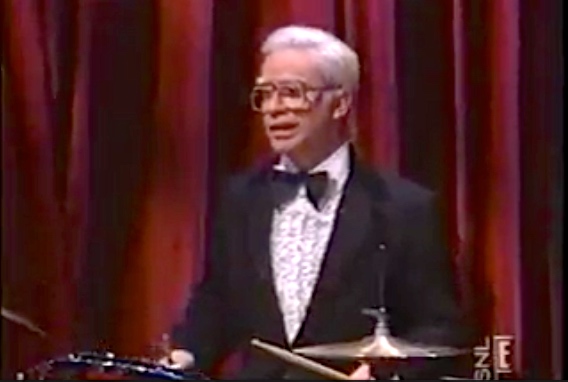
God Bless Fred Armisen! I suppose it takes a drummer to really know drummers. The moment I first saw Fred Armisen on SNL as senile drummer Mackey, botching rimshots behind “the best washed up lounge singer ever, Buddy Mills,” I knew Fred was a working nightclub/bar band drummer. He had to be. His insight is right on target. [Minors or Parents of Minors Note: The language on the Mackey video is coarse in spots.]
In mid-December 2016, thanks to Klaus Kinski’s story at BrooklynVegan.com, I discovered two more Fred Armisen drum characters: Jenns Hannemann offering “Really Complicated Drumming” drum video lessons, and also, Victor Benedetto offering video “Drum Tips.”
I know now I’m not alone. Thanks, Fred.
[Minors or Parents of Minors Note: The language on this video is coarse in spots.]
SKF NOTE: Excerpted from my late 1983 or early 1984 interview with Freddie Gruber. I don’t know how much, if any, of this excerpt is in Modern Drummer’s Focus on Teachers interview, but this excerpt differs in one respect. These are Freddie’s words verbatim. The MD interview was somewhat edited.
This exchange took place at Buddy Rich’s kitchen table in Buddy’s NYC apartment.



 SKF NOTE: Watching current online drum videos now and then, I was starting to think I was alone, scratching my head at some of what passes as wise counsel from self-styled experts on how-to-play drums.


You must be logged in to post a comment.