
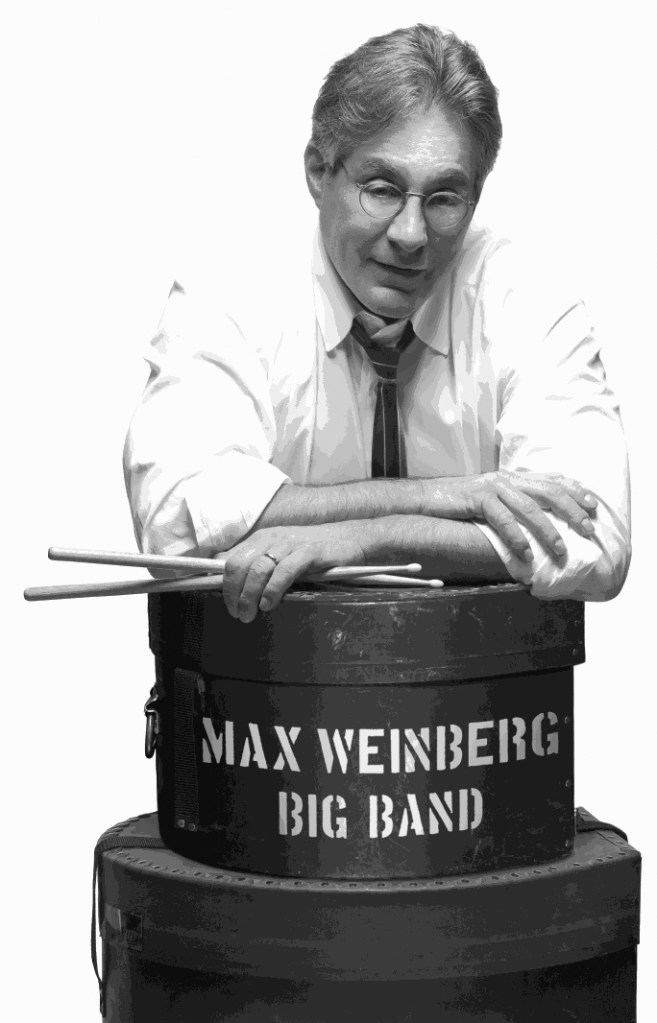
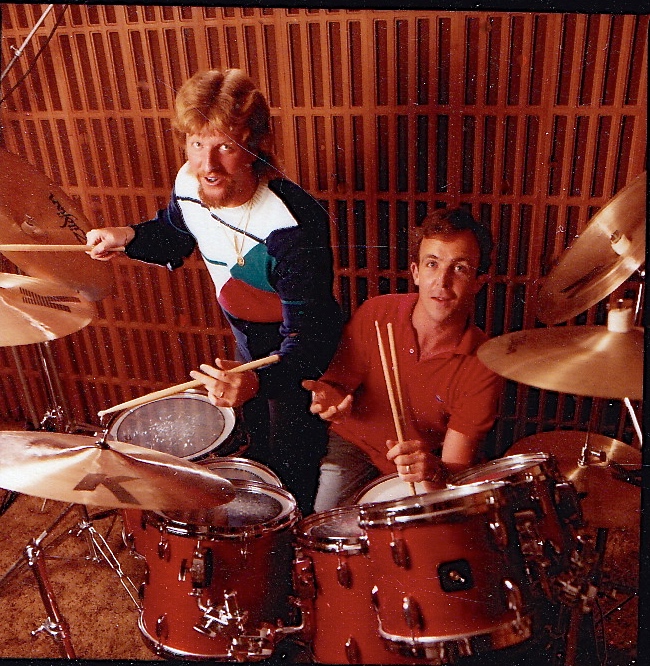
SKF NOTE: This three-way exchange with drummers Max Weinberg and Paul T. Riddle and me. In the early 1980s, Max and I were collaborating on a drum book. Part way into that project, Max wanted to take a different direction I found less appealing. We ended our collaboration on very friendly terms.
Max went on to write and publish his book of drummer interviews, “The Big Beat.” In that book’s Acknowledgement Max thanks “Scott Fish, for his encyclopedic knowledge of drumming and for his help with the Russ Kunkel chapter.” Max and I interviewed Russ Kunkel, Andy Newmark, Jaimo, and Paul T. Riddle for our first book idea.
Russ became part of “The Big Beat.” I have the Andy Newmark, Jaimo, and Paul T. Riddle interviews.
This exchange between Paul and Max about the role of a drummer in a band comes from Paul Riddle’s interview. Max was still drummer with Bruce Springsteen and the E Street Band. And Paul was still going strong as a founding member of The Marshall Tucker Band.
We were in a hotel room for this interview, either in New Jersey or New York. Beyond that I have forgotten the details.
=====
Max Weinberg: What do you think the role of a drummer in a band is?
Paul T. Riddle: To be a team player. Be musical. Listen to the tunes. The song will tell you how it wants to be played.
MW: That’s a simple and obvious truth that takes years and years to learn.
PR: We all want to play musically. And we all want to be a team player. And we all may have said we were being a team player when we were still thinking drums, drums, drums. Thinking just as a drummer.
And you’d listen to it back and you were still listening to it as a drummer and not as a whole musician, and not as a song. When you can really truthfully start doing that with yourself I think that’s the big step in reaching for the door handle.
MW: I try to listen to lyrics as much as possible.
PR: Me too. I like to learn the lyrics first thing.
MW: That can give you a real clue to what to play.
PR: Exactly.
MW: Especially when you’re in the studio and you’re trying to make that statement that’s going to last.
PR: Exactly. And cover that vocal. Exactly. And you can find the holes easier that way./
MW: I’ve been playing with Bruce [Springsteen] for nine years. We were talking about a month-and-a-half ago, and I said, “It really helps me to know the lyrics.”
He said, “Well, I never knew that.” He figured people never listen to his lyrics.
PR: I had Toy [Caldwell] print me up the lyrics to the songs on “Dedicated” before we went into the studio.
MW: That’s important. Because I always look at the rhythm section as like the mountains and the desert. The words and the vocal are sort of the action going across in front of it.
PR: Frank [MTB bassist Franklin Wilkie] and I always say we’re painting a great road for them to ride on.
MW: That’s it. That’s really it.
PR: We always like to give them a real nice road to ride on.
MW: Are you paranoid when you play?
PR: Only when Fish is looking at me. The sucker jinxed me the last time I was here. I went down there in the bright lights and the cameras, and then your ass over there going, “Boy, is he sucking tonight. He’s really sucking bad.”
But have fun when you play.
MW: What if you’re not having fun? What do you do if you get in a situation where you think, “Well, I’m not really grooving here.”?
PR: If you’re having a bad night – relax. Take that deep breath. I always try to relax my shoulders. Danny was talking about how he can look at me from behind and tell me – especially if I’m playing matched grip and I cock that shoulder up – if I’m a little tense. There’ll be that difference, and he can tell. You can feel that more than anybody else, I guess. I used to crouch real bad. I’m still pretty bad.
Scott K Fish: You crouch forward a lot.
PR: Yeah. I’m better though.
MW: We were sitting on the side watching and I said, “Boy, he looks just like a jazz drummer.”
PR: That’s what everybody used to always tell me. I didn’t think I looked like that anymore because I think I’m sitting up a lot better than I guess I am. But I try to take that deep breath and relax if you feel like you’re having a bad night.
And play the song. Go back to the song. Listen to the lyrics and get into the music and quit thinking so much about what you’re doing.
I find if I’m having a bad night I start zeroing in on every little thing. Whereas, when you’re having a good night, and you drop a lick, or something doesn’t sound quite right, you just laugh about it and you brush it off. It’s no big deal because you’re having so much fun. Who gives a shit?
Then if you’re having a terrible night, every little thing starts snowballing. You start thinking about all this crap and it starts snowballing. That’s why you’re sucking. Because you’re thinking about every little thing.
I used to do that a long, long time ago.
MW: I get into that in the studio. But there’s so much shit that goes down in our show. We don’t do any soloing or jamming, except for like eight bars. It’s all songs.
When I got in the band that threw me because I was really into jamming. And suddenly, here I don’t feel like I’m playing anything.
PR: That’s when you really have to get into the song. A team player. It’s fun to mess around, and it’s fun to play a lot of notes. We all like to do that. But when you get into laying it down and filling that pocket, that’s as much fun too.
MW: If you get into that head.
PR: If you find that pocket and you put a smile on your face, and really get into that groove like the way Russ Kunkel does that. He loves it. And that’s why it sounds so good. I’m sure. Get into that as much as you do a five-stroke roll or whatever. Or some hot paradiddles or something.
It just depends on where your head’s at. It all goes back to attitude. If you have a good attitude about the band, the music, and laying it down, then you’re going to have a great time playing that song.
As I was growing with our band, after awhile I started realizing, “Well, shit! Just lay it down on this country song and listen.”
And I’d just get into singing the song, just singing along and playing with it. Because I know later on in the set you
re going to have one to mess around.
Just be patient and be a team player, and take the set as it comes. You don’t have to say everything you’re going to say in one song. I used to try to do that a lot.
MW: I used to do a thing where you do a record – and I wonder if you’ve had a similar experience – your songs are pretty varied.
Our songs are basically all the same. Very similar, I’ve found. I find that I’ve been playing very similar things because all the arrangements are the same. Two verses, a chorus.
Then I thought, well, it doesn’t matter if I play the same thing in every song if that’s what’s right for the song.
PR: Exactly. If that’s what the song is saying – then play it.
MW: I just realized this in the last month.
PR: It’s just all in attitude.
MW: I was trying to play different things in every song.
SKF: Al Jackson never really varied that much.
MW: Well, that’s the perfect example of that. Because he plays nothing, but he plays everything.
PR: Exactly. Listen to the song.


 Scott K Fish
You must be logged in to post a comment.