SKF NOTE: His daughter, Serena, has started a medical fundraiser for her father, drummer Jimmy Cobb. As of this writing they have raised $27,000 toward their goal of raising $200,000. I made a donation. The letter below is an edited version of Serena Cobb’s full plea on herGoFundMepage.
Thank you for checking out Ms. Cobb’s page and for doing what you can, including spreading the word, to help Jimmy Cobb.
=====
My name is Serena Cobb. I am raising funds for my father, legendary jazz drummer, Jimmy Cobb in his time of need.
My father started playing professionally at 18 years old. He recorded the highest selling jazz record in history “Kind of Blue” at age 30, and as we’ve just celebrated his 91st birthday this January, he has recently released two records and is still doing everything he can to give himself to the music.
Mentally and spiritually my father is as youthful and energetic as ever, but for the past 2 years he’s been dealing with some medical issues that have been causing severe challenges for him physically. Unfortunately he has been unable to receive proper treatment due to financial struggles. Although he has been pushing himself to work in order to get some medical attention while still maintaining daily life… it just isn’t enough. We’ve often been left in a position to have to choose between medical attention and his basic necessities. As the days pass, he continues to become more and more in need of assistance.
As a humble and very private man who has always been the strength in both his family and his community, he wouldn’t dare complain or ask for help, however; in order to care for him properly, our family is in dire need. He has been doing his best to fight through but I’m sad to say that the work he loves so much has become more than he can handle at the moment.
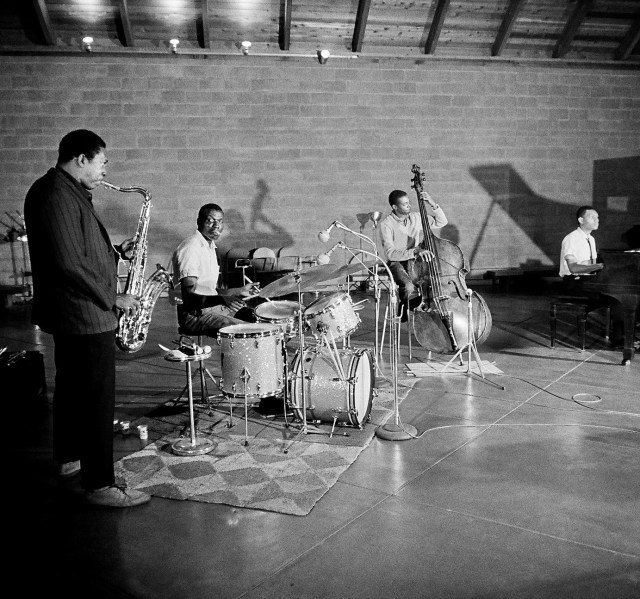
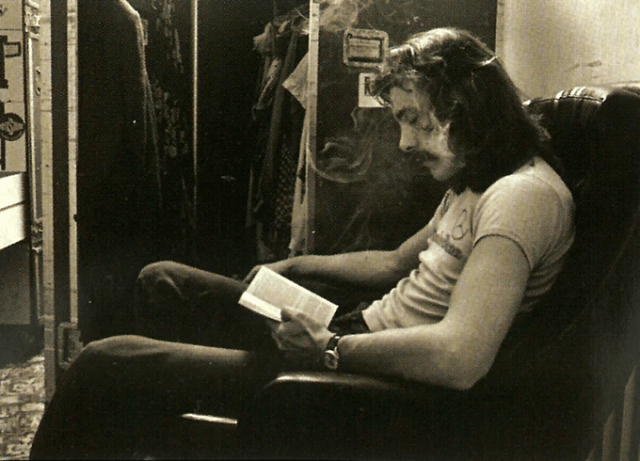
SKF NOTE: I love Elvin Jones’s explanation of what made the Coltrane rhythm section special. And the photo here is from the booklet included with the recentBoth Directions at Once: The Lost Album.
“What made the Coltrane rhythm section different from a myriad of other bands playing in New York City in the beginning of the 1960s? We were all good friends. We would probably have been good friends if we had met under other circumstances. It was one of those things where you meet a person and feel like you’ve known him all your life. It was that kind of instant love for each other.
“When you are associating with someone on a professional basis, [and] if you are friends, so much the better. It eliminates a lot of unnecessary bullshit, so you can go directly to the heart of the matter — which in this case was the music.
“Time doesn’t change. There is nothing new about timekeeping, it’s just that some people can keep time better than others. Some people are more sensitive to rhythmic pulses, and the more sensitive you are, the more you can utilize the subtleties of timekeeping.”
SKF NOTE: A memorable, funny line from one of my favorite songwriters, Leonard Cohen.
At 9:41 in this interview, Mr. Cohen answers his interviewer’s question with:
“In hindsight it seems to be the height of folly to resolve your economic crisis by becoming a folksinger.”
Of course, almost any musical career can be substituted for “folksinger.” The flip side here is that Cohen’s leap of faith turned out incredibly well, artistically and economically.
RIP Neil Peart – Traveling Invisible Highways Scott K. Fish, Special to the Piscataquis Observer • January 17, 2020
The news came through first at 7:12 pm; a voice message from friend Chip Stern, driving his taxi in Brooklyn, N.Y. But I hadn’t checked my phone.
At 9:30 p.m. Eileen received a text message from her daughter, Leanne: “Tell Scott I’m sorry to hear about Neil Peart.”
“What happened to Neil?” Eileen asked.
“I don’t know,” I said.
Neil Peart and I first met in 1982. He was a famous drummer and lyricist with the rock band Rush. I was Managing Editor of the world’s most popular magazine for drummers, Modern Drummer (MD).
I liked Neil as a person, a human being. Had we met first in a diner, striking up conversation knowing nothing about each other, we would still have clicked. We remained friends much less because of what we did for a living, and much more because of our common interests in drumming, writing, politics, and life’s run-of-the-mill moments.
In 1982 Neil asked if MD was interested in coordinating a “Neil Peart Drum Giveaway” contest. I worked with Neil on the contest. Neil’s TamaSuperstar drumset was beautiful and well-known. Neil gave away those 15 drums, seven cymbals, hardware, and drum cases delivered to the contest winner.
I was impressed Neil chose an essay contest. Contestants had to print or type 100 words or less on “Why I Would Like to Win Neil Peart’s Drums.”
The winner was announced through Neil’s “Dear Readers” letter, which began:
“Whose idea was this, anyway? Why didn’t somebody tell me how long it takes to read 4,625 letters [and choose] one winner?
“There were letters from every corner of the U.S., Alaska and Hawaii, every province of Canada, England, Ireland, Scotland, Wales, Sweden, Norway, Finland, France, Germany, Australia, Hong Kong, Singapore, Indonesia, Puerto Rico, Mexico, and even a girl in Borneo!”
I interviewed Neil several times for MD cover stories and MD’s 10th Anniversary issue.
Starting in the mid-1980s my life twisted 180-degrees. I was no longer part of the drumming world as writer or performer. I moved to Connecticut, then Maine. It was sometimes years between letters, but Neil and I kept in touch.
He was so methodical. When obsessed about something — “hopefully in less than a psychological disturbing way,” Neil told one interviewer — he went all in. Touring with Rush was time spent mostly traveling and waiting to perform. Neil’s filled his time reading — a voracious reader and student of classic and contemporary writers.
Neil started riding his bicycle show to show, filling pocket notebooks along the way with ideas, observations; discovering enthusiasm and talent for travel writing.
The bike became a red BMW touring motorcycle. Neil published six travel journals. “Ghost Rider: Travels on the Healing Road” is his most popular. It’s about an awful time in Neil’s life, a time when we were not in touch. Within one year, Neil’s 19-year old daughter, Selena, was killed in a car crash; his wife, Jackie, died from cancer.
I first heard about Selena and Jackie three years after the fact. Stunned, among all my emotions I felt regret over not reaching out to Neil at the time. If he still thought of me at all, he must think very poorly of a so-called friend who was MIA during this unimaginable time.
I spent years trying to reconnect with an on-the-move Neil. No one, not even Modern Drummer, could help me get a letter to Neil. Finally, in year 2014, a woman at Rush’s management office helped me. Soon I had an email from Neil himself. That was a happy day.
My last note to Neil, unanswered, was August 18, 2018: “You’ve been on my mind recently. No special reason. Hope you and your family are enjoying life. All’s well here.”
January 10 I learned Neil was struggling in 2018 with the brain cancer that took his life.
Prayers for Neil’s daughter and wife. And prayers for Neil who, I’m sure, is taking notes traveling invisible highways.
SKF NOTE: This post opens with my last email to Neil Peart in August 2018 — which he didn’t answer. On learning of his death and his years long struggle with cancer, I now know why Neil didn’t answer.
I liked Neil Peart as a human being. We first met because Neil was a famous drummer in a famous band, Rush, and I was Managing Editor of Modern Drummer magazine. That we remained friends was much more about our common interests in drumming and drummers in general, in writers and writing, in politics, and in the daily run-of-the-mill moments in our lives.
In thinking about what, if anything, to write about Neil now — he was a consistently private man — I came across our last email exchange, written on Thursday, June 9, 2016. I am posting our exchange here with one omission. Neil included a photo of he and his daughter, Olivia, on a California train. If that photo had also been posted in public somewhere else — Neil’s blog, for example — I would have included it here. Since I can find no trace of the photo online, I am not going to be first to post it. As I said, Neil was a private man. I always respected his privacy.
I was surprised and happy to see these emails between us were written and sent on the same day within a matter of hours. And, as I wrote Neil then about the photo he sent, he truly did look happy and content.
=====
Scott K Fish Aug 18, 2018, 12:43 PM
Hi Neil —
You’ve been on my mind recently. No special reason.
Hope you and your family are enjoying life.
All’s well here.
Best, Scott K Fish
=====
Scott Fish Jun 9, 2016, 5:26 AM
Hi Neil —
Two nights ago I dreamed I was visiting an oceanside Band Camp. Buddy Rich’s Big Band was there working with advanced music students. That night Buddy’s band was giving a concert.
I watched Buddy rehearsing with a student band on a ballad. Buddy was playing brushes on his cymbals mostly. He had a wooden tambourine placed on top of one cymbal.
I took a walk around outside to see the ocean and to find the bathroom. Exiting the bathroom I was in a bar/lounge with solid black decor, but I could see the ocean and the sun beyond the bar exit. One cocktail waitress said of the bar, “This is for people who like rock.” In other words, for people not interested in listening to Buddy Rich.
“What about people who like rock and jazz?” I asked.
Back at Band Camp, Buddy and the rest of the musicians were on a break. Buddy had his signature towel draped around his neck. I said hello and Buddy said, “Neil Peart’s here.”
“Neil’s here?” I asked.
“Yes,” said Buddy.
“Great. Do you two know each other?” I asked.
Buddy said, “No. I’ve never heard him play.”
“You’ve never heard Neil Peart play?” I asked.
“No,” said Buddy.
“Well, Neil’s a really nice guy. Would you like me to introduce you?” I asked.
I don’t remember if I intro’d you and Buddy or not. But I do remember walking again around the extensive grounds and along the beach. That’s where I was when Buddy’s Band started their concert.
Heading back to the concert area — which was a healthy walk — I heard Buddy over the PA announce you and invite you to sit in with the band. He chooses a number like “Cute” where you and Buddy can trade fours, and you each get to play a one chorus drum solo. The same routine Buddy did many times on Johnny Carson’s Show with Ed Shaughnessy or Louis Bellson.
The number ends — again, I’m hearing all this over the PA system — and I hear you saying to Buddy that you really wanted to play with Buddy’s Band. Not to play a drum solo, but to get the experience of playing with the band, for the band.
“You want to play with my band? asks Buddy, surprised. “I don’t know. No one has ever asked that before. Let me think about it.”
Buddy does let you play one with the band — a new chart. And part way through the song the band stumbles and stops playing. The feeling in the air is that the band must have stumbled because of your misreading of the chart.
Buddy’s calm. He asks the trumpet player who wrote the chart, “What happened?” The trumpet player examines the chart and — lo and behold! — there is a mistake in the chart that the copyist carried over to every band member’s chart. And that was what caused the band to falter. It was not Neil Peart.
End of dream.
Hope all’s well, Neil.
Best, skf
=====
Jun 9, 2016, 11:56 AM to me Santa Monica CA
Hey Scott —
In one of those mystical resonances, yesterday I was thinking about you — how I hadn’t heard from you for a while, wondering how you were doing, and if I owed you a letter. (Sometimes that’s all it takes not to hear from someone for a long time, right?)
And there you were … dreaming of me … and Buddy!
A happy ending, too — and kind of ironic, because when I first did play with Buddy’s band, in the early ’90s, the first song was a chart called “Mexicali Nose.” Short version — the arrangement the band had was different than the one I had learned, and because there was no rehearsal time, that was not discovered until “the night.”
I started out so confident and well-rehearsed, actually smiling and truly relishing this longtime ambition to drive a big band — when almost immediately the whole thing fell apart.
I kept going without anyone else knowing, but of course it snuffed out the joy for me. Not knowing the cause until well after, I blamed myself, and was shaken, rattled, and depressed.
Though the experience did inspire me to record the tribute albums — so I’d get another chance!
All’s well here. Finalizing the details of the R40 book, Far and Wide: Bring That Horizon to Me!, has been a bit of a jolt — going from a large ambitious project I have been building, modifying, and tinkering with for many months, to something I have to live with … for the rest of my life!
Don’t remember being afflicted that way with past books, but a seed was planted with my first reader, Mike Heppner. He is a fine novelist who also teaches writing at Emerson College, so I thought he would have a worthwhile perspective for me. He did, but left me with one obsessive thought, “When I finish a book I ask myself, if this is the last book I ever write, did I get everything in there?”
I am not feeling that “mortal” about it, but this will certainly be the last book I write about touring — so I at least wanted to get everything about that in there.
And so much else in my ongoing study of “Roadcraft,” in its larger sense. A book I was once going to write under that title had the subtitle, “How to Work the World.” But I realized no one person could ever write that book, but only contribute to it. So that’s what I try to do.
Many lovely photographs, too. These days I buy good SLR cameras for my riding partners, and tell them where to stand and what to shoot — using the “spray and pray” method means a lot of editing for me, but always gives one or two “money shots.” It would be easier to take them myself, but early on I realized that when I’m writing and describing a scene it is more powerful to show a photo of me in it.
A couple of weeks ago Carrie, Olivia, and I rode our new Metrolink train from Santa Monica to the Natural History Museum, and it was really great — a leap back to the days after WW2 when L.A. had trains running everywhere, said to be the finest mass transit system in the world.
Then you probably know how GM, Standard Oil, and Firestone got together and bought up all those trainlines, closed them down, and brought in — buses.
I was sure that was just another conspiracy theory, but apparently it’s true. Wicked world.
But at least we’ve got our train back now!
Hope all’s well with you and yours, as it is with me and mine,
NEP
=====
Scott Fish
Jun 9, 2016, 3:48 PM to [Neil]
More later, Neil. But I had to send you an immediate reply and thank you for the photo. What a great shot. You look happier and more content in that photo than in any other photo of you I’ve seen.



 Scott K Fish
You must be logged in to post a comment.