Buddy Rich’s Perfect Snare Drum

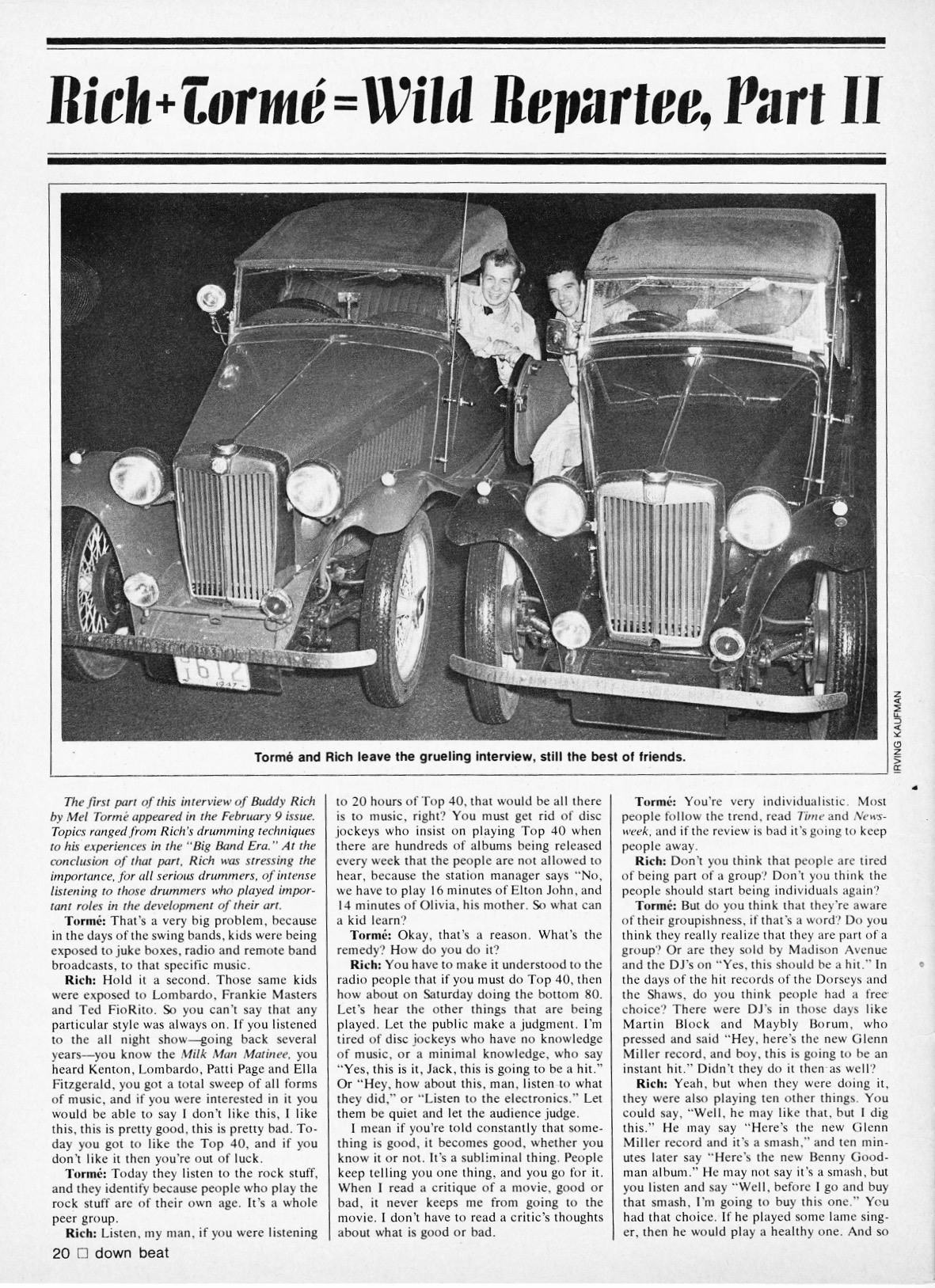
SKF NOTE: This excerpt is from one of the best drum interviews I’ve ever read. It was a two-part Down Beat interview of Buddy Rich by his long-time friend and fellow musician, Mel Torme. Both interview parts were published in February 1978.

So good was this interview, I was let down by Torme’s biography of Buddy, Traps, The Boy Wonder, published years later in 1991. The book I had long hoped would offer more of the insight displayed in this interview, instead never rose to the exceptionalism of this interview.

If you can get your hands on the original interview — do so. Meanwhile, here’s Buddy Rich talking with Torme about what makes a great drum, and Buddy’s once in career perfect snare drum. The original interview refers to a “Slingerland Rail King.” I’m betting that was a interview transcriber’s boo-boo, and it should be “Slingerland Radio King.”

=====

Torme: You used to say that all drums were alike, exactly.

Rich: There’s no difference.

Torme: You’re an endorser of Slingerland Drums.

Rich: I like ’em because I play ’em. And they feel good. But if I were to use Vingerland tomorrow, or fried boots, I would take the heads and I would put heads on. I use a Diplomat head. And so I would take whatever drum I’m using and put that head on, and I would tension the drum to where I feel comfortable, and that would be my sound. I mean, it’s no big deal, you know.

Torme: You mean to say there’s no difference in construction?

Rich: I suppose all construction is different. Some is good, some is bad, but unless a drum is totally unplayable, it can be playable.

Torme: What about this quest that is rivaling the search for the Holy Grail, the search for the perfect snare drum? I have never known you yet to like a snare drum.

Rich. I only played on one snare drum in my whole career that I really loved and that was an old Slingerland Rail [sic] King. And I’m not saying that because of the Slingerland title. Whether it was the aging of the wood, or the processing, or the shellacking, or the density of the wood or whatever, it was the finest drum I have ever played. Why I don’t have it today is something I’ll never understand. It’s gone down the deep with several hundred sets of drums that I’ve had.

Torme: Are you saying that specific snare drum, or that model, the old Buddy Rich rail [sic] model? Maybe it was an old Gene Krupa.

Rich: Listen, it could have been a Gene Tierney, for all I know. The construction of that drum was perfect for the kind of drum sound that I’m looking for.

Torme: Have you ever asked Slingerland if they’ve got any of the old Slingerland snare drums?

Rich: The die was thrown away or it was destroyed or whatever. And they come up with some cockamamie excuses that are unreal to me. They simply….

Torme: You may have been right about the fact that the age of the wood in those days….

Rich: For ten grand you can recapture all that. You can make the die again, get some engineers, spend a little more bread for some aged wood, and you make a more expensive drum — but you make the best drum. It’s just that simple. If you want to make the best in anything, you’ve got to spend some bread. If you don’t, it’s going to be good for six months, and the lugs will drop off, or be good for a year and you’ll find out that it’s warped. I just don’t think there’s good workmanship today.

Torme: You know the snares used to constantly fall off, and you had to continually re-tighten the snare control.

Rich: Yeah, but you do the same with a $400 drum today. When you play the drums as hard as I play them, it’s bound to loosen up. So I’m constantly turning the wheel to pull the snares up. I don’t like loose snares. But the perfect snare drum means more involvement in the making of it: a little more money, a little more aging of the wood, the correct density — so the drum just sings. You don’t have to play hard on a good drum because it will project itself. And this is what’s lacking today.
Posted in SKF Blog | Leave a comment

Remembering ‘The World’s Greatest Drummer’

SKF NOTE – My Uncle Bob sparked my lifelong love of all things drums. And one vivid recollection of Uncle Bob, probably in the late 1950s or early 1960s (he died when I was age 14) is him telling my brother Craig and me, “The world’s greatest drummer is Louis Bellson.”

Yeah, I know “the world’s greatest drummer” designation is arguable, but I remembered Louie’s name. In the early 70s, living in Davenport, IA, I was excited to learn Louie’s hometown of Moline, IL was just across the Mississippi River. I met several people who knew Louie and had seen him play at area nightclubs.

Louie’s dad’s music store, where Louie studied drums, was still in business. And one afternoon I had a chance to see Louie in person at a local high school gymnasium, I believe.

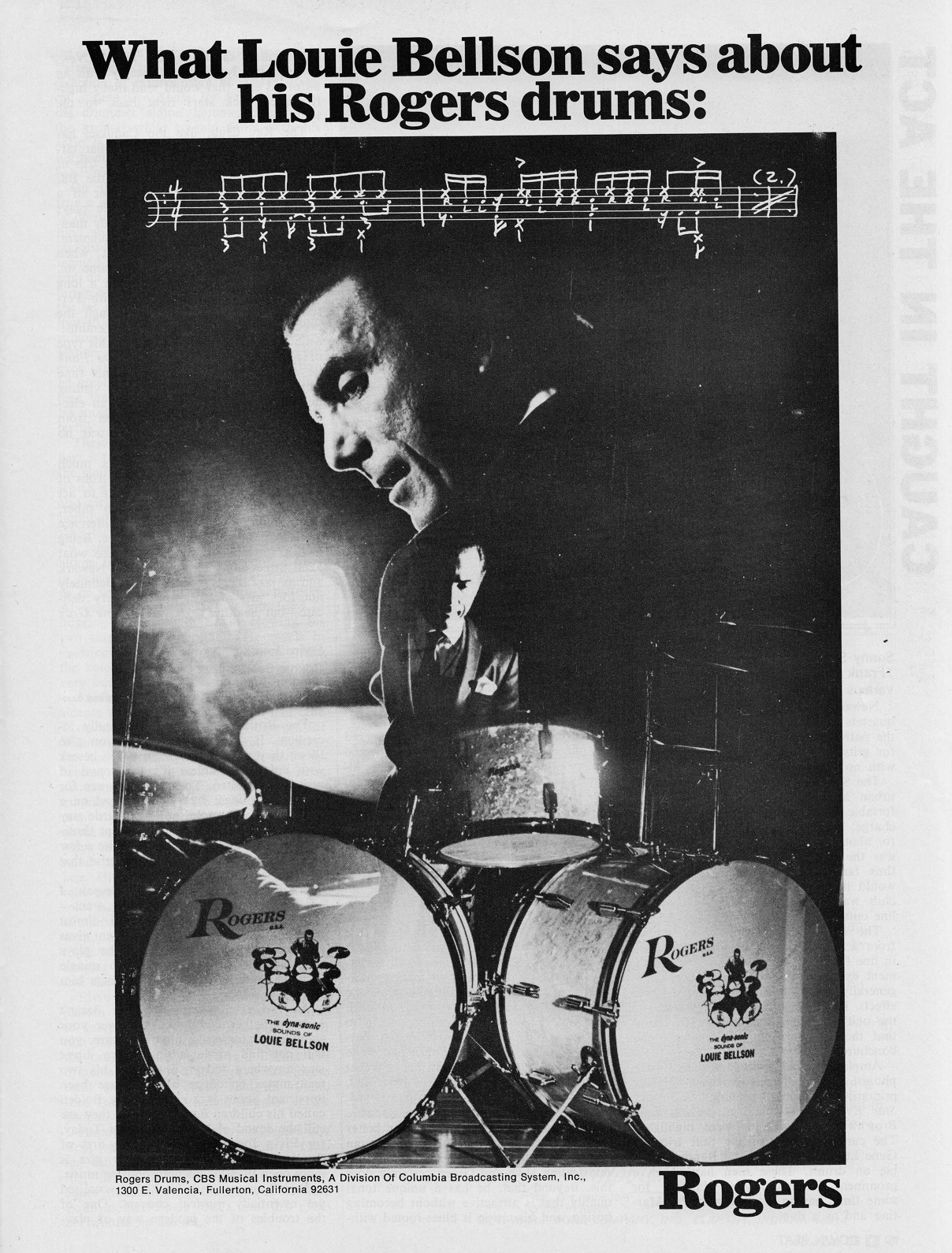
This 1969 Rogers Drum ad featuring Bellson is one of my favorite photos of the drummer. During his long career Louie endorsed several drum brands. Pearl, Gretsch, Slingerland, and Remo come to mind. And whether or not he was “the world’s greatest drummer,” Louie Bellson was certainly one of them.

Fortunately for drummer alive today, and for drummers yet born, Bellson made a bunch of records with other bandleaders and under his own name. And there are several worthwhile Bellson videos available.

Posted in SKF Blog | Tagged , , , , , | Comments Off on Remembering ‘The World’s Greatest Drummer’

Peart – Transitions Are the Weakness of Many a Drummer

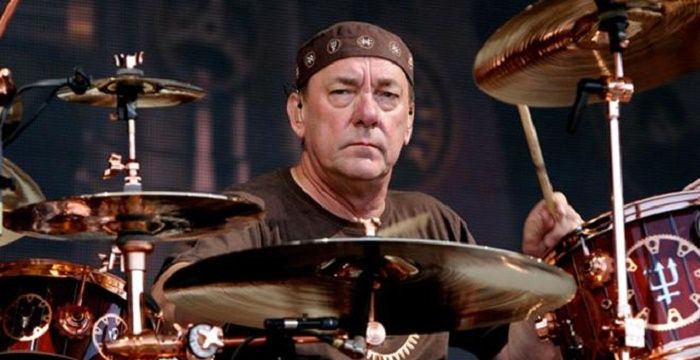
Photo courtesy TheFamousPeople.com

SKF NOTE: One more of my favorite interview moments of Neil Peart explaining his drumming.

Neil Peart: Transitions are much overlooked. But they’re the weakness of many a drummer. He can lay down a nice feel and move to another feel. But the points in between , and bridging the transition between two interpretations of the rhythm, is where a lot of people fall down. It’s still the thing on which I spend the most focus.

When I’m rehearsing our songs with the click track I reverse our roles. As I’m playing a fill I’ll keep track, in another part of my mind, of how my fill affects the click track.

When I play the song without the click, I’m already conscious of the interrelation of metronome to rhythm and flow. Bridging those transitions as smoothly as possible becomes a thing of great moment too.

Then, from a listening layman’s, or [a] beginning drummer’s, point of view it’s: “Now that’s not hard. I could play that.”

Posted in SKF Blog | Tagged , , , | Comments Off on Peart – Transitions Are the Weakness of Many a Drummer

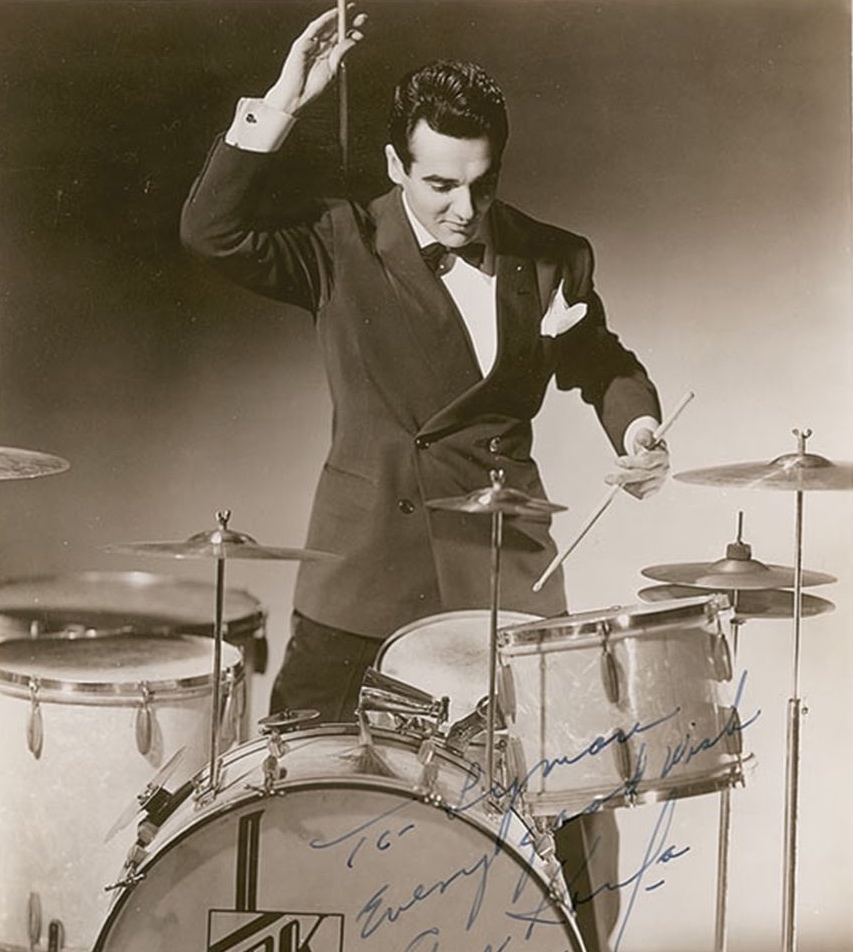
Gene Krupa – Not Bad for a Young Upstart

Gene Krupa

SKF NOTE: I wrote this column. It appeared originally in the Piscataquis Observer newspaper, May 31, 2019.

Since I am no longer employed at the Maine State House (1989 – 2012), I haven’t tried this experiment. But every now and then, while at the State House, I would take one workday and ask people:

If I ask you to name a famous drummer, which drummer first comes to mind?

As someone passionate about drumming, very familiar with the history of drumming and drummers — I was curious to know how drummers appeared to the outside world. That’s all. And asking legislators, lobbyists, visitors, staffers, to name a famous drummer, seemed an easy yardstick by which to measure.

A few people had no response, but most State House inhabitants I asked had, to me, a surprising response. The two famous drummers most often named were Gene Krupa and Ringo Starr. What surprised me was, Krupa was mentioned more often than Ringo.

Gene Krupa’s drumming career started in the 1920s, continuing until Krupa died in 1973. His career first skyrocketed as the drummer for Benny Goodman’s Orchestra (big band) at Goodman’s 1938 Carnegie Hall Concert. Krupa’s concert drum solo on “Sing, Sing, Sing” is considered the first extended drum solo in jazz.

In a familiar interview later in Krupa’s life, he summed up his musical contribution this way: “I’m happy that I succeeded in doing two things. I made the drummer a high-priced guy, and I was able to project enough so that I was able to draw more people to jazz.”

Up-and-coming drummers still cite Gene Krupa as a key influence.

My first exposure to Gene Krupa happened when I was six years old. My Uncle Bob Fish, an amateur drummer, had Gene Krupa’s 1956 quartet recording of “China Boy.” The sound of Krupa’s drumming on that record mesmerized me. Krupa’s drum rolls, especially, on that fast song were puzzling. How does he play that fast? And, as a six-year old, holding a pair of Uncle Bob’s drumsticks, trying to mimic Krupa, I knew at that moment I could not do what Krupa was doing, and I knew I was going to learn how. Someday.

The late actor Sal Mineo starred in a 1959 movie, “The Gene Krupa Story,” which helped spread the word about Krupa the “Drummer Man.”

I haven’t seen “The Gene Krupa Story,” which surprised Rush drummer/lyricist Neil Peart. “You have to see it,” he said. For one thing, the movie was quite influential to young Neil Peart. (Sal Mineo as Krupa appears to play drums in the movie. But, Krupa himself played drums for the movie soundtrack.) Mostly, I think Neil recommended the movie as a rite of passage for any serious drummer. One day, I suppose, I’ll ease my conscience and watch “The Gene Krupa Story.”

My early encounter with the sound of Krupa’s drumming started me along a lifetime career path of learning to play drums, and also, immersing myself in books, magazine and newspaper articles, and record liner notes to learn everything I could about the history of drummers and drumming. Mine was a musical career path through the history of jazz, blues, rock, country, Latin, African, Asian — all kinds of drum history.

How important are drums to music? Well, next time you’re listening to your favorite music, imagine it without drums. Max Roach, a major historical drummer, said what distinguishes one style of music from another is the rhythm. A C-major chord is the same regardless of musical style.

I’ll have to dust off my famous drummer question soon and see what happens. But, from anecdotal evidence it would not surprise me to have Krupa’s name at the top of the list.

And that’s not bad for a young upstart who stuck his neck out in 1938, and forever changed what drummers do forevermore.

Posted in SKF Blog | Tagged , , | Comments Off on Gene Krupa – Not Bad for a Young Upstart

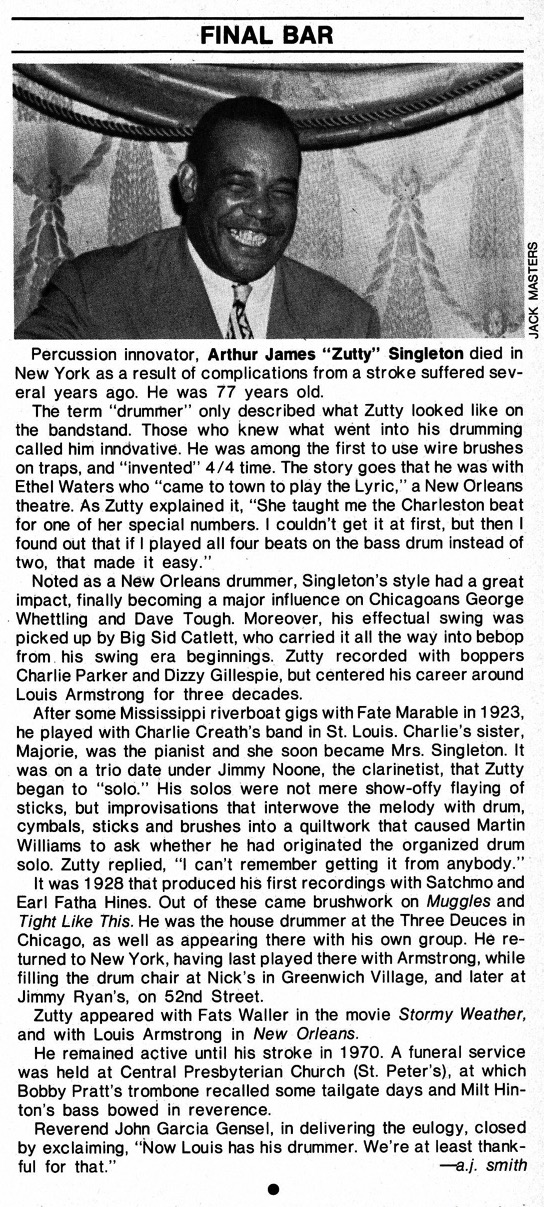
RIP Zutty Singleton (1975)

SKF NOTE: My self-study of drummers started in the 1960s. By age 14 I started my lifelong study of the history of drummers, drums, and drumming. Liner notes, magazines, local jazz radio stations, and books were my prime information sources. Music albums were available as vinyl 33 1/3 RPM long-playing records, holding an average 20-minutes of music per side. An album with a total 45-minutes of music was a bonus.

This October 9, 1975 Zutty Singleton obituary (Down Beat) reminds me of how difficult it was, for many years, to find records of some of the noted drummers. With the first historical drummers, like Zutty, who started recording in 1928, recording techniques didn’t do drummers justice. The popular 78-RPM records were limited to about two-and-a-half minutes per song. Drummers were often forced to record with partial drumsets. Bass drums, for instance, were verboten or covered with muffling blankets.

Obit writer Arnold Jay Smith tells us Zutty started as a New Orleans drummer who became “a major influence on Chicagoans George Wettling and Dave Tough.”

“His solos were not mere show-offy flaying of sticks, but improvisations that interwove the melody with drum, cymbals, sticks and brushes into a quiltwork…,” writes Smith.

Digital technology has made all kinds of music available as never before. Want to see/hear Zutty Singleton? No problem. Just type his name in your web browser and hit the “search” button.

Posted in Drum/Music News, SKF Blog | Tagged , , , , | Leave a comment