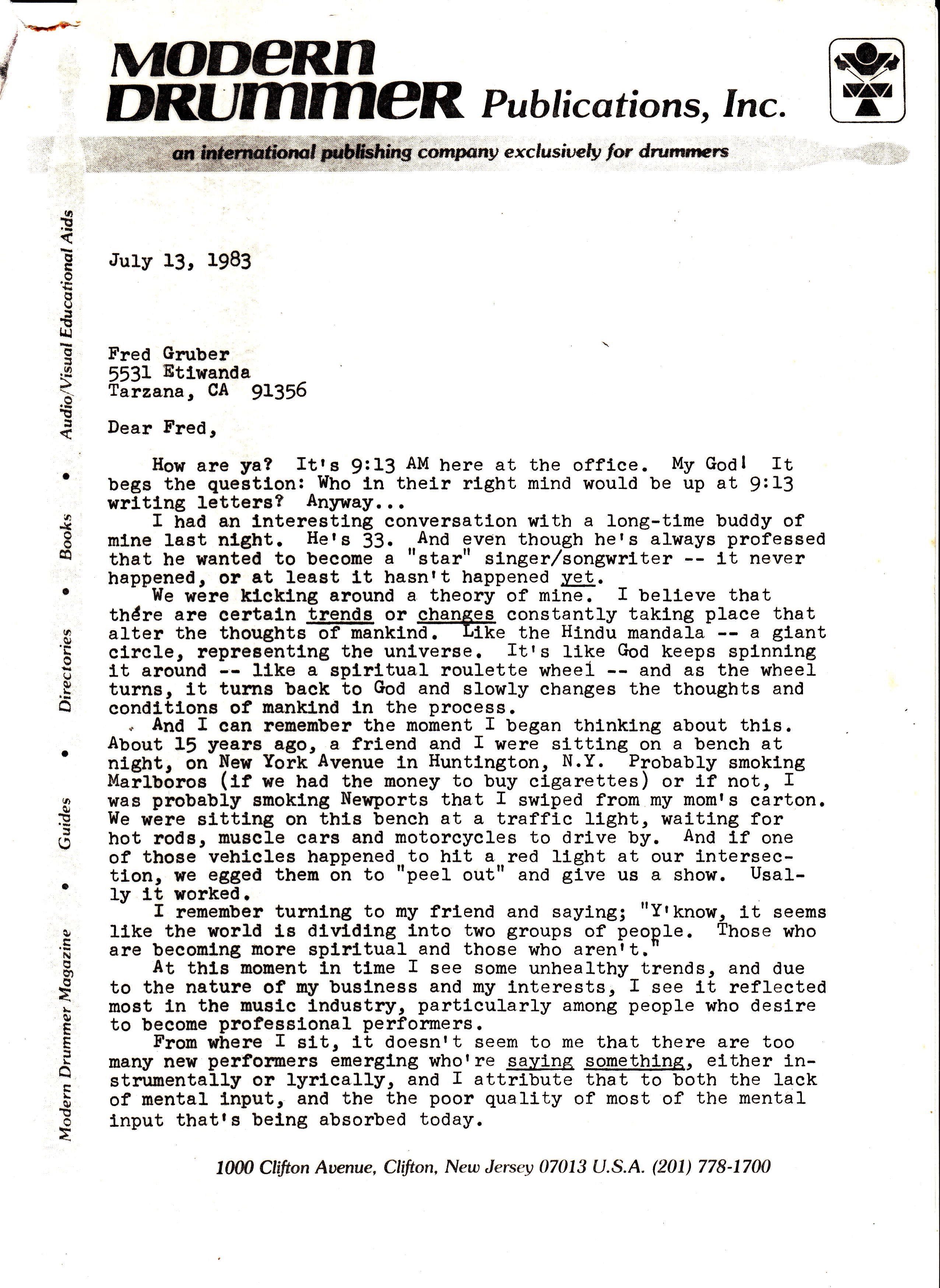
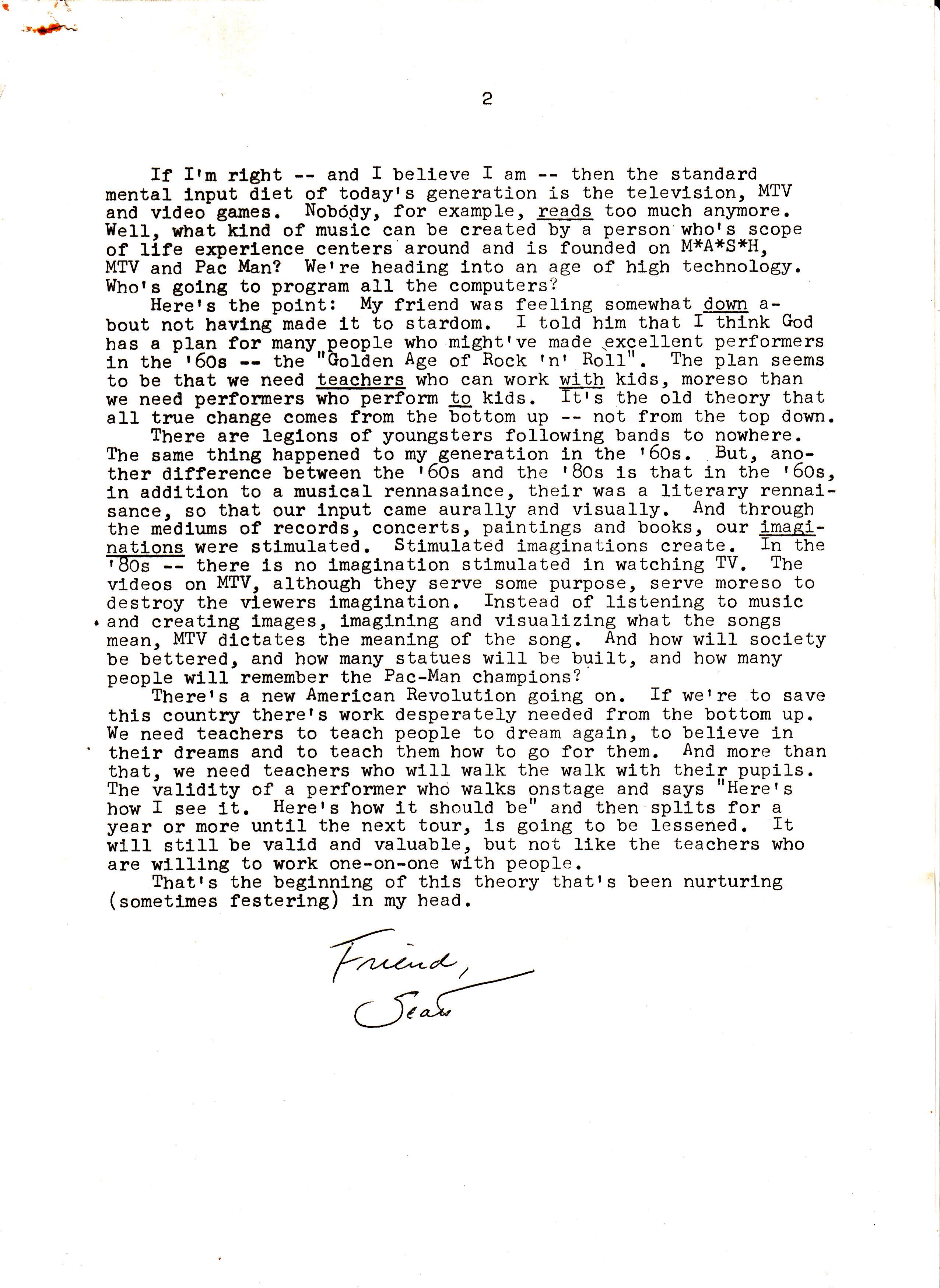
SKF NOTE: This is my letter, written the morning of July 13, 1983, to drummer/teacher Fred Gruber.
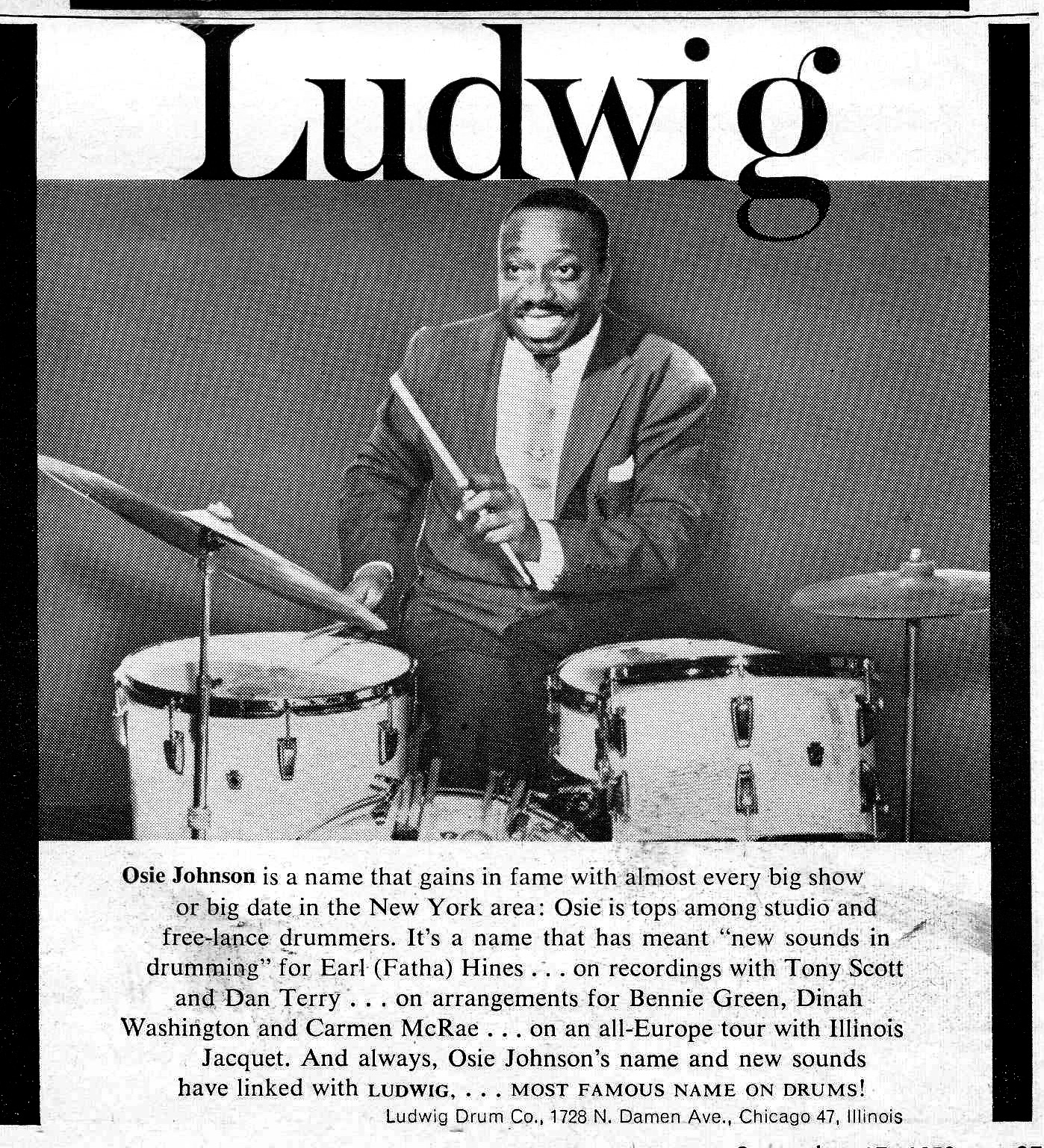
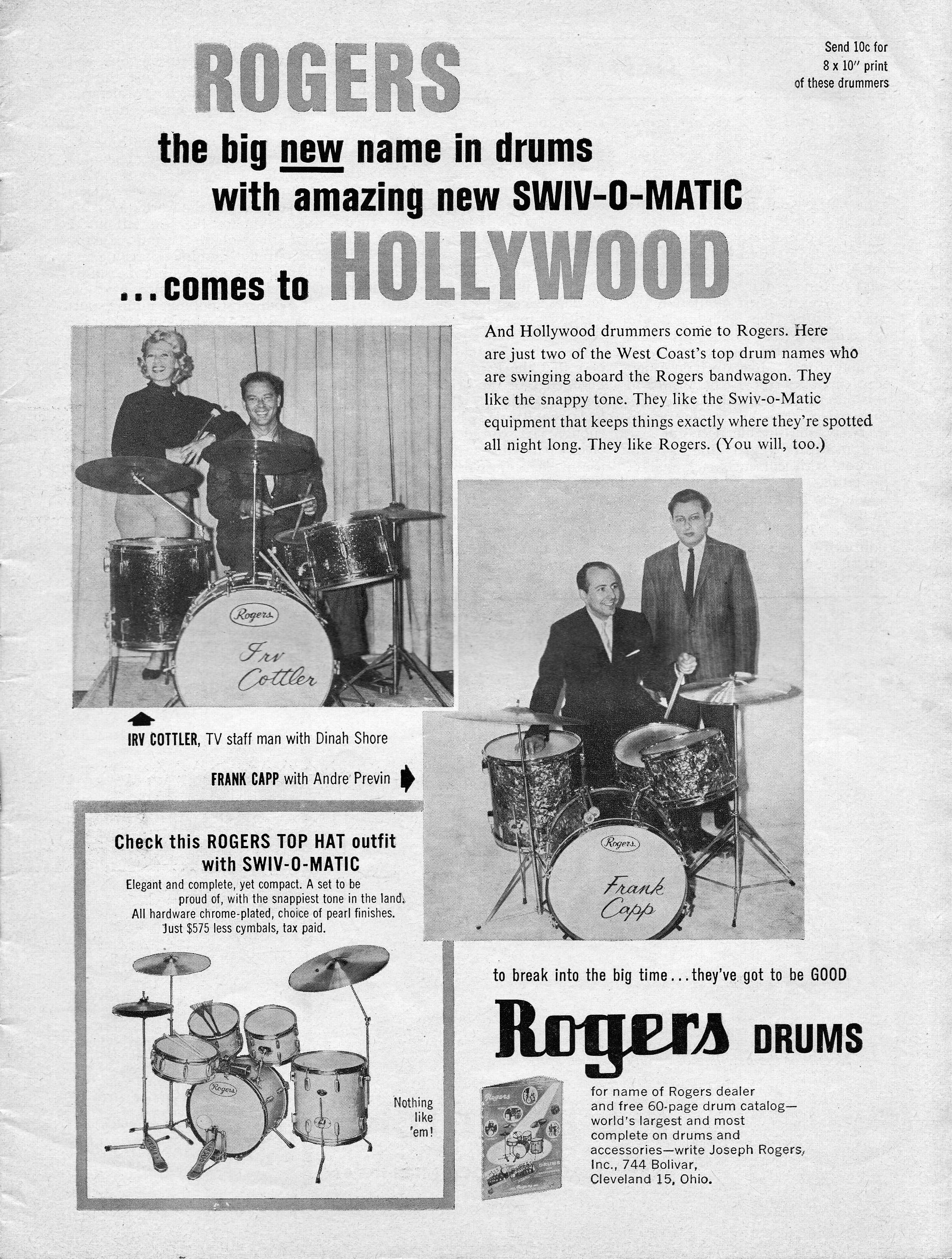
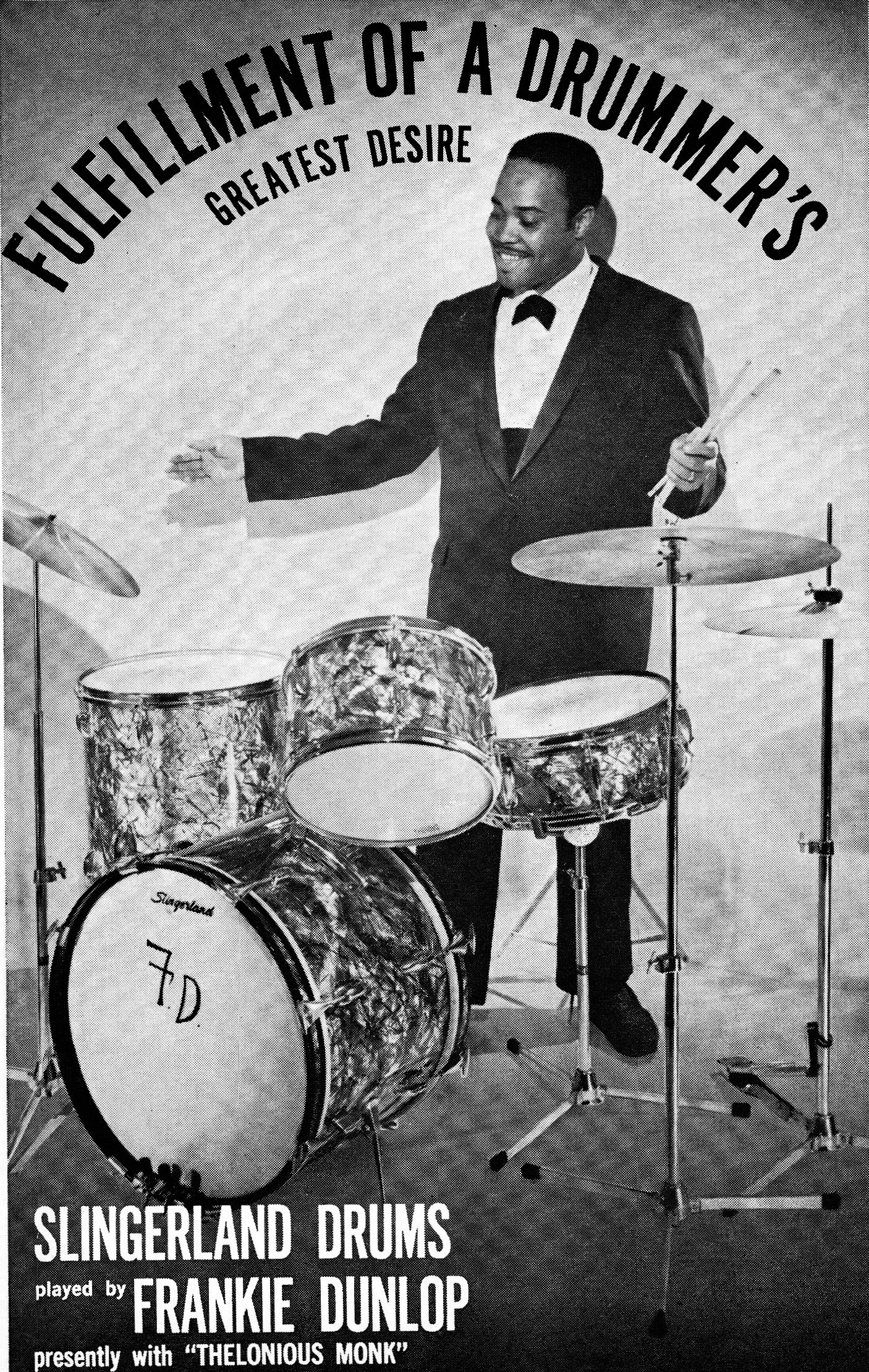
This morning I am scanning a stack of papers. Interview transcripts, drum columns, old contracts, and letters. Letters to me from drummers. And letters to drummers from me.
This letter is mostly about my belief that the world was coming to the end of great, unique drummers who knew and cared enough about their craft, to pass along their knowledge to upcoming drummers.
In general, what I was seeing in 1983, were drummers who neither knew nor cared about drum history. I was seeing more drummers caring about becoming stars, not artists.
Not that artists can’t be stars. But a star doesn’t need the dedication of a true artist.
We need teachers who can work with kids, I wrote Gruber, more than we need performers who perform to kids.
SKF NOTE: At the time of this interview, Michael Shrieve was on a mission to make music that was both true to himself and appealing to the masses.
Could a hit pop record do that? Shrieve believed the answer was “yes.” I wasn’t so sure. And my strong sense was, despite what Shrieve said, he wasn’t so sure either.
He always seemed much more at home outside of pop music.
This two-part interview starts in Part 1 with Michael Shrieve’s quick “no” response to my question, “Do you ever think about playing drums (or drum solos) with the fluidity of a saxophone player?”
But then Shrieve tells us how he does approach playing drums, lessons learned from drummer Pete Magadini, meeting all “his heroes.”
Then we started loosely discussing what Shrieve called “drum questions.”
Part 2 of Shrieve’s interview begins with a continuation of drum questions.
We also talk about drummers Shrieve admires, albums he listens to often, synthesizers, and his new band called Patterns.
Shrieve was with his band, Novo Combo, when I first interviewed him for Modern Drummer. He left that band before MD published his story.
To keep Shrieve’s MD feature current, he and I sat down again for an updater interview, mostly to talk about Shrieve’s new band called Patterns, which was also short-lived.
Instead, Shrieve’s next two album releases – circa 1983-84 – were the excellent “In Suspect Terrain” and “Transfer Station Blue.”
These albums are Michael Shrieve music. They fit comfortably into no category. So what? Both albums are full of intriguing music.
This recording has a few spots or glitches where moments of our conversation were cut. None of the glitches break the flow of the conversation. Again, I thank my friend, Jason J. Carey, for his great work in cleaning up this sound file.
My Shrieve interview came out – finally – in the July 1983 Modern Drummer.
Shrieve has gone on to record a long discography of albums as leader and sideman. Check out Shrieve’s artist page on Bandcamp.
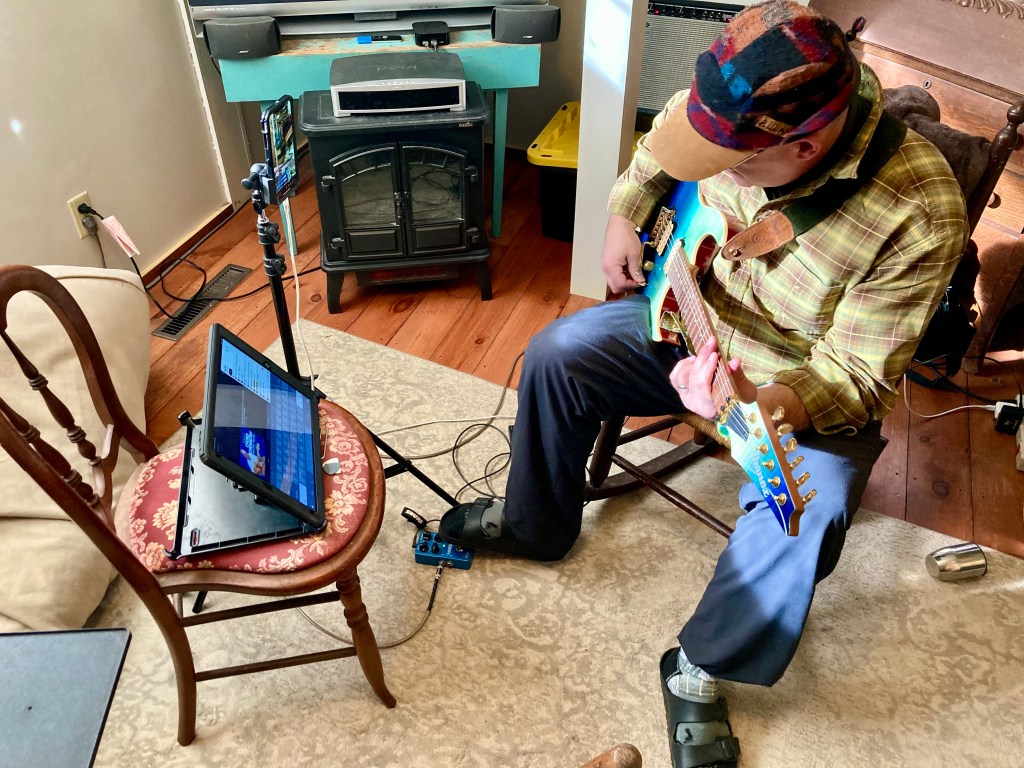
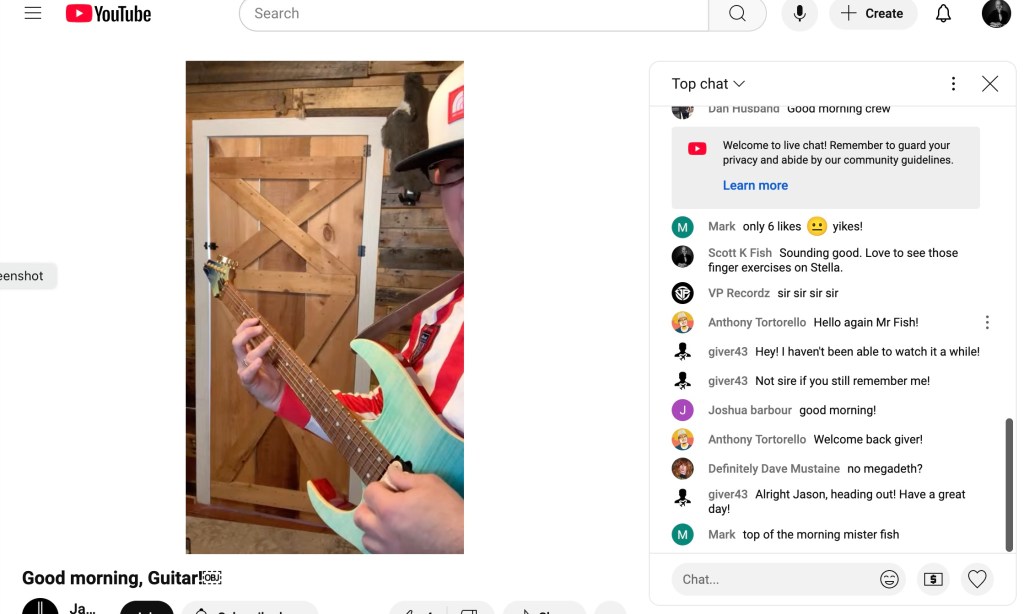
Jason Carey in the “dog room” with is guitar, iPhone, and iPad.
SKF NOTE: Jason Carey, my friend, is an excellent guitarist. Recently Jason started a one-hour YouTube “Morning Ritual for Guitar Growth;” a wake-up session for guitarists.
Broadcasting from his Maine farm house “dog room,” Jason and viewers from around the globe run through guitar finger exercises, breathing techniques. Much like a jam session, Jason’s morning guitar session moves among many topics, depending on what Jason and his viewers want to discuss.
While performing most of the audio cleanup on my recently posted Michael Shrieve interview, Jason found that many of Shrieve’s ideas on making music on a drumset could be applied to making music on guitar.
Tuesday of this week, January 28, Jason invited me to join his morning session to test the concept that guitarists have something to learn from drummers and vice versa.
I had no doubt about the concept. In my life, non-drummer musicians taught me plenty about becoming a better, more sympathetic, more supportive drummer. From the pages of a jazz book or magazine, I believe, great tenor saxophonist Lester Young was first to stress the importance of knowing song lyrics when playing instrumental song interpretations.
Early on my high school music teacher and jazz pianist, Art Simeone, taught me the basics of accompanying piano players.
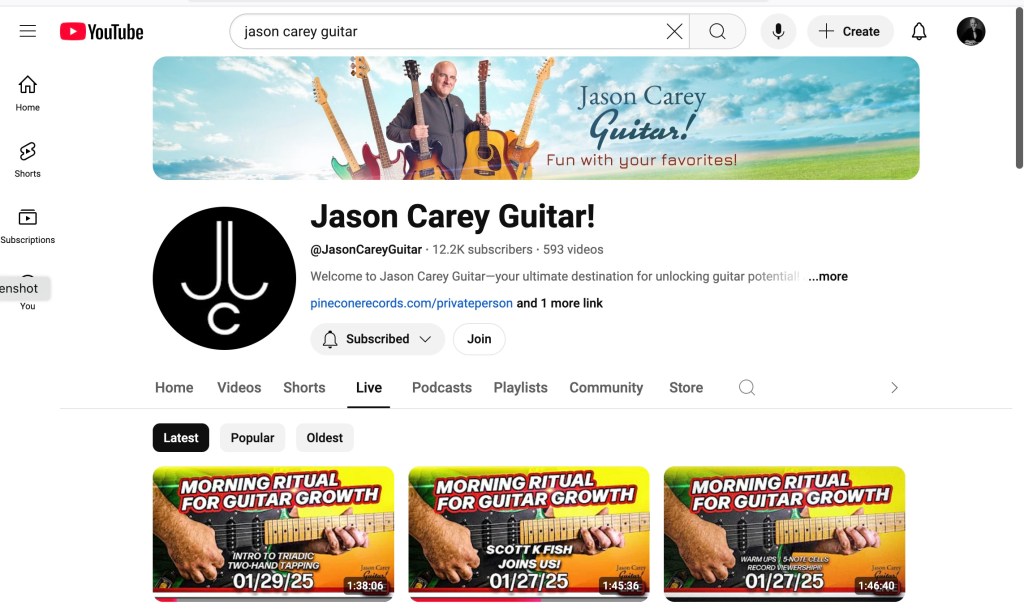
Jason Carey’s YouTube page.
The concept of cross-learning among musicians is sound. And I thoroughly enjoyed being with Jason Carey for last Tuesday’s “Morning Ritual for Guitar Growth.” There aren’t many times now I get to chew the fat about drumming with other musicians.
Tuesday in the “dog room,” listening to the conversation, answering questions, I was channeling lots of drummers i.e., Ed Soph, Michael Shrieve, Neil Peart, Baby Dodds, and Keith Copeland. Their words/answers were entering my head. And, when possible, I passed on those drummers’ wisdom to “Morning Ritual” participants.
One person asked, What can a drummer play to help a guitarist not lose time during guitar solos?
Tony Williams’s circa 1972 came to mind. Asked in a DownBeat interview if he was Miles Davis’s Second Great Quintet’s timekeeper, Tony answered with a firm “no.” He said musicians who can’t keep time without relying on a drummer had no business on the bandstand.
The next time you’re awake at 7:30 am, think about grabbing your sticks and drum pad and join the folks on YouTube at Jason Carey’s “Morning Ritual for Guitar Growth.”
Screenshot from Jason Carey’s “Morning Ritual for Guitar Growth”
SKF NOTE: This interview starts with Michael Shrieve’s quick “no” response to my question, “Do you ever think about playing drums (or drum solos) with the fluidity of a saxophone player?”
But then Shrieve tells us how he does approach playing drums. “I see it as a flow of energy. Let’s say the rhythm I play contains a flow of energy that isn’t locked to the rhythm,” he begins.
In this first of a two-part interview, Shrieve talks about lessons learned from drummer Pete Magadini, such as, “One of the things about white drummers is they always try to play too much. They don’t feel confident enough to just let it sit. Let the magic of the groove happen.”
Shrieve talks about, “Sustaining a rhythm. Like jazz drummers do, but in a pop context.”
We cover Shrieve meeting all “his heroes” at a young age. “It’s good to meet your heroes because then there’s nowhere else to go but with yourself. After awhile you find that music is so transparent and so naked (in) how much it reveals the person. What you play is what you are,” he said.
At about 10:07 we paused recording to collect our thoughts.
The remainder of this part of the interview focuses on “drum questions.” Shrieve’s studio drums vs live drums: drum heads, tuning, bass drum pedals, cymbals (a 24″ crash cymbal????).
We talk a bit about Shrieve working Santana percussionist Chepito, and about how Shrieve might approach staging drum clinics.
This recording has a few spots or glitches where moments of our conversation were cut. Maybe the sound at those spots disappeared during background noise removal. Or, perhaps they are casualties of age. This interview was digitized from a cheap 45-year old cassette tape.
At any rate, none of the glitches break the flow of the conversation here. And I want to thank my friend, Jason J. Carey, for his great work in cleaning up this sound file.
Michael Shrieve was easy to interview. He was a very likeable human being.
However, the Modern Drummer feature interview we were creating was not easy to finish. Remember, this was pre-internet. So the lag time between when MD interviews happened and when they were published was often many months.
We met after Shrieve launched his pop group Novo Combo. I think we met three times to button up Shrieve’s MD interview. This interview took place in a NYC restaurant. Shrieve had been in-and-out of his group Automatic Man. Also, he was no longer with his amazing band, Go, with Stomu Yamashta, Al DiMeola, and others.
Michael Shrieve’s heart, it seemed to me during our interviews and private conversations circa 1981, was more comfortable with more experimental musics. His music with percussionist/keyboard player Stomu Yamashta is a case in point.
Shrieve introduced me to music healing, of the relationship of sound and color. He introduced me to New Age musician/author Steven Halpbern.
And so, Michael and I would finish an interview, and then the music project Shrieve was working on at the time of our interview would be replaced by a new project, prompting an amendment to our initial interview.




 Scott K Fish
You must be logged in to post a comment.