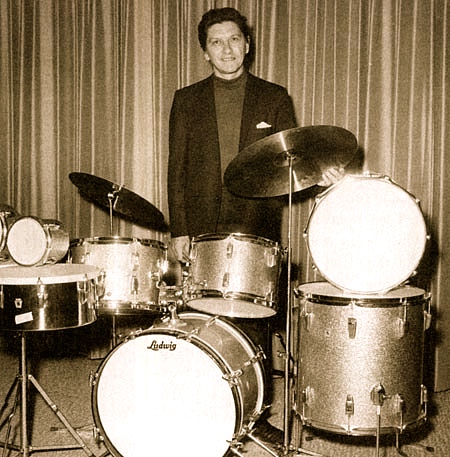
Remembering Mentor Ed Mathews

Around 1967, when I was in high school, age 16 or so, Ed Mathews and his family moved into their Huntington, NY home, directly across the street from our family home. My memory may be off, but I remember Mr. & Mrs. Mathews with three young children. One boy, two girls.

Ed Mathews was a major, positive influence. One of very few adults who encouraged, by his actions and words, my pursuit of music as a profession.

My life goal in 1967 was to be a professional musician. I loved drums, but didn’t own a drum set until I was age 18. In several high school garage bands I was lead singer.

Mr. Mathews, as I greeted him, was Columbia Records’s lead Artists & Repertoire man. Berklee College of Music defines an A&R man as “responsible for finding promising new artists for a record label or music publisher to sign.”

Among the acts Columbia Records signed while Ed Mathews was in A&R were Blood, Sweat, & Tears, Big Brother & the Holding Company, The Chambers Brothers, Leonard Cohen, Laura Nyro, The Electric Flag, Peaches & Herb, O.J. Smith, Paul Revere & the Raiders, The Buckinghams, and Gary Puckett & The Union Gap.

Despite, or because of, our age difference, Mr. Mathews and I talked about music as equals. He knew more about the music business. And he was familiar with more music and musicians.

I was young with good ears and instincts. In hindsight, I was like a one-man (adolescent) marketing gauge for Mr. Mathews.

Mr. Mathews had a small home music room with a quality stereo system, and a floor piled high with LP’s. After a typical visit, Mr. Mathews would send me home with a pile of new albums for listening.

When we’d next meet, he would ask me what I thought of this artist or that album. And I was always straightforward with my answers.

I once suggested to Mr. Mathews he sign The Who. They were on the Decca label at the time. Mr. Mathews wasn’t excited. “What are you going to do with a band that smashes their instruments?” he asked.

Another time I recommended Ten Years After as a great band Columbia records could get from the Deram label. I played Mr. Mathews a Ten Years After track I loved: “Woodchopper’s Ball.”

Again, he paraphrased his “no” by asking, “What are you going to do with a band that plays old Woody Herman tunes?” Of course, I was unfamiliar with Woody Herman’s music and had no idea the Herman band had recorded that “Woodchopper’s Ball” in 1939. I just knew I liked Ten Years After.

In 1969, The Who made such a smash with their rock opera, “Tommy,” which, as of this writing, has sold 20 million copies. Mr. Mathews and I never did get the chance to talk about “Tommy.”

Neither did we talk about how Columbia Records, in 1971, signed Ten Years After to the label.

I have an unpleasant memory of Mr. Mathews telling me Columbia Records was going to “break up” Big Brother & the Holding Company, and build a new “horn band” behind singer Janis Joplin.

Horn bands were hot. Blood, Sweat & Tears, Chicago, The Electric Flag.

But I thought-notwithstanding its raw musical edges-Big Brother, with Janis, was a great band. Breaking them up, I said, was a bad idea.

Mr. Mathews gave me tickets and transportation to see Simon & Garfunkel in Forest Hills Stadium, and later, the newly revised Blood, Sweat, and Tears with David Clayton-Thomas as lead singer in Greenwich Village.

Two Emarcy jazz albums he gave me had a significant impact on my music career. One was pianist Eddie Heywood’s self-titled trio date with Wendell Marshall on bass, and J.C. Heard on drums.

That was my go-to album for learning to play brushes. And many years later, when Joe Morello asked me during our interview if I was familiar with J.C. Heard, I surprised him by answering, “Yes.”

Mr. Mathews gave me a copy of the Emarcy album, “Daahoud,” by the Max Roach-Clifford Brown Quintet. That was my introduction to Max Roach and his drumming concept.

Max’s drumming sounded so different from the obvious rudimental influenced drummers I was listening to; the Buddy Rich and Louis Bellson school of drumming.

I loved Max’s “melodic” drumming. At first, Max’s style sounded easier than trying to emulate Buddy and Louis. But when trying to copy Max’s approach I ran into obstacles, shortcomings.

To drum melodically I needed to know much more about song forms and song lyrics.

Hearing Max for the first time, especially with the remarkable Roach-Brown Quintet, opened my ears immeasurably. It started me down a musical path of limitless musical possibilities.

I once invited Mr. Mathews to listen to a rock trio I was in. Guitar, bass, and me on drums and vocals. He said yes!

The trio, instruments set up in the guitarist’s parents’ basement, played Mr. Mathews a few songs.

On the drive home, Mr. Mathews constructively critiqued the band. He said when I have a band I really think is ready to make a record, he would see that we got into a Columbia Records recording studio in Manhattan.

And he was true to his word. Another band in which I was lead singer, The Neighborhood Blues Boys, recorded six songs in a Columbia Records NYC studio. We released one of the songs, “Slave Girl,” written by our lead guitarist, as a 45-rpm record for our high school art book.

Somewhere along the line, Mr. Mathews told me to be sure to graduate high school. After graduation, he said, he would see that I was hired at Columbia Records.

Why that hiring never happened is a fuzzy memory. I think it was likely because I was more interested in traveling the path of a performing musician.

Eventually Mr. Mathews and I lost contact. In the early 1970s, and again in the early 1980s, I wrote to everyone I could think of who might know the whereabouts of Ed Mathews. No luck.

Still, Ed Mathews is easily among the top people who influenced me in positive directions. Musical and otherwise. I wish we could have revisited later in life. I think, I hope, Mr. Mathews would have been pleased with my life choices.

Posted in Revisiting My Life in Music | Tagged , , , | Comments Off on Remembering Mentor Ed Mathews

Peart – If You Don’t Run Away and Hide

SKF NOTE: Yesterday, within a box of papers, I found a typed 1985 letter from Neil Peart. He had just finished two-and-a-half weeks on his “little computer,” typing up 40 pages from his recent China bicycle trip journal.

The next step, Neil wrote, was to have his typed notes “typeset.” The result, I’m pretty certain, was Neil’s self-published book, “Riding the Golden Lion.”

On page two, near the close of his letter, Neil transitions to Rush business.

Antipathy may be too strong a word to use for Neil’s dislike of the non-performing necessities of his music business. As professional and skilled as Neil was with those necessities, he is quite clear writing in this 1985 letter, how important it was for him to pursue his other passions: traveling and writing.

“It sure is a good thing I went away, I was working on album cover hassles, video, and the new bio’ until literally the night I left, and the day I returned it all started again, getting ready for the tour, production meetings, organize rehearsals, get the gear sorted out, get the tour program laid out – It’s like a never-ending treadmill, and if you don’t get off and run away and hide, it doesn’t leave you alone.”

Source: Letter to Scott K Fish written October 31, 1985 in Toronto, Canada

Posted in SKF Blog | Tagged , , , , , | Leave a comment

Studio vs Live – Truth Be Told

SKF NOTE: Product endorsements sometimes made it unwise for an interviewer to be fully honest with Modern Drummer readers. I’m talking about times when a well-known drummer endorsed certain drums and cymbals, but played other brand cymbals and drums in the recording studio.

Mel Lewis comes to mind. For the longest time I loved hearing Mel’s “great Gretsch sound,” especially his snare drum, on the Thad Jones-Mel Lewis Orchestra albums. During our 1970s interview, Mel’s first feature interview for MD, he said he always used a 1920s vintage Ludwig Black Beauty snare with calfskin heads on all the Jones-Lewis studio albums.

At the time, I thought Mel’s setting the record straight was a great story. He still thought his Gretsch drums were great. He still used his Gretsch wood snare. But, in the recording studio, his Black Beauty and his famous 20″ A Zildjian sounded better to Mel, so he used them.

Today, perhaps after a drummer has died, the truth about what drum equipment they used where can be told without jeopardizing a product endorsement.

I hope so.

Posted in SKF Blog | Tagged , , , , | Comments Off on Studio vs Live – Truth Be Told

Drums: Pass It On

SKF NOTE: During the Moses Brown School’s “Creative Conversation” with Chick Corea and Steve Gadd, an audience member asks about their early influences. Chick asks the questioner if she plays an instrument. She tells him she is primarily a drummer. Chick, in answering her question, names for the audience member, drummers who influenced him early on: Elvin Jones, Art Blakey, Philly Joe Jones, Max Roach, Tony Williams.

Steve Gadd starts off naming Gene Krupa, Buddy Rich, Louis Bellson. He then says Chick’s list of early influential drummers came later.

Chick asks the audience member if she is familiar with any of the drummers he and Steve named. Surprisingly, she answers no. One drummer she likes, she says, is Ginger Baker.

After digging deeper into Moses Brown School, I am relieved to know it is a K-12 prep school, not a college or university. I expect college music/percussion students to be familiar with at least some of the drummers Corea and Gadd mentioned. High school students? Maybe not as much.

Thinking back to 1972, I was 20 years old during my formative time as a sales clerk at Sam Goody’s music store. I learned about plenty of jazz drummers listening to cheap LP cut-outs, and through conversations with fellow employees.

But, I’m sure before day one at Goody’s I was familiar with Krupa, Rich, Bellson, and Max Roach. Maybe Elvin. My first time hearing Elvin was on a mono version of John Coltrane’s Africa Brass album, which I’m reasonably certain I bought before I worked at Goody’s. I remember being impressed with Elvin’s press rolls and the beautiful recorded sounded of his drums and cymbals on Africa Brass.

I also remember at Sam Goody’s, after reading the liner notes and questioning jazz-head coworkers, before buying the Elvin Jones Trio’s Puttin’ It Together album. Hearing that trio album, not knowing what I was hearing, I concluded Elvin was flailing around his drums making noise. And it didn’t matter what Elvin was playing as long as he ended his noise making on time.

I had a lot to learn about jazz drummers.

I’m never surprised at non-musicians unfamiliarity with specific drummers. But I am often surprised at musicians’, especially drummers, unawareness of specific drummers. Especially the historical drummers like those mentioned by Steve Gadd and Chick Corea. Recognizing all aspiring drummers are on individual paths, I would love to see as a standard part of every drum teacher’s and school percussion curriculum, an introduction to the great jazz drummers.

It could be a system as basic as handing a student at each lesson an anonymous MP3 track at the end of each lesson. For example, give a student a single MP3 of Max Roach’s “For Big Sid,” or Steve Gadd’s “St. Thomas” from the Chuck Mangione Alive! Album. There are tons of great tracks from all eras. Ask the student to listen. That’s all. Just listen.

Ideally, the listening will prompt a discussion or a hunger to hear and learn more.

But that won’t happen if those of us familiar with our great drumming heritage don’t share it.

Posted in SKF Blog | Tagged , , , , , | Comments Off on Drums: Pass It On

Corea, Gadd ‘Creative Conversation’

SKF NOTE: This morning I spotted this “Creative Conversation” with Steve Gadd, Chick Corea, and the audience at Moses Brown School in Providence, RI. I surprised myself by listening and watching the entire 50-minute video.

A very relaxed, informative Q&A session, with a several minute Chick and Steve duet.

It’s disappointing to not be able to link directly to this YouTube video, but…. Enjoy.

Posted in SKF Blog | Tagged , , , , | Comments Off on Corea, Gadd ‘Creative Conversation’