
What About ‘New-To-Me’ Drummers?

SKF NOTE: I don’t often write about them, but drummers owe a lot to players we might refer to as “one hit wonders.”

Think of Ronnie Wilson, the Surfaris’ drummer who gave the world the classic drum hit, “Wipe Out.” When I was a kid, and for many years after, the ability to play “Wipe Out” was the standard by which drummers were measured. A drummer who could play Ronnie Wilson’s “Wipe Out” solo was “a good drummer.”

Neither have I written very much about “new-to-me” drummers. Much of my enjoyment studying and writing about drumming is through discovering “new-to-me” drummers. Hearing unfamiliar drummers for the first time is often rewarding, and a great way to expand my knowledge about drummers and drumming.

Unfamiliar drummers grace our ears often. Some aspect of their drumming surprises us – their infectious beat, beautiful sounding drums, a surprising fill – and it leaves a lasting impression.

Time and again such drummers pass quickly through our lives. So quickly we rarely get their names. Consequently, I rarely write about such drummers.

That’s my mistake.

Right now I have a number of “new-to-me” drummers to write about in the days ahead. Up-the-road I will do better at identifying, researching, and writing about “new-to-me” drummers I come across.
Posted in SKF Blog | Tagged , , , | Comments Off on What About ‘New-To-Me’ Drummers?

Keep Drumming History Alive

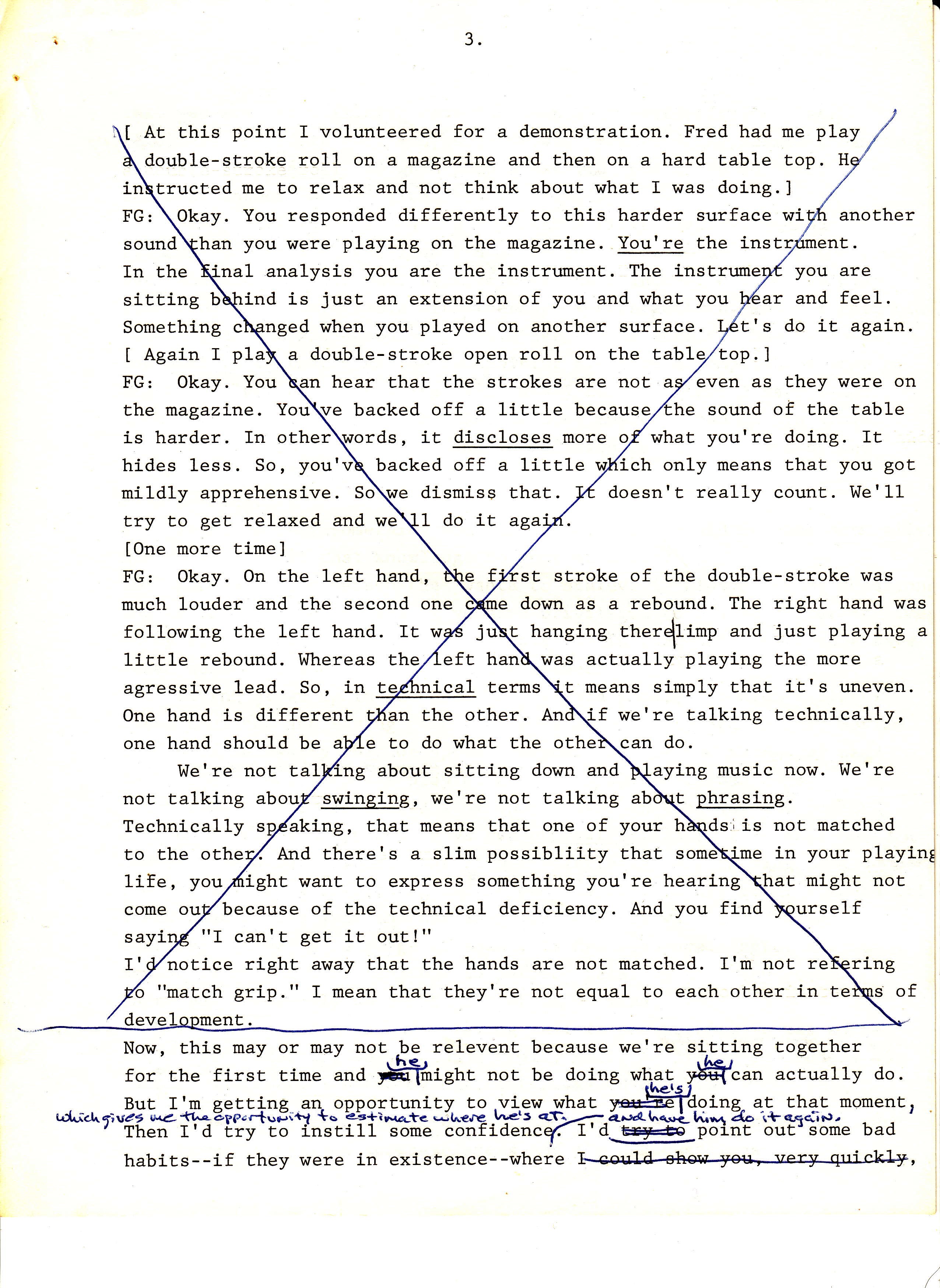
Edited page from the transcript of my Fred Gruber interview.

SKF NOTE: Several decades ago there emerged political activists who said the teaching of US history prior to 1950 was irrelevant to modern students. Pre-1950 US history, they said, didn’t matter. If taught in classrooms at all, protested the activists, pre-1950 US history deserved brief mention.

I am not aware of any public calls to limit or ban teaching drum history prior to any past decade. But I am concerned, as time goes on, fewer young drummers will care about the development of the drumset; of the people who gave us the modern drumset, and the the language we use to play it.

Sometimes, in my darker moods, after spending hours reviewing my 1980s drummer interview tapes for excerpts to post, I think, “Does anybody care about this drummer or what he has to say about anything?”

But that’s not the point of preserving drum history. Maybe at the moment I’m digitizing an interview excerpt nobody does care about the drummer interviewed or what he has to say.

That’s not to say no one will ever care.

Plenty of times while researching for a writing project, I have spotted a jewel of information, a significant fact, buried in some obscure album or concert review, a letter-to-the-editor; an old drummer profile, or a decades old magazine editorial. It is, in a way, finding a missing piece that completes a jigsaw puzzle.

Perhaps it has always been the case that the percentage of drummers interested in drum history is small. Surely there is room for more. Until then, I trust those drummers interested now are sufficient to keep the history alive and moving forward.

Posted in SKF Blog | Comments Off on Keep Drumming History Alive

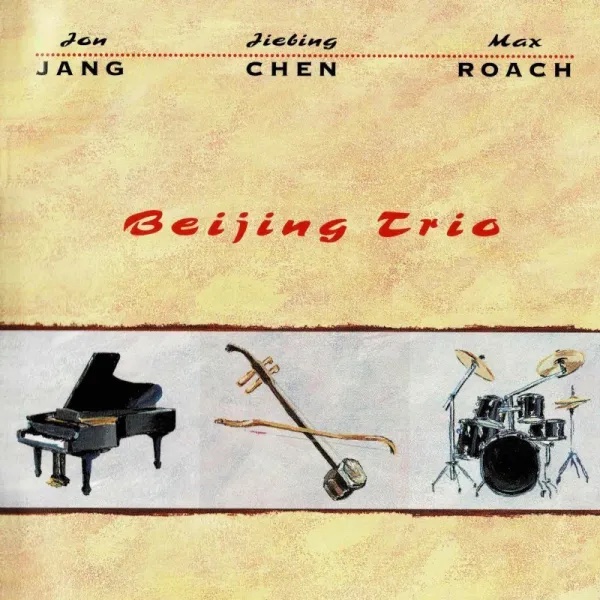
Max Roach and the Beijing Trio

SKF NOTE: A week or so ago, after updating my Instagram page, I was impressed by erhu musician Jiebing Chen‘s playing in a short rehearsal video also posted on Instagram. The erhu is a two-stringed bowed musical instrument, sometimes called a Chinese vertical fiddle.

I was inspired to find out if Jiebing had any albums. She does. Among them is the 1998 Beijing Trio with Jiebing on ehru, pianist Jon Jang, and Max Roach on drums!

Jang, on his web site, tells how the album happened. He said, “At a private meeting with Max, I invited him to produce and perform a recording with me…. A 74 year old Max jumped up with excitement: ‘Let’s do it next month! I am not getting any younger!’”

Jang continues. “Originally, the Beijing Trio was going to be a Max Roach-Jon Jang duo. However, when erhu performer Jiebing Chen visited one of our rehearsals, Max and I decided in a matter of seconds to add her to our ensemble,” he said, adding, “Because Max also made it a rule that we do not read music while we are performing, the whole recording was improvised.”

The Beijing Trio track, “Fallen Petals,” featuring Roach using mallets, is from Jiebing’s web site. [SKF NOTE: The track volume is very soft for the first 12 seconds.]

Roach has this quote about the Beijing Trio on Jiebing’s site: “One of the most refreshing and enjoyable experiences in my career. In this cross-cultural artistry, I heard and did things musically I had never done before.”

Before hearing any of the album music I was ready to buy and download the digital version. Disappointingly, there is no digital album. The CD is available from Asian Improv Records for $20.00 plus $10.00 for shipping. I did write the label to suggest they offer a digital album as well.

I’ve heard Roach play drums in many settings including solo, duets, trios, percussion ensembles, quartets, quintets, big bands, and choirs. But, until yesterday I was unaware of Roach playing drums as a member of the Beijing Trio.

I look forward to hearing this whole album..

Posted in Audio, Drum/Music News | Tagged , , , , , , | Comments Off on Max Roach and the Beijing Trio

Barry Keane Modern Drummer Interview 1981 Pt 2 of 2

SKF NOTE: This is Part 2 of my interview with Barry Keane, published in the August-September 1981 Modern Drummer magazine as a feature interview titled, “Barry Keane: Canadian Studio Kingpin.”

Our discussion was as much about Keane’s studio drummer work in Canada as it was about his membership in Gordon Lightfoot’s band. In August 1980, Barry had been with Lightfoot five years. I was freelance writing for Modern Drummer, two months away from being hired as MD’s first Managing Editor.

This interview, I believe, took place after the band’s soundcheck at the Performing Arts Centre, Saratoga Springs, NY on August 2, 1980. Gordon Lightfoot’s album, “Dream Street Rose,” was released two months earlier.

Researching drummers in 1980, even well-known drummers, was often labor intensive, yielding few results. There just wasn’t much backgrounder information available on most drummers.

Modern Drummer was successful, in part, because it showcased drummers in-depth. No other magazines had done that.

When Barry and I, along with my friend and Lightfoot fan Wayne Pasco, met at Saratoga Springs in 1980, I didn’t know much at all about Barry’s background or his studio drumming career. Re-listening to this interview after 43 years, my nervousness, my trying to ask the right questions to gather the best elements of Barry’s story, is quite evident. At least in spots.

Of course, neither Barry nor I could have known we would sit down for another interview 42 years later

Posted in Audio, SKF Blog | Tagged , , , , , , | Leave a comment

Barry Keane Modern Drummer Interview 1981 Pt 1 of 2

SKF NOTE: This is Part 1 of my interview with Barry Keane, published in the August-September 1981 Modern Drummer magazine as a feature interview titled, “Barry Keane: Canadian Studio Kingpin.”

Our discussion was as much about Keane’s studio drummer work in Canada as it was about his membership in Gordon Lightfoot’s band. In August 1980, Barry had been with Lightfoot five years. I was freelance writing for Modern Drummer, two months away from being hired as MD‘s first Managing Editor.

This interview, I believe, took place after the band’s soundcheck at the Performing Arts Centre, Saratoga Springs, NY on August 2, 1980. Gordon Lightfoot’s album, “Dream Street Rose,” was released two months earlier.

Researching drummers in 1980, even well-known drummers, was often labor intensive, yielding few results. There just wasn’t much backgrounder information available on most drummers. Modern Drummer was successful, in part, because it showcased drummers in-depth. No other magazines had done that.

When Barry and I, along with my friend and Lightfoot fan Wayne Pasco, met at Saratoga Springs in 1980, I didn’t know much at all about Barry’s background or his studio drumming career. Re-listening to this interview after 43 years, my nervousness, my trying to ask the right questions to gather the best elements of Barry’s story, is quite evident. At least in spots.

Here’s the link to Part 2 of this 1981 MD interview.

Of course, neither Barry nor I could have known we would sit down for another interview 42 years later:

Posted in Audio, SKF Blog | Tagged , , , , , | Leave a comment