Revisiting My Life in Music: The Rise of Writing Influences

american_revolutionSKF NOTE: I’ve written about some of my key musical influences. But what about my writing influences? When did that start?

I am surprised I cannot pinpoint a specific moment when I fell in love with writing. My parents were readers. Growing up I read comic strips, comic books, young readers books, (i.e. The Hardy Boys Series), magazines (MAD, and Famous Monsters of Filmland, hot rods and auto racing), and children’s history books about The American Revolution, The American Civil War, pirates, WWI fighter pilots.

My father graduated Syracuse University with a journalism degree. All my life he was a magazine editor, then a book editor. He worked first for Boy’s Life, then Sports Afield, and most of my life, Outdoor Life. I have memories of my dad on weekends, sitting on our living room sofa with a typed manuscript, a yellow legal pad, and red pencils, editing magazine articles. That was my first look at proofreaders marks.

proofreadingWriting letters to grandparents and other relatives, I suppose, was my intro to writing. Long distance telephone calls were too expensive. If I wanted to communicate with family members, letter writing was the best means of communication. My letters were written mostly in longhand. We had a manual typewriter at home. Sometimes I used it and two fingers to peck out a personal letter. But that method was slow. My brain was always working faster than my two fingers could type.

typewriter_manualI learned penmanship, grammar, and spelling in school and at home. I was also privvy to my father’s rapid writing on his manual typewriter. Wanting to learn how to type with all fingers on both hands I enrolled in a high school typing class. Typical of my attitude about school (forced confinement!) I learned how to type and how to format business letters (headings, dates, introductions, closings, tabs, margins), paying little attention to the rest.
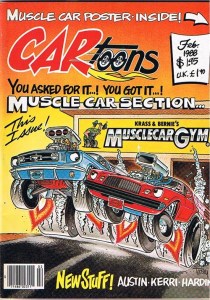
cartoonmagcoverSo early on I loved reading, history, writing to communicate with people, and, on a manual typewriter, I was typing with accuracy 100 words per minute. CARToons magazine published my poem, “The Midnight Ride of Paul Chevelle,” when I was 15-years old. That was a complete surprise. My poem was just a Chevy fan’s response to a pro-Ford Paul Revere spoof CARToons published. That was my introduction as a published (unpaid) freelance writer.

In junior high school and high school, through new friends at school, work, and in my neighborhood, I was exposed to more and more varied musicians and writers. Time now to sort out those experiences and how they – and other experiences – were my training ground for getting paid to write about musicians, mostly drummers.

To be continued….

-end-

Posted in Revisiting My Life in Music | Tagged , | 1 Comment

Rhythm: Who Could Ask for Anything More?

[SKF NOTE: All that’s missing is the hamster wheel.]

http://www.ultimate-guitar.com
Today in Crazy Instruments: Meet Yamaha’s 360-Degree Spherical Drum Kit
04/18/2015

raijin_spherical_drum_1[W]e…present you Raijin, Yamaha’s 360-degree spherical drum set.

[T]he kit allows musicians to take on a different approach to drumming and possibly express themselves in a different way than usual.

It has all the components of a standard drum set, with not one, but several cowbells, four bass drums with pedals and numerous cymbals and toms.

The manufacturer stated: “This design seeks to create an ideal form that will allow human beings to go beyond existing methods to express themselves. The design resembles a globe and allows performers to let their imaginations run wild on an assortment of different kinds of drums. Energy erupts centered on the performer and creates an increasingly visually dynamic world of sound.”

Full Story

Posted in Drum/Music News | Tagged , , , | Leave a comment

Are Drummers a Dying Breed?

Linn Drum (Photo courtesy VintageSynth.com)

A Drum Forum drummer using the name “homeby5” has thread titled, “Are We a Dying Breed?” “When I was young I was attracted like crazy to live music with one catch….they had to have a drummer or it wasn’t a real band!,” writes homeby5. “But today, we are replaced by machines, DJ’s, single acts, tambourine players, etc…but mainly computer beat machines!”

Are drummers a dying breed? Good question. In the early 1980’s I was at Max Weinberg‘s home and he was showing me a Linn Drum, an early drum machine that sold for $3,000. The Linn Drum was causing a lot of excitement in the recording world. Someone thought Modern Drummer should feature the Linn Drum as a cover story. That is, instead of a drummer on the cover, have a Linn Drum on the cover.

Max said, at the time, he could envision future drummers no longer bothering to learn the rudiments. Why, Max asked, would you go through all the trouble of playing a decent double-stroke roll when you can just push a button and have a near perfect double-stroke roll?

That thought literally made me shiver because I thought Max was making a great, plausible point.

Bottom line: acoustic drums, electric drums, drum machines — at best they are all communication tools. How well people communicate with them is up to the individuals using them.

end

Posted in SKF Blog | Tagged , , , , , | Leave a comment

Stradivarius Tympani: Like Itzhak Perlman, Only Louder

[SKF NOTE: Three musical discoveries in this story: The Stradivarius drums, a copyist mistake in a Vivaldi concerto, and the identity of the musician for whom Stradivarius built the tympani. Nice.]

A Sale Is Booming: Rare Stradivarius Drums Up For Auction
APRIL 01, 2015 8:03 AM ET — MARK MOBLEY

DEA Picture Library/De Agostini/Getty Images

DEA Picture Library/De Agostini/Getty Images

Timpani are also called kettledrums. These instruments crafted by Antonio Stradivari were, for a time, more kettles than drums.

[A] pair of lovingly restored Stradivarius timpani…were lost roughly a century after they were built by Cremonese master luthier Antonio Stradivari, whose violins, cellos and…violas…sell for millions…of dollars. The drums were rediscovered…last year at the Vatican…during a routine inventory of kitchen equipment.

The two copper bowls, 26 inches and 29 inches in diameter, were secreted for decades behind…pasta-making and cannoli-filling machines. Apparently the vessels had been used to make…soups [for] 19th-century Pope Honorius V….

“It’s an astonishing discovery,” said Metropolitan Philharmonic Principal Timpanist David Sheppard, who supervised the cleaning/restoration…. “Once we were able to remove the remaining traces of pasta and parmesan, all we needed to do was stretch calfskin for the heads.”

The mysteries that have perplexed musicologists since the unlikely emergence of these drums include: Why did Stradivarius make timpani? Did he make any more? And why did they fall out of use? Some answers appear…in a piece that has intrigued scholars since…nearly a century ago.

For decades, musicologists…assumed…one…concerto by Vivaldi, “Il Cammelo” (The Camel)…was for double bass. It…feature[s] a solo part…of only two notes, G and D, played over and over…. Vivaldi’s biographers…assumed he composed the piece for a Venetian nobleman and amateur bassist of modest gifts named Gianluca Wimpani. It now appears the W on the title page was erroneously substituted for the correct T by a copyist long ago.

“This shows the piece in a whole new light,” Sheppard said. “And it explains the subtitle. Back in the 1400s, Mongols and Turks had armies with timpanists riding on camels.”

Thanks to markings etched on the drums, scholars now believe Stradivarius crafted them especially for Giorgio Della Giungla, an adventurer, strongman and musician whom Stradivarius referred to in his diary as “amico per te e me” (friend to you and me).

“Della Giungla played a number of instruments, and quite well, but he was best known for riding elephants,” said Yale University symbologist B. Reid Morris. The Stradivarius timpani appear to have fallen into disuse when, after repeated collisions while swinging from tree to tree on vines in the instrument maker’s beloved Musical Woods, Della Giungla had a fatal encounter with an heirloom spruce.

How the Vatican came to acquire the Stradivarius drums is unknown.

“You just have to hear them,” Sheppard said. “When I play Also sprach Zarathustra with the Philharmonic, I swear I feel like I’m Itzhak Perlman. Only louder.”

Full Story

Posted in Drum/Music News | Tagged , , , , | Comments Off on Stradivarius Tympani: Like Itzhak Perlman, Only Louder

Joe English on Jaimoe: He Was Incredible

SKF NOTE: Joe English was tough to interview. Here’s what I wrote as part of the interview introduction in the June 1986 Modern Drummer:

L-R: Scott K Fish, Joe English

“Joe English agreed to to this interview in 1980. Then he disappeared. In 1983, I got approximately three-fourths of this interview on tape, when Joe disappeared for another three years. I nicknamed him the Howard Hughes of Drumming. I had no positive proof that Joe was a bad guy. He never returned my phone calls or answered my letters, but I have two grandmothers who are guilty of the same thing, and they’re not bad people. The last quarter of this interview was, finally, taped at the tail end of 1985, and I submitted it to MD and it was published in the June 1986 issue.”

I left MD’s employ in 1983. Rather than have someone else finish them, I had Ron Spagnardi’s okay to complete a handful of interviews I started. Joe English was one of them.

Today I came across Joe English’s recent video testimonial in which he asks fans of his Christian music to forgive him because, he says, it was all a sham. “Jesus was not in the music I was doing,” Joe says in his testimonial. And Joe explains what could be reasons for his frequent disappearing acts while I was trying to complete his interview.

R-4146692-1356846841-8187.jpeg

I’m glad Joe has his life together. I still think the Joe English Band released several excellent albums. They weren’t just good Christian music, they were good music. I was not, as Joe says in his testimonial, in awe of him because he had played and recorded with Paul McCartney. I liked the Joe English Band: the songs, the message, and Joe’s singing and drumming.

This excerpt from our interview appears in the 1986 MD interview. I like it for what Joe says about our mutual friend Jaimo.

=====

Joe English: When I moved near to Macon, Georgia I lived on a farm that was owned by the Allman Brothers Band. I had heard about them from their first album when I was living in Syracuse.

Theirs was a real different sound.

When I lived on the farm I use to go to Jaimoe’s house. I didn’t know how good a drummer Jaimo was. He played good with the Allman Brothers, but when I went to his house and heard him play – he was incredible. I said, “This is the guy who’s on the record?”

So I told Jaimoe that I wanted to get a few lessons from him. He says, “Joe, you don’t need any lessons.” I said, “Okay. Don’t call them lessons. Let’s hang out together.”

modern_drummer_joe_english

Jaimoe’s idea of a lesson was to lay on the floor and listen to John Coltrane for a long time. And then listen to Elvin Jones. And then to go from his stereo room into his music room and just play together for hours on end. Those were some incredible times.

I use to tell people how incredible Jaimoe was. They wouldn’t know. It was as if it was Jaimoe’s secret. I don’t think he ever got a chance to really get outside, like he would when he wasn’t with the Allman Brothers. He completely blew me away.

When I tell people what a musical highlight that was, they think that I must have just gotten caught up in the who Allman Brothers scene. But it was the furthest thing from that.

I’d pull into Jaimoe’s driveway and hear Coltrane and Rashied Ali‘s album, “Interstellar Space,” coming from inside his house.

I had dabbled with jazz, but I went from not doing it at all to getting into that kind of jazz. I’d just come out of Jaimoe’s house sweating.

And before he and I ever got together he told me that he and I would have to go over some things.

The first thing he had me do was take my drums completely apart. I stripped every part, cleaned them, and put them back together. And then we’d play. Maybe that was for discipline. It makes me laugh to think about it now, but it was some serious practice. It was good. I got a whole different outlook on drumming. A quick lesson in how to play outside.

end

Posted in SKF Blog | Tagged , , , , , , , , | 1 Comment