SKF NOTE: Thank you to Wall Street Journal Music and Pop Critic Jim Fusilli for bringing this story, this documentary, to my attention. A chilling piece of music history.
What the Khmer Rouge Did to Rock
The new documentary “Don’t Think I’ve Forgotten: Cambodia’s Lost Rock and Roll” recounts the fate of Cambodian musicians, including the band Baksey Cham Krong.
“If you want to eliminate values from past societies you have to eliminate the artists. Because artists are influential. Artists are close to the people.”
Q. You write that when Jerry’s opiate problem became obvious, you all wanted to play with him so much that you turned a blind eye. Could you have done more?
Kreutzmann: We attempted interventions, but he saw a setup for what it was. And he would go to [rehab] places, but he was smarter than the therapists and could outtalk them all. I think 12-step is a great program, but he would have nothing to do with it, firmly believing that a person had the right to do whatever he liked as long as it didn’t hurt other people. But hurt where? Hurt how? Emotional pain can be much more painful than physical pain.
Q. And your pain is still evident.
Kreutzmann: We just had no luck with getting him to leave heroin. The drug owned him and that’s really sad. I was never mad that he was a heroin addict. I felt compassion and deep sorrow. He would play the most forlorn, lonesome-sounding solos. It was the one time where I could really hear inside him and it was a great, deep sadness.
According to [Bill] Kreutzmann.., …the book was a by-popular-demand project. “I would be telling these stories at parties or after shows . . . and different people would say, ‘You have to write these down,’ ” [he] said.
“The thing that I mostly discovered in doing this book was the amount of love I have inside of me that I can put into music,” he said. “I love to play music. I had no idea how much I loved it. And then you start writing the book and you realize how people enjoy what you do, and it reaffirmed my feeling about playing music.”
When the Grateful Dead formed in 1965, he said, “The only expectation was the desire to play music as best as we could. We didn’t expect to be rock stars, we never expected to get as famous as we did. We never set goals or anything like that.
“The only goal we had . . . was to play music at the highest level possible. I think we did a pretty good job.”
In Praise of the Teen Summer Job From hauling bricks to delivering newspapers, traditional summer work taught generations of teens about life, labor and their place in the universe By DAVE SHIFLETT — April 24, 2015 11:40 a.m. ET
Jack Casady
…Jefferson Airplane bandmate Jack Casady…remembers being a paper-delivering prodigy. “I started when I was 11 years old,” he said…. “On Sundays, I got up at 3 a.m. and delivered 400 papers.” He adds, “I made good money”—some of which he used to start the grass-cutting business that paid for his first musical instruments, including an amplifier kit he put together with help from his father.
“All of that taught me the thought process of setting your goal and then putting together the steps to reach that goal,” said Mr. Casady. “I learned that work was a means to independence and that if something you want is not available, you can make it yourself. There was no drudgery involved for me. Work was a means to freedom.”
His advice to young workers: Live and toil “with integrity,” and adopt a no-slacking attitude. “Luck and timing can make a big difference,” he said. “But Lord knows, prepare. If you prepare properly, you’re ready for luck and timing if they come your way.”
SKF NOTE: I want to correct my original post intro. I left Modern Drummer as a full time managing editor in October 1983, and continued freelance writing for MD for a few years after, including this John Von Ohlen interview. Having digitized and re-listened to the Von Ohlen interview tape, I know I conducted this interview from my home phone. The rest of my original intro is accurate.
John wanted to talk about Indianapolis music teacher extraordinnaire Bob Philips, “[T]he guy who really taught me music,” John told me.
So here , along with the transcript from the interview, is the audio from the interview.
==========
[SKF NOTE: From the transcript of my interview with John Von Ohlen, published in the March 1985 Modern Drummer. This interview was done by phone. I was in my MD office. John was home in Indiana. My introduction to John’s playing, years earlier, was through Stan Kenton’s Live in London album. Mel Lewis, who I had befriended by the time of this interview, spoke very highly of John. I happened to be in Mel’s apartment for one of his birthdays when he received a Happy Birthday phone call from Von Ohlen. “He always calls me on my birthday,” Mel said.
And prior to this interview I had listened a few times to John’s Blue Wisp Big Band albums. A terrific big band.]
John Von Ohlen
John Von Ohlen: I’ll tell you about the guy who really taught me music. His name is Bob Phillips. To Indianapolis musicians he’s like the guru, sage, teacher. He taught all of us just about everything we know. You can graduate from Indiana University or from Bob Phillips. He teaches in a very unorthodox way.
Bob invited me to play trombone in his “B” band on Saturday morning. And I went there every Saturday morning. He taught all of us how to play in the ensemble, and he had a beautiful way of teaching figures.
First of all, it was the real shit. There was no time for mistakes in reading. He made you play as if you were on a national television show, even when you were just a little kid. We ha no time for mistakes in reading. No time for playing wimpy. He wanted it out there and he wanted it right now. He’d say, “If we wanted it tomorrow we’d have rehearsal tomorrow.”
John Von Ohlen
Scott K Fish: What was his reaction when someone did make a mistake?
JVO: He’d stop the band, single you out, and make you feel like shit. Right in front of everybody.
And he’d never compliment you. Week after week. Then when you were just about fed up with him he’d compliment you highly in front of everybody. Boy, you’d feel like a million bucks.
He never had drums at rehearsals. He didn’t believe in it. He’d say, “The band ought to swing by itself.” I’m very grateful to him for everything I learned from him. He was doing it to further good music.
SKF: After you graduated high school you went to study at North Texas State.
JVO: Yeah. I was never into school. It was bondage. I went to North Texas State because I was coming out of 12 years of school and I thought I should go to college.
Prior to going, Bob Phillips had said to me, “Think about your favorite players. How many of them went to school?”
I couldn’t think of any. Not one. None of my favorite players went to school.
Bob said, “You don’t need to go to school. Just start working. You already know what you want to do.”
But, I went down to North Texas State and, right away, I found out that I didn’t want to go to class.
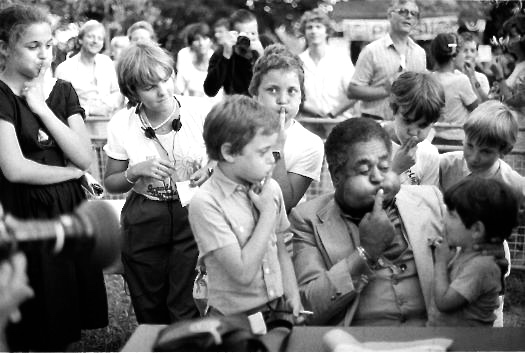
This morning I am remembering accepting Dixmont’s First Selectman’s invitation to serve as one of three judges of a public speaking contest for grade school kids. Not that I felt qualified to do so!
Dizzy Gillespie
The second speaker, as I recall, was a petite 12-year old girl with long dark hair. Standing onstage in the school gym, this young lady said her topic was Dizzy Gillespie. Dizzy Gillespie??? For the next few minutes this kid spoke of how she discovered this legendary jazz trumpeter, and how much Dizzy Gillespie influenced her own trumpet playing.
I was – no pun intended – blown away and delighted to hear a 12-year old who knew about, and spoke with passion and knowledge about, Dizzy Gillespie.
Not long after that I came across a photo book about Dizzy. I bought it thinking I could get it to that student somehow. That never happened. From time-to-time, such as this morning, I remember that young lady and regret not making more of an effort to get her that book. I hope she’s still playing.
And, yes, I voted her as the public speaking contest winner.



 Scott K Fish
You must be logged in to post a comment.