SKF NOTE: Learning stage fright happens to the some of the giants of music, was a help in overcoming moments of stage fright I had drumming or singing. In my case, the jitters came when stepping outside of my musical comfort zone. Sight-reading charts onstage the first time, for instance.
Here’s Frank Sinatra at age 84 talking with radio show host Larry King about stage fright. What Sinatra says here about show biz professionalism are also words of wisdom for all musicians.
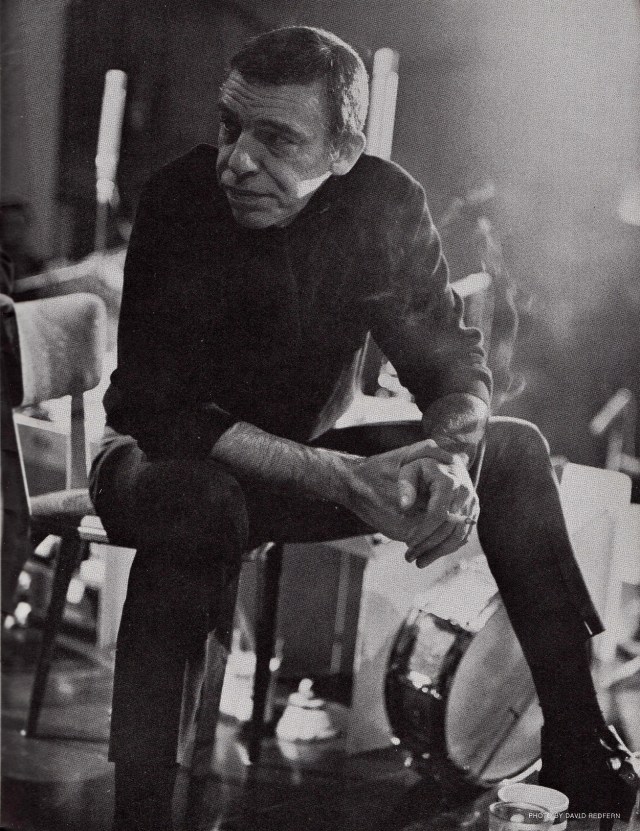
Frank Sinatra
Larry King: Is it still a kick when the man says, and now, ladies and gentlemen –
Frank Sinatra: Oh, it’s a kick. Absolutely. And I swear on my mother’s soul, the first four or five seconds I tremble every time I take the step and I walk out of the wing onto the stage. Because I keep thinking to myself, I wonder if it will be there? When I go for the first sounds that I have to make, will it be there? I was talking about it jus the other night at Carnegie Hall…. I said, even just going out and looking at the audience, I was terrified for about four seconds and then it goes away.
King: How do you explain that?
Sinatra: I don’t know. I can’t explain it. I always had it. Will you remember the lyrics? Is your tie right? Will you use your hands right? Will you look pleasant to the audience? You have to be on the ball from the minute you step out into that spotlight. You have to know exactly what you’re doing every second on that stage. Otherwise, the act goes right into the bathroom. It’s all over. Good night.
SKF NOTE: In the early 1980’s, Max Weinberg asked if I’d like to see Buddy Rich playing at either New York University or Columbia University – I can’t remember which. Of course, I said, “Yes.”
I saw Buddy Rich play live about a half dozen times. I remember particular moments from each venue. For example, sitting one night on the Eisenhower Park, East Meadow, New York lawn watching Buddy’s big band burn it up. The first set over, Buddy thanked the crowd and announced a short break.
After 15-minutes or so, Buddy’s band members begin filtering back to their seats onstage. Buddy steps back onstage to rousing applause. He starts a tune intro playing swing time on his hi-hat. Then, looking left at his band, he spots a conspicuously empty chair in saxophone section in front.
Buddy stops playing. He asks the band, “Where’s Fred?” No one knows. But, a moment later Fred (not his real name) is onstage, hurrying to his chair. He sits down, pulls his sax strap over his head, and turns to the music chart.
As Fred gets ready to play, Buddy stands and walks directly in front of Fred. He extends his right hand to Fred and the two men shake hands. “How long have you been with my band?” Buddy asks. The exchange is picked up by the live band mics. Fred answers. Buddy says, “Well, enjoy your last night with the band.”
Then Buddy walks back to his drums, to his hi-hat intro, and the band burns through a second set.
I don’t remember Buddy’s band when Max and I heard Buddy in that University setting. It must have been a small band. We were in balcony to Buddy’s left. I don’t think we were in a theater. My recollection is Buddy was playing in an inside general purpose open area. People listening to the music were sitting or standing near the stage. But people (students?) were also going about their business on the outskirts of the concert goers.
I recall Buddy playing very much “for the band” that day. It was a kick seeing Buddy play that way. If you were seeing and hearing Buddy Rich for the first time, you might think, “This drummer swings. He’s a great team player.” But you were not witnessing Buddy’s technical wizardry.
Buddy’s solos were always different, but they followed a pattern. Buddy, I believe, compared playing a drum solo to delivering a good joke. The build-up, done well, leads to a perfectly timed punch line .
Buddy’s solos often (always?) included his playing a super soft, beautiful sounding buzz roll on his snare drum. Playing that buzz roll, Buddy would bring the drumsticks towards him, closer to the edge of the snare head, until finally he was playing on the snare drum rim.
Then he’d work his way back to the snare head, ending his solo with a blistering crescendo of drums and cymbals.
But this day, in New York City, Buddy plays his snare buzz roll, draws his sticks back onto his snare rim — and stops playing! He grabs a towel, stands, wipes sweat from his face and neck. He walks to the front of the stage and tells the audience – as a matter of fact, no regrets, no in-your-face – that he just didn’t feel like finishing his solo.
Buddy tells the audience “you all know what comes next” in his solo, describing, as I did a moment ago, the drum crescendo and cymbals crashing. Since the audience knows what was coming – it doesn’t matter if Buddy doesn’t repeat it.
Buddy thanks everyone for coming. The show is over.
“’Everybody hates something!’ the angry child flings. Perhaps. Surely most men do. But the artist must love to create. He must bring love to his art if it is to live. He can hate, but if this becomes all-consuming, his creativity dies.”
Source: Don DeMichael (Down Beat publisher): Love, Hate, and Jazz, Down Beat 10/26/61
In the early 1980’s, Max Weinberg and I were working on a book that, unfortunately, never happened. But along the way, Max and I had a handful of interesting interviews with drummers.
When we asked if he could pinpoint the key to his success as a drummer, Russ Kunkel said it was because when he decided to be a pro drummer, “The only thing I had to fall back on was my ass.”
Now and then I recall a brief correspondence I had with a drummer – call him Eddie – seeking help publishing and selling his drum method book. At the time, Modern Drummer was not publishing books, but in each magazine we published drum method columns.
Some columns, such as David Garibaldi‘s and Roy Burns‘s, were long running. And some were one-time-only columns. It was not unusual to receive envelopes from MD readers with unsolicited columns inside. If the columns were good – they were published.
So when Eddie contacted me, I suggested he condense his drum method book, or a part of his drum method book, into a column. MD would publish the column, include Eddie’s contact information, and we’d let the chips fall where they may.
We spoke a couple of times after that. Eddie was always in doubt. He was not saying yes to the column, and neither was he saying no. I couldn’t figure out why he was staying on the fence.
Then Eddie came clean. He said he was afraid if MD published a column based on his drum method book, someone would steal his ideas. As far as I know, Eddie never changed his mind. I don’t know what happened to him or his drum method book.
How do you create without sharing your ideas? Most of my life I’ve shared ideas openly. Sure, sometimes when approaching someone with a business idea, I think of the possibility that person could run with my idea, leaving me high-and-dry.
But everytime that happens – that’s when I remember Eddie. If I am so distrustful of people I never share my ideas – then I am never creative. My ideas die on the vine.
Instead, I pray, deal with good people, trust my instincts, and share my ideas. Every day of my life I’m benefitting from something I learned from someone.






 Scott K Fish
You must be logged in to post a comment.