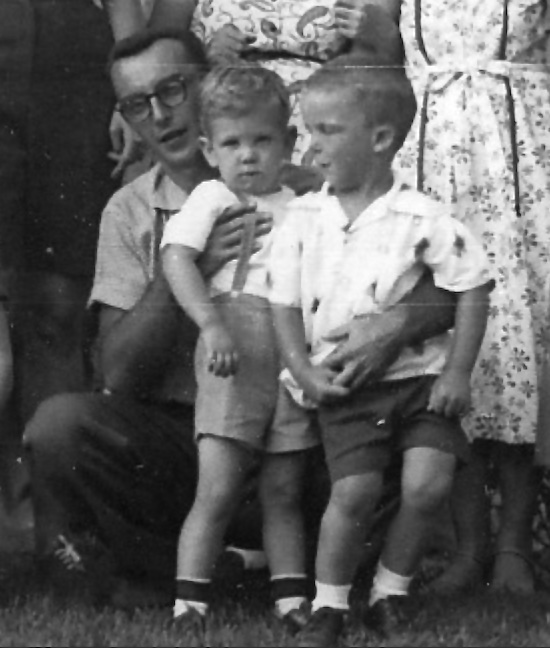
My Uncle Bob on the far left. Scott K Fish on far right.
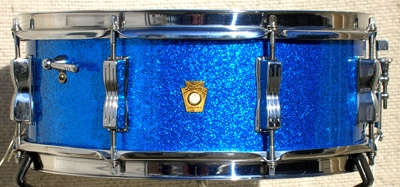
SKF NOTE: My Uncle Bob, older brother Craig, and I are standing in the dirt driveway at Charles R. Fish Nurseries, 39 School Street, Auburn, Massachusetts. I’m maybe 10 years old. Craig is one-and-a-half years older. The sun is shining on everything, including the chrome and blue sparkle Ludwig snare drum Uncle Bob is holding in his hands. Bob tells us he paid $75.00 for the drum.
He then asks Craig and I, “Do you know who’s the world’s greatest drummer?”
I say nothing. I have no idea.
Craig offers, “Gene Krupa?”
“No,” says Uncle Bob, “The world’s greatest drummer is Louis Bellson.”
It’s curious how Louis Bellson appears at key places throughout my life. In the early 1970’s, while living in Davenport, Iowa, I found out Louis grew up right across the Mississippi River in Moline, Illinois. Local musicians and jazz lovers talked of hearing Louis in clubs when Moline was a happening place.
Louis’s name would also often prompt the same people to rave about another Illinois drummer, Gaetan Caviola. Some said Gaetan was a better drummer than Louis. I never saw Mr. Caviola play. I only heard him on two albums: “The Sotos Brothers Quartet – On Stage“, and also, “Introducing Sue Childs.”
I saw Louis play once in Illinois. I stood to his right so I could watch his feet and hands. He was, of course, great.
In another blog post I write about an embarrasing teachable moment of sitting in at a Davenport jam session and stepping all over the group leader — on a drumset custom made by Bob Grauso for Louis Bellson.
Then there was my correspondence with Louis, and his consenting to be a part of the “Who Reads Modern Drummer?” ad series.
The first time I remember hearing Louis was on his “Concerto for Drums” album. This was before hearing his more famous “Skin Deep” with Duke Ellington. Louis introduces his “jingle sticks” – a set of tambourine cymbals attached to drumsticks – on “Concerto.” And his calfskin head drums sound wonderful. It’s a great solo. Especially impressive to an up-and-coming drummer.
Once in conversation with Joe Morello, Joe was wishing Louis’s playing was more spontaneous, less pre-planned. Joe and Louis were friends and, in my conversation with Joe, Joe was not being unkind about Louis. We were simply having a candid talk about drummers. My impression was Joe couldn’t understand why Louis, with his drumming ability, wasn’t playing more spontaneous. As if Joe was looking at the math equation 2 + 2 = 5, knowing it should be 2 + 2 = 4.
As I listened, and still listen, to Bellson, I understand Morello’s point. And I have seen times when Louis seems to let loose. His performance here on The Tonight Show with Buddy Rich is one example. I can’t help laughing whenever I watch it.
Sometimes Louis’s playing is exactly what I need to hear. His measured, clean, supportive and swinging accompaniment; his solos in which, as with all great players, I hear familiar phrases. And everytime I hear Louis I recall my first, and perhaps greatest drumming influence, my Uncle Bob, standing on a sunny day holding his blue sparkle Ludwig snare drum telling me, “The world’s greatest drummer is Louis Bellson.”
SKF NOTE: A glimpse at Billy Cobham’s drumming concepts 41 years ago in Different Drummer magazine.
Billy Cobham: My concept is my own, my personality is my own. Dynamics enhance my playing and gives a lot of contrast to the amount of intensity and volume that I project off the drums naturally. When the band is really in a level of intensity, I like to let it all hang out and then drop back and let it build again.
The more drums you have the wider your scope in what you can think to do. Drums aren’t just drums to me, they don’t all work in every situation. I don’t record with the drums you see. I record with other drums that have a mellower sound, and, to me, they record better.
Depending on who I play with is what I’m gonna use. If I’m gonna work with people that don’t play hard, I’m gonna use smaller drums to cut down on my projection. I want to play with people, not against them.
I’ve always considered myself a better rhythm player than a soloist, so I learn toward team playing. I have nothing to prove. First I want to be an artist. I want to share my emotional thoughts with the people through the musical medium. I’m going for something where I can say here it is right here all the time, but there it is up there too. You can’t grasp that, but you can grasp this. So grasp it, and we’ll take you.
Source: “Billy Cobham,” by John Stix, Different Drummer, November 1974
SKF NOTE: Thank you, Doug Ramsey, for this wonderful piece on a true missionary of American music.
wsj.com
The Radio Broadcaster Who Fought the Cold War Abroad but Remained Unheard at Home Willis Conover spread American culture and values across Europe and the U.S.S.R. with his radio program, but almost no one in the U.S. knew about his show.
By DOUG RAMSEY — July 21, 2015 5:09 p.m. ET
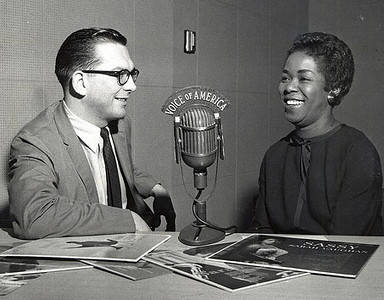
Willis Conover and Sarah Vaughan
During the Cold War, listeners in captive nations behind the Iron Curtain huddled around radios in basements and attics listening to the imposing bass-baritone voice of the man who sent them American music.
For 40 years, until shortly before his death in 1996, Conover’s shortwave broadcasts on the Voice of America constituted one of his country’s most effective instruments of cultural diplomacy. With knowledge, taste, dignity and no tinge of politics, he introduced his listeners to jazz and American popular music.
Countless musicians from former Iron Curtain countries have credited Conover with attracting them to jazz….
In its Dec. 9, 1966, issue, Time magazine quoted Conover on the importance of the music he championed. “Jazz tells more about America than any American can realize. It bespeaks vitality, strength, social mobility; it’s a free music with its own discipline, but not an imposed, inhibiting discipline.”
L-R Allman Brothers drummers Jaimoe, Butch Trucks. And Scott K Fish
Scott K Fish circa 1982 at MD interview for M’Boom.
In Revisiting My Life in Music: Early Days at Modern Drummer I write about how the preliminary actions the MD Editors and Art Director took in deciding which columns and feature stories were in each magazine. Using the December 1982 MD as an example, I said I would tell you about actually putting together – assembling – MD issues.
MD editors were always working on three issues at once in different stages of publication – like an assembly line.
At the bottom of the last page of the December ’82 issue is a teaser for the next MD, the January 1983 edition. It tells readers MD will include interviews with Peter Erskine, Chester Thompson and Jim Gordon. So, those interviews were either complete at MD‘s office, or we were fully convinced they would be completed on time. Otherwise we would not have included them in our “Don’t Miss It!” teaser.
Two of January ’83’s interviews were done in-house. Rick Mattingly did the Erskine interview. I interviewed Jim Gordon. Freelancer Stanley Hall spoke with Chester Thompson.
To put an MD issue to bed we needed all copy for the features, columns, letters to the editor. Look through any MD. We needed, in hand, all the copy you see. And we were publishing on schedule. There were several entities in the MD publishing chain counting on us to stay on schedule. From the magazine printer, to distributers, to subscribers.
Let me spend a moment on the logistics of a typical Modern Drummer feature interview. This might give better insight into why, from the Editor’s desk, having a completed interview manuscript – or at least an audiocassette – was a great feeling.
Step one in interviewing was finding the drummer (or his spokesman) and seeing if they were interested in interviewing for MD. Sometimes drummers were not interested, or they had demands of MD to which we just could not agree. But, when a drummer said yes to an interview, we had to then find a time and place for the writer, drummer — perhaps a photographer — to meet. Ideally, interviews/photos happened at one session. Sometimes they happened at multiple sessions.
Even with phone interviews we still had to connect photographers with drummers.
There were many variables at this stage of interviews. The drummer’s management might set up the interview in a noisy setting, making it impossible to conduct an interview the writer could hear during tape playback.
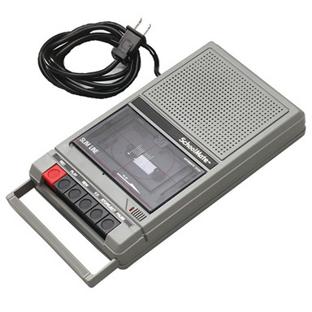
The typewriter I first used as an MD freelance writer and, briefly, as Managing Editor.
Management might not schedule enough time to conduct a feature interview. I was re-reading an old notebook in which I mentioned spending 17 consecutive hours interviewing Jaimoe and Butch Trucks of the Allman Brothers. That wasn’t 17-hours sitting around a tape recorder. I saw them in concert at two venues and interviewed them in two or three locations.
My Allman Brothers experience was exceptional, but I don’t think it was that exceptional. I’ve had interviews where the drummer refused to be interviewed on tape. Or where the drummer would give one, two or three word answers to questions. In both cases, I was unable to do the interviews.
Sometimes management would say, “You have 30-minutes to do your interview.” No way.
And photos sometimes needed taking at non-interview sessions. Concerts or recording sessions, for example.
Feature interviews were taped on audiocassettes, then transcribed using typewriters and typewriting paper. Double-spacing between lines! We were using proofreader’s marks, needing white space for indicating moving text, modifying text, cutting/adding words. You had room for about 300-words on one side of an 8.5 x 11 sheet of typewriter paper.
Feature interviews were no less than 25 double-spaced typewritten pages. At 300-words per page that’s 7,500 words. Remember: that’s the final edited interview. Typed transcripts of full interviews could easily be twice as long. Even fast typists – which I am – often found it slow going.
MD Editors also had to have photos in hand. Again, this was the pre-digital world. There was no emailing jpegs. Photos came by snail mail, usually in 8 x 10 or 5 x 7 prints. Sometimes we used color slides. We may also have used 35mm negatives, but I don’t remember that happening.
All the regular photographers I worked with were exceptional. When they said they would take and deliver shots of a drummer – that’s all I needed to know. They always delivered. (While I’m on the subject, the same is true of MD’s regular freelance writers.)
Sometimes I had to improvise with photographers Jim Gordon’s interview in the January 1983 MD is an example. Jim Keltner arranged that interview. One day I will share that back story. Part of the story: it was doubtful Jim Gordon was going to pose for an MD photographer at all.
Keltner mentioned during a phone conversation with me that his son, Eric, was a photogapher. Eric was young. He may have still been a teenager. But Eric and Jim Gordon knew each other. So we gave Eric Keltner the green light, Jim Gordon allowed Eric to come to his house to take photos, and those are the photos we used for Gordon’s MD interview.
Finally, we needed to have at MD‘s office all of the advertisement photos and copy. Ad sales keep MD alive and determine, to an extent, the number of MD pages in an issue.
At last! MD‘s Editors and Art Director have before them all the contents for the December 1982 issue. This is where Art Director Dave Creamer took over.
MD Editors would meet with Dave and make decisions about order of interviews. About the photos we wanted to use in each interview. About the MD cover photo and the copy overlaying it.
Dave would take all that input, all of the content/photos from MD‘s Advertising Director, Kevin W. Kearns, and make it all fit into December 1982’s 124 pages plus front and back covers. This is called “laying out” the magazine. It’s tricky business. You have to be conscious of interview text jumping pages, the layout has to be appealing visually and to readers’ eyes.
When Dave Creamer was finished, he and the Editors would review Dave’s layout, making corrections and suggestions. The whole process was literally done by cutting-and-pasting each magazine page, sending the printer hard copies with instructions on sizing photos.
We’d receive a mock-up hard copy — our last chance at spotting errors — and then the printer was given the “Let ‘er rip!” order. And – Presto! – the new issue of MD was born and on its way to subscribers and newsstands.
SKF NOTE: Sam Lay was a Butterfield Blues Band member in 1965 at this pivotal moment in Rock history. Mr. Lay and the Butterfield Blues Band were inducted into the Rock and Roll Hall of Fame this year.
When Bob Dylan Went Electric Fifty years ago, Bob Dylan picked up a Stratocaster and changed the world of rock ’n’ roll forever.
By MARC MYERS — July 20, 2015 6:45 p.m. ET
Elvin Bishop and Sam Lay
When Bob Dylan appeared at the Newport Folk Festival on the night of July 25, 1965, he had a Fender Stratocaster electric guitar around his neck. Three of his five backup musicians also took up electric instruments. Minutes into the first song, “Maggie’s Farm,” roughly a third of the 17,000 people in the audience began to boo. The media covered the rude reaction the next day.
Mr. Dylan couldn’t have wished for a better outcome. In the months ahead, the 24-year-old singer-songwriter was transformed from folk’s boy wonder into the poet equivalent of Elvis Presley.

 It’s curious how Louis Bellson appears at key places throughout my life. In the early 1970’s, while living in Davenport, Iowa, I found out Louis grew up right across the Mississippi River in Moline, Illinois. Local musicians and jazz lovers talked of hearing Louis in clubs when Moline was a happening place.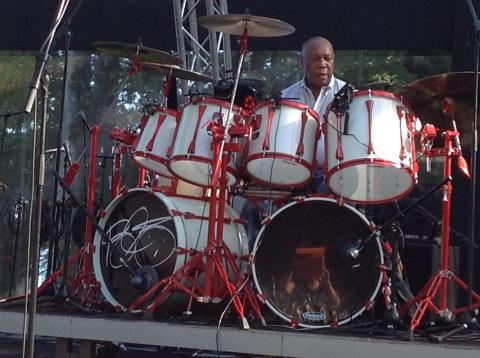





 Scott K Fish
You must be logged in to post a comment.