SKF NOTE: Good to see Joe LaBarbera in the news. He was recording with Chuck Mangione when I first heard him, and I saw LaBarbera with Mangione at My Father’s Place on Long Island, NY. His work with pianist Bill Evans on The Paris Concert: Edition 1 and Edition 2 is exceptional. The communication, the interplay among the musicians on these CD’s is at a very high level.
Drumming up the works of Evans
Joe LaBarbera, former drummer of Bill Evans’ trio, slated to perform area show.
By Kirk Silsbee August 1, 2015 | 10:17 p.m.
Joe LaBarbera
“For his first trio,” LaBarbera points out.., “Bill told drummer Kenny Dennis to play against him — that wasn’t part of the jazz vocabulary. Drummers had always worked with the pianist up to that time.”
“Bill’s approach pushed past boundaries,” LaBarbera…maintains, “and all musicians learned from his discoveries. For example, he wanted a high emotional content on ballads but he cautioned against hammering people over the head; he didn’t ever want to overstate something.”
“My perception of Bill, going into the Trio,” LaBarbera offers, “was as a swinger. There are so many great examples of him playing straight-ahead.”
“I’ll take to the grave the fact that Bill liked my playing. He started to compose again with our trio and added about six new originals to the book. I’ve got a letter here somewhere where he said he was going to write something for me, and it was about that time that my daughter was born. He wrote ‘Tiffany’ for her.”
“I’d be happy if my tombstone reads: Bill Dug Me.”
Spencer Drum Clinic seeks to teach students to succeed in music and in life Former SU band member’s clinic offers students lessons in playing, reading music; life
OLIVIA MCCLURE| OMCCLURE@THEADVOCATE.COM Aug. 03, 2015
Photo by The Advocate
If Kelvin Spencer’s drum students sound or look anything like Southern University’s famed Human Jukebox marching band, it’s no mistake.
Spencer was a section leader in the band in the 1970s.
At the Spencer Drum Clinic, every child is held to the same expectation: “to become whatever you want to become,” Spencer said. And for many of those he teaches — some of whom are underprivileged or have disabilities — marching in Southern’s band is a dream.
…Spencer believes, drum lessons condition the children’s minds for success in everything from schoolwork to music to life in general.
Spencer, who retired a year ago from a 37-year career teaching at the Louisiana School for the Deaf, has conducted his drum clinic since 1976, stopping lessons only for a few years to care for ailing family members.
He has taught about 400 children how to play the drums over the years.
Spencer remembers all of their names and what they’re up to nowadays.
There’s something about the drums that can bring a child straight out of their shell and turn them into a proud musician.
“It’s some kind of calmness in it, some kind of peace in it,” said Spencer’s wife, Perlinda, who manages the clinic’s office. “It motivates them. … When they play those drums, they stand out with their chest out. Everybody loves to hear those drums.”
Spencer’s youngest student is 4 years old. Beginners practice beating their drumsticks on pillows to learn to control their hands, Spencer said. Next, they go to the drum pads, whose texture requires a harder stroke that develops tendons in their arms.
….Spencer…also teaches them how to read music.
He approaches his clinic as a youth ministry and sometimes refers to its acronym, SDC, as “Saving Da Children.”
Joshua Mason, 10, said he wants to keep playing the drums, but realizes “your grades have to be good to play” in middle and high school bands.
At the end of every class, Spencer kneels with his students in a circle to pray.
“I’m on a mission to save as many youth as I can,” he said. “… I give God the glory. A seed was sown, and I’m that seed. … He watered me and gave me all I needed to know to one day reach so many kids.”
SKF NOTE: My first memory of Art Blakey is in the early 1970’s when I was working at Sam Goody’s record store in Huntington, NY.
Sam Goody’s was a great place to learn about jazz, rock, and classical music. Store manager, Sal Romeo, hired you only if you had at least a working knowledge of one of those musics. The Record Department (vinyl LP’s) had rows of record bins categorized (i.e. “Rock,” “Jazz,” “Classical”) and alphabetized (i.e. “Jazz A-D,” “Jazz E-H,”).
My forte was rock music, but I was blessed to have co-workers who knew a lot about classical and jazz musics.
Also, Sam Goody’s offered all kinds of jazz/classical cut-out LP’s for $1.00 – $3.00. With our 50-percent employee discount off those cheap prices it was an opportunity to build a record collection. I was mostly interested in learning about jazz. Reading LP liner notes was a great education. So was consulting fellow employees who were already “jazz heads.”
Art Blakey’s “Roots and Herbs” LP cover, then a cut-out, caught my eye. I asked Allen, a “jazz head,” if Blakey was “any good.” Allen wrinkled his nose while shrugging his shoulders. But a customer standing opposite me on the other side of the record bin said, “Art Blakey is one of the great jazz drummers.” I didn’t buy “Roots and Herbs” that day.
I’m sure Gretsch ads in Down Beat magazine were an early exposure to Blakey. Especially Chuck Stewart’s classic Gretsch photos.
When did I first hear Art Blakey? Best guess is it was early- to mid-1970’s while living in Davenport, IA. I bought an import album of Billy Eckstine’s big band with Art on drums. The sound quality was just okay. Even so, I was impressed with Art’s ability to swing, his gift for catching chart accents, and the sound and use of his bass drum! “Blowin’ The Blues Away” is the LP track that stayed with me.
Around that same time I bought “Gil Evans: Pacific Standard Time.” This 2 LP set featured on different tracks: Art Blakey, Philly Joe Jones, Dennis Charles, and Elvin Jones. Listening to this music for the first time, Blakey blew me away. He is still swinging, but I was also impressed by – to my 1970’s ears – his uncoventional fills and how he creates music on his drumset. Listen to Art on “Bird Feathers,” especially his intro.
Art Blakey’s way of accompanying the other musicians in the studio and onstage was, and is, a drummer’s lesson in how to be supportive, how to be musical, how to be felt without being oppressive. I don’t remember when I first heard Cannonball Adderely’s “Somethin’ Else” album, but Art’s playing on this classic date, especially on “Autumn Leaves,” is a case in point. He never overplays, His choice of what to play, of whether to play it with stick, brush, or mallet, is always the perfect choice.
Around this same time, I listened to United Artists’ 2 LP “Miles,” a reissue of Miles Davis’s two Blue Note albums, “Miles Davis: Volume 1” and “Miles Davis: Volume 2.” Yes, all Art Blakey qualities were there, but on top of them, Art’s unique drum fills really grabbed my attention. I’ve read writers attributing this part of Blakey’s drumming as African influenced. Maybe so. To my ears it was unlike any drumming I had heard and it was so musical. Check out “Kelo” and “Tempus Fugit.”
I flew back to Long Island, NY from Iowa for to visit my parents, taking time to also catch Art Blakey and The Jazz Messengers at The Five Spot in NYC. I don’t even remember who was in the band! My attention was on Art, sitting up high behind his four-piece white Pearldrumset. How did he make those sounds I was hearing on my LP’s? That’s what I wanted to know. Whether it was his drum rims, the bell of his ride cymbal, in one motion striking and choking his crash cymbal, his signature press roll and non-stop 2-and-4 hi-hat, his brush playing. Magical!
Since then I’ve acquired and listened to Art Blakey on many, many albums. His own and others. I love Art and pianist Horace Silver together. Silver’s left-hand comping in tandem with Blakey’s left-hand comping is like a boiling cauldron of swing. Yikes! (Someone could transpose Silver’s left-hand rhythms and make of them cool drum exercises!)
Of course, all drummers should study Art Blakey with Thelonious Monk. Jazz doesn’t get any better. Here’s a classic track with Blakey and Monk in a trio setting 65 years ago! It’s fun to compare Art’s playing here with the many versions of “Bemsha Swing” recorded since.
Art Blakey and The Jazz Messengers with saxophonist Wayne Shorter and trumpeter Lee Morgan remains my favorite version of The Jazz Messengers. That band, for me, is in the same league as Miles Davis‘s Second Great Quintet. I own all the albums.
Something inside us, often when we’re very young kids, tells us, “Play drums!” We know at that moment what we’re supposed to do in life. We may not know if we’ll be performers, teachers, inventors, manufacturers. But we know, beyond a doubt, one reason we’re on Earth is to play drums.
And then — WHAM! The whole world, it seems, conspires against us. In a world where so many people go through life without any direction, it would make sense for our families and friends to celebrate our finding a goal. A positive goal about which we’re passionate. Committed!
But, no. The Dream Stealer’s negatives start early: “Drums are too loud.” “You can’t make a living playing drums.” “Drums are okay as a hobby, but you need to think about what you’re going to do for a living.” Blah, blah, blah.
Some drummers are blessed with the opposite life experience. They really do have the support and encouragement of family and friends.
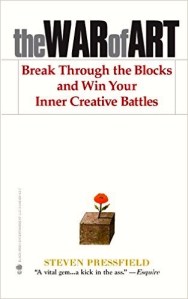
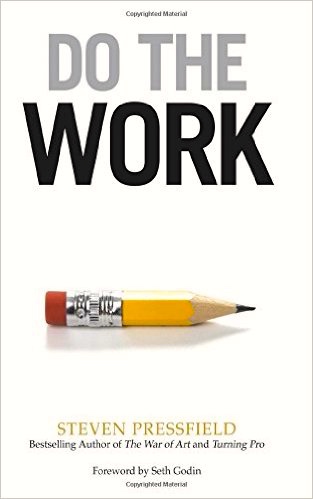
For drummers who didn’t or who don’t have that life experience, I have two books which should be of immeasurable help. The books are not written specifically about drumming and drummers. But author Steven Pressfield, drawing from his own life struggles as a writer, offers words of wisdom that can help any drummer feeling as if they are about to drown while swimming against the tide.
For what it’s worth, Mr. Pressfield’s books, not long ago, helped pull me through tough times. I still enjoy revisiting them. In fact, I was listening to “Do The Work” on the way to the post office this morning. That’s when I realized it made sense to share these books with Life Beyond the Cymbals readers.
Again, Mr. Pressfield’s books are written primarily to an audience of writers. But as a writer and a drummer, I promise these books are helpful to just drummers.
The book descriptions are Mr. Pressfield’s descriptions. I agree with them.
What keeps so many of us from doing what we long to do? Why is there a naysayer within? How can we avoid the roadblocks of any creative endeavor—be it starting up a dream business venture, writing a novel, or painting a masterpiece?
The War of Art identifies the enemy that every one of us must face, outlines a battle plan to conquer this internal foe, then pinpoints just how to achieve the greatest success.
The War of Art emphasizes the resolve needed to recognize and overcome the obstacles of ambition and then effectively shows how to reach the highest level of creative discipline. Think of it as tough love . . . for yourself.
Do The Work isn’t so much a follow-up to The War of Art as it is an action guide that gets down and dirty in the trenches. Say you’ve got a book, a screenplay or a startup in your head but you’re stuck or scared or just don’t know how to begin, how to break through or how to finish. Do The Work takes you step-by-step from the project’s inception to its ship date, hitting each predictable ‘Resistance point’ along the way and giving techniques and drills for overcoming each obstacle.
There’s even a section called ‘Belly of the Beast’ that goes into detail about dealing with the inevitable moment in any artistic or entrepreneurial venture when you hit the wall and just want to cry ‘HELP!’
SKF NOTE: In April 2014, when the time was right for me to start writing again about drummers and drumming, I expected to find changed, but vibrant, freelance writing opportunities.
To be clear: when I stopped looking for those writing opportunities years ago, I wasn’t walking away from my passion for music in general and drumming in particular. To the contrary, I devoted those years to study in two areas.
First, I re-learned how to use my hands. I was holding drumsticks, and using my hands, in ways making it impossible to execute rhythms and melodies I was hearing. I wanted to break my lifelong bad habit, replacing it with good hand technique I had learned while interviewing Freddie Gruber.
Along with Freddie, my inspirations were Big Sid Catlett and Arthur Rubinstein. Big Sid said, “I can swing seventeen men with one wire brush and a phone book.” And I know he could. So I set up in my home office a snare drum. That’s it. No hi-hat. No cymbals. No bass drum. No toms. And I kept a pair of sticks and brushes nearby.
“In 1934, [Arthur Rubinstein], who stated he neglected his technique in his early years, relying instead on natural talent, withdrew from concert life for several months of intensive study and practice.”
I’m not putting myself in the same league as Catlett and Rubinstein. They simply inspired me.
In brief, I spent years relearning drum rudiments and how to use my hands correctly using sticks and brushes.
The freelance music writing opportunities I knew are gone. The days of earning a few hundred bucks from a magazine for a feature drummer interview disappeared. The internet and blogs changed all that.
Last year I had a great time playing drums in public for the first time in 30 years. Me and my snare drum, a pair of sticks and brushes, among a dozen or more Celtic musicians: violinists, guitarists, cellists, mandolin players, and a bodhran player.
My blog, Life Beyond the Cymbals, is my first writing step through the new open door, eyes and ears wide open for new opportunities.


 “I’ll take to the grave the fact that Bill liked my playing. He started to compose again with our trio and added about six new originals to the book. I’ve got a letter here somewhere where he said he was going to write something for me, and it was about that time that my daughter was born. He wrote ‘Tiffany’ for her.”



 Scott K Fish
You must be logged in to post a comment.