http://www.npr.org
All About That Bass, But Give The Drummer Some
AUGUST 28, 2015 5:39 PM ET
Here’s a duo that’s at the foundation of music itself, but which isn’t always noticed: the musical interplay between the bass and the drum.
“You know, in any sort of music, the bass and drums should work as one instrument,” Christian McBride says. “It determines whether it’s funk or jazz or country or rock ‘n’ roll. It all depends on what rhythms are coming from the bass and the drums that make a particular music what it is.”
So what does McBride look for in a drummer? He says he looks for drummers who are good listeners, who respond well to the rest of the band — sort of like a basketball point guard who inadvertently controls a game.
“I love a drummer who is sensitive and lets the person who’s soloing navigate where the song is going,” he says.
SKF NOTE: This is the second segment I’ve posted here from my early 1980’s interview with Keith Copeland. The back story is here.
In this part of the interview Keith and I were talking about his drum students. I asked him, “What are the characteristics of a winner?” Here’s Keith’s answer.
Keith Copeland
Keith Copeland: He’s got to have good time and good feeling. There’s got to be something in his playing that makes me feel that he’s got something so valid and natural that I can improve upon to make it even more extra special.
It doesn’t mean that he’s got to have a high degree of either drumset technique, snare drum technique, or coordination. He’s got to have good feeling. He’s got to make my heart feel good when I hear him play. Just the way he plays time. Just in his concentration towards the instrument.
If he plays four bars of time that starts at one tempo and has sped up by the end of the four bars, I’m going to stop him and say, “What you need I can’t give you.” I can recommend working with a metronome. Maybe that might help. Maybe not.” If it goes from here to there in four measures, the problem is usually beyond a metronome.
If he’s got it, he’s got it. It either feels good or it doesn’t.
Scott K Fish: Can someone develop the ability to keep good time?
KC: Yes, but he’s got to have something to develop from that feels good.
Suppose I ask him to play a tune an sing the tune while he’s playing it. Then I ask him to sing the tune and trade fours with himself. If he speeds up a little bit, well, when I was young I sped up a little bit too. But I learned to work at that more and concentrate more to really be aware of meter at all times when I’m playing.
So, if the problem is relative, you can work with it. If I was a vocal teacher and a student couldn’t hold close to any kind of pitch, I’m going to tell him to do something else!
SKF NOTE: As with my recent Bob Berryhill, Sandy Nelson, and Jesse Sailes interview postings, drummer Frank Capp‘s interview here was done circa 1981 as backgrounder for my History of Rock Drumming series. I recall wanting to get back to Mr. Capp for a feature interview, but I left Modern Drummer before that.
I don’t think all my questions are included in this transcript, probably as a time saver. My main focus here was to find out Frank Capp’s contribution to Phil Spector’s records as a member of The Wrecking Crew. Then, when I found out Capp has been involved in early Motown recording sessions, I pursued that too.
Uncovering information about Motown was, to me, very interesting and frustrating. Interesting because I wanted to identify the drummers on Motown’s records. In 1981 their identify was not well-known. Then I was hearing from drummers and other musicians, about questionable recording practices by Motown. In this interview, Capp suggests Motown was cutting demo records and overdubbing singers later on. Earl Palmer told me the same story — which I will post soon. And there were other stories like that.
What I found frustrating about such stories, it meant I might never find out who really played on Motown’s records. Over the years, as other writers have researched the music, we have more facts.
For the record, I was in my Modern Drummer office and Frank Capp was somewhere in Los Angeles when we did this interview.
==========
Frank Capp
Frank Capp: I did all the sessions Phil Spector did out here when he came from Philly to here to do his recordings. But I didn’t do them on drums. Hal Blaine was the drummer. I did all the percussion stuff. I hate to say this, but I was sort of the rock and roll percussion player out here in the Sixties.
I was doing all the dates on percussion. I invented all kinds of strange sounds, effects that Phil Spector would ask. Double castanets on top of mounted castanets. All kinds of weird crap like that.
I never really got in to playing rock drums until I did Sonny & Cher’s stuff. I did I Got You Babe, but I’m primarily a jazz drummer. I’m not a rock drummer. I made the transition out of necessity and out of a challenge. Just to do it.
Scott K Fish: How did you happen on to the Spector gig?
FC: When Phil came out here he had a guy contracting for him and he probably asked for a percussion player. I don’t even remember. I did a date for him and, before you know it, I was doing all of them. He wanted that percussion sound.
That was probably ’63 or ’64. Up until the end. I worked with The Beach Boys. I was like a studio rock percussion player: tympani, xylophone, but mainly hand percussion.
I did a lot of early Motown stuff like Marvin Gaye. I used to do Motown dates before Motown moved to L.A. We used to record in Armin Steiner‘s garage at his mother’s house. It was a garage apartment. In that apartment he had a lot of electronic recording gear. We used to do dates there that they called two for thirty-five. For $35 bucks you’d do two tracks within an hour-and-a-half. Motown did a lot of dates there.
Earl Palmer was on a lot of those dates. There were other drummers at that time. Guys that have faded away. Guys like Sharkey Hall. Jesse Sailes did more of those dates than anybody else. Jesse Sailes used to come into those dates with his sailor cap. That was his trademark. He did a lot of early Motown stuff for Gene Page.
There were about three guys that used to do these very early demos. Somehow these demos would wind up being released. That was before we had a union that really policed things. Now they take care of business out here. You can’t get away with that anymore. I played drums on a lot of that stuff.
A lot of times you’d go in to do a date and you wouldn’t be doing the date with the singers. We’d just be making the track. Then they’d overdub the voices. They wouldn’t overdub instruments. Back then I think it was two-track stuff. They’d put the orchestra on one track and the voice on the other.
Armin Steiner was just the mix engineer. I don’t know what the specific arrangements were. He would be paid by Motown, I’m sure, for the use of his facilities. He didn’t have anything to do with the bootlegging part of it. He just did what he was being paid for: recording and sending the tapes.
I went with Stan Kenton when I was 19. I’m 50 now. I’ve been playing drums in LA for about 26 years now. I started recording from the first I came out here. I’ve done literally thousands of record dates, but I can’t remember them. I may have saved 200 or 250 of the albums I’ve done that I particularly liked in my collection.
I’ve recorded with John Lennon. I don’t remember the tunes. Phil Spector produced it. Hall Blaine and I were on drums. There were two drummers on some of the dates. Phil Spector was a maniac with that stuff.
SKF: Can you give me a rundown of a Phil Spector date?
FC: The dates could be anywhere from a minimum of two to three hours to a maximum of two weeks.
I recall a date, I can’t remember the tune, we said, “Do you believe how long it took us to get that track?” We went in for like six sessions over a two week period of time for one song. Eighteen hours of recording. It was like Chinese water torture. But who can criticize it? Whether he knew what he was doing or not is not the point. He made himself a fortune.
SKF: Would you be working with charts?
FC: Lead sheets. Guitar sheets. Chord sheets. We’d practically write our own part.
If it were a 32-bar song they would have a scratch sheet of 32-bars with the chords on them. Phil would kind of dictate, “Okay, at the end of this thing I want a lot of eighth notes.” Or, “I want a break.” He would dictate certain things. We would invent certain things. We would contribute. It was like a group effort.
There was no overdubbing in those days. We were all in the same room together. It got a sound like an orchestra playing in a tunnel. Echoey. That was his concept. There was no knowing what he was going to do or what would make him happy.
One particular quirk about him is that when you did a date — you take a ten minute break every hour, or five minutes at that time — but, whenever he gave a break he would always say, “Okay. Take a break. But be careful. DON’T MOVE THE MICROPHONES!” He was a nut, but he was a very successful one. He knew what he wanted to hear and he created a certain sound in that era.
I played percussion on all the Beach Boys things. Back in that era most of the stars came out of their garages. High school kids would get together and start banging two or three chords. I mean, that was the most terrible time in music that I can remember.
I’m not talking about the Beach Boys. I’m talking about the era of three chords: the tonic, subdominant, dominant, and back to the tonic again. They learned three chords.
And the drummers…. My theory is that the way they got the flat sound, the real dead sound in drums, was because most of these kids, their fathers would go out and buy them a set of drums, and they would take them out of the vcartons without even tuning them, and play on them like that. It would be flat sounding.
I also helped the engineers, but I think that’s where they originally got that flat sound.
They knew three chords and they would sing some stupid lyric and go out and become smash hit artists. Who could figure that?
I don’t mean to put the Beach Boys in that class. Brian Wilson was a brilliant composer. He wrote some great things and he wrote some great sounds for the Beach Boys’ harmonies.
But he got that from listening to people like The Hi-Lo’s and The Four Freshman, who were more jazz oriented than the average singing group at that time. Brian developed that kind of an ear.
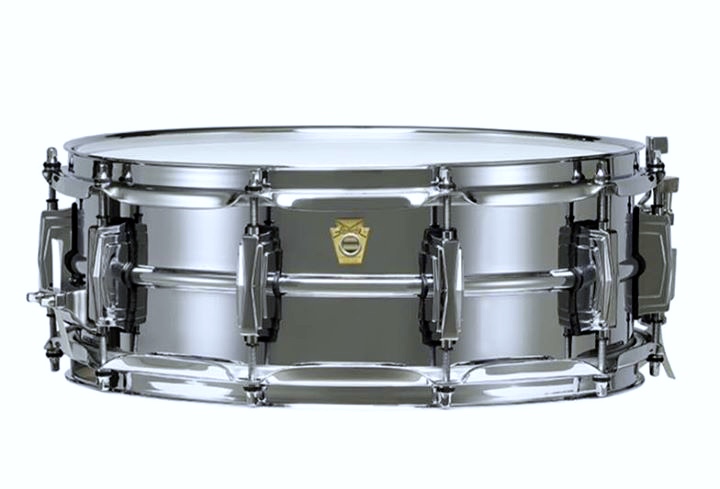
Ludwig‘s Facebook post today commemorating the company’s 400 Supra-Phonic Snare Drum reminds me of story involving drummers Jimmy Madison and Joe Morello. Madison told me the story during our interview which was published in the October 1982 Modern Drummer.
Madison was a kid living in Ohio. The Dave Brubeck Quartet was set to appear at a local fair. Jimmy was very excited at the chance to hear and see Joe Morello.
Madison arrived at the fair stage in time to see Morello setting up a drumset. As I recall the story, it was a rental set. I think Joe’s drums were lost in transit. Jimmy said the rental snare was dead-sounding and awful. He watched Morello trying without success to adjust the drum so it was playable — and then Madison approached Joe Morello.
Madison told Joe Morello he had just acquired a Ludwig snare exactly like the snare Morello normally used. It was a present, I think, from Jimmy Madison’s parents. Madison offered to loan it to Morello for the show. He lived close by and, said Madison, it was no trouble to go get his drum.
Morello accepted the offer, played the gig on Madison’s snare. It was a win-win. Plus, Jimmy told me, he had the bonus of owning a new Ludwig snare drum used in concert by Joe Morello.
Which reminds me: Whatever happened to Jimmy Madison? He was a super nice guy and a top-shelf player.


 Scott K Fish
You must be logged in to post a comment.