
SKF NOTE: This is a full-page ad from the November 2, 1967 issue of Down Beat.

SKF NOTE: This is a full-page ad from the November 2, 1967 issue of Down Beat.
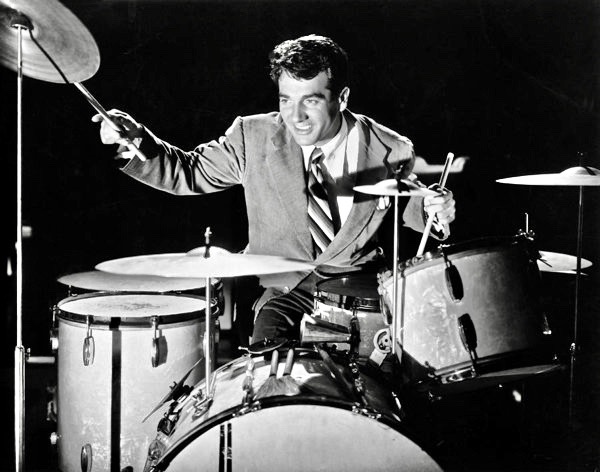
Gene Krupa said, in an interview I read decades ago, that he learned from the great “black drummers” the difference in playing drums leading with the right hand or the left hand. A change in sound, Krupa said. The way he spoke about leading with his right/left difference still has me figuring out what exactly Krupa picked up from “black drummers” on this point. What was the big deal?
Over the years I thought, for example, maybe Krupa is talking of the tendency for drummers to have one hand stronger than the other. Right-handed people tend to have stronger, better controlled right hands than left hands.
The problem with that explanation? Serious drummers practice so both hands have equal strength and control, so they can play anything with either hand. This was certainly true when Gene Krupa was coming up. So why would he make such a big deal out of it in his interview? He must have been talking about something else. But what?
My latest best guess is this: I am naturally right-handed. In most drumming instances, my mental focus — my attention — was on my right hand. Yet, my right hand is not always playing the lead. Sometimes my left hand is leading on the snare drum. Other times my bass drum has the lead. I discovered things are easier to execute when my mental focus is on that limb as my lead voice.
A non-music analogy: Think of a fall hike up a 4,000 foot mountain trail and coming to a steep incline of boulders, branches, underbrush, and icy spots. You can no longer just automatically walk, one foot in front of the other, arms swinging to and fro. The terrain demands focusing your mind on your right-hand when reaching up to grab a solid rock or branch for support. Next you focus on your right-foot, raising your leg, making sure you find a safe foothold. Once you have a safe foothold, your mental focus moves to your left hand, and so forth. You ascend the mountain.
Now, imagine me, a right-handed drummer, playing a four-bar drum break using a couple of two-bar phrases broken up by a quarter note rest. I begin #1 two-bar phrase with my right hand on the snare, ending the phrase with right-hand on floor-tom. The sound of that two-bar phrase is entirely built around a right-hand lead with, say, a right-hand accent on the small tom, a ride cymbal tap, and ending with my right-hand on the floor tom.
My mental focus for those first two bars was on my right-hand. (Remember: Humans can’t think about more than one thing at the same time.) My left-hand and my feet were following my right-hand lead.
For my #2 two-bar phrase I’m in a great place to lead with my left-hand. My left-hand is raised, my right-hand is on my floor tom. And at moments like this — I was messing up. Instead of shifting my mental focus to my leading left-hand, I would lead with my left-hand while keeping my mental focus on my right-hand. Probably out of habit.
When I did that it was often uncomfortable, even impossible, to execute phrases I was hearing. No wonder! My mind and limbs were at cross purposes. I was thinking of right-hand lead phrases, trying to play them with a left-hand lead. Or, instead of taking advantage of my left-hand being in the best position to lead, I’d ignore that truth, fall back on my right-hand, ending up playing something — but something other than what I had in mind.
Right-lead or left-lead: I discovered they both work best when my mind and limbs are in sync.
And maybe that’s what Gene Krupa was talking about.
— end —
SKF NOTE: September 10, 2015: I found Gene Krupa’s quote. I used it in a feature called Innovators of Jazz Drumset: Part II in the December 1994 Percussive Notes magazine. In the footnotes the source for the quote is the Oct./Nov. 1979 Modern Drummer in a feature story by Karen Larcombe, Gene Krupa 1909-1973. That’s not the original source. So the search continues. But the Krupa quote I refer to in my opening post:
“I had no idea of the wide range of effects you could get from a set of drums. I picked up from Zutty Singleton and Baby Dodds the difference between starting a roll or sequence of beats with the left or right hand and how the tone and inflection changed entirely when you shifted hands. Those Negro drummers did it nonchalantly as though it were a game.”
— end —
My early 1970’s introduction to Jackie McLean’s New Soil (recorded 1959) was through a brand new cut-out LP from a store in Davenport, Iowa. It’s a great album by great musicians: Jackie McLean (alto sax), Donald Byrd (trumpet), Walter Davis, Jr. (piano), Paul Chambers (bass), and Pete LaRoca (drums).
The tune Minor Apprehension features Pete LaRoca in what is often called the first free drum solo on record. Minor Apprehension is a fierce hard bop tune. I expected the drum solo to reflect the tune: fast, high energy. Instead, LaRoca’s is more an impressionistic solo — totally unexpected and ear-opening. Not only for me, but for many others who’ve heard this cut.
If you’ve not heard Pete LaRoca on Jackie McLean’s Minor Apprehension — you’re in for a treat.
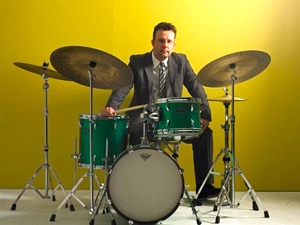
Jon McCaslin
I had a pleasant surprise yesterday. On a 150-mile highway drive I listened – listened, not had-on-in-the-background – to Jon McCaslin’s CD Sunalta on the Cellar Live label. Four measures into song one — the title track — I felt the same as I do listening to a few Shelly Manne & His Men albums I treasure, when his band included Russ Freeman or Mike Wofford (piano), Frank Strozier (alto sax), Conte Condoli (trumpet), Monty Budwig (bass).
McCaslin’s Sunalta, to my ears, has the spirit of the great Blue Note, Atlantic, and Prestige jazz albums of the late ’50s and ’60s. This is a band record. A band of seasoned players: McCaslin (drums, composer), Brad Turner (trumpet), Phil Dwyer (tenor sax), Tilden Webb (piano), Jodi Proznick (bass).
 Each musician is a unique story teller. When the CD ended I wanted to hear it again and I wanted to hear these musicians in other settings.
I’ve known Jon McCaslin through his excellent Four on the Floor blog. And he and I have exchanged an email or two over the years. But Sunalta is the first I’ve heard Jon play, the first I’v’e heard his composing.
His drumming is aces. Very much in the spirit of Shelly Manne and Mel Lewis. I’m not saying McCaslin is a Manne/Lewis clone. His isn’t. McCaslin has his own voice and does a superb job driving the band, shading, supporting soloists, conversing with band members. Excellent stuff. Plus — and this is no small point — McCaslin’s drums and cymbals sound great.
Thank you, Jon. I’m looking forward to hearing more from you and your band members.
— end —
Vidacovich a NOLA drum master
POSTED 6:35 PM, AUGUST 31, 2015, BY LBJ
NEW ORLEANS (WGNO)- Drummer and music educator Johnny Vidacovich’s name is in every conversation concerning the best of New Orleans drummers.
Vidacovich…took lessons and credits his early growth on drums to New Orleans musician Warren Duncan, who taught neighborhood kids standard tunes, and his bands played around town at various gigs.
He also credits the elders of New Orleans music….
“I didn’t understand it, and it was overwhelming at first, but I knew that these older guys that I was hanging out with said Johnny, don’t worry about it, just listen,” according to Vidocovich.
Vidocovich has favorites, “Ernie Elly is my favorite drummer right now. Has been for a long time. The touch…just a beautiful touch…makes the drum sing. He plays the music, he don’t beat the drums just plays the music.”
[W]hat makes a New Orleans drummer?
Says Vidacovich, “A guy who makes you, you can be sitting in your seat, and he gon make you dance, it’s gonna make you smile, without a doubt. I think it’s a linear thing, I think it’s a very lyrical thing. Even though they’re beating, there’s something lyrical about it.”

Life Beyond the Cymbals
A Blog about Music and Popular Culture
Online Drum Tracks | Drum Recording | Remote Session Drumming | Pro Session Drummer
Life Beyond the Cymbals
Writing About and Reviewing Classical Music and Jazz
Life Beyond the Cymbals
A Drummer's Look at Drums and Drumming
 Scott K Fish
You must be logged in to post a comment.