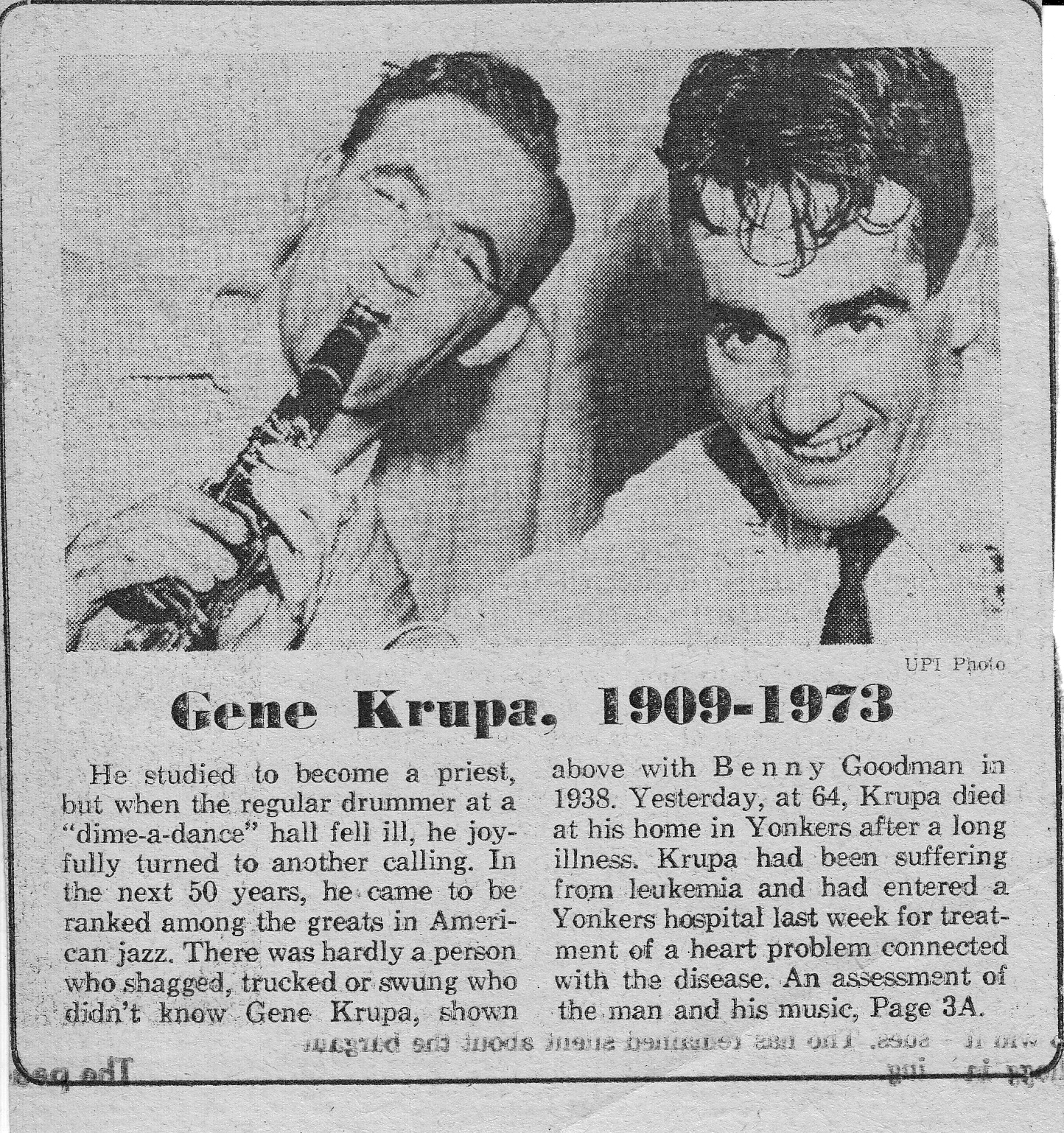
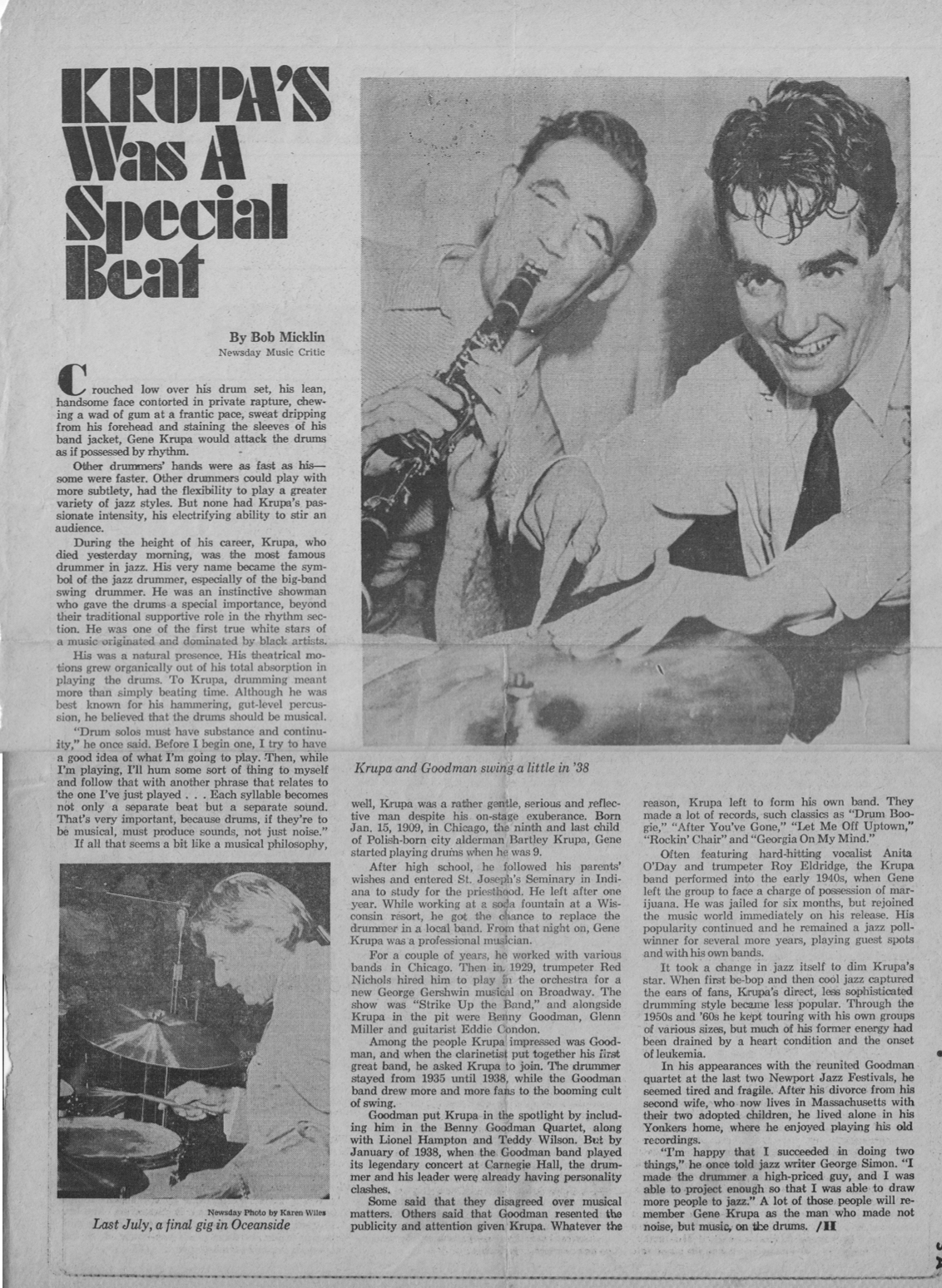
SKF NOTE: Going through some of my music newspaper clippings file folders. Found these two Gene Krupa obituaries from New York newspapers The New York Times and Newsday. I remember this day very well. I was age 22. Sixteen years earlier, age 6, Gene Krupa’s recording of China Boy, set me on my lifelong love of drums and drumming.
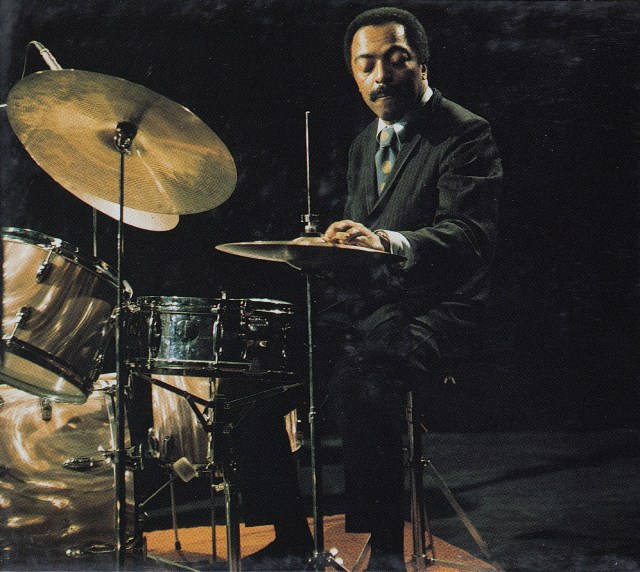
SKF NOTE: This segment is from my interview with Roy Haynes at his home on November 15, 1978. According to my notes “It was raining, traffic was heavy, a chilly…evening, and I was nervous about meeting him. We had spoken on the phone a few times.
Roy Haynes is a clinician for the Ludwig Drum Company and he’s a favorite at Symposiums. He told me about his means of communicating to his audience, and a bit about what exactly goes on at a Roy Haynes drum clinic.
“People are hungry for the naturalness of music,” he explained. “There are some people coming up today that don’t even wanna hear words! They don’t even want to relate with havin’ to write something on the board. They want you to tell them and show them how to do this. There’s some clinics — the real ones — where they’d rather have you play than talk,” Haynes stressed. “There are also the other ones that are not real. They’d rather talk about drums rather than display it.”
Suppose Roy Haynes is giving a demonstration, and someone asks him what he just did. How does he explain the technique?
“You don’t have to give them a name for it. Whatever it was, you can show ’em. Everything don’t have a name. Especially if you’re creative. If you’re gonna play the same thing over and over again, and you gonna play only things you got a name for and that you know — you’re gonna be limited!
“But,” he continued, “if you’re gonna create while you even doing that — that’s gonna blow their mind! The real people. Even if they’re not real, they’re gonna feel so much in what you play that they gotta say, ‘Oh man! He’s incredible.’ They gotta, man.
“A lot of people fight the truth, and the truth will always outlive B.S. and lies. And when you display with creativity and emotion…. Hey, man!” Roy breaks out in a big smile.
“I’ll tell them [clinic attendees] right from the beginning, my classes are gonna be different from any other classes. They’re gonna be relaxed and we’re gonna get into the instrument.
“I let a lot of ’em come up and play. I had a thing where I was lettin’ ’em do four bars of silence and four bars of playing to see who could really feel it. And it took off into such a thing!
“Nobody teaches like that.
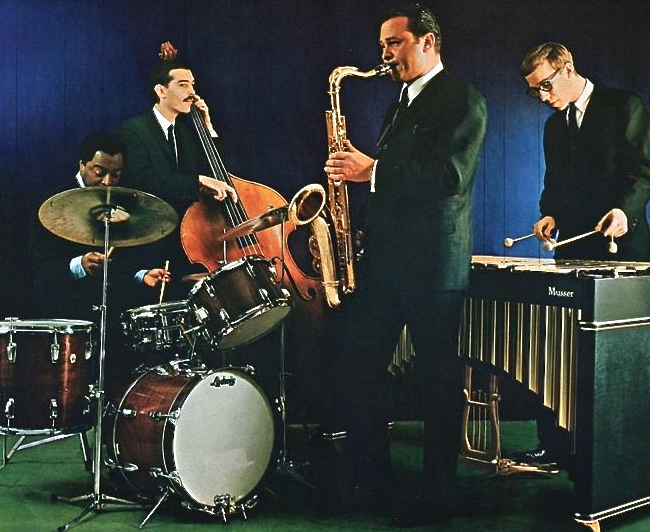
Roy Haynes with Stan Getz Quartet
“‘Do four bars of silence,’ I’d say. First I’ll count it off for you so I know where the tempo is and everybody knows where the tempo is. And there’d be four bars of silence.
“That gets back to what I was saying before. Even if you have a few bars of silence, you still count that. And that’s my conception. What I just told you is a lesson in itself, man,” Roy said.
“I try to be truthful.” Roy continued. “I like to be able to look at my kids like this.” [SKF NOTE: Roy gives me a long, piercing stare, holding it as he continues speaking.] “I like to be able to look at anybody like that when I say somethin’.
“Stan Getz used to say I looked an audience dead in the eye. I say, ‘Well, how do you feel? How do you all feel out there?’
“Not sayin’ I’m the most truthful cat in the world,” Roy said. “I’m not saying that. But that’s the way I feel. And I feel good.”
SKF NOTE: This short interview with Ed Sharkey Hall is another of background info gathering session for my History of Rock Drumming series. Read my first posting of background info for the series. I wouldn’t swear to it in a Court of Law, but I’m reasonably certain Hal Blaine referred me to Sharkey Hall when I told Hal about the series.
My transcript isn’t dated, but this phone interview probably happened in 1981 or 1982. Mr. Hall says here that he is 60-years old. If someone can find his birth date, we can tell the year of this interview.
I read this transcript today for the first time in about 35-years. There are several neat factoids that may still be news. For example, Hall says he recorded with the group The Diamonds. That means he may have been the drummer on my first 45-rpm rock and roll record, The Stroll, when I was about 7-years old.
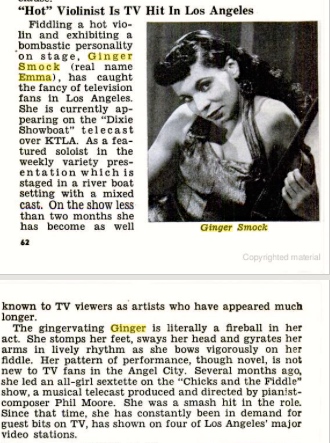
Also, Sharkey Hall mentions working in a trio led by violinist Ginger Smock. Thanks to the internet, there is info available on Ginger Smock, including YouTube videos of her playing jazz violin. She was good!
Finally, as of this writing I have no photos of either Sharkey Hall or, one of his drummer influences, Rudy Traylor. If anyone can point me in the direction of either or both of those, I would love to include the photos in this post.
==========
Sharkey Hall: I’ve known Hal Blaine for many, many years. We were kind of like young men together out here. I really don’t know what to say.
Scott K Fish: I wanted to ask you about your contribution to the music of the ’50s.
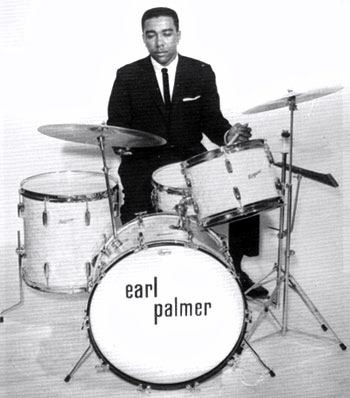
Earl Palmer
SH: Well, I think a fellow you would probably like to talk to would be Earl Palmer.
SKF: I’ve spoken with Earl.
SH: You have, huh? Well, out here, Earl and Hal, they were kind of like pioneers in the business. They did many things.
SH: Yeah. Of course, that was when they were real young. I don’t remember who was the regular fellow in the band at that time, but when they were real young they had a kind of a time problem. It took a little while for them to get the experience to be steady.
I guess the biggest thing that I was on was Ernie Freeman‘s Raunchy, and Jewel Akens‘ Birds and The Bees. They’re about the only two to come to mind now that were like gold records.
SKF: Do you remember what stuff you did with The Ventures?
SH: That was way back. I don’t remember at all.
SKF: Were you coming from a jazz background?
Hal Blaine
SH: Well, yeah. I was kind of a…. Well, most of my life up until…. I was kind of a Sammy Davis type of guy. I was raised in show business.
After I got out of the service I was primarily a jazz drummer. And I don’t know how it happened, but I ended up working with…, in a club with Ernie Freeman out here. And about that time Earl Palmer came to town with Fats Domino.
He used to come in the place where I worked and I let him sit in. And at the time, because he was working with Fats Domino, a lot of the jazz fellows didn’t think that he could play jazz. So I invited him to come on and sit in.
Come to find out that he had been expressly brought out here by Aladdin Records to be their staff drummer.
The next thing I know my phone started ringing with referrals from Earl because he had gotten quite busy. Between that and when Raunchy became a hit, well, then I ended up for awhile being about third man on call in the studios out here for about ten years. That’s kind of the way it happened.
Of course, I had known Hal out in San Bernadino when he was a teenager. We used to hang out together down there. And we didn’t see one another for quite some time, and then he walked into the studio where I was working. And come to find out that, he had been on the road with Presley, I believe. And he had made quite a name for himself.
SKF: Are you and Hal roughly the same age?
SH: Well, no. I’m a little older than Hal. I’m probably about six or seven years older than Hal.
SKF: Man! You sound like you’re about 21.
SH: No, well I’m 60 years old now. I kind of have that young outlook, I guess.
SKF: Who were the drummers who influenced you when you were starting out?
SH: Guys like Old Man Jo Jones, Shadow Wilson. And, of course, everybody had to be somewhat influenced by Buddy Rich and Gene Krupa because of their great popularity.
And there was another drummer that I admired that never got a whole lot of credit. But he was with the Erskine Hawkins Band and his name was Rudy Traylor. I picked up a few little tricks that I saw that he used that kind of fascinated me and I used them through the years.
Those were my main influences as a teenager.
SKF: When you were ghost drumming, was it mostly with groups or did you get into television or radio?
SH: Mostly phonograph records. Of course, it wasn’t in the rock field out here. But on the West coast, why, I was a member of the… a group that had a t.v. show called Rhythm Review.
Incidentally, for what it’s worth, it was the first Black group Local in LA to have a t.v. show that was sponsored. That was about 1957, I believe it was. It was kind of a variety show. It was a trio. Organ, jazz violin, and drums. The violinist was a lady named Ginger Smock. She was the leader. I can’t think of the organist’s name.
On the show I was doubling vibraharp and guitar on some things, and did sing a few little novelty numbers.
But that was kind of a high spot for me.
SKF: So you play proficient vibes and guitar too?
SH: Well, enthusiastically if not good.
Ginger Smock on violin
SKF: You must have seen a lot of changes musically.
SH: Oh yeah. I started playing professionally in 1939 and joined the union in about 1941 out here. I did it from the age of 3. And about the age of 11 I finally started going to school on a regular basis.
About the time I got out of Pasadena Junior College — it wasn’t long before I went in the service. I was in infantry for awhile, and then I landed in a Special Services outfit.
SKF: This was World War II.
SH: Yeah. Arizona was the original home of the 9th and 10th Cavalry. Back up in the mountains there. They finally found out that I was a musician, so I spent about two-and-a-half years in the Army Band in the Special Services outfit.
I got out of the service about ’45 and kind of bummed around, playing little local clubs, and that’s when I ran across Hal.
At that time I really wanted to be a Bebop drummer, but I couldn’t make a living at it. So I had to play more commercial style.
Then all of a sudden in the early ’50’s the kids found the rock thing. And so I stepped from jazz right on over into that.
SKF: Was that a tough transition for you?
SH: Psychologically it was, for awhile. Because it was just like anything else. One of the things that helped me was my career. For awhile there I wondered about the appeal. And I thought for awhile there that it was kind of like a step backward.
But as the thing began to get a little more sophisticated — then it became a challenge.
Of course, some of the guys ut here with the heavy reputation — well, they kind of thought it was a passing fancy. As a matter of fact, a lot of the guys — I won’t mention any names — a lot of the guys actually refused to do rock dates. So consequently, that gave me a clear shot at the number three slot.
SKF: The number one and two would be Hal [Blaine] and Earl [Palmer]?
SH: Yeah.
SKF: Are you playing now at all?
SH: Oh yeah. I’m still active. I do…. It’s kind of like semi-retirement. At my age now I kind of like to work weekends. I work clubs or society casuals. Things of that nature. I do a little record date every once in a while. I’m not working as often as I was. I do a commercial or two during the year.
That’s about the way it is. I’m kind of comfortable with it.
SKF NOTE: Piecing together for my History of Rock Drumming series the mystery that was Motown‘s drummers, I called Motown’s offices for help, and Brian Holland spoke with me! I didn’t ask to speak with Mr. Holland. I imagine the woman answering phones at Motown, after putting me on hold, announced, “There’s a guy on the phone from Modern Drummermagazine. He wants to talk with someone about Motown drummers. Anybody want to talk to him?” And Brian Holland was nice enough to come to the phone.
Backgrounder: The Rock & Roll Hall of Fame Web Site says, “Brian Holland, Lamont Dozier and Eddie Holland wrote and produced many of the songs that are most closely identified with Motown. These include “Stop! In the Name of Love” and “You Can’t Hurry Love” (the Supremes), “Heat Wave” and “Jimmy Mack” (Martha and the Vandellas), “Reach Out I’ll Be There” and “Baby I Need Your Loving” (the Four Tops), and “Can I Get a Witness” and “How Sweet It Is to Be Loved by You” (Marvin Gaye). These classics are only the tip of the iceberg, insofar as Holland-Dozier-Holland’s 10-year output at Motown is concerned. In their behind-the-scenes roles as staff producers and songwriters, Holland-Dozier-Holland were as responsible as any of the performers for Motown’s spectacular success.”
Holland, Dozier, Holland
This interview took place by phone on May 12, 1982. It’s important to me that readers understand how little information existed at this time on Motown‘s drummers. Their identities were not well-known. Once the principal drummers were known — Benny Benjamin, Uriel Jones, Richard “Pistol” Allen — there were no set records on who played on what song.
That was, in part, because of Motown‘s way of recording — which Brian Holland talks about in this interview. But it was also, in part, because a number of drummers claimed to be the drummer on this Motown record or that. The story is, Motown recorded instrumental tracks in Los Angeles, New York, Chicago — sometimes with unknown singers. Those tracks, the story goes, were taken back to Detroit where Motown‘s hit maker vocal groups were added to the mix.
I confess. In 1982 my prime goal was finding out about Motown‘s drummers. I struggled with verifying stories told to me by other drummers. Asking certain Motown people, “Hey, drummer X told me Motown was involved in illegal recording practices. Is that true?” Questions like that risked ending the interview, and ending a great opportunity to learn about Motown‘s drummers.
I don’t know if any of this info is now old news. Brian Holland was gracious enough to allow me to interview him. I appreciate it.
=========
Benny Benjamin
Brian Holland: There wasn’t about but three main drummers that we used. Benny Benjamin — who was probably the most frequently used on most of those songs — and a guy by the name of Pistol [Richard Pistol Allen] was another one who was very much used. But he was more of a shuffle kind of a drummer. He was the best at the shuffles.
Benny Benjamin was the best at the 4/4 and the 2/4 beat. And we used a couple more, but those are the premier drummers that we used back then.
Scott K Fish: Do you know anything about Benny’s background as a musician?
BH: I don’t know too much about his background. I know he used to play with a lot of big bands before he got with Motown. When he started with Motown we kept him on as a studio musician. That’s all I knew. Because I was so young at that time.
SKF: Michael Carvin told me that Motown would just record the rhythm section, and those musicians would never know what songs they were playing on.
BH: That’s what we did 98-percent of the time. We’d go in and record just the track — maybe four or five pieces at most — and then go back and dub lead and the group in. Then you dub the strings in — maybe for the group and maybe not. But we did do the rhythm track first back then.
Basically that’s what they do now. But we were doing that then. That was unusual at the time because, generally, then everybody would be in the booth somewhere, or off in the middle of the floor singing, as you cut the track.
Richard “Pistol” Allen
They had no idea what songs they were going to be playing on. No, no. They never knew what the songs was they were going to be playing on at all.
SKF: Did the producers and arrangers know?
BH: Oh sure. We always knew. Very infrequently they would go down there and just try to come up with a song. Those were very infrequent things. Generally, we got an arranger, and then got the musicians, and went down and cut.
But the musicians would never know. They’d be the last to know.
SKF: Was Benny Benjamin reading charts?
BH: Oh no. He could read music. You’d have, basically, no what we’d call right now the real drum chart, per se. More or less just a rhythm type of chart. Then the producer would basically tell him what he wanted.
Sometimes they’d write out a few drum parts — like on a few breaks or things like that. But mainly they felt their way through most of that stuff.
SKF: Were they the same drummers that would go out on the road with the different Motown acts?
BH: Sometimes they would go out on the road! That’s right. That’s when the other three or four percent…. When we’d have to call in, maybe, someone else.
They were fantastic. Believe me. We never really realized how great those guys were back then. But, looking back, in retrospect, it was really amazing and phenomenal how that stuff came out.
SKF: How did you find Benny Benjamin?
BH: I think Berry Gordy knew Benny or heard about Benny from some big bands back then. Because he used to work a lot of people before Motown got started anyway. I think that’s how we came about with Benny.
He was a great drummer. The timing he had was…. I mean, I could play some things back now and listen to those pickups, and the timing that he had was just unbeatable. I mean really unbeatable.
I’m not saying that because he played with us back in those Motown days. I’m saying that because he had such great timing and with pickups. And he always felt the music as he went along. He would hum the music as he would go along, singing, just as happy as he could be, right along with the music. And he would always say, “Man, that’s a hit. That’s a hit.” And most of the time he was right.
I could tell you damn near which cuts Benny played on. If you gave me a list of them. It’s hard for me to think. I still remember basically all those things.
I know Benny did My Girl because I cut all those sessions back then myself.
And the Four Tops and The Supremes — mainly he played on all of them. On the shuffle things, like Heat Wave, I know Pistol played on that. He might have played on Baby Love by the Supremes.
But Benny had to play at least 75-percent of them.
SKF: I’ve heard that when Junior Walker recorded he used Benny.
BH: Yeah, he would use Benny too.
SKF: So all those tunes like Shotgun — that’s Benny?
BH: That’s right. He was a great one, man. I’m telling you.
SKF: Did those guys play with click tracks?
BH: Oh, no, no. We never heard of a click track. There was no such thing back then. Every now and then we would try to use a metronome, but that would never work.
Now they put it right through the earphones. But we tried to put a metronome right out in the studio and let them listen to it. But it could never work that way because the music would just filter it out.
SKF: Why do you think click tracks are used so much now?
BH: I think basically because a lot of the musicians don’t have that kind of timing. Most of them guys race or slow it down. They’re just not that steady.
Don’t get me wrong. There are some great musicians out here that can do it. I think the competition and competitiveness has brought in so many musicians now that you just still have a few at the top. Which goes the same about most things.
The Temptations
Back then there was just a few guys around. And always we found the best ones. And that’s the reason we had those few top guys. And that’s the reason we just mainly used those two guys or three guys. They were straight and they knew how to keep the time and the tempo right.
Pistol came in after Benny. I think Mickey Stevenson — who was A&R man at the time — got Pistol to come in. Pistol was a good shuffle man, and I think Mickey wanted him to play a few shuffle/big band beats.
Pistol used to play at a local bar called the 20 Grand — which was a very popular bar with the trio there.
SKF: Do you remember when Benny stopped recording or when he died?
BH: Well, he didn’t stop recording. He died. Somewhere around ’68 or ’69.
SKF: Were you able to replace him?
BH: Well, they brought in a young guy. I can’t think of his name. He was pretty good. But there’s no Benny. There’s no Benny Benjamin around.
SKF: Do you think the drummers played a major part in the creation of Motown music?
BH: A very premier and emotional part too. I always say emotional because a couple of those guys — like Benny and Pistol — always was emotionally into it. Not like a mechanical guy just up there playing drums: “Okay. Give me a chart. I’ll play.” They was emotionally into the song. They got into it, where they really emotionally felt what you were doing. And they got into it. They were unique.
I mean, these guys today just want to get a paycheck.
It’s almost like the guy was saying on t.v. He said, “Is there anymore great baseball players?” No! He said, really there aren’t anymore really great baseball players. You can’t find no Joe DiMaggio no more. No Jackie Robinson’s. No Babe Ruth’s no more.
All these guys out there want to hit the ball for big paychecks. They’re not really in the game of baseball like them guys were back then. And I can understand that and I can relate to what he was saying.
The same thing goes for these musicians back then. Even, like, the producers. Like a Phil Spector, man. You don’t find them kind of producers who, night and day, get into it. They’re just not the same. Believe me.
Four Tops
SKF: I’ve heard that in the early ’60s, besides recording in Detroit, Motown was using musicians in New York and Los Angeles.
BH: Well, very, very infrequent. Once in a awhile my music partner, Lamont Dozier, we would come out to cut a session. Most of those things were basically mechanical type things. We might have got a hit once or twice out of it, but we stayed in Detroit because they didn’t have the same kind of feeling back then like they did in Detroit.
New York was pretty good. But we did a few things in both places. True enough.
It was almost like I’d say, “Hey, let’s go on a vacation. And while we’re on vacation let’s cut a few things.” That’s basically what it was.







 Scott K Fish
You must be logged in to post a comment.