SKF NOTE: Is it time to retire ding-dinga-ding-dinga?
Jon McCaslin’s drumming blog, Four On The Floor, is among my favorites. Dr. McCaslin posts unique drum videos that say something. A recent video is from new-to-me drummer Joe Farnsworth‘s master class in Italy.
At one point in the video, Mr. Farnsworth tells attendees it is important to practice keeping steady time on the ride cymbal with quarter notes. Only when drummers can do that, says Farnsworth, can they keep steady time playing the standard jazz ride rhythm ding-dinga-ding-dinga.
That brought to mind a couple of my drumming ideas. (And this is not a dig at Mr. Farnsworth. Watching his video simply triggered a memory. It could have been any drummer’s video.) I think it may be time to retire ding-dinga-ding as the foundation of modern jazz drumming.
When I play the drumset, when I listen to others playing the drumset — I hear melodies, musical lines, musical sounds. I don’t hear stand alone rhythm. When trying to imitate a drum beat or concept — I first try to imitate the sound(s). I don’t dash for pencil and staff paper to musically notate what the drummer is doing with his right hand, left hand, left foot, right foot — and then try to duplicate the sound from my written notation.
Is that a long way of saying I play by ear? No. I think we’ve all grown up with the idea that drummers who play by ear are never quite as good as drummers who read/write music. People who can’t read or write their native language are illiterate. Drummers who can’t read or write music are…musically illiterate? I think the stigma holds true. It is the root of most drummer jokes.
Yet, Max Roach told me of a Ghanian drummer who teaches separated from his students by a curtain. The teacher, said Max, does not want students imitating how he, the teacher, makes sounds. He wants them to listen and discover their own way of making the sounds.
Max, Alan Dawson, and Roy Haynes are a few great drummers who spoke with me about hearing Papa Jo Jones’s hi-hat playing on radio or record. They had no way of seeing Papa Jo unless Count Basie came to town. But they wanted to play their hi-hats like Jo Jones. So they worked at making the sound they heard.
Which brings me to my second point. Ding-dinga-ding on the ride cymbal hasn’t always been with us. It was preceded by press rolls on the snare drum. Indeed, ride cymbals weren’t always with us. They too were preceded by snare drum press rolls. Press roll timekeeping transferred to the hi-hit, then to the ride cymbal. And each transition kept the press roll rhythm Baby Dodds used.
Plus, even the early great jazz drummers — Baby Dodds, Chick Webb, Jo Jones, Gene Krupa — didn’t play slavish ding-dinga-ding.
Meanwhile, most of the great drummers I listen to don’t play locked in to ding-dinga-ding. I hear them — on the whole drumset, not just their ride cymbals — playing melodies, musical lines. And what about the rock and latin cymbal beats that are part of the modern jazz drummer’s language?
Are there times ding-dinga-ding is appropriate? Yes. Is ding-dinga-ding valid for drum student use in developing independence and coordination? Yes. But I think it is time drum teachers stop insisting students always play ding-dinga-ding as the one right way to play jazz. Really? Ding-dinga-ding is a right way to play some styles of jazz — but all styles of jazz?
“Not everything I play has a name,” said Roy Haynes. I love that idea. It reminds me that we, as drummers, might better serve upcoming drummers by giving more emphasis to the drumset as a musical instrument; using the drumset not just to play beats and licks, but to play music.
SKF NOTE: This backgrounder phone interview with drummer Al Duncan is among several I did for a multi-part Modern Drummer feature series, The History of Rock Drumming. The entire interview is published here for the first time. And you can read more of the background story to the series here.
I was interested in speaking with Al Duncan because I knew — from printed sources and from other musicians, like Willie Dixon — that Mr. Duncan had played on several early rock recording sessions for Chess Records and Motown.
A quick Google search today shows Al Duncan on records by The Orioles, The Spaniels, The Dells, Little Junior Parker, Priscilla Bowman, Dee Clark, The Falcons, The El Dor ados, among many others. Thank you to the internet discographers for doing yeoman’s work filling in these blanks.
The Chess brothers were Phil and Leonard. Leonard produced the Chess records recording sessions I had in mind during this interview. He is the “Chess” referred to by last name only in this interview. Now, since Al Duncan and I never clarified which Chess brother we were talking about — my assumption was we were both talking about Leonard.
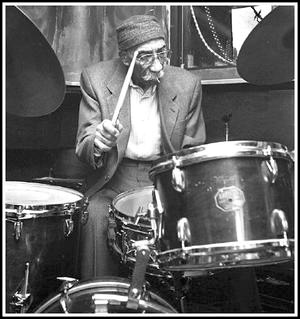
Final points. First, I cannot find a photo of Al Duncan! If someone will be so kind as to email me one I will include it in this post. Second, the language here is coarse in spots, but I’m leaving the transcript intact. Forewarned is forearmed.
Scott K Fish: Could you tell me about your contribution to the music that came out of the ‘40s and ‘50s? Particularly your involvement with the Chess sessions?
Al Duncan: Well…. If I can think of it! It’s been so damn long ago, man. The little shit I can remember — I’d be glad to do it. I was involved with quite a few of them.
SKF: I don’t want to depend on hearsay or liner notes. So, could you run down the musicians you were involved with?
AD: Recording-wise or working?
SKF: Both. Mainly recording, but also performing.
AD: My era started around 1958 or ’59 when I came to Chicago from Kansas City. I came there with Jay McShann’s Orchestra. We had just put out a hit called Hands Off in 1955 and we went and made a tour. And when we got back to Chicago I spoke to some people — that was when Vee-J ay Records was just getting started. And Chess records was just getting started. I got in on practically all the beginning Vee-Jay rock records — and most of Chess’s beginning stuff. Then I just freelanced all the way with just about every company you could name. I did something for somebody, you know?
Then I would up in the Regal Theater with Red Saunders Orchestra as the house drummer. I’d sit there for two-and-a-half to three years. And everybody that had a hit record at that time came through there. I played with just about everybody you can name back in them days.
I kept freelancing. A lot of companies wanted me to come with them like Maurice White, Morris Jennings, [Fred] Below, and all of them cats. They worked with different companies as house drummers. And I kept freelancing.
About that time, for a ten year span, Chicago was pretty well known for it’s recording studios. So, a lot of artists, instead of going to New York or California, they’d come to Chicago. I recorded for just about every known label that out at the time.
In 1970 I left and came out here [Los Angeles] and I’ve been kind of quiet since then. I’m gigging now, but I’m in school taking advanced theory and harmony and percussion at LACC [Los Angeles Community College]. I took kind of a vacation from the scene, but I’m ready to come back now.
Inside Chess Recording Studio
SKF: Willie Dixon told me he thought you were on some of the ChessChuck Berry sessions.
AD: I didn’t do too much for Chuck. I worked with Chuck, but I didn’t do too much recording with him. I can’t remember who Chuck’s [session] drummer was. I did a couple of things with him, but I’m not sure what they was.
I did so many things at that time that I can’t remember none from the other.
But I did a whole lot of stuff with Willie Dixon. And a lot of them people that I was recording [with] — I didn’t even know their names. Back in those days I was pretty busy. I’d go in the sessions, do the session, and I’d just leave out of one studio into another. From one place to another. And a lot of these people I recorded, I don’t even remember who they were.
A lot of them that didn’t quite make it big. Just kind of mediocre like. Then a lot of them didn’t make it at all.
SKF: If you were playing with Jay McShann, would it be safe to say you came from a jazz background?
AD: Oh yeah. I’m a jazz drummer. But, I play both of them, you know? I prefer jazz. But, I kind of got off on the rock thing and it was paying off, so I stuck with it. I worked with [Count] Basie and Duke [Ellington] and all the cats for a short while.
But, most of the stuff that I did around Chicago was all with the rock cats. I mean, being in the Regal Theater I did The Miracles, The Temptations, and all of them. Marvin Gaye. Everybody came through there. Back in those days they had the Black theaters for the Black artists who had to work the Black circuit.
By me being the house drummer at the Regal Theater, just about everyone you could name came through there.
SKF: Those artists wouldn’t come through with their own bands?
AD: Some of them would. None of them hardly had their own bands. Most of them had their own rhythm section. Most artists would have to have somebody to kind of direct the band. I recorded The Miracles and The Temptations and just about all of them cats on their very first recordings.
See, Berry Gordy, on his first recordings, he made his masters in Chicago. Before he got his studio he did most of his masters in Chicago and took them back to Detroit to peddle them. Then, after he had a few hits out and got ahold of some money, he built his own studio. But most of the first artists were really recorded in Chicago. I was on these sessions with Smokey [Robinson] and all them cats.
Then Chess was getting started there and I did most of the beginning things with Little Walter, Howlin’ Wolf, and all them cats.
SKF: Do you remember what records you did with Wolf?
AD: No I don’t. I can’t name the name of nothing. (laughs). The only thing I remember that stays in my mind was John Lee Hooker with Boom, Boom, Boom.
I did most of Etta James’ first stuff, but I don’t remember what the name of the tunes was. I didn’t have time, man, at that time. I was working around the clock doing the theater, doing sessions. I was making a lot of money back in them days.
SKF: It’s sad, in a sense, because there was so much great drumming on those records. And who knows who the drummers were?
AD: Well, see, back in those days they didn’t list musicians. They listed them on jazz records. But, on rock records they didn’t’ list the musicians. In fact, they didn’t put nothing on the record but the name of the artist and the name of the cat that wrote the tune. Back in them days they didn’t even tell who the producer was! Or the engineer! Because it was mostly 45s. And they didn’t take the time to put the name of nobody on nothing. Just the name of the artist and the name of the person that wrote the tune.
A lot of those record companies that I did things for, they are all gone, man. Like Vee-Jay, Chess, Mercury, Capitol. All that stuff. It’s all over.
SKF: Were you close with drummers, like [Fred] Below and [Odie] Payne, who were active at that same time? Could you kick around ideas together?
AD: Well, it wasn’t so much the ideas. Because back in those days everything was just left up to the drummer. It was all total creation in those blues things, of course. I read music, but them cats, most of them didn’t read. Most of that stuff was just left to their own creativity. Below, Odie, and all them cats — it was just left up to them as to what they thought. And the cats had great big ears, man! And they had the blues feeling. So they could hear something and just about adapt to what it should be just by total creation. On the spot.
SKF: You were on some Sonny Boy Williamson dates with some pretty big horn bands. Were there rehearsals or charts for those dates?
AD: Yeah, they did.
Now, here’s what would happen: Johnny Pate and Riley Hampton — and all of them different arrangers around there — they would make arrangements. They go in the studio and they’d have competent musicians when they were going to use horns and things. There weren’t too many horns on the blues things. But, on the other things, they went into the strings bit.
There’s a lot to be told about the Chicago story. Nobody’s seemed to every been interested in it. Most of the time the stuff was left up to the creativity of the rhythm section. They’d give them cats a skeleton guide. And you go by that and do what you feel. If there was some specific thing, then it would be stipulated musically. But most of the blues stuff was just strict impromptu stuff.
They wouldn’t just go in the studio cold. They would have rehearsals in somebody’s house, down in the basement. And they’d rehearse it and get it down and then they’d go in the studio and record it.
And the cats had big ears and a good memory. When they’d go in the studio the arrangement might not be on paper. But it was in the cats’ heads. And they’d go in the studio and record it.
SKF: What was it like at the Chess Studios?
AD: Chess progressed very rapidly. He started out in a garage. In a barn, really. Then he left there and moved to Michigan Avenue into a building. At that time, Michigan Avenue was Record Row. He moved into a building and stayed there on 21st and Michigan in a little small building. He had two studios up there. And he hung right there, man, and just got rich as hell.
Then he turned around buying an eight-story fucking building. The cat was a genius. At one time, the way Chess was going, he was just about to have a musical record monopoly. He did everything from discovering the artists, to developing them and recording them, to playing them on his own stations, his own distribution and everything.
There’s a hell of a story behind Chess, man. There’s a good story behind Vee-Jay.
SKF: Was Chess an easy man to work for?
AD: Chess had a way of adapting. See, I think he was a Jew, you know, and he had a way of adapting to get himself to get pulling out of the Black musicians what they had. Because when he was around Black people he acted Black. He knew all of the different things that the Black people did and they way they’d think and everything. So, he was just like another brother — although he was the boss.
But, like, you’d go in the studio [and] he’s just another brother. You know, it’s “Hey, motherfucker. Get your shit together.” One of them things, Scott. He was a cool cat in that area.
SKF: So, bandleaders liked working for him?
AD: There was no hassle. Chess had his own family. He had a way of doing things. See, in the beginning Chess did the shit himself. Then as he made money and progressed he hired people to do it for him. Engineers and all that stuff. But when we first started out there in the garage, man, he just had a little old four-track, man, and he was doing the shit himself.
Between him and Willie Dixon…. Willie Dixon was the genius behind all of the blues shit. Somebody should really take that cat and put him on the front page of every major United States paper, man. Because Willie Dixon has created more shit in the blues idiom than any one man that I know. The story’s never been told. But, if the story of Willie Dixon was told, that would be fantastic. He’s a blues genius, man.
SKF: If Willie Dixon was on a date, would he take control? Even when he wasn’t the bandleader?
Willie Dixon
AD: Willie was the man. Most of the stuff that all those artists was doing was Willie’s stuff. He wrote the shit. You understand? So naturally he would have control.
Like, some of the blues cats would come in there and they would have tunes that they wrote. Everybody recorded their own shit. And they would have tunes that they wrote and Willie Dixon would be the one that would take it and put the arrangement behind it.
And all of that shit was done orally. There was no [written] music. It was, “You do this and you do that.” And just add what you feel, and keep your ears open and think of what you’re doing.
We’d go in there and do a tune and everybody knew what they wanted to do just from memory.
SKF: How was it different working for Berry Gordy and Chess?
AD: I never really worked with Berry Gordy. Berry Gordy always had different arrangers from Chicago do arrangements for him. Or he would send his arrangers. They would get the shit together in Detroit the same way that we did in Chicago in the beginning. then they would come to Chicago. Because Chicago had Universal Studios, and most of the Motown stuff was done at Universal and RCA Victor.
When they’d get the time, they got their shit together. And Johnny Pate or some other arranger would throw the charts out there and we’d play the charts.
SKF: So, with the Motown stuff you would use charts?
AD: Yeah. But, Berry Gordy did very little of the directing, himself, in Chicago when we were doing it. He’d get the shit together in Detroit and then when they’d get to Chicago, they’d just record it. It was quite a thing.
SKF: Did you have to change your style when you shifted from playing the way you were playing in Kansas City to playing rock and blues?
AD: No, I never changed, because I’m a versatile drummer. I had to condition my mind because I love to play drums, and I learned the old-timey way to play all kinds of drums. All phases of them.
There were instances where I’d have three or four recording sessions in a day. And I’d go in the studio and maybe I might be doing a blues artist with this session. The next session I might be doing a gospel group. I recorded all them gospel groups, too. Then I might go and do a jazz thing with Ahmad Jamal or some of them cats. I might would leave that and go in with Dave Carroll and do some commercials.
So I had to learn how to condition my mind to play all styles. But, when I was in a studio for one session, I would totally involve myself in that type of thing. Then I’d just have to leave it there and go in another studio and just start all over again.
There wasn’t too many drummers that was doing that sort of thing — versatile type stuff — that was making it. But, I was making it in all different areas. I was playing jazz gigs and recording blues stuff, playing rock gigs and recording gospel stuff. I was working the Regal Theater in front of five to six thousand people with all the different artists. Then I would do recording sessions and I was doing miscellaneous engagements. Working around the clock for eight to ten years.
I was a young man. I was alert then. I started doing a lot of that stuff when I was about 30 years old. And it lasted about ten years. I’m 54 now.
SKF: Why did you stop?
AD: I just got totally disgusted, man. I got musically disgusted. I hung up for almost four years. I gave away everything I had, musicaly, man. Just, “Fuck it!” I said, “Forget it.”
But it came back and I said, “What the hell.” So here I am again.
SKF NOTE: This is a small piece of a longer interview that took place on April 3, 1982 after an Elvin Jones drum clinic at Professional Percussion Center in New York City. Taking part in the interview were Max Weinberg, Jaimo Johnson, me, and Candy Johnson. Candy was Jaimo’s wife and the late Allman Brother’s Band bassist Berry Oakley’s sister.
Jaimoe has gone through a few ways of spelling his name. Today he is legally Jaimoe. At the time of this interview he was Jaimo Johnson.
This interview was meant to be included in a book Max and I were writing. Max wanted to take the book in a different direction. I didn’t. So we amicably went our own ways, with Max publishing his book, The Big Beat. Jaimo’s interview stayed with me.
Jaimoe in his home practice room circa 1981. Photo by Scott K Fish
Scott K Fish: Was there ever a time when, like a lightning bolt struck you, you said to yourself, “I don’t care what it takes. I’m going to be a professional musician”?
Jaimo Johnson: Yeah. That happened when I was in the 10th grade.
Max Weinberg: What happened?
JJ: I just got out my set of drums. It was February 1960. February 28th. I was playing the drums and I thought I was pretty good. For what I was doing, I was pretty good. I wasn’t a damn professional or anything like that. I had good rudimental hands and I was interested in learning.
This friend of mine, Benny Lockhart…, him and Len Barney, he told me, he said, “Hey man. You got to go on by The Throne and hear this band.”
There was this place around the corner called The Throne Lounge.
“They got a bad drummer over there from New Orleans.”
Well, that bad drummer turned out to be Charles Otis. Honeyboy. And man! You talking about walking around in a daze? Jesus Christ! I mean, you only heard playing like that on records. And this was happening in Mississippi, man, in 1960.
Candy Johnson: So, hearing it live made the difference like that?
JJ: Hearing it live?
CJ: Yeah.
JJ: Phew! Man!
MW: What kind of band was it?
JJ: They played everything. Charles Fairley is from Pascagoula, Mississippi. Charles Otis is from New Orleans. Otis Dubonnet was the bass player and he was from New Orlenas. And Duke Verrell was the piano player.
Now, everbody in that band [would] sing. Otis, the bass player, he’d sing stuff like those Billy Eckstine kind of tunes. He didn’t even use a microphone. That’s the kind of lungs he had.
And as bad as Honeyboy was, Honeyboy sang 90-percent of the songs. And he sung everything: Ray Charles, Fats Domino. You name it, he sung it. But, he admitted, he said, “Man, Otis [Dubonnet] can sing.” He said, “‘Cause I don’t have them kind of lungs. If I don’t use that microphone,” he saaid, “I won’t be able to talk to you by the time I leave here.”
Those cats, man, they were playing…. This is when I got hip to [John] Coltrane too. They were playing Giant Steps and all that stuff, man. Horace Silver tunes. They’d do that for about an hour-and-a-half. Then Honeyboy would start singing. And he’d sing stuff like, “In the morning when the sun comes up / She brings me coffee in my favorite cup. [Hallelujah, I Love Her So]. He sang it all, man.
And Charles Fairley use to sing this thing: “You always hurt the one you love / The one you shouldn’t hurt at all.” [“You Always Hurt The One You Love”] He did little tunes like that.
But, everybody in the band [would] sing. And Charles and Charles — Charles Otis and Charles Fairley — had been knowing each other since they were 17.
MW: How old were they at this time?
JJ: Honeybody was 33 when I met him. I’ve known him since ’60. And I think he’s 49.
MW: So they were quite a bit older than you.
JJ: Oh yeah. Shit, man, I was a kid!
SKF: How did hearing Honeyboy change your concept of yourself?
Elvin Jones
JJ: The records that I had been listening to were Stan Kenton records, Ahmad Jamal, Miles, Coltrane, Stan Kenton, Gerald Wilson. All this stuff I’d been listening to — and hearing these cats play like that? There was four guys sitting there playing like that. And, I mean, it wasn’t on no record!
MW: That was the first time you’d heard anything like that?
JJ: Right! Man, it just blew me away.
SKF: Did you feel like, “Uh oh. I’ve got to woodshed now”?
JJ: I tell you, man. I wanted to quit playing the drums.
MW: That will make you want to do that. Sure.
JJ: Because…. I’ll tell you what I did do. I had been with Honeboy then. I was like his shadow, man. We had a band called The Matadors. I was Honeyboy’s shadow. I’m not kidding you. I was his shadow.
One night they played at Beck’s Playhouse. They played like a jazz hour thing. They played from 3:00 to 7:00. Then they went down to the beach and played their regular gig.
Well, we [The Matadors] came in to start playing at nine o’clock. And I had been sitting there watching Honeyboy play. And I had all these damn drums like they use today, because I was into Gene Krupa and Cozy Cole. Cozy had Topsy out.
MW: He had that big drumset.
JJ: Right. He had, like, two tom-toms here and two tom-toms on the floor. He played two bass drums at one time.
But, I had all those drums, man, and we started taking them out [of] the car to go set up. [The] cats were helping me put the stuff up, and I said, “Wait a minute, man. Put this stuff back in.”
They say, “What? You’re not going to use them?”
I said, “Are you kidding me, man?” I couldn’t even think. What was I going to do going in there with all them drums? After what I just heard? Phew! There was no way I was going in there with all them drums. Because in later years I found that all those drums are a distraction. Unless you know how to use that instrument — they are a distraction.
MW: From what?
Charles Honeyboy Otis
JJ: They are a distraction from playing the music. Because of something sitting there you’re just sitting there playing. I mean, it’s not really adding anything to it. I mean, it’s not nothing about it. It’s’ not fiery or hip or whatever. It’s unnecessary energy. It’s a waste of energy to just play something just to play it. And that’s what those instruments do unless you sit down and practice with them. And then, when you go on the gig, if you’ve got four or five tom-toms, you know how to use them tom-toms without the damn set turned into Drumsville.
MW: Right. The object is to make music.
JJ: A lesson I learned I was telling you about earlier. I learned from Honeyboy and I learned from Elvin Jones.
Honeyboy use to play a snare drum, a bass drum, a ride cymbal, and a sock cymbal. And man — phew! It was something else.
Well, in ’62, when I graduated from high school, in November Coltrane came to New Orleans. And Elvin had a snare drum, a bass drum, a sock cymbal, a crash, and a ride. And it sounded like he had all of them. It sounded like he had all of them.
Well, in ’63 I went out in Texas with these guys in a rock band. Make us some money and play in these Mexican bars and shit. So, one night somebody breaks in the station wagon they got my two tom-toms.
So, for a year-and-a-half, I had to play, and that bass drum was the tom-tom and the bass drum. And you knock the snares off and, you know, it was just a matter of flipping those snares on and off, playing different things.
MW: That’ll give you some independence things.
JJ: Yeah. We use to do, like, What I Say, and I’d play it hitting the bass drum with my stick. The stick would give the bass drum one kind of tone, and the mallet on the bass drum pedal would give it another kind of tone.
So it sounded like nothing was really missing.
MW: That’s amazing. That’s a great way to play.
JJ: But, I could have went crazy if I had not seen that it had been done.
SKF: Maybe Elvin took your tom-toms.
MW: So you saw that it was possible to play that kind of music on just a snare drum and a bass drum.
JJ: And I’ll tell you something that Honeyboy told me. Honeyboy said, “Man, let me tell you something. If you can’t go on the gig and play with a snare drum, a sock cymbal, or a snare drum — then you’re not ready to go on the gig.”
MW: That’s it. You have to learn the basics.
JJ: You have to learn the basics. And that snare drum is the primary instrument.
SKF NOTE: Amazing musical word descriptions from Andres Segovia in this short clip.
Describing his guitar as the best in the world, Mr. Segovia then tells how long it took the German guitar maker to craft his guitar and why. Segovia describes the first guitar from the German craftsman as:
Without soul. I mean, without the quality of voices and the volume that I require.
Explaining how guitar differs from piano:
The light of music coming to the guitar breaks in many beautiful orchestra sounds.
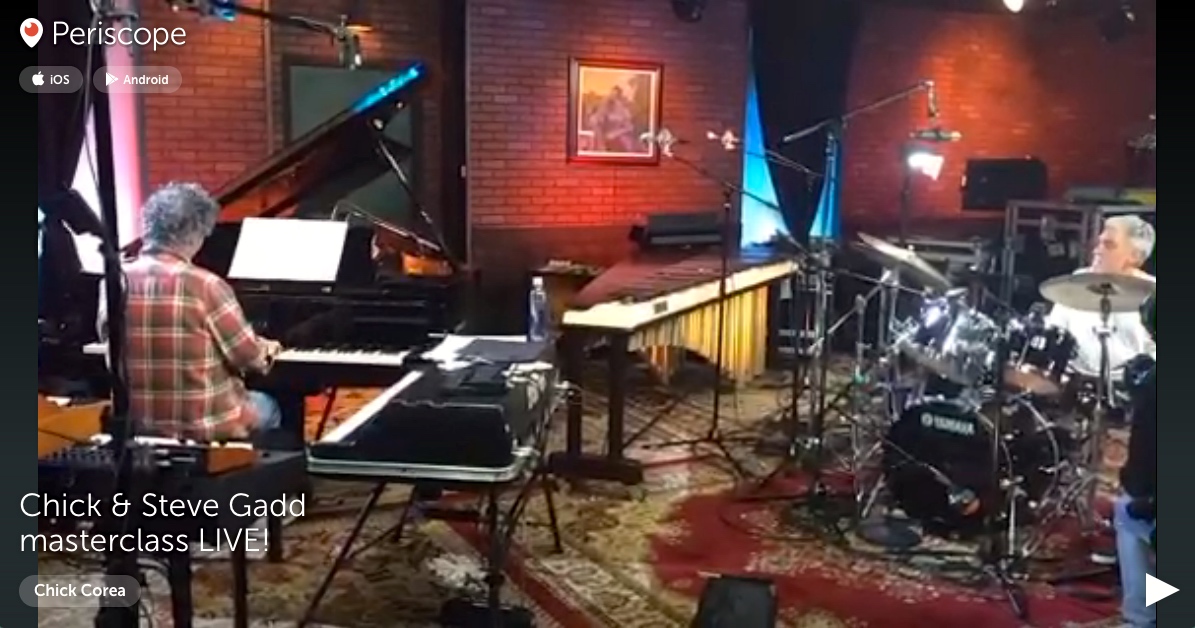
SKF NOTE: This Tweet from Chick Corea came through yesterday. This morning I watched the almost 14-minutes available — two songs — of this master class on my iPhone.
I also watched it on my Macbook, but the iPhone Periscope app gave me options not available online. For example, online you will see a steady stream of hearts bubbling up on the right side of your screen. On the left side you’ll see a steady stream of Twitter chats, reactions to the class.
Periscope iPhone enables me to turn off the Twitter feed and the hearts. I could not find a way to do that online.
I like this concept. Maybe in the future Chick will have the camera crew record different angles. This was one camera throughout.
Thank you, Chick Corea. Great idea. And thank you, Steve Gadd, for participating.


 JJ: They played everything. Charles Fairley is from Pascagoula, Mississippi. Charles Otis is from New Orleans. Otis Dubonnet was the bass player and he was from New Orlenas. And Duke Verrell was the piano player.

 Scott K Fish
You must be logged in to post a comment.