Arts & Entertainment Music Howard Reich A bold concert series digs deeply into Max Roach’s art
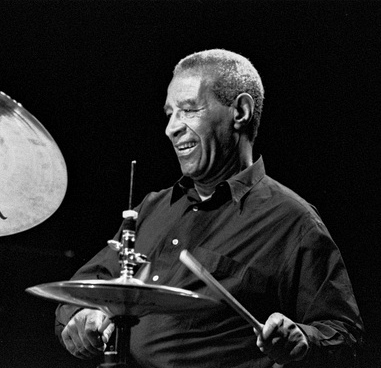
“You have to remember that our classrooms were the speakeasies and joints and clubs, there was no formal instruction,” he told me in 1991, long after he had begun teaching at the University of Massachusetts, Amherst, in the early 1970s.
“Back then, you learned by imitation, by watching and then analyzing the greats. But you also had to learn how to be different from the people you revered, or else people would say: ‘He sounds too much like Charlie Parker‘ or ‘I heard Bud Powell do that already.'”
SKF NOTE: In a recent post about Led Zeppelin’s song Black Dog, drummers on DrumForum.org commented on other songs with notable trick starts.
“I always loved how Misty Mountain Hop starts off. I still hear the main riff one way, but once the drums kick in, I realize I was hearing [the one beat] wrong. Heard that song…maybe thousands of times and it…gets me every single time,” writes one drummer.
“Hendrix’s version of Watchtower and the way it switches in the intro gets me every time. Apparently Hendrix wanted it that way and it took [drummer Mitch] Mitchell a while to catch on,” writes another DrumForum member.
The Doobie Brothers’s song, Minute by Minute, has a start that always tricks my ear.
Sometimes new songs — songs I’m hearing for the first time — trick me. Listening to the intro riff (A bass? Guitar? Drumset? Keyboard?) with brand new ears, I might start playing an accompanying beat on my car dashboard or in my mind. When the full song kicks in it’s obvious I was tricked. The downbeat isn’t where I heard it. Or my beat is in half-time. Or I was playing a Latin feel to the intro of a song that, once the trick start ends, is actually a medium tempo 4/4 rock song.
What is my normal reaction when I recognize my ears were tricked? I stop playing whatever beat I was playing. I mentally scold myself, “Aarrrgh! You were tricked! You were playing the WRONG BEAT.”
Was I really playing the wrong beat? I wasn’t hearing the song the way the musicians on the record were hearing it. But was my hearing WRONG? Sometimes — not often enough — when a song tricks me that way I keep playing my beat, my creation, anyway. And it often sounds great. Different? Of course.
I’m working on trusting my ears more often. If it turns out a song’s original feel or beat works better than what I was hearing — okay. But it cannot be good to train ourselves to automatically criticize and throw away as wrong every original idea that comes our way.
J.D. Considine: You’re undoubtedly aware that Led Zeppelin is seen by many as the godparents of heavy metal — do you think that what you do, or did then, could accurately be called “heavy metal”?
Robert Plant: No. Take the first album — Babe I’m Gonna Leave You, Your Time is Gonna Come, How Many More Times— that was not heavy metal. There was nothing heavy about that at all. You listen to How Many More Times, which is really borrowed from the blues, anyway. The kind of dynamics in the middle of that, or Jimmy [Page] using the wah-wah pedal on some of the parts, or Bonzo [John Bonham] aping him with the cymbals, or stuff like that — it was neat. Bonzo was twenty years old when he did that and it was neat. And it wasn’t an insult to people’s integrity and sophistication. It was ethereal in places. Dazed And Confused too. The musicianship was such that people could go off on tangents and create passages that were compelling. They were skull-crashing in a way. But it wasn’t through sheer, brute volume. It was the way it was played. It’s a distinct difference.
Source: Robert Plant: Life in a Lighter Led Zeppelin, by J.D. Considine, Musician December 1983
SKF NOTE: A summer night, driving top down in a convertible with friends on Long Island’s south shore. To my left, the distant sky is lit up and the sound of killer snare drumming is reaching my ears in a stream of sound sometimes soft, sometimes loud. As if a someone with his hand on a stereo volume knob is turning the sound up, down, up, down.
But the killer snare drumming is unmistakably live. There is a band playing somewhere. Let’s go find it.
So my friends and I steer the convertible along strange roads, following the light and sound until we reach a municipal park full of people listening to four musicians in concert. Collectively they are the JPJ Quartet with Budd Johnson on saxophones, Bill Pemberton on bass, Dill Jones on piano, and sitting behind a beautiful four-piece silver sparkle set of Slingerland drums: Oliver Jackson.
I was thinking just this morning of the JPJ Quartet. They impressed me so much — especially Oliver Jackson — that I bought their album recorded live at Montreaux. The good news: what the JPJ Quartet played at Montreaux was what they were playing on Long Island. The bad news: Mr. Jackson’s drum solo on Oliver’s Twist was poorly edited on the album. The full solo, it appears, is restored on the JPJ Quartet’s reissue on the Storyville label.
“In one van,” says Barbara Borden. “All of us and all our stuff.” “All of us” means the jazz quintet Alive!. Ms. Borden is the group’s drumset player.
“You came out from the West Coast in a van?” I double-check.
“That’s right,” says Ms. Borden. To which Alive! percussionist Carolyn Brandy adds, “And we’re going back in a van!“
I remember liking Alive!‘s 1981 album, Call It Jazz, but as of this writing, I do not recall the specifics of how I came to interview Alive!‘s drummers for a Modern Drummer feature. No matter. I enjoyed meeting both women, and I’m very glad to see both are still playing individually and with Alive!.
One thing I remember vividly. I approached this as an interview with two drummers. Not two female drummers. After all, I never approached interviews with, say, Neil Peart and Frankie Dunlop, as interviews with male drummers. In the ebb and flow of all my interviews, if the conversation turned to matters specific to men or women — so be it. Other than that, I focused on the music and the musicians.
Here is an excerpt from the Alive! interview.
Scott K Fish: Did you ever have friends that you played in bands with when you were growing up that quit playing music when you kept on?
Barbara Borden: Mm hm.
SKF: What was the difference between you?
BB: Well, a lot of times people get into trappings. For example, they may have a family. A lot of people go out and find out what it really takes to be a musician and don’t want to deal with it.
Playing on the stage is about five percent of it. The other is hauling instruments, practicing, dealing with business, dealing with your own emotional self, and the other band members. There’s so much involved. It’s a constant challenge.
Then, your creativity is out there. You’re always open for a lot of criticism. Some people find that very difficult and want to find a very quiet nook and hang out. When your kids are in school and you have that quiet nook. The school provides that very reassuring type of situation. But when you get out in the big world, there’s a lot to contend with.
The other part is — and I think this is true for all of us in the band — at some point we drifted away from things for a while and felt that we had to do other things.
Our singer was an actress for many years. Then she got back to singing and that’s what she wants to do now. Sometimes people want to be creative people and might do a few different happenings like that: Be a musician for a while, then do drama for a while. I know a lot of drummers who are very good singers. From the back of the band to the front of the band. I think it’s a matter of following your heart. Our piano player is writing a song about how sometimes you wonder if you should have taken the other way.
SKF: Do you ever think about that?
BB: There are moments when it gets real difficult and I say, “Oh, boy!” But then I think, “What would I really want to be doing?” I know I’m on the right track still. I think one knows when you’re on the right track. You have this constant energy to do this; putting yourself out there and doing whatever it is. That you’re not bored. That you’e always having met the challenge.
I think that’s a very exciting way to live your life.
SKF: Why do you think you continue, Carolyn?
Carolyn Brandy:I don’t know. It’s fate, isn’t it? I was married for seven years and at that time pitty-pattied around the house and my drums.
SKF: Was your husband a musician?
CB: He played guitar.
We got into a discussion about what makes somebody really succeed and become a great improvisor. What is it? Is it hard work? Is it struggle? Sometimes it boils down to: it’s a gift. Is it ninety-nine percent hard work and one-percent inspiration? Surely it is a lot of hard work. I believe in that ten-percent genius, ninety-percent hard work [adage]. But, like Betty Carter said, you’re not the one to tell yourself that you’re a genius. The people tell you if you’re a genius.
But I don’t know why some people stay in the music business and some fall along the way. If you asked them I don’t think the people would say that they fell along the wayside. They would say, “I chose to do this because….”
Is it the financial situation of being a musician? Because the financial rewards are not guaranteed. That’s for sure.
You must be logged in to post a comment.