Scott K Fish: Les DeMerle Interview 1984

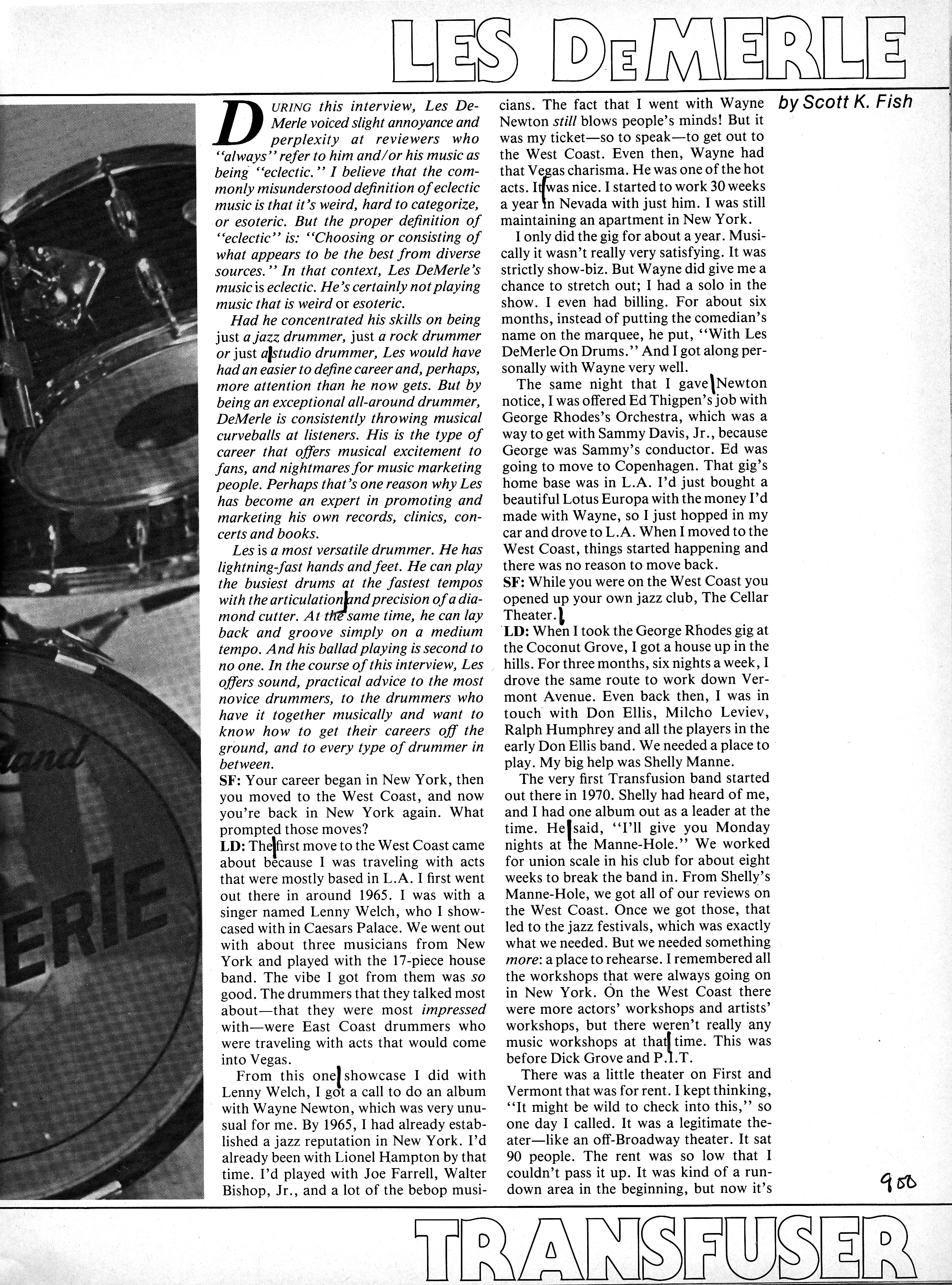
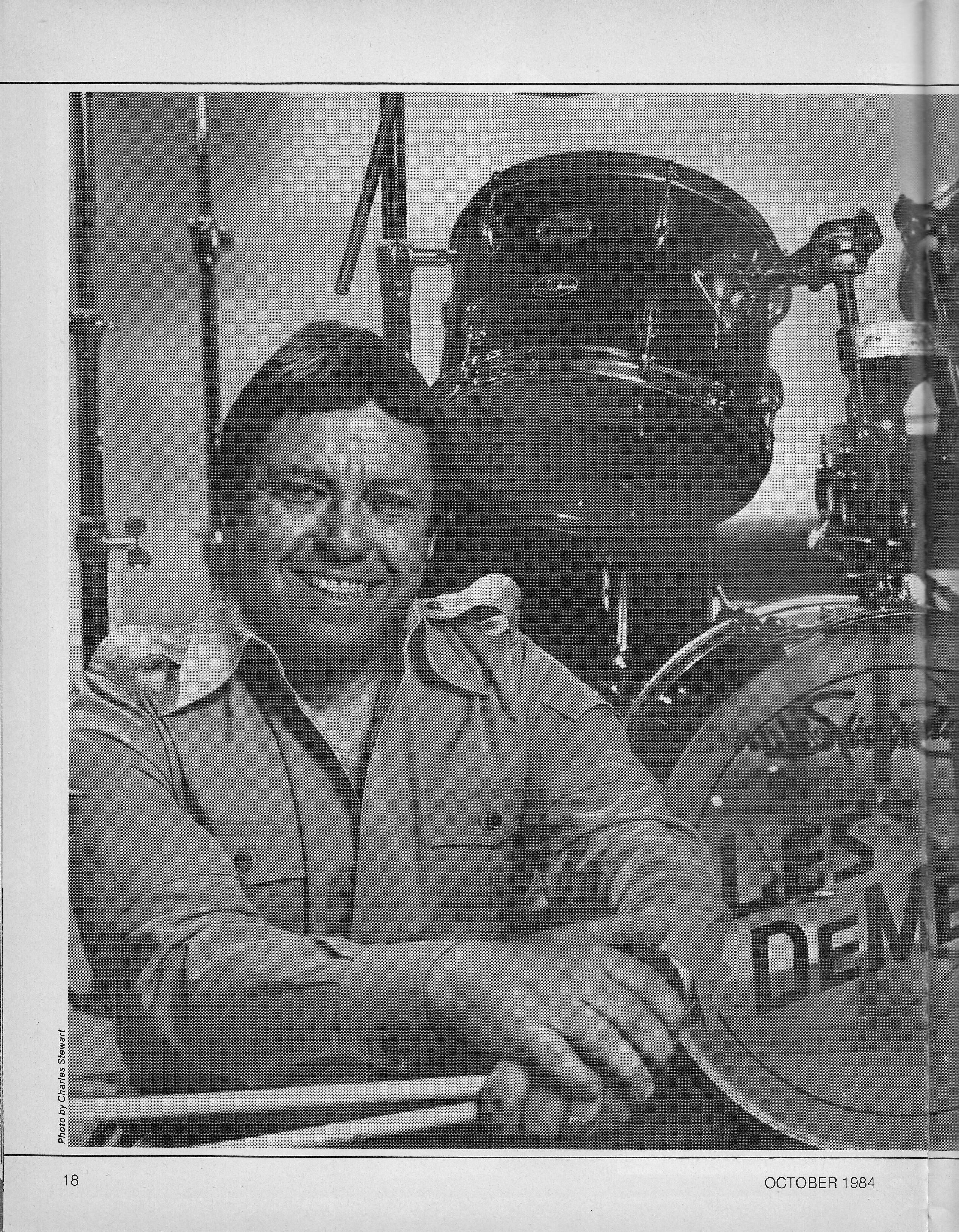
SKF NOTE: Last year I began posting small exchanges from the full transcript of my 1984 Les DeMerle interview. Here is Les’s full interview as published in Modern Drummer October 1984.

In my 1984 introduction I write, in part, “During this interview, Les DeMerle voiced slight annoyance and perplexity at reviewers who ‘always’ refer to him and/or his music as being ‘eclectic.’ I believe that the commonly misunderstood definition of eclectic music is that it’s wierd, hard to categorize, or esoteric. But the proper definition of ‘eclectic’ is: ‘Choosing or consisting of what appears to be the best from diverse sources.’ In that context, Les DeMerle’s music is eclectic. He’s certainly not playing music that is weird or esoteric.”

Les DeMerle also offers valuable insight into the business of professional drumming. While the internet has changed that business, much of Les’s experience as a drummer/businessman is still very relevant.

Also, I am pleasantly surprised at how many photographers contributed to this interview: Charles “Chuck” Stewart, Tom Copi, Paul Jonason, and Veryl Oakland. They were all excellent to work with.

One last thought: I almost didn’t scan/post this copy of Les’s interview because of it’s pen markings. But those markings, and the numbers written in pen in the page margins, might be of interest to drum journalism junkies.

When I left Modern Drummer in October 1983 I was still working on a handful of feature interviews — including this Les DeMerle interview. Apparently MD founder/publisher Ron Spagnardi and I agreed I would be paid for that handful of feature interviews X-cents per published word.

My 1984 system for counting published words was: count 100 words and mark the page, count 100 words and mark the page. Then I counted my page marks and wrote the total in the right margin. So first page has 900 words. The second page has 600 words.

Trust me, having computers count words is much better.

[SKF NOTE: 6/17/17 – Les DeMerle’s full interview is now available on MD‘s Archive Page.]
840010_les_demerle_skf_md_feature

840010_les_demerle_skf_md_feature_0001

— end —

Posted in SKF Blog | Tagged , , , , | Comments Off on Scott K Fish: Les DeMerle Interview 1984

Jason Bonham’s 1988 Promo Cassette Sampler

SKF NOTE: A couple of people have written me asking if I am still in possession of this or that audio cassette and/or magazine. Yesterday, while searching through boxes for other items, I found this sampler cassette of Jason Bonham’s 1988 album, The Disregard of Timekeeping. I’m guessing it was mailed to me prior to my interview with Jason published in Drums & Drumming July/August 1988.

For young drummers asking, “What’s an audio cassette?” — here’s a look at an audio cassette case.

bonham_jason_cassette

— end —

Posted in SKF Blog | Tagged , , , , , | Leave a comment

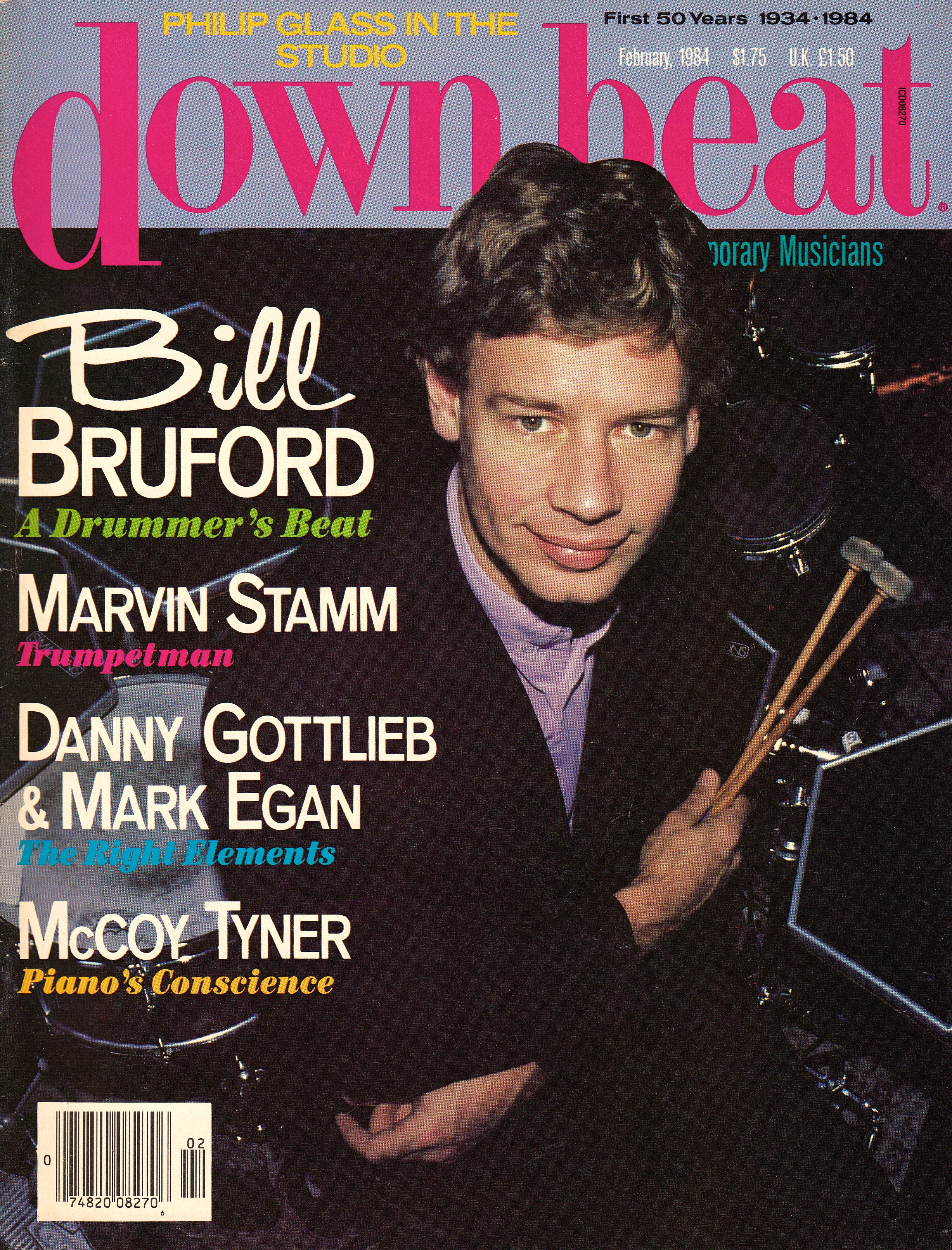
Bill Bruford: Technique? Texture and Sound Were Much More Important

bruford_bill_db_1984

SKF NOTE: More words for drummers to live by from drum pioneer Bill Bruford.

Art Lange: You’ve stated elsewhere that [Jamie] Muir influenced you a lot. How, specifically?

Bill Bruford: Specifically that drumming wasn’t all about thumbing through glossy magazines and buying cymbals and looking at shiny drums.

I grew up with him, in that I was playing a real musical instrument, and that it was a good idea to try to hear the drumming from the other musician’s point of view.

Drummers are a very small narcissistic bunch, and they often are only interested in drums, and they can only hear music up until their ride cymbal, and then after that they’re not interested, until “Here comes my fill” and then rrrrrrr and then this boring stuff goes on until the next fill. They wait unti these drum events occur.

Well, I grew out of that around that time, and I was no longer interested in all things wonderful about drumming — the speed and the flash and all those things are no longer of so much importance to me. Jamie Muir rubbing two pieces of polystyrene foam together which produced a squeaking sound that was more suitable for the tune, well that was fine, we would do that then.

And he was making me do all kinds of things that were heretical on the drum kit, you know — being very simple and doing silly things with it and playing it in a different way, treating sounds and putting chains on it and making industrial drum kits and lots of other things like that.

And he was seeing things much more conceptually than drumming; we weren’t interested in technique. Texture and sound were much more important, yes.

Source: Bill Bruford: A Drummer’s Beat, by Art Lange & Charles Doherty, Down Beat, February 1984

Posted in SKF Blog | Tagged , , , , , , , | Leave a comment

Max Roach: Rise of the 18″ Bass Drum Legend

SKF NOTE: This exchange with Max Roach took place on July 15, 1981 at his home in Connecticut. The opportunity to meet Max Roach and interview him for a Modern Drummer cover story was a dream come true. Max had recently released his Chattahoochee Red album. I especially liked Max’s mixed media use of Martin Luther King’s “I Have a Dream” speech with a new Max Roach drumset solo, The Dream / It’s Time.

But I missed the Max Roach drum sound I fell in love with many years earlier. On Chattahoochee Red, Max is playing Ludwig drums with thicker drumheads –Ludwig Silver Dot drum heads, I believe. Our interview gave me a chance to ask Max about his new sound and many other questions.

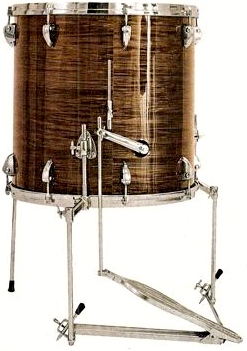
Max’s drumset at the time of this interview? “I’m playing a 22″ bass drum, 12″ and 13″ mounted toms, a 16″ floor tom, and a 14” [floor tom] which is a tuneable floor tom with a Meazzi footpedal. That’s alot of fun,” Max said.

Also, I wanted to solve the Rise of the 18″ Bass Drum Legend once and for all. Max Roach was a perfect drummer to ask.

Scott K Fish: Back in the ’50s and ’60s jazz drummers were primarily using the smaller size drums: 18″ bass, 12″ mounted tom, and 14″ floor tom. I’ve heard that one of the main reasons drummers used that size bass drum was because they were easier to transport than larger drums.

hollywood_meazzi

Meazzi FloorPedal

Max Roach: Exactly. It made it easier to get from town to town. Pack up your gear, put it in your car — your [station] wagon, and off you go. That was one of the main reasons, I think. Plus the bass drum had begun to become less and less an integral part of the whole musical set-up.

It’s coming back now. It’s different now. Because the bass drum at that time would stamp out what was happening with the [acoustic] bass. Even the pianists would leave that part. They would voice their chords and the bottom of the piano would be in thirds and sevenths instead of tonics and fifths. They left [tonics and fifths] for the [acoustic] bass.

So your bass drum would only be used for accents. And support. So the small drum was great. Plus, you didn’t have all the electronics around you, so you didn’t need that power there.

There were many reasons [why ’50s and ’60s jazz drummers used smaller size drums.] But today you do need that power with the electronic scene.

SKF: The bigger drums?

MR: Yeah. You need that power. When you go into a studio today, or even a concert hall, sometimes in a concert hall I’ll have at least five microphones on the [drum]set: One for the foot cymbal and snare; bass drum is two; two hanging overhead will cover the top area, and one on the side that will capture the tom-toms. At least five [microphones]. You could do with even more.

Credit for Hollywood Floor Tom Photo 

— end —

Posted in SKF Blog | Tagged , , , , | 3 Comments

Kenny Clarke: Music Comes From the Heart

Art Taylor: How important do you feel technique is for playing the drums?

Kenny Clarke: I think any musician needs just enough technique to express himself; I don’t think he should go beyond that. It becomes meaningless if it goes beyond his feelings. It’s always good to have a little technique to spare, but I don’t think you should become wrapped up in technical things as far as music is concerned, because music comes from the heart! It has nothing to do with technique at all as we know it.

Source: Notes and Tones: Musician to Musician Interviews, by Arthur Taylor, 1981 – Coward, McCann & Geoghegan, New York

Posted in SKF Blog | Tagged , , , , , | 4 Comments