Coltrane on Playing, Steadily, Steadily, Every Night

coltrane 65

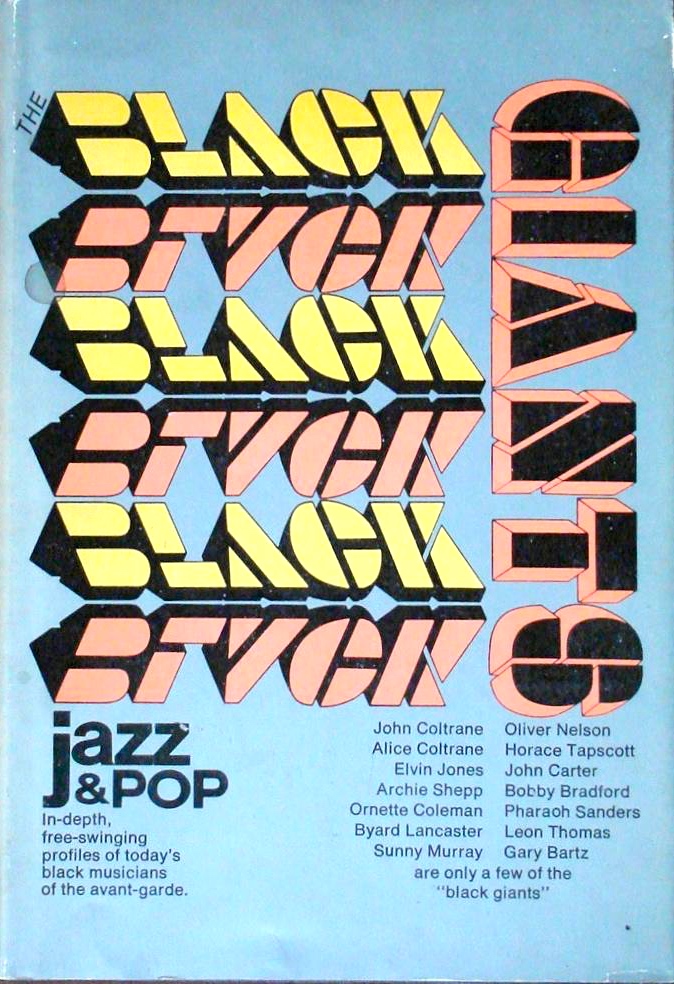
SKF NOTE: Black Giants is a 1970 book collection of interviews and essays with/about some of the “New Jazz” prime movers, i.e. Elvin Jones, Archie Shepp, and John Coltrane.

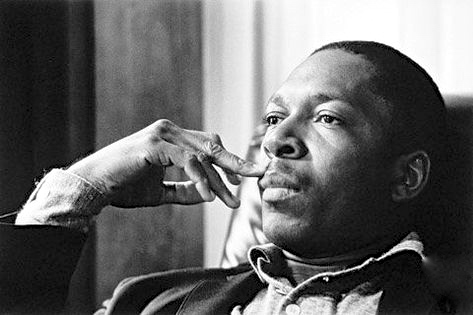
Contributor Frank Kofsky‘s Septermber 1967 interview with John Coltrane has Coltrane’s view on his great quartet with McCoy Tyner, Jimmy Garrison, and Elvin Jones vs the group Coltrane had after Elvin’s departure with Rashied Ali on drums and Emmanuel Rahim on percussion.

Also, John Coltrane’s thoughts on the benefits of musicians “playing, steadily, steadily, every night,” are worth highlighting. Coltrane using the examples of Elvin Jones with the Coltrane Quartet, and his, John Coltrane’s, own learning curve with Miles Davis’s First Great Quartet are worth remembering.

=====
black_giants

Black Giants Book Cover

Frank Kofsky: When I talked to you a couple of years ago…and I asked you if you would ever consider adding another horn to the group, you said probably the thing you would do is…you would add drums.

John Coltrane: I still feel so strongly about drums, I really do. I feel very strong about these drums. I experimented in it, but we didn’t have too much success. I believe it would have worked, but Elvin and McCoy [unintelligible]

FK: It doesn’t necessarily have to be two drums. It coud be drums and another rhythm instrument.

JC: I think so, too. I could come in different forms, shapes; I just don’t know how to do it, though.

FK: After all, the things that you’re using in the group now — shakers, bells, maracas — are rhythm instruments too. Not all rhythm instruments are drums.

JC: Oh, that’s true.

FK: …Sun Ra said…you hired Rashied Ali as a means of driving Elvin and McCoy out of the band….

JC: There was a thing I wanted to do in music, see, and I figured I could do two things: I could have a band that played like the way we used to play, and a band that was going in the direction the the one I have now is going in — I could combine these two, with these two concepts going. And it could have been done.

FK: How do you feel about having another horn in the group, another saxophone? Do you feel that it in any way competes with you or that it enhances what you’re doing?

jones_elvin

Elvin Jones

JC: Well, it helps me. It helps me stay alive physically, man[.] [T]he pace I’ve been leading has been so hard, and I’ve gained so much weight, that sometimes it’s been a little hard physically. I feel that I like to have somebody there in case I can’t get that strength.

[T]here’s always got to be somebody with a lot of power. In the old band, Elvin had this power. I always have to have to have somebody there with it, you know?

Rashied has it, but it hasn’t quite unfolded completely; all he needs to is play.

FK: That was my impression too, that he really was feeling his way ahead in the music and didn’t have the confidence Elvin had. But then, of course, look how long Elvin was with you before….

JC: Elvin was there for a couple of years[.] [A]lthough Elvin was ready from the first time I heard him[.] [Y]ou know, I could hear genius there[.] [B]ut he had to start playing, steadily, steadily, every night….

With Miles [Davis] it took me around two and a half years, I think, before it started developing, taking the shape that it was going to take.

Source: John Coltrane Interview, by Frank Kofsky, The Black Giants, The World Publishing Company (1970)


Posted in SKF Blog | Tagged , , , , , , , | Leave a comment

Clifford Brown: You’ve Got to Hear Things Before You Can Do Them

cliffordbrown_memorialalbum

SKF NOTE: At some point, serious music students — jazz students, at least — will meet Clifford Brown. A brilliant trumpet player, the world is blessed to have Clifford Brown’s impressive recorded legacy to listen to. Clifford Brown was 26-years old when he died in an automobile accident. He was also, at that time, part of the Clifford Brown/Max Roach Quintet.

The Brown/Roach group is where I first heard Clifford Brown AND Max Roach. I still love the Brown/Roach group and the music both men recorded in other settings.

In 2005 I bought and read Nick Catalano‘s biography, Clifford Brown: The Life and Art of the Legendary Jazz Trumpeter. This segment on how learning to hear played such an important part in Clifford Brown’s early studies makes sense to me, so I pass it along to you.

=====

Clifford Brown was a junior high school student when he was brought to Boysie Lowery. He had advanced considerably beyond his initial fascination with the shiny trumpet and had developed a serious musical interest “through experience with the junior high school band.”

“I didn’t start him in a book,” Boysie Lowery recalled years later. “I taught him how to hear. The most important thing is to be able to hear. I know a lot of guys that have been to college, but they don’t have what it takes to improvise. They can’t hear. You’ve got to be able to hear things before you can do them.”

Lowery’s system has now become legendary. He calls it “the classes.” Briefly, it teaches the student how to hear chord changes and then to improvise on the basis of what is heard.

“The classes gave you the freedom to execute and develop a style,” [Lowery] said. “It gives you a chance to know what you want to do.”

Improvisation? Chord changes? Certainly not the stereotyped exercise books and uninspiring classical practice pieces that comprise the bill of fare for most young music students.

Lowery’s approach cut to the chase. It gave great motivation to youngsters who wanted to play jazz, which was where Clifford Brown’s aspirations lay.

“He really knew what he wanted to do as far as music was concerned,” Boysie Lowery later told jazz scholar Phil Schaap. “All he needed was the right person, and I think I was the one at the time.”

Source: Clifford Brown: The Life and Art of the Legendary Jazz Trumpeter, by Nick Catalano, Oxford University Press (2000)

Posted in SKF Blog | Tagged , , , , , | Leave a comment

Scott K Fish: Les DeMerle Interview 1984

SKF NOTE: Last year I began posting small exchanges from the full transcript of my 1984 Les DeMerle interview. Here is Les’s full interview as published in Modern Drummer October 1984.

In my 1984 introduction I write, in part, “During this interview, Les DeMerle voiced slight annoyance and perplexity at reviewers who ‘always’ refer to him and/or his music as being ‘eclectic.’ I believe that the commonly misunderstood definition of eclectic music is that it’s wierd, hard to categorize, or esoteric. But the proper definition of ‘eclectic’ is: ‘Choosing or consisting of what appears to be the best from diverse sources.’ In that context, Les DeMerle’s music is eclectic. He’s certainly not playing music that is weird or esoteric.”

Les DeMerle also offers valuable insight into the business of professional drumming. While the internet has changed that business, much of Les’s experience as a drummer/businessman is still very relevant.

Also, I am pleasantly surprised at how many photographers contributed to this interview: Charles “Chuck” Stewart, Tom Copi, Paul Jonason, and Veryl Oakland. They were all excellent to work with.

One last thought: I almost didn’t scan/post this copy of Les’s interview because of it’s pen markings. But those markings, and the numbers written in pen in the page margins, might be of interest to drum journalism junkies.

When I left Modern Drummer in October 1983 I was still working on a handful of feature interviews — including this Les DeMerle interview. Apparently MD founder/publisher Ron Spagnardi and I agreed I would be paid for that handful of feature interviews X-cents per published word.

My 1984 system for counting published words was: count 100 words and mark the page, count 100 words and mark the page. Then I counted my page marks and wrote the total in the right margin. So first page has 900 words. The second page has 600 words.

Trust me, having computers count words is much better.

[SKF NOTE: 6/17/17 – Les DeMerle’s full interview is now available on MD‘s Archive Page.]

840010_les_demerle_skf_md_feature

840010_les_demerle_skf_md_feature_0001

— end —

Posted in SKF Blog | Tagged , , , , | Comments Off on Scott K Fish: Les DeMerle Interview 1984

Jason Bonham’s 1988 Promo Cassette Sampler

SKF NOTE: A couple of people have written me asking if I am still in possession of this or that audio cassette and/or magazine. Yesterday, while searching through boxes for other items, I found this sampler cassette of Jason Bonham’s 1988 album, The Disregard of Timekeeping. I’m guessing it was mailed to me prior to my interview with Jason published in Drums & Drumming July/August 1988.

For young drummers asking, “What’s an audio cassette?” — here’s a look at an audio cassette case.

bonham_jason_cassette

— end —

Posted in SKF Blog | Tagged , , , , , | Leave a comment

Bill Bruford: Technique? Texture and Sound Were Much More Important

bruford_bill_db_1984

SKF NOTE: More words for drummers to live by from drum pioneer Bill Bruford.

Art Lange: You’ve stated elsewhere that [Jamie] Muir influenced you a lot. How, specifically?

Bill Bruford: Specifically that drumming wasn’t all about thumbing through glossy magazines and buying cymbals and looking at shiny drums.

I grew up with him, in that I was playing a real musical instrument, and that it was a good idea to try to hear the drumming from the other musician’s point of view.

Drummers are a very small narcissistic bunch, and they often are only interested in drums, and they can only hear music up until their ride cymbal, and then after that they’re not interested, until “Here comes my fill” and then rrrrrrr and then this boring stuff goes on until the next fill. They wait unti these drum events occur.

Well, I grew out of that around that time, and I was no longer interested in all things wonderful about drumming — the speed and the flash and all those things are no longer of so much importance to me. Jamie Muir rubbing two pieces of polystyrene foam together which produced a squeaking sound that was more suitable for the tune, well that was fine, we would do that then.

And he was making me do all kinds of things that were heretical on the drum kit, you know — being very simple and doing silly things with it and playing it in a different way, treating sounds and putting chains on it and making industrial drum kits and lots of other things like that.

And he was seeing things much more conceptually than drumming; we weren’t interested in technique. Texture and sound were much more important, yes.

Source: Bill Bruford: A Drummer’s Beat, by Art Lange & Charles Doherty, Down Beat, February 1984

Posted in SKF Blog | Tagged , , , , , , , | Leave a comment