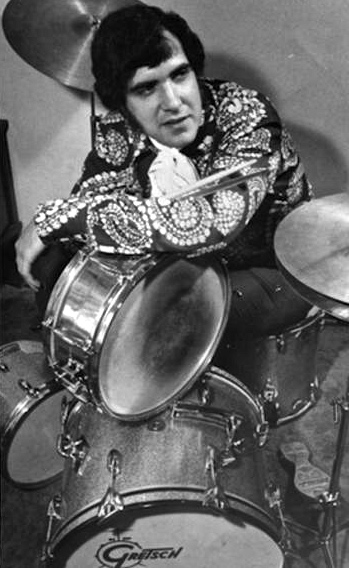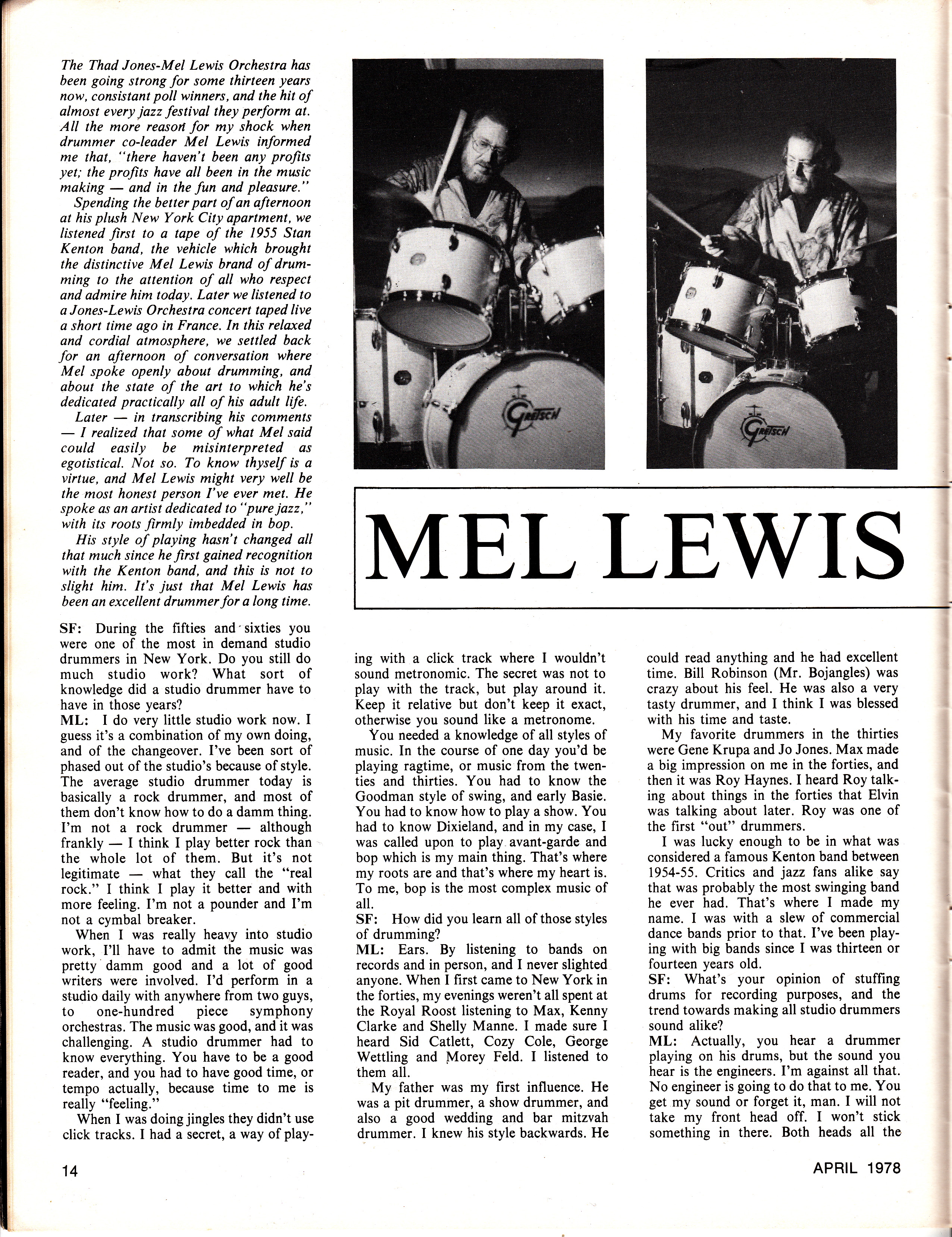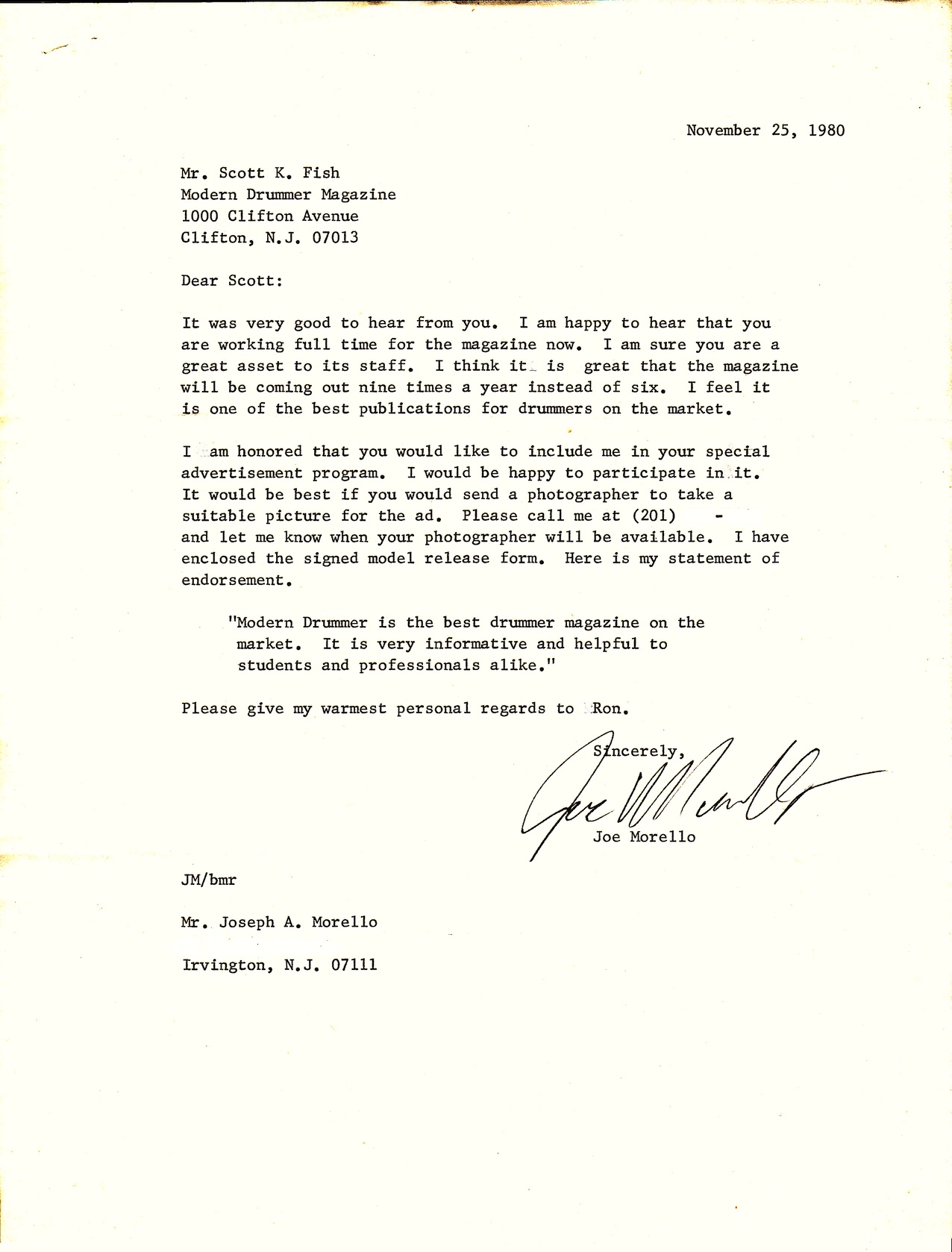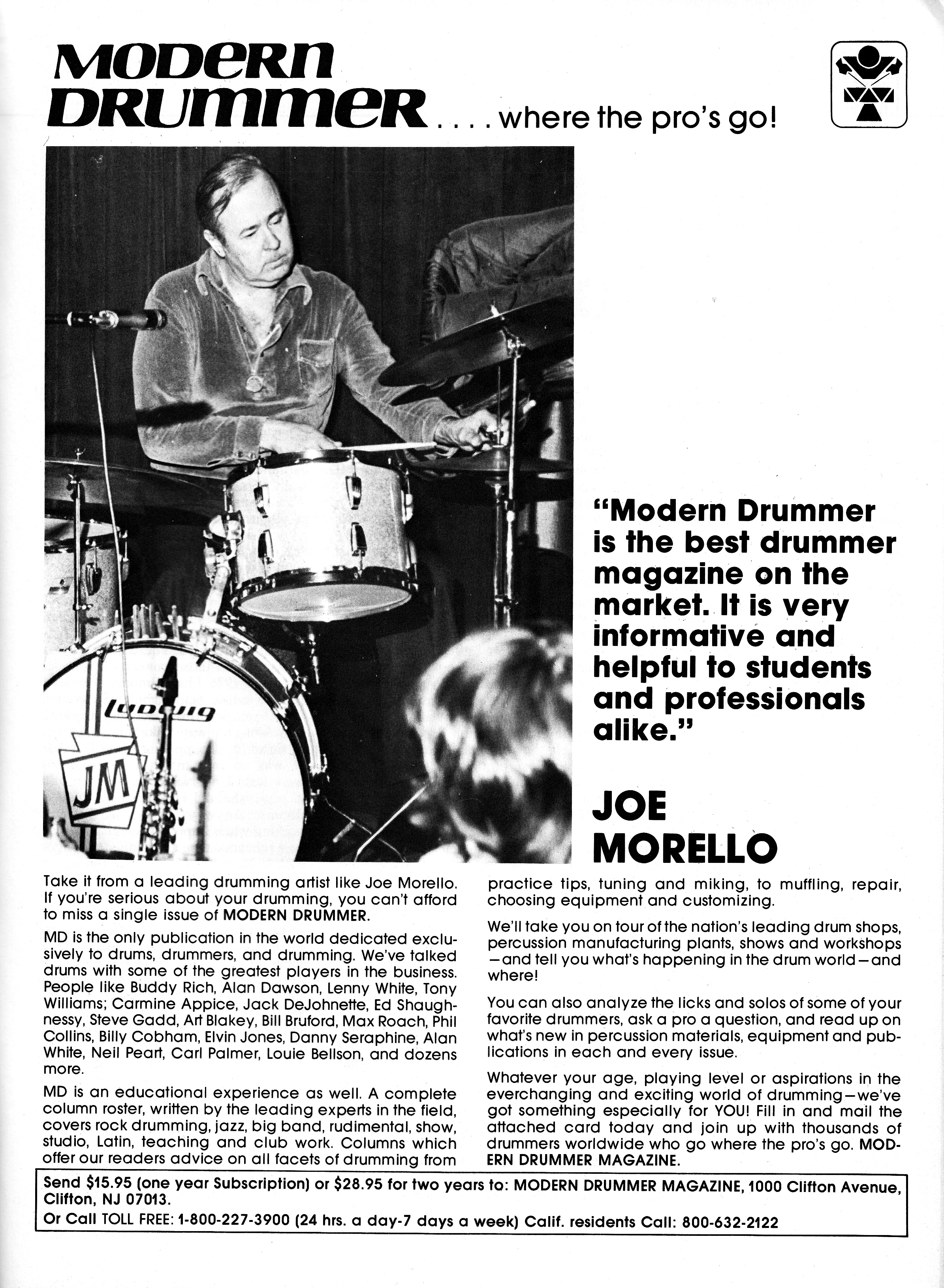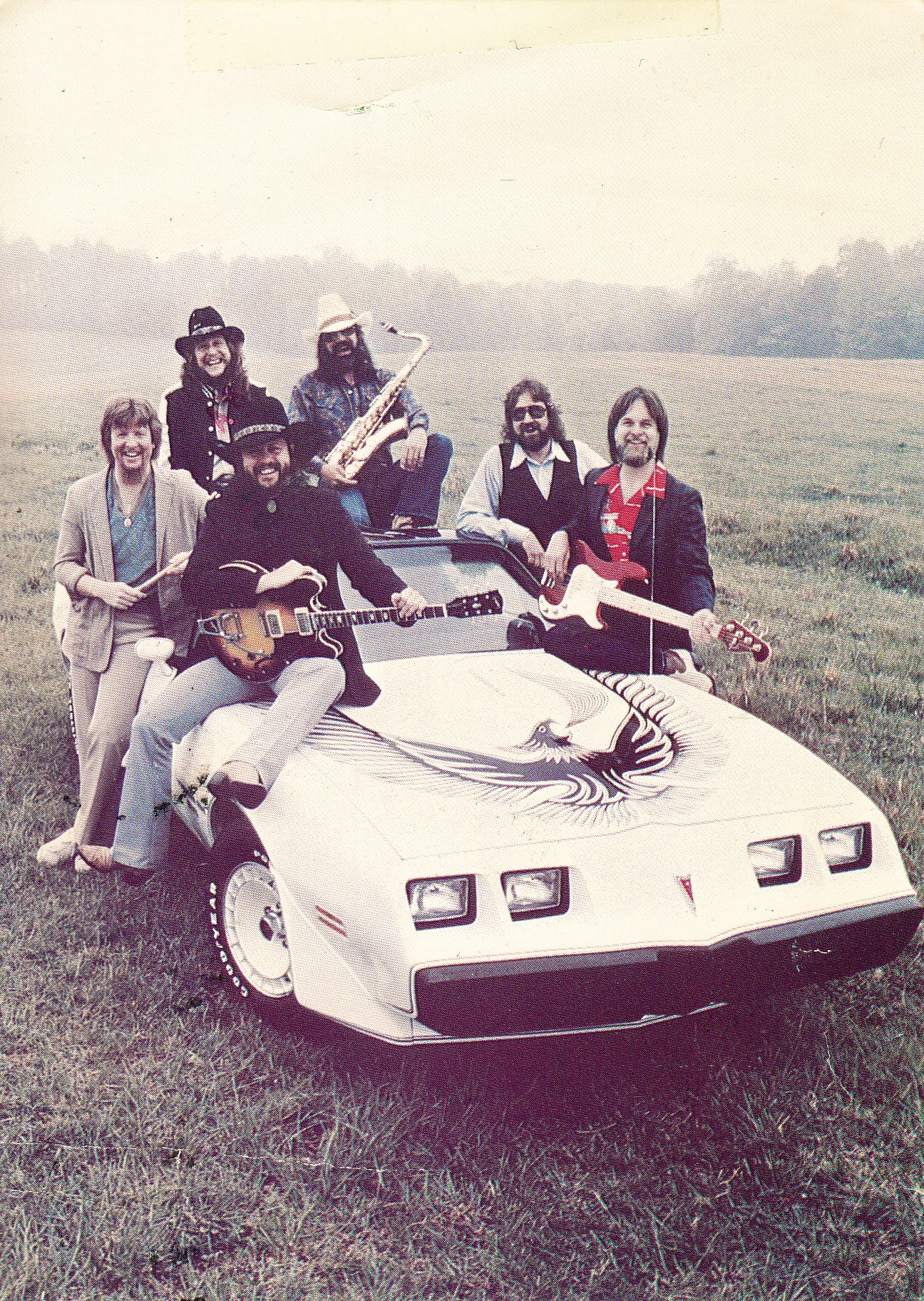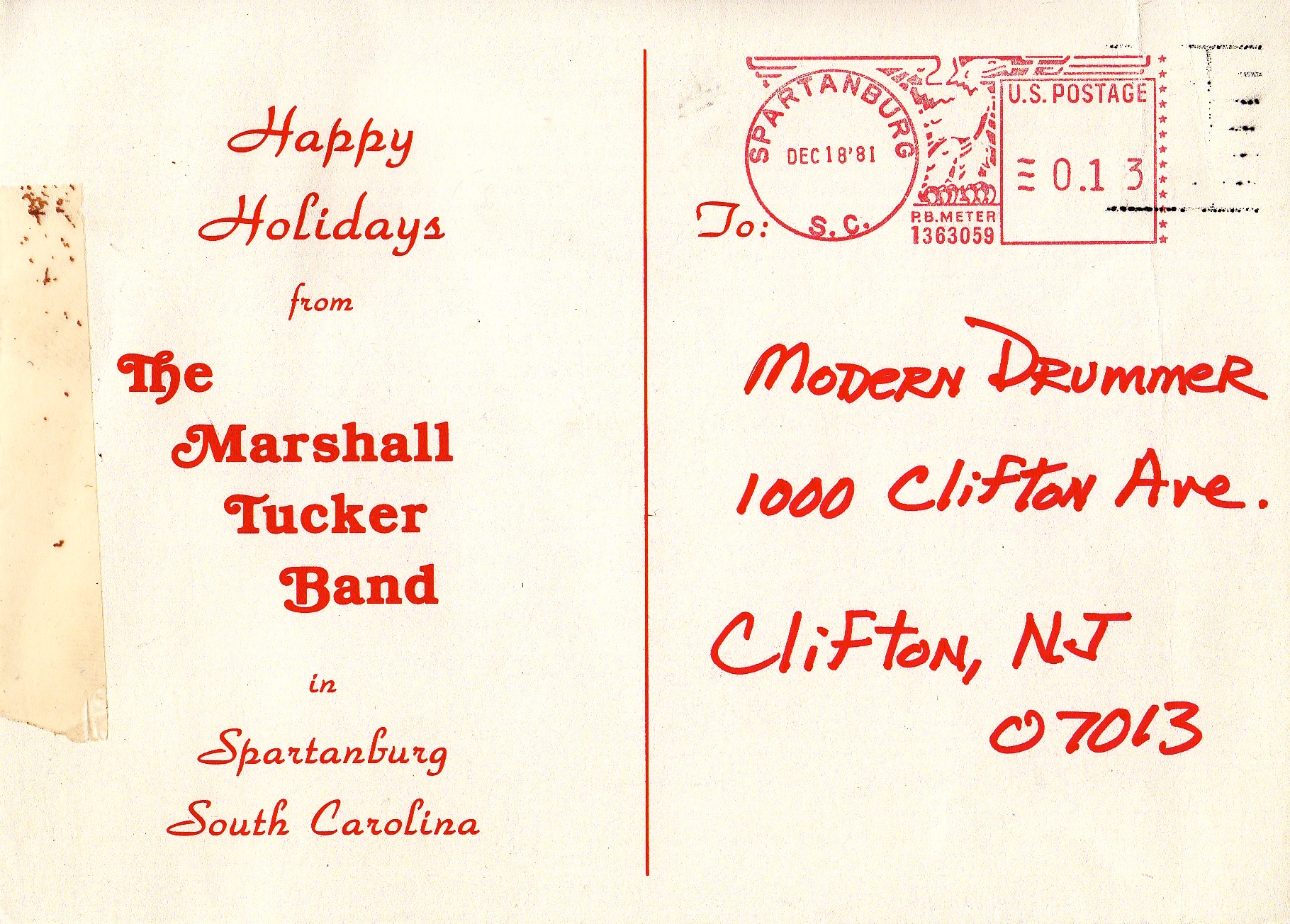
SKF NOTE: From among my yards of drum memorabilia. A Christmas card from the Marshall Tucker Band with my very good friend, Paul T. Riddle.


— end —
SKF NOTE: From among my yards of drum memorabilia. A Christmas card from the Marshall Tucker Band with my very good friend, Paul T. Riddle.


— end —
SKF NOTE: The Boston Jazz Society, Inc.’s A Tribute to Percussionist Roy Haynes is a 12-page program I found among my boxes of drum memorabilia. I don’t remember how I got the Haynes program. Terri Lyne Carrington‘s father, Sonny Carrington, was the BJS, Inc. President at the time. My best guess is the program either came from Sonny or Roy Haynes.
I’ve scanned a few of the program pages most likely to interest readers.


— end —

SKF NOTE: This exchange is from my 1983 interview with Dave Weckl for Modern Drummer. Most of this interview is not published anywhere. Portions of it were published in MD as a profile of Dave Weckl. I first heard of Dave Weckl around the same time I met and interviewed Gary Chester. Here’s the back story.
Weckl was age 23 when we met. He was living in Bridgeport, CT getting ready to go on tour with Simon and Garfunkel — arguably the first major gig that put Weckl on the map.
Dave and I were talking about his rehearsing songs for the 1983 Simon & Garfunkel tour. That’s where this part of our interview starts. Two more points: this interview took place about two years before Gary Chester’s New Breed drum method book was first published. Also, a great place to learn more about Gary Chester is the In Memory of Legendary Drummer Gary Chester Facebook page.
=====
Scott K Fish: When you were practicing the songs did anything challenge you technically?
David Weckl: No. I had to work out something new on Allergies. There’s two drummers playing the track on the album. Steve Gadd was playing the beat under Simmons drum fills by Steve Ferrone. There were two parts going on and I had to take the main ingredients of both and come up with a groove.
That was challenging because I ended up playing a left hand hi-hat part and Simmons fills with the right hand — while keeping the groove happening underneath. It was all the stuff that I’d learned from Gary Chester. If I have to do something left handed now it’s no longer a big deal. Because I went through a couple of retarded stages with [Gary Chester].
I’m still studying with Gary off-and-on now. But I plan on studying with him full-time again when I get off this tour. I’ve been studying with him about seven months.
SKF: How had you changed from your first lesson with Gary compared to the way you were playing seven months later?
DW: My concentration level had changed. It had gone up considerably just towards concentrating on what I was actually playing. I was actually hearing what I was playing instead of letting a little ghost note go in here or there.
Every time I walked in to a lesson I felt [like a novice]. [Gary] would come up with a different system every week. I’d go home and practice it and get it down so it was cooking.
I’d come back the next week and [Gary] would tell me to do something else with it that I hadn’t practiced — and make me feel [like a novice] all over again.
It was great though. His lessons are such a challenge.

At first I had no idea what Gary’s teaching was like. My friend, John, said, “You should go talk to Gary, man.” Because I was getting impatient. This was even before I’d gotten the gig with French Toast. I was spending a lot of time practicing, and I knew what I could do if just given the opportunity.
John said, “You should talk to Gary. He’s got so many connections. He could help yo out and get you into the studio.”
I said that I didn’t want to just approach [Gary] and say, “Hey, could you turn me on to some studio work? I can play.” I was just interested in taking a couple of lessons to see what he was all about.
Gary said, “Well, what I’m going to teach you I can’t really do in a couple of lessons. Either come study with me on a steady basis or it doesn’t happen.”
So I agreed. I wanted to find out what was going on. I went up there with the attitude that if I could do whatever he wants me to do, then after a few lessons I want to talk to him about some studio work. And if I can learn something from [Gary] — great.
I walked in there, man, and after I was done I felt like I was starting over. On my first lesson! I was embarrassed to death. Any idea of me even talking to him about wanting to do anything just went right out the window after the first ten minutes.
He was laying this stuff on me that had to do with hand and eye coordination.
For instance, one of [Gary’s] systems is keeping a consistent bass drum pattern, keeping a consistent hi-hat pattern, and then there is a snare drum line to read in-between. And on top of that, you sing the quarter note, you sing what you’re doing with the bass drum after that. Then you sing what you’re doing with the snare drum. You do this left-handed and right-handed.
Then he comes up with all these other ways to play the bass [drum] line. It gets nuts. And that’s only one of the things [Gary] does.
The coordination thing is unbelievable because you actually have five coordination things going on when you’re singing something against it. That helped me out with my time so much. Not that I had terrible time before that. But it just made me concentrate on it that much more. I could actually feel and sing the quarter note to myself — or sing the eighth note, or whatever — to help me really concentrate on what was going on.
If you’re able to do that and play against it, it’s unbelievable how much it helps lock it in so much more.
SKF: So [Gary Chester’s] is a very valid teaching system.
DW: Oh yeah. It enables you to take a line — something you hear in the music — and what you’re striving for from all this is to be able to play it any way.
Say, for instance, that a producer comes up to you and says, “I’d like you to play this type of thing.” The idea is to be able to say, “Okay,” and do it. Not to then sit down and work it our for an hour while you’re trying to figure out what to play.
A lot of people get hung up on reading. They say, “I just can’t read that well.” And a lot of times they can read rhythms fine. A lot of it is having the coordination to fit those rhythms in along with the beat, and try to make it all groove, and try to make the music happen.
You have hot to be able to see that whole thing and be able to see the beat as you’re playing
— end —

SKF NOTE: This exchange with Max Roach took place on July 15, 1981 at his home in Connecticut. The back story is posted here.
How up-and-coming drummers learned from their drummer elders has always interested me. In this interview segment, I asked that question of Max Roach. As sometimes happens in interviews, one question leads to others. Max’s story about Haitian drummer Tiroro‘s (also written as Ti Roro) teaching method impressed me greatly. It is one of the stories I recall most often from among all of my drum interviews and studies.
Now, thanks to internet technology, I can include a link to a Tiroro album and readers can listen to Tiroro or not. I didn’t have that option 35-years ago.
Scott K Fish: Were the older drummers receptive to you as a young guy? Could you go up to Baby Dodds or Jo Jones and say, “Hey, what is that you’re doing?” Or would they say, “Get lost, kid.”?
Max Roach: It was always… You had to first…. They would have to come to you. I wouldn’t dare approach them. You’d learn from them by watching and listening to records, and…whenever they’d come to town.
It’s not so much asking them how they did it, as to the fact that they could do something creative.
You don’t necessarily want to do what they did, but you want to be as creative as they are. That’s what it is.
So you may ask, “Well, how do you do such-and-such a thing?” They’ll never show you how to do it. But you saw [what they did] and figured out your way of dealing with it so you…preserve your own individuality. Contrary to saying, “Okay, you must hold the stick like this. You must do this with the right hand and left hand.” No. Then that would make you a slave to someone else’s technique.
SKF: And that would kind of diminish you in [the older drummers’] eyesight?
MR: Yeah. Well…. You know, you’re after being creative. So you have to listen to it — and we all learn like this — you have to listen to it and figure out how it was done on your own. That’s ear training. That’s what it is.
That way, it keeps you in the frame of mind to think and create. You think and figure out ways of doing things. Because the minute you say, “Oh, let me see how that was done,” and you listen to it over and over again — eventually this kind of thinking becomes a part of you so that…you know how to arrive at [an answer] by your own ingenuity, not by someone coming up to you and saying, “Well, okay. You do this this way. And that this way. And raise your stick to a certain height. And don’t hit this too hard.” Or whatever!
I know I had an interesting experience. I went to Haiti and a great, great drummer there, Tiroro, he played the skin-on-skin instrument. And he knew how to make the drum sing. I watched [Tiroro] teach a student and it was very close to the way we learned.
We used to listen to records and take off the record what the [musician] was doing. You didn’t see the [musician]. You would just hear [musicians]. We’d figure out what was happening with our ears. And then we’d duplicate the sound.
Well, [Tiroro] taught that way. He’d put a student in another room with a partition. And then [Tiroro] would make a sound, and the student would have to imitate the sound.
And when I asked [Tiroro] why he [taught] like that, why he would never have the student look at how he, [Tiroro], did things, [Tiroro] said, Because everybody’s anatomy is different. So it’s beholden up the student to listen, and then figure out a way — using [the student’s] own hands and the skin on the drum — how to create that sound.
SKF: That’s tough [to do].
MR: It is tough. But since [Tiroro’s] is a system they use — kids get it faster.
And I said, “Wow. That’s so close to the way we did things. Because I had to listen to records and find out what was happening. If it was a snare — what [a drummer] did on the snare; or if it was a hi-hat, or what kind of cymbals was [a drummer] using as rides, and all these things.
First, hear these things. And then find…out [what was happening], and maybe write it down, or just duplicate [the sound] by playing it.
SKF: How would that apply to different stickings?
MR: Same thing. If you heard [a drummer] traveling across the drumset, you had to figure out the stickings, and figure out just where the accents were. Maybe slowing down the records helped too.
SKF: Do you think it’s a bad approach for a kid to learn from a book that might have Steve Gadd‘s drum part from Fifty Ways to Leave Your Lover written out? Not only written out rhythmically, but also with the stickings?
MR: It has always been like that, even with the old books…. They always put sticking in. The old Haskell Harr books.
But I know what you mean. What would happen when we’d learn the stickings? Sometimes I would play something that sounded like what I heard on a record. And I’d create my own stickings and it would be totally different. Then, when I’d go to a theater and see, [for example], Jo Jones [play what I was trying to duplicate from Jo Jones on a record], I’d say, “Wow. He does it completely different.”
But the sound was there. I had the sound.
As I said earlier, getting that involved with sticking makes you lazier.., because you can do the same thing so many different ways, as far as sticking is concerend. You don’t necessarily have to say, “Well, this is the way it has to be sticked.” Because, actually what you’re playing for is sound.
In a case like, perhaps, what Gadd is doing [on Fifty Ways to Leave Your Lover] it is a rhythmic device to accompany a certain style of playing that particular number. It may work like that. Then, the sticking probably has to be done a certain way.
But for improvisational playing you don’t want to get wound up with “this is the sticking” all the time. Because every time you move from one thing to another, you’re not as felxible as if you can just play for the sound itself.
Now, I never think about sticking. I just hear the sound. I hear a certain amount of sound in a certain amount of space. And how you [create] that [sound] in that space doesn’t necessarily depend on the sticking.
I would be interested to slow it all down and say, “Ah ha! That’s what my sticking was.” But, basically it’s single [strokes] and double [strokes] unless you’re going to switch over sometimes.
— end —
Life Beyond the Cymbals
A Blog about Music and Popular Culture
Online Drum Tracks | Drum Recording | Remote Session Drumming | Pro Session Drummer
Life Beyond the Cymbals
Writing About and Reviewing Classical Music and Jazz
Life Beyond the Cymbals
A Drummer's Look at Drums and Drumming
You must be logged in to post a comment.