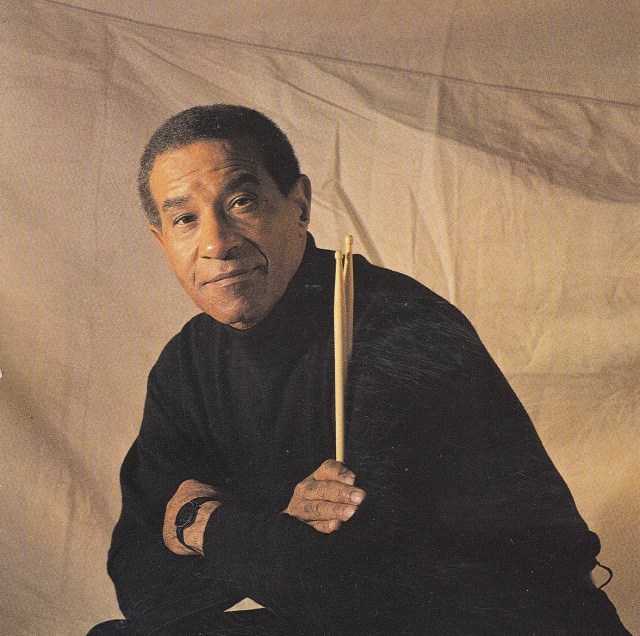
Scott K Fish: You had mentioned something in International Musician about the importance of being aware of the quarter note. I wonder if you could elaborate on that.
Max Roach: See, the quarter note is the basic thing, regardless of the meter. It’s like the common denominator. If you’re in 3/8, or 6/8, or 7/8, there’s a relationship to understanding where the quarter note is [in ] that pulse, regardless of where you are.
The basic rudiment, for me, for percussion players, is that which is a drone: All four limbs playing just a quarter note. They can do it for five minutes. It’s like a drone.
Where it’s transparent…. Say you play the quarter note with the bass drum, and the foot cymbal, and the snare, and maybe a ride cymbal. Just the quarter notes itself. And have the kind of transparency in it, that you could hear all four limbs in concert [together]. One [limb] would not override the other.
It helps give you some kind of perspective on what the drumset sounds like collectively. Of course, you’re listening to yourself when you do that, and make sure that your bass drum doesn’t override your hi-hat.
It helps you also to understand the relationship between the timbres of the instrument: all these drums, these different thing you have around you.
And it also helps you physically, to know that maybe you have to come down heavier on the hi-hat. Or maybe you have to lighten up on the ride. Maybe you have to lighten up on the snare, or come down heavy on the bass drum.
I was talking [in International Musician] about the quarter note from that aspect. In understanding the timbre of the instrument, and also, of getting a feeling of all four things [limbs] working like a machine. So when you start beginning to separate things out — there’s a certain amount of transparency, no matter how much you’re traveling all over the instrument, if you are playing the hi-hat, or doing something else — everything is being heard. Everything should be heard.
I hate to hear someone pounding away, and [I] see the hi-hat moving, and [I] don’t hear what they hear, in relationship to what they’re doing. I know that the drummer onstage hears that hi-hat within the context of what he’s doing. He hears that. But all I do is see it.
That means, if he could, maybe, develop a system where he could make sure, maybe, that he comes down with his hands on some areas [so] that the hi-hat [sound] woud [stand] out, and it would enhance what he’s doing — because that’s [the sound] he means to do. Otherwise, [I] wouldn’t see the hi-hat moving.
SKF NOTE: Jean Morello, Joe’s wife, was a gracious person. I imagine Joe Morello‘s life would have been much different without her. I don’t know for sure, but I am willing to bet the handwritten Christmas signature is Jean’s. The yellowing on the card inside is where I had taped the card to the wall.
Some family and friends can’t understand why I save personal items like Christmas cards. That’s okay. I save personal items like Christmas cards anyway. They always carry good memories.
SKF NOTE: Here’s one of my favorite photos of drummer Shadow Wilson. The original is from the liner note insert of The Complete Joe Newman RCA Victor Reccordings (1955-1956): The Basie Days CD. Joe Newman’s two-CD set includes music from four LPs. Shadow Wilson is on Newman’s two Octet dates, which is where this photo was taken. The photo is used in the CD insert courtesy of French jazz pianist and record company executive Henri Renaud.
From the opening track, Corner Pocket, Shadow Wilson plays so well on this date. As is often true of the few Shadow Wilson photos I see, the drummer is recording with a bare bones drumset: bass drum, ride cymbal, snare drum, hi-hat. That’s all Shadow needs to create model swing drumming. Phew!
In a moment you’ll read an excerpt from the CD liner notes the back story to this session, including that this date was recorded using one microphone.
I wish this music was online for you to listen to. As of this morning I am unable to find it, but perhaps a reader will find the music and let us know.
Excerpt from Don Waterhouse’s liner notes: [Joe Newman] was booked into New York’s Webster Hall to record for the giant RCA-Victor. He took with him an octet built around a nucleus of fellow Basie-ites (Ernie Wilkins, Freddie Green and Shadow Wilson) and completed by a team of seasoned exponents of the swinging Kansas City style — a formula he would retain for most of his subsequent recording dates. The arrangements here are mainly by hornmen Ernie Wilkins and Al Cohn, but Manny Albam also lends an appreciable helping-hand.
The session was beautifully captured by sound-engineer Dick Gardner using a single microphone, no mean feat by today’s multi-tracking standards. The musicians were seated around this lone mike, and drawn into the foreground for their solos simply by standing up! An after hours affair, the gig took place between midnight and ten o’clock the next morning. As fairly usual in America, it was broken down into three three-hour stretches, with a half-hour break between each.
This can prove an amazingly efficient way of operating, with a fine balance between concentrated spells of hard work and well-earned rest, and it somehow avoids the constraining pressures of time. The atmosphere certainly proves wonderfully relaxed, and the music strikingly imaginative.
SKF NOTE: Writers of Modern Drummer’s 10th Anniversary Issue all agreed our interviews, in MD founder/publisher Ron Spagnardi’s words, “would be to assess the current state of the art by looking back at how it was arrived at, and then looking ahead to predict where it might be going. As always, the answers had to come from the drummers themselves. [T]he obvious drummers to contract were those whom the readers of the magazine had honored in the MD Readers Poll: the four living Hall of Fame members, and six other drummers who were voted to the top of their categories in the most recent poll.”
Today, my written introduction to Neil Peart’s 1986 interview brings back two new points worth mentioning. Yes, ours was a telephone interview, and I scrambled at the last minute to make it happen. Normally I would have made sure I had either a working electrical outlet, or fresh batteries, for my cassette recorder. Cleaning and demagnetizing the tape heads were routine. Finding a quiet, comfortable place to sit, where I could take notes, or refer to my written ideas/questions was key. That was all good in Northport, Maine the day of this interview.
What I had not planned on — because I had never experienced it before — was desk phones (land lines) not working with my Radio Shack suction cup mic. Fortunately, I was in a home with two phones, so I improvised. I placed one phone’s earpiece near my cassette recorder’s built-in mic and recorded our interview that way. Using the other phone in the other room, Neil and I had our conversation.
East Vassalboro, ME Grange
The busboy I wrote about in 1986 who said Neil Peart was among his favorite poets? Well, I’m still having encounters like that. Here’s one encounter I wrote about in an April 7, 2014 letter:
Two weekends ago I’m at a contra dance in the East Vassalboro, ME Grange. Putting on my coat to leave after the dance I ask a 20something lady if she is a dancer. No, she says. I then ask if she’s a musician. She tells me she’s just started singing.
Well, yours truly asks, “What kind of music do you sing?” And then I ask about, perhaps, favorite songwriters.
“Do you know the band Rush?” she asks. “Yes,” I say. “Well, their drummer doesn’t sing, but he writes lyrics to their songs. And I think he’s very, very good.”
To which Neil replied in an April 7, 2014 email:
As Count Basie said after hearing a playback of “Francis A. & Edward K.” (still an all-time masterpiece),
“Always glad to hear about that kind of carryin’ on!”
[SKF NOTE: 6/17/17 – Neil Peart’s full interview is now available on MD‘s Archive Page.]
Derek Hess and I met at that concert. I liked the Rossington Collins Band songs — the band was tight and swinging. And Derek played loose, musical, creative. Assuming from what I was hearing and seeing onstage, Derek was a schooled drummer, his answer surprised me: “If you laid [a drum method book] out in front of me, a basic rudiment pattern, or a school book, I’d have no idea what was going on. I swear. I could not do it,” Derek said.
“I guess, to categorize, my playing would be, in some instances — [drum] fill-wise — melodic. There’s music going on besides pounding. That’s what I’ve been told, and I guess that kind of makes sense, because I had a lot of music training,” he said. In his full interview, Derek details his music experience with piano, alto sax, listening to all kinds of music, from Glenn Miller, to Joan Baez, to Jeff Beck. In brief, Derek Hess had a great ear, which showed in his drumming.
Our second interview took place by phone, January 8, 1982, andModern Drummerran Derek’s feature interview in May 1982. Here’s a snippet from the transcript on Derek’s drum and cymbal setup at the September 5, 1981 Rossington Collins concert — which you can now hear for yourself!
And thank you, Eclipse Recording Studio in St. Augustine, Fl for the updated studio photo here of Derek Hess.
Scott K Fish: You’re endorsing Slingerland now, right?
DH: Just the hi-hats. The rest of them are Zildjian Brilliants. I’ve got one Ride and four Crash. My ride cymbal’s a 21″ Medium weight. They’re real pingy sounding. They don’t swell up and sit there and roar while you’re doing a ride. I like a lot of close-to-the-bell playing, anyway. So it’s really pingy — like a San Francisco trolley car.
The Crashes are 15″, 16″, and two 17″. The little [Crash is] over the hi-hat, one [is] over the floor tom, and the other two in the midst. I like that explosive, realy quick bash that quiets right down. That’s what smaller cymbals are good for.
I’ve got a 15″ pair of Sound-Edge hi-hats, and I’m probably going to have to use something else. They’ve got too top-endy for me. I like a fatter sounding hi-hat.
SKF: What do you look for when you’re choosing your cymbals?
DH: I think the only time you’re going to hear any contrast between cymbals is in the studio, because live, it ain’t going to make much difference. Under all that volume and miking, you might hear a little pitch difference, but a cymbal’s a cymbal when you’re running live, and there’s no way I could be convinced otherwise. That is, outside of a Pang cymbal or something special.
I just mainly go for small sizes, and have maybe a two-step difference in pitch, and that’s about it. Nothing fancy. I don’t try to hear notes in them because it’s important. But, maybe in rock-and-roll [distinct cymbal sounds] can be captured how you want it [by the recording engineer] at the [mixing board] knob.
Derek Hess at Eclipse Recording Studio, St. Augustine, FL
SKF: Why are you playing Slingerland drums?
DH: That’s a combination of two things. I started out, and we were going to do a deal with Ludwig. And then, because the band was new — and Ludwig is a pretty together company. I like their drums for the most part. I guess, in the beginning I preferred having their [Ludwig’s] stuff. But they damn horsed around, wish-washed back-and-forth about whether they were going to do an endorsement deal or not.
They turned me on one time, then turned it down. I had to go out with a borrowed set of drums, about the first three months the band was touring.
DH: No. They’re a wood finish, and they’re, like, six years old. I still like a real impressive stage look. I just like a mean looking stage. If it’s too empty or barren, it takes away. I know I’ll probably get a loot of objections to that, because bands like Journey, and Heart, are going for a cleaner stage look. Heart has the best looking empty stage there is.
Our assistant engineer on the first album knew some guys at Slingerland. And he helped, I think, Dennis St. John….
And I sold drums at the music store for eight years, and I always thought Slingerland’s toms sounded good. Real resonant, and easy to tune. I think they were ready to jump on a half endorsement deal.
See, my Gretsch drums fall short of making an impressive appearance. I pretty much made these Slingerland drums like I wanted them. The company was real cooperative. There’s nothing to look at on them other than the color. There’s nothing that really looks any different from any one of [Slingerland’s] catalogs.
I’ve got a longer kick drum. The power toms are longer. I’ve got a 16×24 kick drum which sounds great. The toms are all equal in depth. My 12″ and 13″ are both 10 inches long. The 14″ and 15″ [toms] are 12 inches long.
The floor toms are standard siz, and the cutaway toms are catalog items — except I got them in chrome.
People ask, “God! What are those?” They’re just a lot of drums that look sassy. My only dissatisfaction is that I’m having some hardware problems, mainly with the tom stands and cymbal stands where they clamp down. They’re too hard to work. SKF: You were using Aquarian cymbal springs, weren’t you?
DH: Yeah.
SKF: What do you like about the cymbal springs?
DH: They just have enough rock about them. They don’t sustain the cymbal so much, where it bangs up against those little washers. They look sturdy, and they move right. When you hit them [cymbals], they come back, and get in place quick enough so that you can get at [the cymbal] again.
The whole concept of [Aquarian cymbal springs] is real clever. I just like them. They way the cymbal gets protected.



 Excerpt from Don Waterhouse’s liner notes: [Joe Newman] was booked into New York’s





You must be logged in to post a comment.