SKF NOTE: This excerpt begins right where my earlier excerpt, Frankie Dunlop: Monk’s Lesson on Slow vs Fast Playing, ends. Here Frankie talks more about developing his melodic drumming with Monk. This segment ends with Frankie citing his greatest drumming challenges for power, and also, stamina.
SKF NOTE: When my neighbor, Ed Matthews, told me Columbia Records was breaking up Big Brother and the Holding Company, and putting singer Janis Joplin in front of a horn band — I was visibly and vocally disappointed. Mr. Mathews was head A&R man at Columbia records then and a great friend and mentor to me. But, Big Brother was a great rock band that played with an impossible to duplicate spirit.
I saw Big Brother, with Janis Joplin, perform at Westbury Music Theater on Long Island, NY in 1968 — and drummer Dave Getz, fun to watch, definitely played with a jazz drummer’s sensibility. Getz’s approach to the drums — including his obligatory solo during Big Brother’s show — was similar to John Densmore with The Doors .
Piece of My Heart is probably the best known song from Big Brother with Janis. But I’ve always been partial to the band’s Combination of the Two — which I’m posting here.
It was good seeing David Talbot’s 5/4/17 report on Dave Getz. Glad to know he is doing well.
=====
Big Brother drummer holding onto the times that slipped away
By David Talbot
May 4, 2017 Updated: May 5, 2017 10:26am
Last Saturday afternoon, I lunched with Dave Getz, the drummer who rode to rock immortality with Big Brother and the Holding Company.
At 77, Getz defies the old adage that if you remember the ’60s, you weren’t there. He was there, and he still has a photographic recall of much of it. But his most evocative memories are of the earlier bohemian days in San Francisco, before the media-branded Summer of Love.
Getz arrived here in 1960 from New York, where he had grown up in a crowded Flatbush apartment….
Getz fled to the West Coast as a 20-year-old budding painter to attend the San Francisco Art Institute. Getz…was a jazz drummer who had played gigs in the Catskills, but…decided against a music career….
.But…in San Francisco in the early ’60s, …the concert posters, not the music, …first attracted Getz. [P]articularly…the artwork…for a new band called Big Brother and the Holding Company.
[H]e found himself trying out for the band….
“It’s hard for me to listen today to some of Big Brother’s music from those days,” Getz said. “I had the most experience in the band, and our music wasn’t precise. Sometimes the guitars were out of tune. But we were like a punk band; we had incredible energy. I just wanted to play as hard and fast as I could. I would come offstage completely soaked.”
When Janis Joplin joined the band, it was like being strapped to an even more powerful rocket. “At the start, Janis wasn’t a great blues singer, but she absorbed things much quicker. It was inevitable that she would leave the band someday.
“I was the first one in the band to get to know her.”
It was the easy camaraderie between San Francisco’s young musicians — before they became rock stars — that Getz remembers most fondly. [B]efore…their fateful trajectory toward stardom and addiction, they were just friends and fellow musicians.
SKF NOTE: Boy, finding a stack of Hal Blaine‘s replies for his Modern Drummer “Staying In Tune” column brings back memories. I’m posting one page of Hal’s replies here.
From strictly an editing perspective Hal’s typed replies meant lots of work. If we had computers enabling us to highlight Hal’s paragraphs and choose the “Sentence Caps” function – editing would have been much, much simpler.
As it was, pre-computers, it was easier for us to retype Hal’s answers before editing them and sending the copy to the Modern Drummer printer. Unless we wanted Hal’s answers to appear in all upper case letters – we had to change them. We could have used proofreader marks, but with no space between sentences that was impossible. And even with space between sentences, the number of proofreader marks would have been silly. So we retyped Hal Blaine’s replies.
All of which was well worth it to have Hal Blaine willing and able to share his experience and wisdom with MD and our readers.
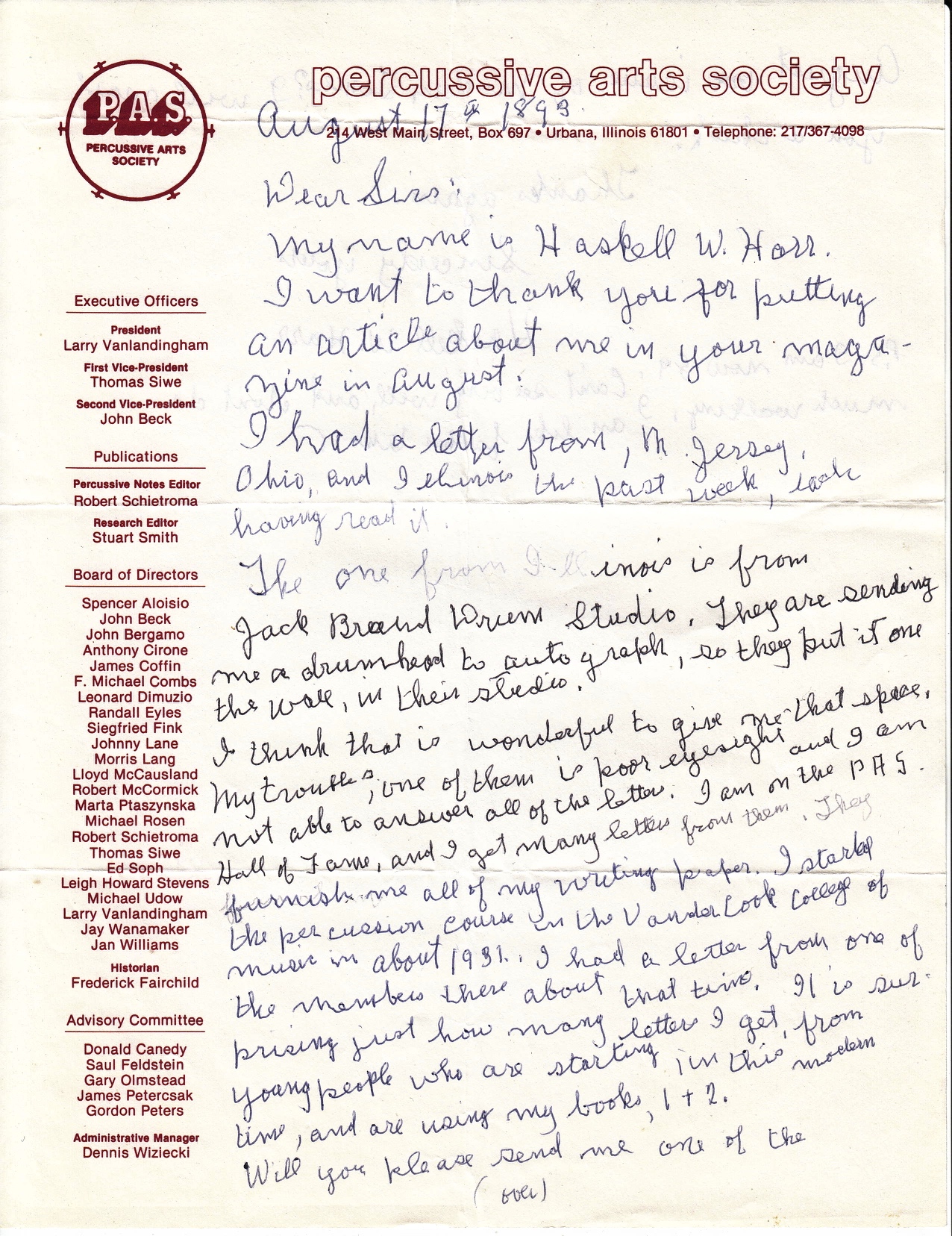
SKF NOTE: Haskell W. Harr is one of the renowned historical drum instructors. At age 89, Mr. Harr wrote this letter to Modern Drummer to thank us for publishing a story about him and his legacy to drumming. Mr. Harr, as he writes in his letter, is a member of the Percussive Arts Society Hall of Fame. And I remember my surprise and honor at receiving Haskell Harr’s handwritten letter.
Here is the text of Haskell W. Harr’s letter:
August 17th, 1893 (sic)
Dear Sirs:
My name is Haskell W. Harr. I want to thank you for putting an article about me in your magazine in August.
I had a letter from, N. Jersey, Ohio, and Illinois the past week, each having read it.
The one from Illinois is from Jack Brand Drum Studio. They are sending me a drumhead to autograph, so they put it on the wall, in their studio.
I think that is wonderful to give me that space. My troubles, one of them is poor eyesight and I am not able to answer all of the letters.
I am on the PAS Hall of Fame, and I get many letters from them. They furnish me all of my writing paper.
I started the percussion course in the VanderCook College of Music in about 1931. I had a letter from one of the members there about that time. It is surprising just how many letters I get, from young people who are starting in this modern time, and are using my books, 1 & 2.
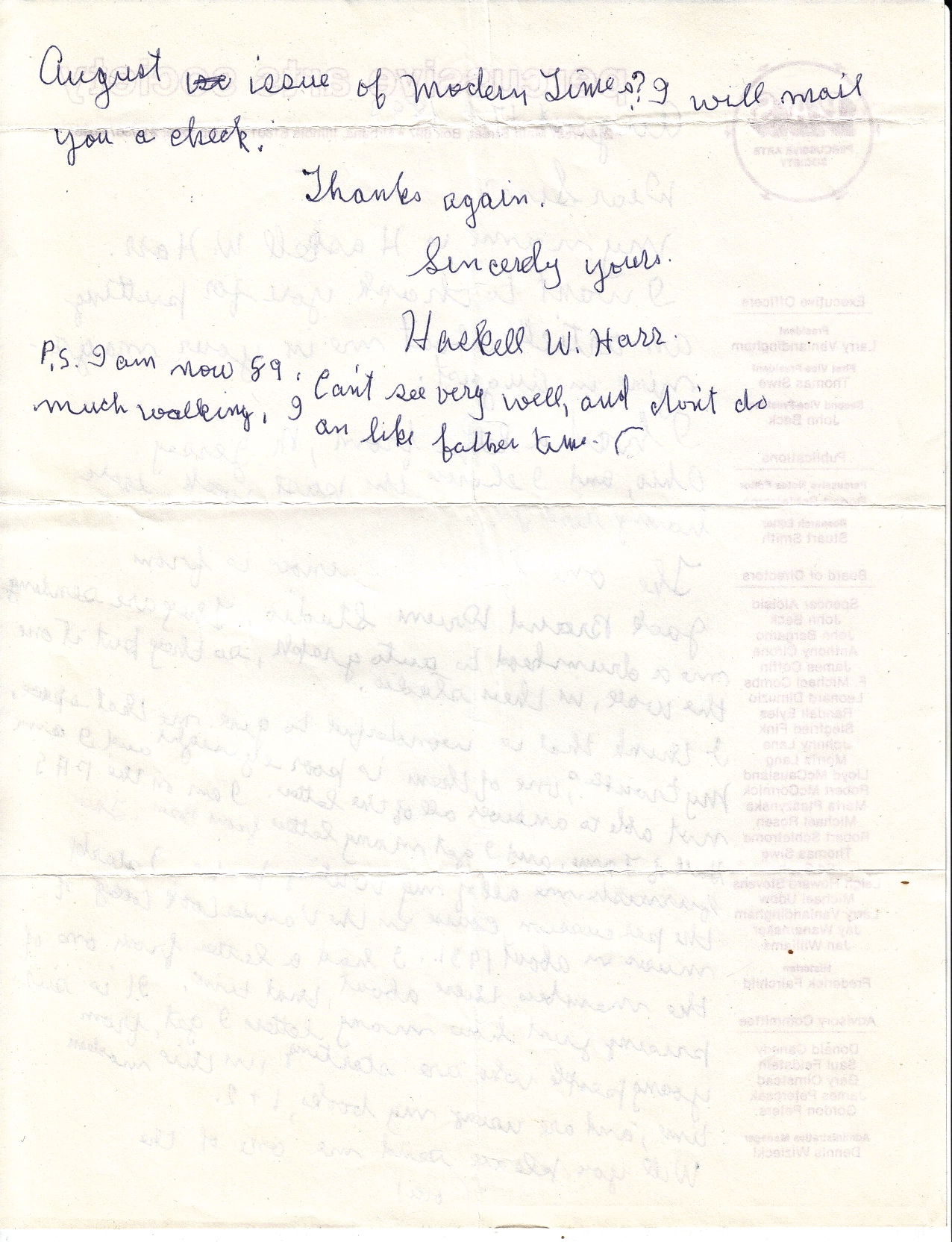
Will you please send me one of the August issue of Modern Times (sic)? I will mail you a check.
Thanks again.
Sincerely yours
Haskell W. Harr
P.S. I am now 89. Can’t see very well, and don’t do much walking. I am like father time.
SKF NOTE: “The rhythm section, as a section, was unrecognizable to me.” That was part of Cannonball Adderley‘s response to Down Beat columnist Leonard Feather during November 2, 1967 Down Beat “Blindfold Test.”
A montly Down Beat tradition, Mr. Feather would play records for well-known musicians – without disclosing ahead of time the musicians on the records, and ask his guests to rate the recording one star to five stars.
A few minutes later, thinking about what Adderley said, I thought for the first time: How awful! Unrecognizable is the worst that can be said about a musician!
How much better — whether a performance is no stars or five stars — to have listeners say, “I know who that is. I recognize their playing.”






You must be logged in to post a comment.