SKF NOTE – Last week, in the mood for jazz organ, I bought Volumes 1 and 2 of Blue Note Records’ Jimmy Smith Live at the Club Baby Grand. Recorded and released in 1956. These are trio dates with Jimmy Smith (organ), Thornel Schwartz (guitar), and Donald Bailey (drums).
This was such a great trio. Club Baby Grand is gone. How big it was I don’t know. Based on the background noise – customer conversations, cash registers ringing, glasses clinking – it sounds as if the three musicians were right on top of each other.
Donald Bailey plays very well on these albums. I listen and think of a phone conversation in my Modern Drummer office with Jim Keltner, when Jim was urging me or another MD writer to interview Donald Bailey.
It never happened.
At the time, the early 1980s, it’s true I was a little familiar with Donald Bailey’s drumming. But in my mind I wasn’t familiar enough to conduct an MD Donald Bailey feature interview. Getting up-to-speed was expensive. Listening to new Donald Bailey music meant buying LP’s. There was no YouTube. Plus, there was a healthy time commitment listening to new music in preparation for interviews. Or buying and reading books, magazines, and/or newspapers.
Listening to Donald Bailey live at the Club Baby Grand, my conversation with Jim Keltner and my excuses for not interviewing Bailey haunt me.
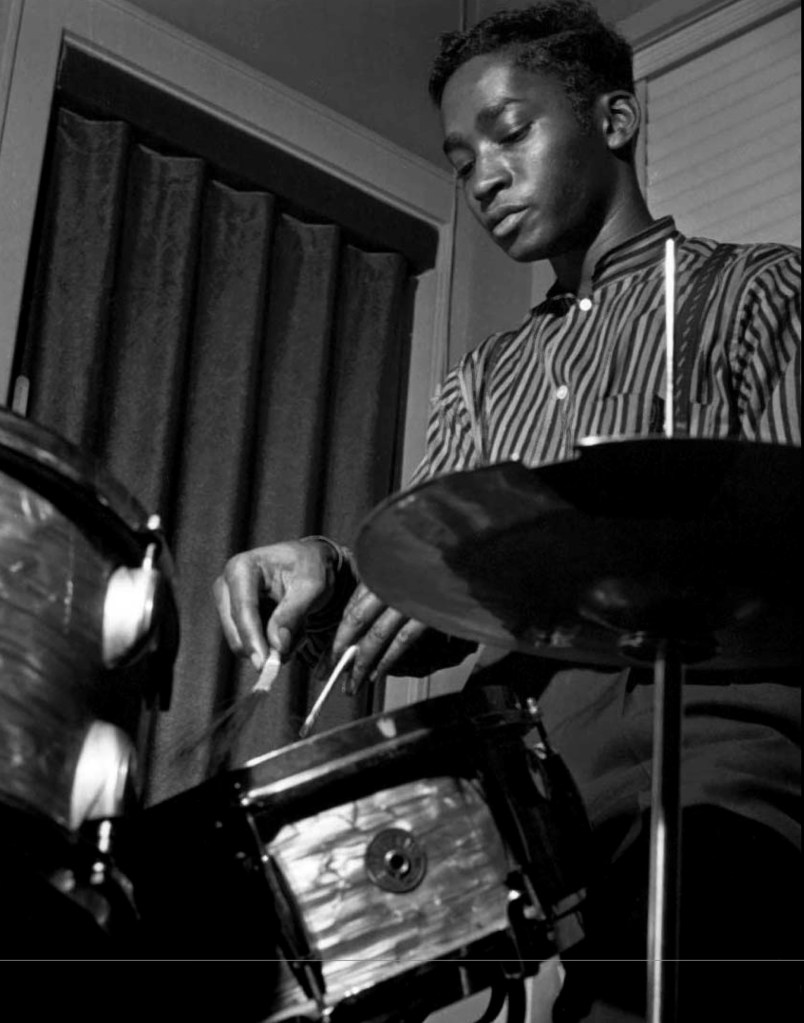
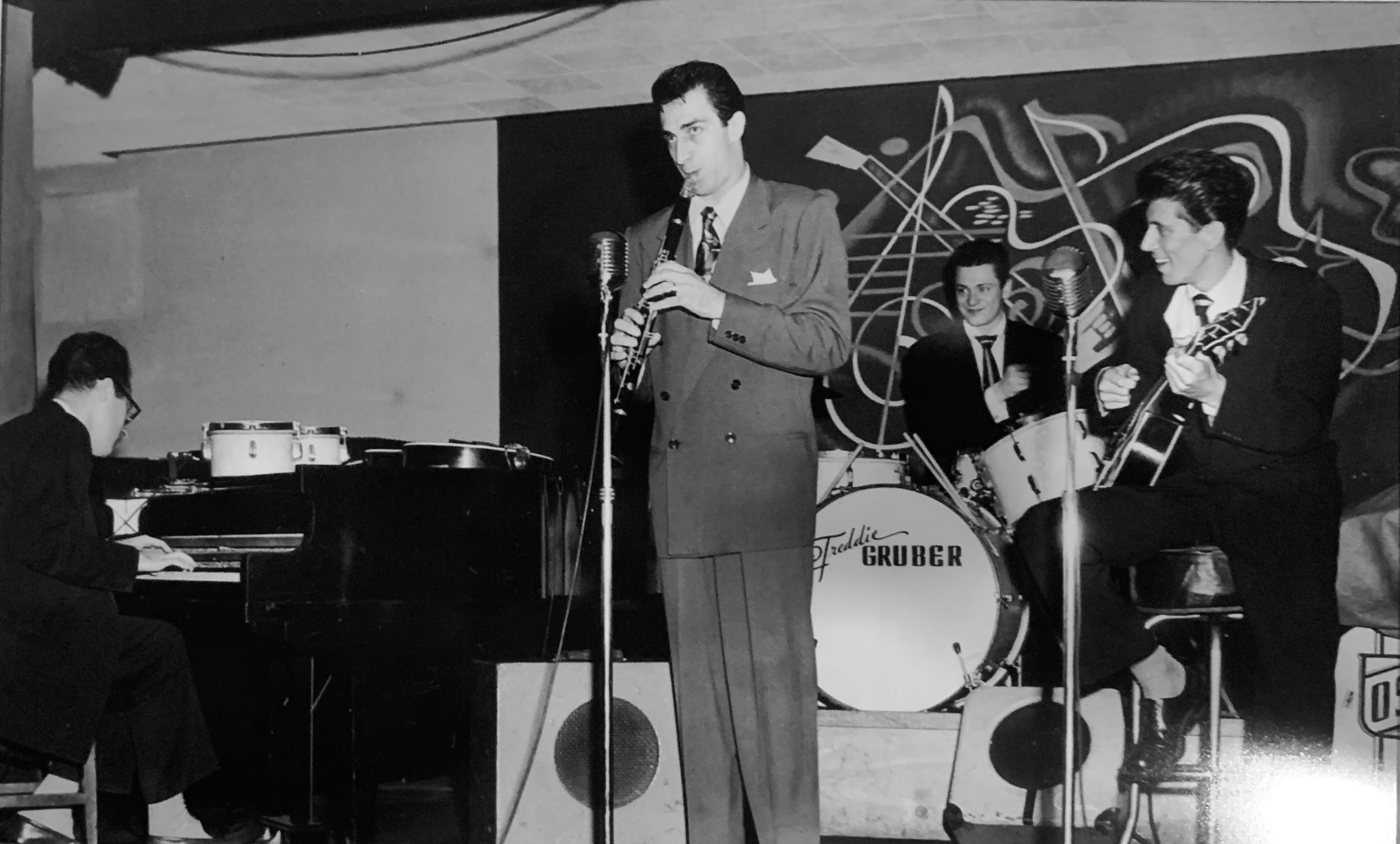
Feddie Gruber with Buddy DeFranco and Tal Farlow.IAMD Newsletter.Freddie Gruber drumming on Gene Roland Big Band date with Charlie Parker.
SKF NOTE: The late drummer Freddie Gruber is known by many drummers, including me, as an exemplary teacher. Other drummers, however, say Freddie is full of hot air, a charlatan, who has somehow put a spell on Neil Peart, Buddy Rich, Jim Keltner, Steve Smith, Mel Lewis, and other drumming legends.
Skeptics point out the absence of Freddie recordings. If Freddie Gruber was such a great player, they say, how come he never made any records? Of course, that’s asking to prove a negative.
What we’ve always had is the testimony of respected drummers who did hear Freddie Gruber drumming in his prime, and the praise of first-class contemporary players such as those named above.
Then last week I received an interesting email from Neal Sausen who provides new insight into Freddie Gruber. Here, in part, is what Neal wrote:
…I’ve been a Freddie Gruber drum student for over well 50 years. I started with him when I was 18 on April 2, 1969, and stayed with him continuously until around 1990-92. Then studied off and on with him, formally or informally, until shortly before his death in 2011. I was at his house almost every night the last year or so of his life, hanging out with him, and keeping him company.
The man was nothing short of a genius.., ahead of his time! Do you know the “push-pull” technique everybody’s so on about Lately? Freddy was teaching that in the 1960s. Hell he taught it to me in 1981! He was way ahead of his time with the “FLUIDITY OF MOTION” Concept. Not only with hands on the snare drum, but on the entire drum set including the feet! You should see my old beat-up copy of Colin Bailey’s “Bass Drum Control” book.
Freddie wrote his own notes as he went along. He wrote a “book within a book.” Yes, we used all the classic books: “Buddy Rich’s Modern Interpretation of Snare Drum Rudiments,”Roy Burns & Lew Malin Practical Method of Developing Finger Control,” The aforementioned Colin Bailey bass drum control book, “Rhythmic Patterns,” by Joe Cusatis, Ted Reed’s “Syncopation for the Modern Drummer,” Jim Chapin’s “Advanced Techniques for the Modern Drummer.,” and many others. I went through something like 30-35 books with Freddie including all four of the Gary Chaffee books.
Freddie was good enough to play with Bud Powell, Charlie Parker, and Buddy De Franco. I have photographs of him sitting in with the Buddy Rich band in the late 40s.
=====
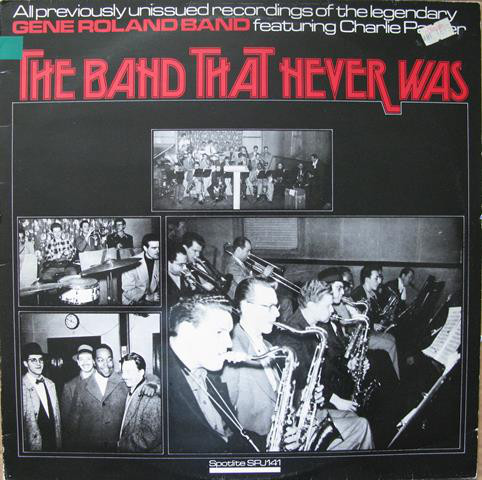
Neal’s email also mentioned that there is, in fact, one album available with Freddie Gruber in the drum chair. On the Spotlite label, the album by the Gene Roland Big Band featuring Charlie Parker is called “The Band That Never Was.” The back on the album jacket features band photos, one of which clearly shows a young Freddie Gruber on the drums.
Some sources incorrectly cite Tiny Kahn as the date drummer. Kahn did play with the Gene Roland Big Band, but other sources list Freddie Gruber among the musicians on this date.
Also, of interest, Neal Sausen said in his email, “Freddie showed and played for me independently released CDs of Freddie playing with Charlie Parker and others. Maybe these were not commercially released, but they were recorded and put on CDs. They sounded freaking amazing!”
I’m not sure who’s in possession of those CDs, but I know lots of drummers – maybe even some skeptics – would love to hear them.
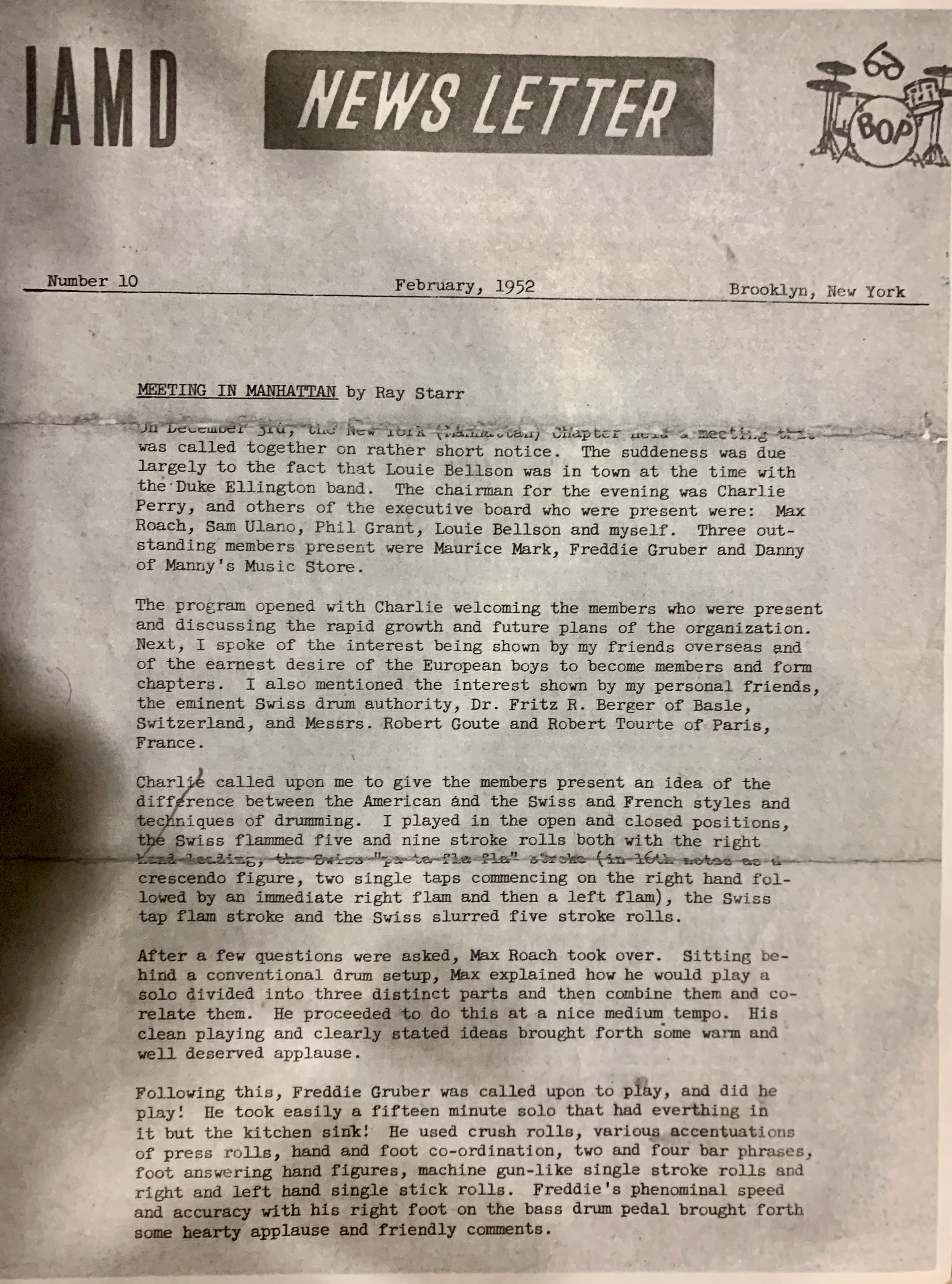
Finally, Neal sent me photos of a 1952 Newsletter by the New York Chapter of the International Association of Modern Drummers. This group is new to me, but the members at this meeting – including Max Roach and Louie Bellson – were quite impressive. The meeting included solos by several members, including Freddie Gruber. Ray Starr’s report on Freddie’s solo echoes what Jim Chapin and Barry Ulanov said about Freddie’s drumming.
=====
IAMD Newsletter Number 10, February 1952, Brooklyn, NY
MEETING IN MANHATTAN, by Ray Starr.
On December 3rd, the New York (Manhattan) Chapter held a meeting that was called together on rather short notice. The suddenness was due largely to the fact that Louie Bellson was in town at the time with the Duke Ellington band. The chairman for the evening was Charlie Perry, and others of the executive board who were present were: Max Roach, Sam Ulano, Phil Grant, Louie Bellson and myself. Three outstanding members present were Maurice Mark, Freddie Gruber and Danny of Manny’s Music Store.
Charlie called upon me to give the members present an idea of the difference between the American and the Swiss and French styles and techniques of drumming.
…Max Roach took over. Sitting behind a conventional drum setup, Max explained how he would play a solo divided into three distinct parts and then combine them and co-relate them.
Following this, Freddie Gruber was called upon to play, and did he play! He took easily a fifteen minute solo that had everything in it but the kitchen sink! He used crush rolls, various accentuations of press rolls, hand and foot co-ordination, two and four bar phrases, foot answering hand figures, machine gun-like single stroke rolls and right and left hand single stick rolls. Freddie’s phenomenal speed and accuracy with his right foot on the bass drum pedal brought forth some hearty applause and friendly comments.
=====
Thank you, Neal Sausen for contacting me. And thank you for providing some great material to help set the record straight about Freddie Gruber as a drummer.
SKF NOTE: Antoine Sanfuentes recently posted on his Facebook page some cool pictures of Frankie Dunlop onstage at The Five Spot with Thelonious Monk. Here’s one of the batch. This morning I’m unable to find the rest, but I’ll keep looking.
I’m guessing Frankie’s playing the Slingerland drum set he was so happy to get after playing on, what he called, a “raggedy” set of old drums.
LikeLoading...
Posted inSKF Blog|Comments Off on New Pics of Frankie Dunlop with Monk
SKF NOTE: I’ve mentioned before in my writings that Freddie Gruber, when I interviewed him, helped me overcome a bad drumming habit I had developed. A few people have asked me to talk about how Freddie helped me. I’ll do so now.
After hearing for awhile about drummers, like Joe Morello, using “finger technique,” I gleaned what “finger technique” info I could, mostly from magazines, and developed my own version. The basis of “finger technique,” as I understood, was that the stick was controlled – mostly the left-hand stick – by the fingers, not the wrist.
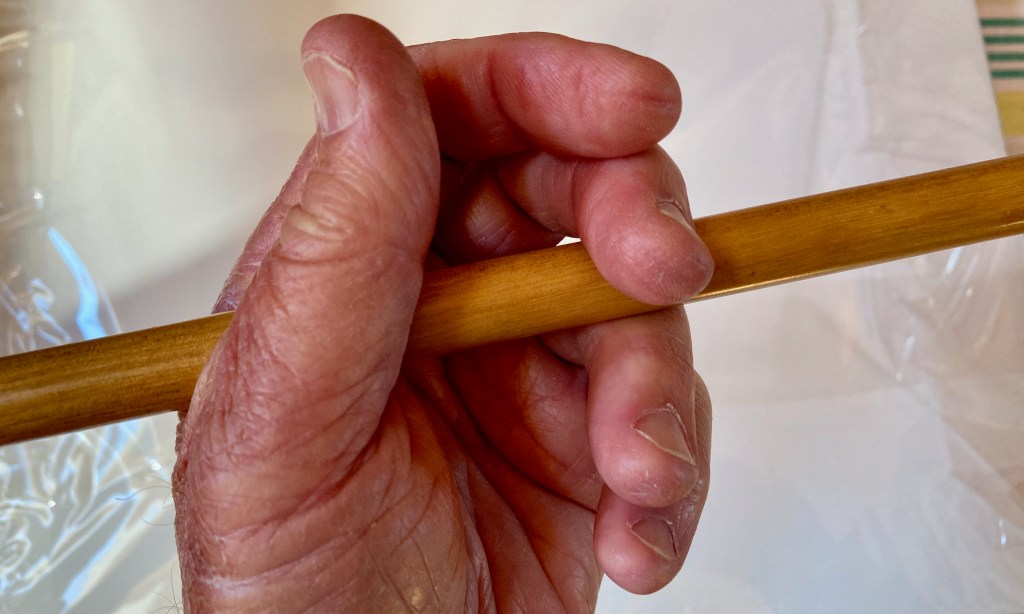
As a result, I developed a bad left-hand habit of almost holding my left-hand stick between my middle and fourth fingers, much more than I was holding it in the fulcrum between my thumb and index finger. (Photo 1).
Photo 1
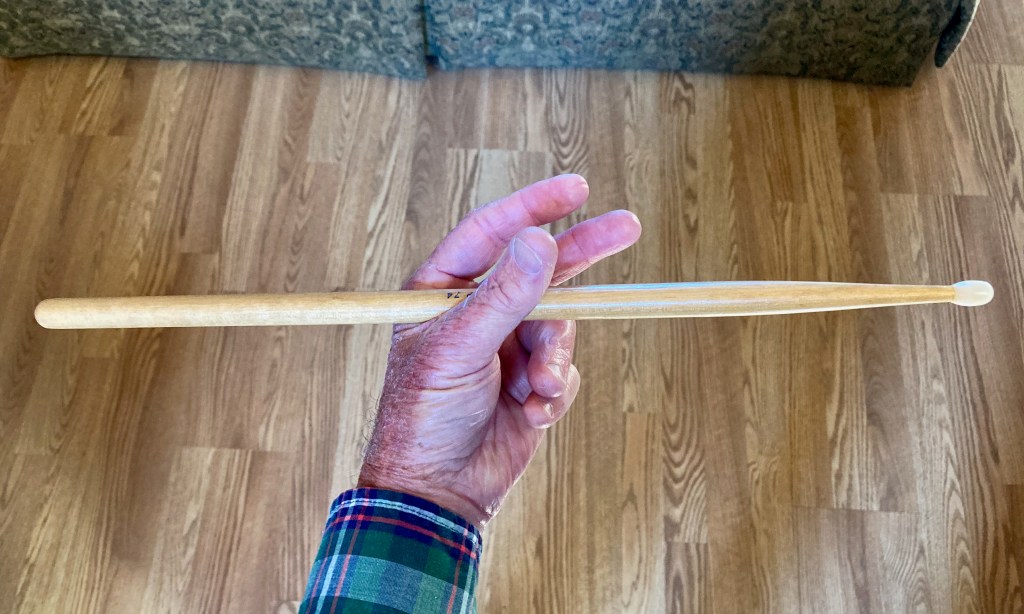
Freddie Gruber showed me, first, how to properly hold a drumstick in my left hand. Position the stick on the open fulcrum between my index finger and thumb, and adjust the position of the stick until, without the hand trying to hold the stick, it balances on that fulcrum. When the stick is balanced, said Freddie, that’s where you should hold it. (Photo 2).
Photo 2
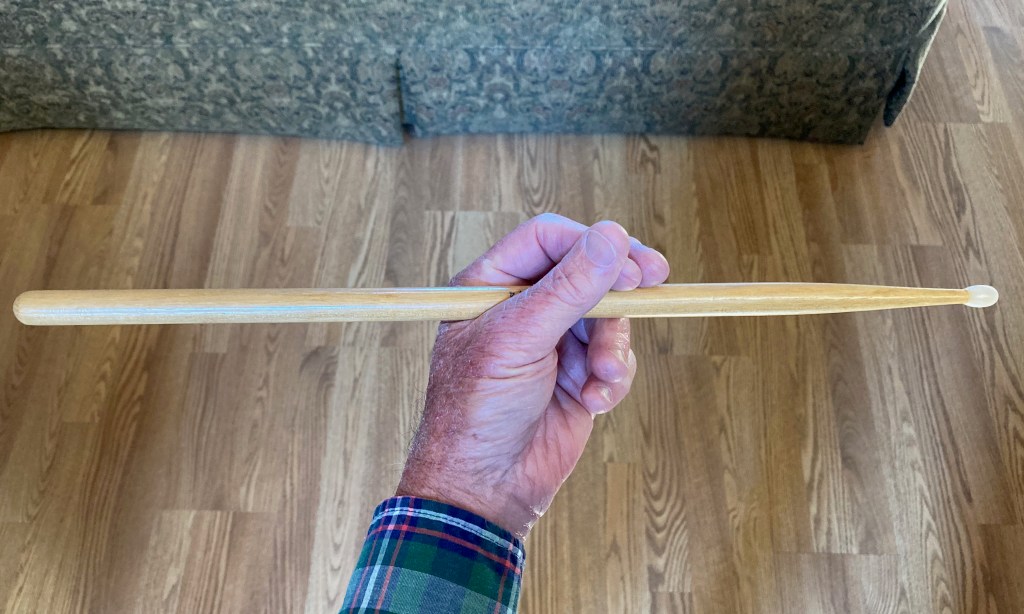
At first it felt, when the stick was balanced, as if I was holding the stick too far up the shaft. But Freddie also showed me how to play with my left-hand naturally, and how to let the stick do the work. In other words, controlling the bounce. Freddie pointed out that the well-known method book, “Stick Control,” is “not meant for developing hot licks.” The exercises in that book, he said, are designed to help drummers control the sticks.
It took practice to break my years-long bad left-hand habit, and to experiment and get comfortable with balancing the stick and controlling the bounce. It’s a technique I could always improve, but it made a huge difference in my playing. Certainly what Freddie Gruber showed me that day was one of those “plateaus” musicians hit throughout our lives. (Photo 3).
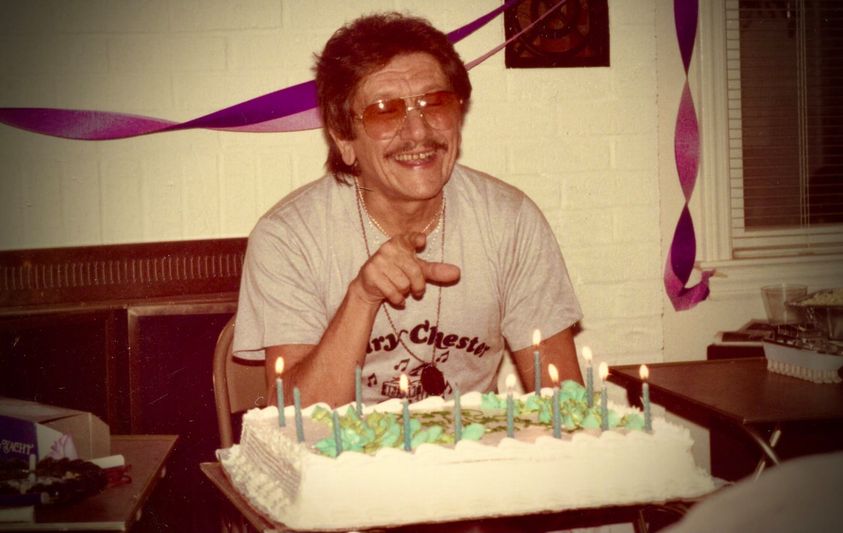
SKF NOTE: I would be remiss if I failed to mention Gary Chester’s birthday. Here’s a snippet and link to the full Facebook post.
=====
Gary Chester The Drummer
HAPPY BIRTHDAY GARY CHESTER!!! Talking to one of Gary’s students this morning he said “what the hell would I have gotten as a gift to a 97 year old GARY CHESTER today??





You must be logged in to post a comment.