Passion for Your Instrument: A Must

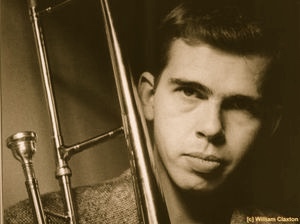
Bob Brookmeyer

Bob Brookmeyer

Bob Brookmeyer: “Whatever instrument you play, you must have a passion for it, and you must play it passionately. Even if you aren’t good and keep making mistakes, you must have the passion.”

Source: Bob Brookmeyer: Strength and Simplicity, by Bill Coss. Down Beat, 1/19/61

Posted in SKF Blog | Tagged , , , , | Comments Off on Passion for Your Instrument: A Must

Drum Lessons by Ear, Not Eye 

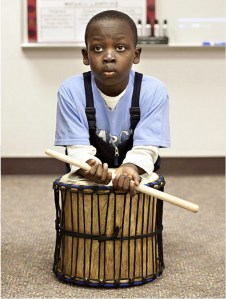
Max Roach spoke to me highly of an African hand drum teacher’s way of teaching. The teacher and his student are sitting in the same room. But they are separated by a sheet or curtain hanging from the ceiling between them. The teacher and student are listening to each other.

These are aural, not visual lessons. There is no music reading. The African hand drum teacher never shows his student how to play something. Instead, the student listens to what the teacher is playing and figures out on his own how to get the same sounds.

Max was responding to my asking him if, when he was a young up-and-coming drummer in New York City, did the preceding generation of drummers, such as Papa Jo Jones and Big Sid Catlett, show him any drum techniques or licks that helped him.
drum_kidNo, said Max. Here’s what happened instead: Max grew up learning from Papa Jo Jones on record or radio. Again, an aural, not visual lesson. And when he heard Papa Jo playing something he, Max, wanted to use, Max would figure out his own way to duplicate it. Sometimes Max would succeed, sometimes he would come close, and sometimes, in the process of trying to copy Papa Jo, Max would discover a new way of playing.

Max said, after he was in New York City, there were times when he would see, say, Papa Jo Jones in a club or theater, playing a song Max had only heard on record or radio, and discover, “Ah, so that’s what he’s playing on that record. That’s how he gets that sound.”

Sometimes I ask myself, “How many more drum method books do we need?” No offense to drum method book authors. It’s just that maybe it’s time we gave equal time to learn to play by ear.

end

Posted in SKF Blog | Tagged , , , | Leave a comment

Chico Hamilton: You Remember What a Nickel Was

SKF NOTE: Just finished reading Hannah Rothschild’s biography of her Aunt, “The Baroness: The Search for Nica, the Rebellious Rothschild.” Excellent reading about a woman Thelonious “Toot” Monk, Jr. describes as a combination Santa Claus and Mother Theresa for Bebop era jazz musicians, most notably Thelonious Monk.

I have read many books and articles on jazz, on the Baroness, but I still learned new insights from Ms. Rothschild’s book. This exchange with Chico Hamilton is one example.

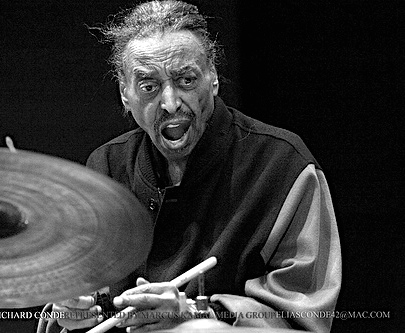
Chico Hamilton
Chico Hamilton

Hannah Rothschild: I asked [Thelonious] Monk’s contemporary, the legendary drummer Chico Hamilton, about his own career prospects in the 1930s.

“I had a choice of being a musician or a pimp,” Hamilton replied.

Assuming he’d made a joke, I smiled was promptly excoriated.

“You might smile,” he said, leaning towards me, his eyes blazing with fury,

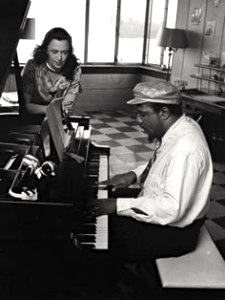
The Baroness with Monk

jabbing a drumstick in my directions, “but when I was eight, nine, ten and eleven years old, I shined shoes. That was how I bought my first set of drums, shining shoes for a nickel. You remember what a nickel was. I would go out on a Wednesday and a Saturday from school, I would stay out all day Saturday until I made a dollar and then come home. I made enough money shining shoes, like I said, to buy my first set of drums. I have been making my living ever since. I was a lucky one.”

end

Posted in SKF Blog | Tagged , , , , , | Comments Off on Chico Hamilton: You Remember What a Nickel Was

Stanley Turrentine: Mystery Albums Sometimes the Best

Le-Stanley-Turrentine-Organ-Project-Jazz-a-ChevillyStanley Turrentine: “Sometimes I’d go into the studio without knowing who was on the date. I wouldn’t know who was playing bass, drums, or whatever. No music, no nothing – we’d go right into the studio and create. And some of those albums, man, were some of the best I’ve made.”

Source: “Stanley Turrentine, The Blue Notes of Mr. T,” by Gene Kalbacher, Down Beat, May 1985

Posted in SKF Blog | Tagged , , , , , | Leave a comment

Revisiting the Bo Diddley Beat

SKF NOTE: This is an interesting chronology of the Bo Diddley beat. Missing from this article is drummer Clifton James who recorded many of Bo Diddley’s great records, and deserves credit for popularizing that beat.

Bo Diddley used a canny sense of PR to open the door for modern rock and hip hop
JUNE 4, 2015
BY NICK DERISO

…“Bo Diddley” is something you can’t get out of your head. Perhaps that’s because the song, reduced to stark simplicity, is almost all rhythm.

Clifton James
Clifton James

…Diddley opened a door that the British Invasion, punk music, hip hop and new wave would later rush through.

Still, …Bo Diddley’s …“shave-and-a-haircut, two-bits” beat didn’t start with the man who made it famous. The sound, called kpanlogo, originates from Ghana, West Africa.

A similar rhythm drove “Hambone” by Red Saunders and his Orchestr…years before…. Kpanlogo-style drumming, in fact, made several appearances in the previous decade, notably showing up on a post-war Gene Krupa recording.

Clearly, Red Saunders needed a better PR rep. What he needed, of course, was Bo Diddley.

Full Story

Posted in Drum/Music News | Tagged , , , , | Comments Off on Revisiting the Bo Diddley Beat